
What You're Actually Dealing With
The Scams That Actually Catch People
Côte d'Ivoire's scams split into two categories: the street-level petty crime you'd find in any major West African city, and the internet-based romance and financial scams that the country has become internationally associated with. Both are avoidable.
Côte d'Ivoire is one of several West African countries associated with internet-based romance and financial scams. The pattern: a relationship develops through a dating site or social media, the "partner" asks for money for travel, medical bills, or a business opportunity, and the money disappears. Some victims are lured to the country to meet their partner, where they may be robbed, kidnapped, or extorted. This is not a risk for most tourists visiting the country, but if you've been communicating with someone in Côte d'Ivoire online, treat any request for money as a red flag. Multiple Western governments issue specific warnings about this.
- Never send money to someone you've only met online, regardless of the story. This is the single rule that prevents 100% of romance scam losses.
- Do not travel to Côte d'Ivoire to meet someone you've only known online, or to recover money you've sent. Get legal advice at home instead.
- Tell friends and family to be sceptical if they receive requests to transfer money to you in Côte d'Ivoire. Scammers impersonate travellers.
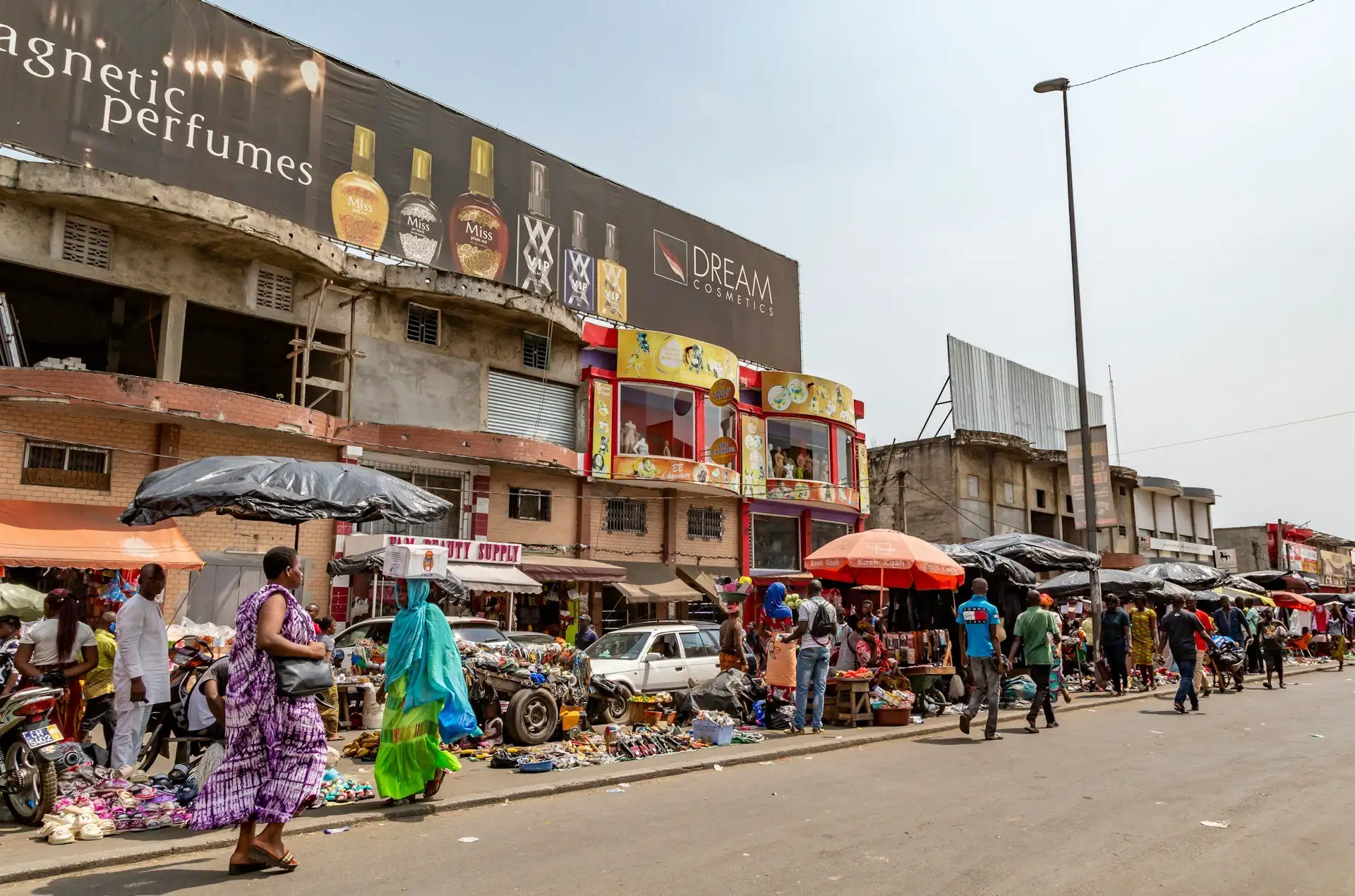
Pickpocketing, bag snatching, and theft from vehicles are common in Abidjan's crowded markets and commercial areas. Criminals do not hesitate to use force when met with resistance. Luxury and 4WD vehicles are particularly targeted for carjacking. Home break-ins and burglaries target residences of foreigners in both Abidjan and Pointe-Noire. At Grand-Bassam's beaches, unattended belongings disappear quickly, especially on busy weekends.
- Don't display signs of wealth: no expensive watches, no visible jewellery, no flashing large amounts of cash. Keep your phone out of sight in crowded areas.
- Keep vehicle doors locked and windows up at all times when driving. Carjacking is a documented risk, particularly for 4WDs.
- At beaches, don't leave belongings unattended. The same rules as any West African coast apply here.
Police and military roadblocks are common throughout the country. Most are routine document checks. Some are opportunities for officials to solicit payments from drivers, particularly foreigners. Unofficial roadblocks, though less common now than in previous years, have been used for robbery in some areas. The dynamic is similar to other West African countries: stay calm, carry copies of your documents, and a small payment may sometimes be the fastest resolution.
- Carry certified photocopies of your passport, visa, and yellow fever certificate. Keep originals secure at your accommodation.
- A hired driver who knows the roads and the checkpoint dynamics will handle most interactions for you. This alone justifies the cost.
- Do not drive outside major cities after dark. The U.S. government prohibits its staff from doing so. Take the same precaution.
Taxis are unmetered in Abidjan. Foreigners pay more. The overcharging is typically double or triple the local rate but rarely outrageous. Shared taxis and gbakas (minibuses) are the local way to get around and cost very little, though they can be crowded and the driving can be creative.
- Agree the fare before getting in. Ask your hotel what a fair price should be for your destination.
- The orange taxis in Abidjan are the official ones. Agree on the fare and confirm whether it's private or shared before you depart.
Credit card fraud and ATM skimming are documented risks. Keep your card in sight when paying. Inspect ATMs for tampering before use. Street money changers operate near banks and markets offering inflated rates, then deliver counterfeit notes or shortchange on the count.
- Use ATMs inside banks during business hours. Cover the keypad when entering your PIN. Monitor your statements for unauthorised transactions.
- Pay in cash at markets and small restaurants. Use cards only at established hotels and restaurants where the terminal is in your line of sight.
- Exchange money at banks only. The CFA franc is pegged to the euro at a fixed rate. Anyone offering significantly better is running a scam.
Photographing government buildings, military installations, and public infrastructure is restricted and can result in detention and equipment confiscation. Customs officials may question cameras, drones, or professional-looking equipment at entry. Always ask permission before photographing people, particularly women and in more conservative areas. Drones require permits and are likely to attract official attention.
- Don't photograph anything that looks official or military. If stopped, remain calm and cooperate.
- Ask before photographing people. A smile and a gesture goes a long way. Most Ivorians are happy to be photographed if asked respectfully.
- If bringing professional camera equipment or drones, be prepared to explain their purpose at customs. Carry documentation of your purpose.
The Destinations: Honest Takes
Côte d'Ivoire is not on most tourist radars, which is exactly why the people who come here tend to love it. There are no crowds. The hospitality is genuine. And the country is working hard to build a tourism sector that matches its economic ambition.
Abidjan hits you with its energy before you've left the airport expressway. This is a city that moves: five million people, a lagoon that splits the urban fabric into districts connected by bridges, and a commercial intensity that explains why every West African business passes through here at some point. Le Plateau is the financial district, all glass towers and French-language billboards. Treichville is the soul: the Marché de Treichville is enormous and chaotic and sells everything from Dutch wax fabric to bootleg DVDs. The maquis (open-air restaurants) of Marcory Zone 4 are where Abidjan eats after dark: chargrilled fish, attiéké (fermented cassava couscous), and alloco (fried plantain) at prices that make Paris look ridiculous. The Cathédrale Saint-Paul is a modernist shell-shaped wonder designed by Aldo Spirito. The Galerie Cécile Fakhoury in Cocody has some of the best contemporary African art on the continent. Banco National Park, a tropical forest inside the city limits, offers guided walks through jungle ten minutes from downtown traffic.
- Petty theft is concentrated in markets and commercial areas. Keep valuables hidden and don't carry more cash than you need
- Orange taxis are official. Agree fares before entering. Gbakas (shared minibuses) are cheap but chaotic
- The Plateau area empties after business hours and can feel isolated at night. Treichville and Yopougon have higher crime rates after dark
- For food: find a maquis in Zone 4 and order poisson braisé (chargrilled fish) with attiéké. This is the meal Abidjan was built on
Grand-Bassam was the French colonial capital until a yellow fever outbreak forced the administration to move in 1896. What remains is a UNESCO World Heritage Site of colonial buildings in various states of elegant decay, a stretch of Atlantic beach popular with Abidjan weekenders, and a pace of life that makes the capital feel like a different country. The National Costume Museum, housed in the former governor's palace, is genuinely interesting and typically includes a personal guided tour in French. The Ancien Bassam quarter south of the Ébrié Lagoon is where the historic buildings and the beach converge. The Village Artisanal sells traditional masks, textiles, and pottery. The N'Zima people hold the Abissa festival here every late October, a colourful celebration of democracy and ancestral tribute that draws thousands.
- Very low scam risk. The main concern is beach theft on busy weekends. Don't leave belongings unattended
- The 2016 terrorist attack at the Étoile du Sud hotel is part of Grand-Bassam's recent history. Security has been significantly increased since
- 45 minutes from Abidjan by taxi. Easy as a day trip or overnight. Weekdays are quieter and more pleasant
- The ceramics workshops in town are worth visiting. Hand-crafted pottery remains important to the local economy
Yamoussoukro is the official capital, though almost all government business happens in Abidjan. The reason to come here is the Basilique Notre-Dame de la Paix, the largest church in the world (it's taller than St. Peter's in Rome), built by President Houphouët-Boigny in the 1980s with his personal fortune. Whether you find it magnificent or absurd depends on your relationship with architectural ambition, but the scale is impossible to deny. The stained glass windows are extraordinary. The surrounding gardens are meticulously maintained. The rest of Yamoussoukro is a quiet, spread-out city with wide boulevards that feel designed for a population that never quite arrived. The presidential palace has a lake with sacred crocodiles that are fed chicken by palace staff. Yes, really.
- Very low crime risk. Yamoussoukro is quiet and feels safe during the day
- About 3 hours from Abidjan by road. The highway is good quality
- The basilica is free to enter. Guided tours are available. Dress modestly (shoulders and knees covered)
- The crocodile feeding at the presidential palace lake is a genuinely surreal experience. Ask locally for timing
Assinie is where wealthy Abidjanais go on weekends: 80 kilometres east of the city, a strip of Atlantic coastline with resort villas, water sports, and some of the best seafood on the Ivoirian coast. It's the closest thing Côte d'Ivoire has to a beach resort destination. The Éhotilé Islands National Park, a group of six islands in the lagoon near Assinie, is a mangrove ecosystem with remarkable birdlife, traditional fishing villages, and the kind of quiet that Abidjan has forgotten how to produce. If you have two spare days and want to see the country's coastline at its best, Assinie delivers.
- Low crime risk. This is a resort area. The main concern is the usual beach theft and water safety
- Strong currents on the Atlantic beaches. No lifeguards. Swim cautiously
- Boat trips to the Éhotilé Islands can be arranged locally. Budget about $20 for a day including transport and food
Taï National Park in the far southwest is one of the last significant areas of primary tropical rainforest in West Africa, a UNESCO World Heritage Site sheltering chimpanzees, pygmy hippos, and over 1,000 plant species. The Man region further north has waterfalls, stilt-dancing traditions of the Dan people, and dramatic mountain scenery. This is Côte d'Ivoire for serious nature travellers and cultural enthusiasts willing to handle limited infrastructure, rough roads, and basic accommodation. The rewards are real, but so is the effort required to reach them.
- Access to Taï requires advance planning with a guide. There are eco-lodges inside and near the park
- Roads in the west are poor, especially in the rainy season. A 4WD and a driver who knows the region are essential
- The Dan mask dances near Man are a genuine cultural experience. Arrange through local guides, not freelancers at the roadside
- The Liberian and Guinean borders are nearby. Don't approach border areas without current security intelligence
Before You Go: The Checklist
- ✓ Get your yellow fever vaccination and carry the original certificate. It is mandatory for entry, no exceptions. Apply for your e-visa online before travel.
- ✓ Take antimalarial prophylaxis. Malaria is endemic year-round on all three islands and the mainland. Use DEET repellent. Sleep under a treated net.
- ✓ Hire a driver for any travel outside Abidjan. Do not drive outside major cities after dark. Police roadblocks are routine and a local driver handles them better than you will.
- ✓ French is essential. English is extremely limited. If you don't speak French, arrange a guide or fixer. It's the difference between frustration and enjoyment.
- ✓ Carry certified photocopies of your passport, visa, and vaccination certificate. Keep originals locked at your accommodation.
- ✓ Do not travel to the northern border region near Burkina Faso or Mali. This is a Level 4 zone with active jihadist threat. Stay south of Bouaké.
- ✓ Bring euros as backup cash. The CFA franc is pegged to the euro. Exchange at banks only. Never use street money changers.