
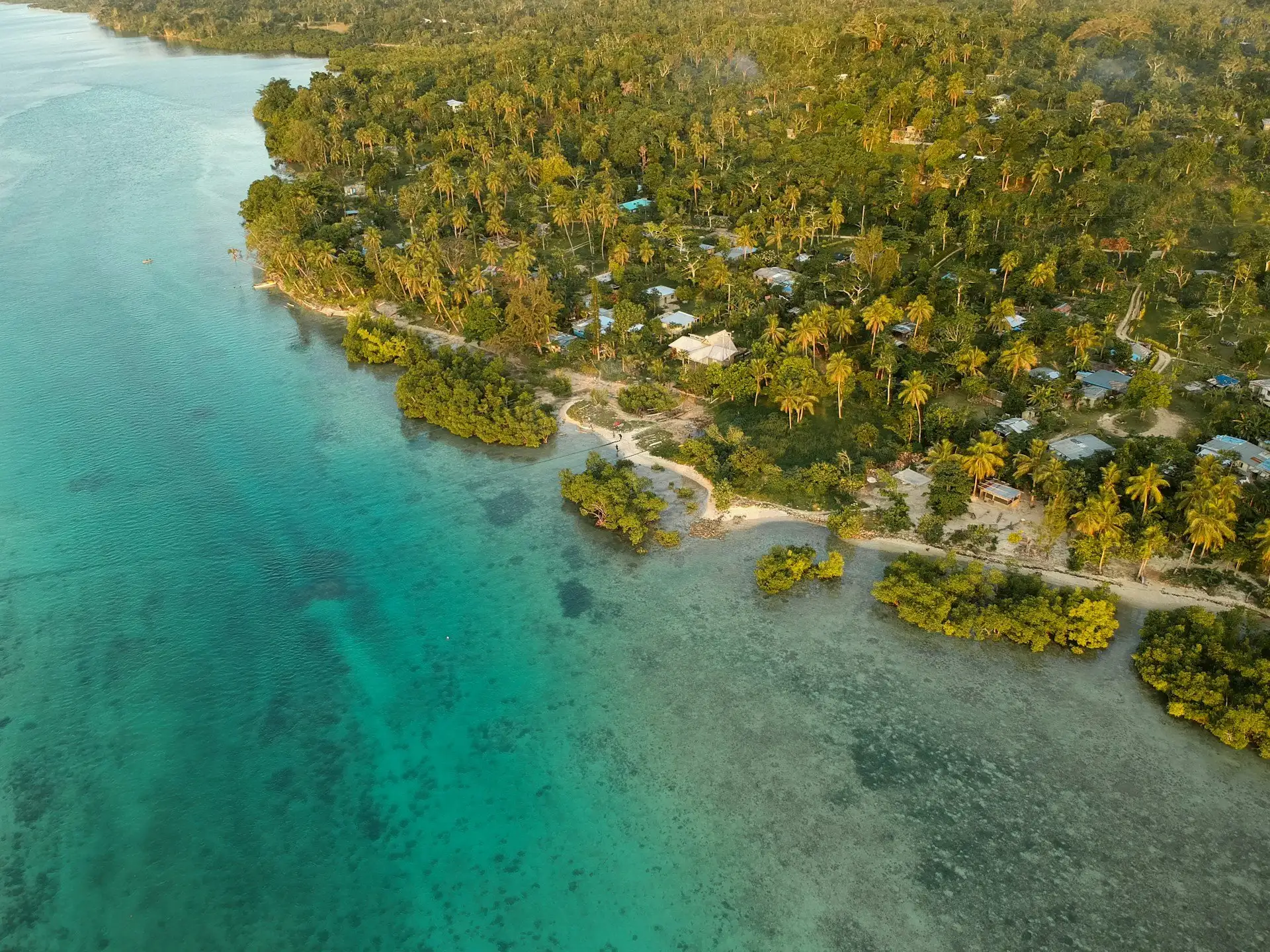
Vanuatu
Stand on the rim of an active volcano and watch lava bombs arc against the night sky. Swim through water so blue it looks wrong. Dive the largest accessible shipwreck on earth. Watch men leap from 30-meter towers with only vines on their ankles. Drink kava until the world goes quiet. Eighty islands. Eighty languages. One of the most genuinely diverse and extraordinary countries in the Pacific.
What You're Actually Getting Into
Vanuatu is an archipelago of 83 islands in the southwest Pacific, stretching about 1,300 kilometers from north to south on the Pacific Ring of Fire. The islands are volcanic, most of them mountainous, all of them covered in dense jungle that runs to the beach. Nine of the islands are still volcanically active — on Tanna, Mount Yasur has been erupting continuously for at least 800 years and possibly much longer. On Ambae (Aoba), the island's entire population was evacuated in 2017 and again in 2018 due to eruptions. Vanuatu has more volcanoes per square kilometer of land than almost anywhere on earth, and the geological energy that produces them also makes the islands extraordinarily fertile, the reefs around them among the most productive in the Pacific, and the underwater environment shaped by lava formations unlike anything found on coral atolls.
The human landscape is equally remarkable. Vanuatu has approximately 315,000 people speaking around 138 local languages — the highest language density per capita anywhere in the world. The national language Bislama (a creole derived from English, French, and local languages) serves as the common tongue, and English and French are both official languages from the colonial period as the New Hebrides, when the islands were administered under a peculiar Anglo-French Condominium that resulted in parallel French and British administrative, legal, and educational systems that still shape the country today. The official name for the colonial government — "pandemonium" — was applied by the residents themselves and has been used affectionately since.
What this produces in practice is a country of extraordinary diversity. Each island group has its own kastom (traditional culture), its own ceremonial practices, its own relationship with Christianity and modernity. The land diving of Pentecost — where men leap from towers with only vines attached to their ankles — is practiced nowhere else on earth in quite the same form and is the direct ancestor of commercial bungee jumping. The kava of Vanuatu is the strongest in the Pacific. The volcano tourism on Tanna is the most accessible active volcano experience available anywhere. The wreck diving on Espiritu Santo at the SS President Coolidge is the most significant WWII wreck dive outside Truk Lagoon. The Blue Holes of Espiritu Santo are among the most visually extraordinary freshwater environments in the Pacific.
Port Vila, the capital on Efate, is the entry point for most visitors and has the infrastructure of a small but functional Pacific tourist hub: decent restaurants, good accommodation, easy island day trips, and the chaos of a city where colonial history, Pacific tradition, and modern tourism have been layered on top of each other in ways that are simultaneously confusing and genuinely interesting. From Port Vila, domestic flights reach Tanna in 40 minutes, Espiritu Santo in 50 minutes, and the archipelago's other main islands in 1–2 hours.
The honest complication: Vanuatu is the most cyclone-prone nation in the Pacific. Cyclone Pam in 2015 was one of the strongest storms ever recorded in the Southern Hemisphere and devastated significant portions of the country. Cyclone Harold in 2020 caused widespread damage to the north. Infrastructure outside Port Vila and Luganville can be limited and is cyclone-dependent in its reliability. Travel insurance with trip cancellation and cyclone evacuation cover is not optional here — it is the minimum sensible precaution.
Vanuatu at a Glance
A History Worth Knowing
Vanuatu has been continuously settled for approximately 3,000 years, with the oldest evidence of human habitation found at archaeological sites on Efate and other southern islands. The Lapita people — the same seafaring culture whose descendants became the Polynesians — were among the earliest settlers, but the majority of the modern population descends from Melanesian peoples whose ancestors arrived before and alongside the Lapita expansion. The extraordinary linguistic diversity that produces 138 languages in a population of 315,000 reflects millennia of relatively isolated community development on islands separated by challenging sea crossings, with neighboring valleys sometimes developing distinct languages over centuries of limited contact.
European contact began with the Portuguese explorer Pedro Fernandes de Queirós in 1606, who landed on the island of Espiritu Santo (naming it himself, convinced he had found the Great Southern Continent he had been seeking) and attempted an ill-fated colonization before disease, violence, and logistical collapse ended the venture within weeks. Captain Cook visited and named the island group the New Hebrides in 1774. The following century brought missionaries — both Catholic and Protestant — whose influence on the islands was transformative and sometimes catastrophic, combining with introduced diseases to devastate populations that had no immunity. The blackbirding era hit Vanuatu hard: thousands of ni-Vanuatu were taken as indentured laborers to Queensland and Fiji through the 1860s and 1870s.
The Anglo-French Condominium of the New Hebrides, established in 1906, was one of the stranger colonial arrangements in Pacific history. Britain and France jointly administered the islands without either annexing them, resulting in parallel administrative systems: two police forces, two legal systems, two sets of courts, two currencies, two school systems, and two sets of government officials, all operating simultaneously on the same islands. The arrangement required a Joint Court to resolve conflicts between the two systems. Residents created the term "pandemonium" to describe it, adapted from the original word for a place of all demons. The colonial awkwardness produced an independent nation in 1980 with the remarkable institutional challenge of integrating two entirely separate administrative systems while also managing 138 different traditional governance systems on 65 inhabited islands.
Independence was achieved on July 30, 1980, under the name Vanuatu — derived from the word vanua (land) plus the suffix -tu (stand), meaning "our land standing forever." The first years of independence were complicated by a secessionist movement on Espiritu Santo (the Coconut War, briefly suppressed by Papua New Guinean troops at Vanuatu's invitation) and by the challenge of building national institutions in a country with no shared language, history, or cultural tradition beyond the colonial experience they were trying to move past. Bislama, the creole that had developed as a trade language during the colonial period, became the national language precisely because it belonged to no particular island group and carried no colonial prestige.
Cyclone Pam struck on March 13–14, 2015 with wind speeds up to 320 km/h — one of the most powerful cyclones ever recorded in the Southern Hemisphere. It killed 11 people (a number that speaks to the extraordinary preparation and shelter-seeking behavior of ni-Vanuatu communities given the storm's intensity) and destroyed or severely damaged approximately 90% of infrastructure on the most affected islands. The recovery has been substantial but uneven. The 2020 Cyclone Harold struck a population already dealing with COVID-19 travel restrictions and caused significant damage in the north. Vanuatu's vulnerability to cyclones, earthquakes, tsunamis, and volcanic eruptions — it sits at the intersection of multiple geological and meteorological hazard systems — is the defining physical challenge of the country's existence.
Lapita culture settlers arrive, eventually joined by Melanesian migrants. The foundation of Vanuatu's extraordinary linguistic diversity begins with isolated island communities developing independently over centuries.
Portuguese explorer Pedro Fernandes de Queirós lands on Espiritu Santo, convinced he has found the Great Southern Continent. His colonization attempt collapses within weeks.
Thousands of ni-Vanuatu taken as indentured laborers. Introduced diseases devastate island populations with no immunity. Some communities lose the majority of their population.
Anglo-French Condominium established. Two parallel administrative systems, two police forces, two legal systems, two currencies — all operating simultaneously on the same islands. Residents coin the term "pandemonium."
Espiritu Santo becomes the largest American military base in the South Pacific. The SS President Coolidge sinks entering the harbor. Millions of dollars of military equipment is dumped in the sea at war's end.
Vanuatu achieves independence — "our land standing forever." The first years involve integrating two colonial administrative systems and 138 traditional governance systems into one national framework.
One of the most powerful cyclones in Southern Hemisphere history strikes Vanuatu. Wind speeds up to 320 km/h. 90% of infrastructure destroyed on the most affected islands. Recovery is substantial but ongoing.
Vanuatu's Islands
Vanuatu's destinations divide by island group. Most visitors orbit around three main experiences: Port Vila on Efate as the hub, Tanna for the volcano, and Espiritu Santo for the wreck diving and Blue Holes. These three cover the country's signature experiences. Adding Pentecost for the land diving (April–June), Malekula for traditional kastom, or the outer northern islands for genuine remoteness extends the trip significantly and reveals a Vanuatu that the Port Vila–Tanna–Santo circuit doesn't fully show.
Mount Yasur — Tanna Island
Tanna Island in Vanuatu's south is home to Mount Yasur, one of the world's most accessible active volcanoes. The drive from Tanna's White Grass Airport through the ash plain to the volcano base takes about 30 minutes. The walk from the car park to the rim is 20 minutes of moderate incline. And then you are standing on the edge of an active crater looking down into a system that erupts, on average, multiple times per hour — not gently, but with concussive thumping that you feel in your chest, and with lava bombs that arc from the crater and land on the rim area in ways that make the experience viscerally real rather than merely spectacular from a distance. At night, the glow from the crater against the sky is extraordinary. The volcano is monitored by the Vanuatu Meteorology and Geo-hazards Department, which assigns alert levels from 0 to 5 — above level 2, access to the rim is restricted. Check the current alert level before traveling to Tanna. Most of the time it is at level 1 or 2 and accessible. The same island also holds John Frum movement villages worth visiting with a local guide, and the extraordinary Vanuatu Cultural Village at Yakel where a community maintains entirely traditional kastom life including traditional dress.
SS President Coolidge — Espiritu Santo
The SS President Coolidge was a 22,000-tonne luxury liner converted to a WWII troopship that struck two American mines entering Espiritu Santo's Second Channel in October 1942. The ship sank in shallow water — the bow sits at 21 meters, the stern at 70 meters — and remained largely intact, coral-encrusted over 80 years into something that manages to be both a war grave and one of the most extraordinary dive environments on earth. The wreck is penetrable throughout its length, with dive sites including the wheelhouse (35m), the engine room (60m), the swimming pool (with glass tiles and all, 30m), and The Lady — a mosaic panel of a woman on a unicorn in the first class lounge at 42 meters that has become the wreck's most photographed feature. The dive is rated intermediate to advanced depending on which section you explore — Open Water is sufficient for the bow section at 21 meters, advanced certification recommended for deeper penetrations. Dive operators in Luganville (Santo's main town) run multiple daily dives. Million Dollar Point, where American forces dumped surplus WWII equipment at the end of the war, is a separate snorkel and shallow dive site 10 minutes away.
Espiritu Santo Blue Holes
On Espiritu Santo, a series of freshwater springs emerge from underground limestone aquifers into the jungle and flowing rivers, creating water of an electric blue that results from the depth and purity of the water interacting with the limestone bedrock. The Nanda Blue Hole, about 25 kilometers north of Luganville, is a large river pool where the blue is most intense — you lower yourself into water that looks photoshopped, sitting between the jungle floor and suspended visibility down to 10 meters. The Matevulu Blue Hole further north is fed by an underground river and is equally extraordinary. Champagne Beach nearby is among the finest beaches in Vanuatu, a white sand arc on the northern coast used by cruise ships but genuinely beautiful. The combination of Blue Holes, Coolidge dive, Million Dollar Point, and Champagne Beach makes Espiritu Santo one of the most rewarding single island experiences in the Pacific.
Pentecost Island — Naghol
Every year from April through June, the men of Pentecost Island's south perform the Naghol — the original land dive. Towers of freshly cut timber and vines are built to heights of up to 30 meters, and men and boys launch themselves headfirst, arms at their sides, falling until the vines tied to their ankles pull taut and their head just touches the earth. The dive is a ceremony tied to the yam harvest — the touch of the head on the ground is meant to bless the yams. The vine length is calculated by specialists who have been doing this their whole lives. Deaths have occurred when the vines snap or the calculation is wrong, but the ceremony continues because it has always continued and because it means something specific to the people who do it. Visitors are welcome to watch from designated areas — this is kastom, not a show, and is priced accordingly. Flights from Port Vila to Pentecost (Lonorore Airport) or to Lamap on Malekula with onward speedboat. Book through a Port Vila tour operator well in advance for the April–June window.
Port Vila & Efate
Port Vila is a compact, energetic, surprisingly good-value Pacific capital with a genuine restaurant scene built around the French colonial heritage, a harbor waterfront that works well for evening strolling, and a central market where produce from all over Vanuatu arrives by boat and truck. The Ekasup Cultural Village on the outskirts provides the most accessible kastom demonstration program on Efate. The Vanuatu National Museum has a small but worthwhile collection of traditional material culture. Day trips around Efate — the island has a ring road passable by rental car in a day — include Mele Cascades waterfall, the Hideaway Island marine sanctuary, and several other pleasant beach and snorkel stops. Port Vila is also Vanuatu's kava capital, with dozens of nakamals (kava bars) operating throughout the city.
Malekula
Malekula is Vanuatu's second-largest island and home to the Small Nambas and Big Nambas peoples, whose kastom traditions — including extraordinary sand drawing (a UNESCO Intangible Cultural Heritage), traditional initiation practices, and elaborate ceremonial life — are among the most intact in Vanuatu. The island's interior is mountainous and jungle-covered, with communities accessible mainly by boat or light aircraft. Malekula was among the regions most devastated by blackbirding and introduced disease in the 19th century, and the communities that survived have maintained their cultural practices with particular tenacity. A specialist cultural tour operator is essential for any meaningful Malekula visit.
Banks & Torres Islands
The northernmost islands of Vanuatu, near the boundary with the Solomon Islands, are among the most remote and least-visited in the country. The Banks Islands group includes Gaua (with an active volcano and a crater lake), Vanua Lava, and Mota Lava. The Torres Islands are tiny, with subsistence fishing communities and some of the Pacific's most untouched reef. Access is by infrequent Air Vanuatu service or inter-island shipping. For travelers who have already done Tanna and Santo and want to understand what genuine outer island Vanuatu looks like, the Banks and Torres are the answer.
Mele Cascades & Hideaway Island
Two of the best half-day trips from Port Vila. Mele Cascades, 9 kilometers from the city, is a multi-level freshwater waterfall system accessible via a 30-minute walk through a tropical garden — the top pool offers a natural plunge pool and slide. Hideaway Island Marine Sanctuary, a short boat trip from Mele Beach, has excellent snorkeling in a protected marine area with the unique option of the world's first underwater post box — you can buy waterproof postcards, write them in the water, and post them in an underwater mailbox. Both are crowded on cruise ship days; mid-week visits are significantly more pleasant.
Culture & Etiquette
Ni-Vanuatu culture is anchored in kastom — the traditional laws, ceremonies, land rights, and social organization that vary significantly from island to island and community to community. The nakamal is the center of men's community life in most of Vanuatu — the kava bar that opens at sunset and where the day's social and political conversation happens. The role of kastom chiefs (moli) in land governance and community decision-making is real and constitutionally recognized. Vanuatu's land laws are among the most community-protective in the Pacific — all land remains in customary ownership and can only be leased, never sold, to non-ni-Vanuatu people or entities.
Community visits in Vanuatu — particularly to kastom villages like Yakel on Tanna or communities on Malekula — are properly arranged through kastom protocols that a guide navigates. The guide pays the kastom fee to the chief, informs the community of the visit, and ensures the interaction happens on terms that respect the community's autonomy. Showing up unannounced at a kastom village is not how things work here.
Visiting a nakamal is the single most culturally specific experience available in Vanuatu. It is not a performance or a tourist attraction — it is where Vanuatu men spend their evenings. Visitors are generally welcome, particularly at nakamals that have experience with tourists. Dress appropriately (not beachwear), arrive after dark, be quiet and respectful, drink your shells, and participate in the social rhythms of the place rather than treating it as entertainment.
Outside beach and resort contexts, conservative dress is expected throughout Vanuatu. Shoulders and knees covered for both men and women in village settings. On Tanna particularly, where kastom villages maintain traditional practices, respectful dress matters significantly.
At land diving, kastom ceremonies, and traditional performances, photographing is typically permitted from the designated visitor area but should always be confirmed before raising the camera. At nakamals, photography is generally not appropriate. At cultural villages with clear visitor programs, follow the operator's guidance.
"Halo" (hello), "tankyu tumas" (thank you very much), "wanem nem blong yu?" (what is your name?), "mi save" (I understand). Bislama is immediately accessible to English speakers — most words are English-derived with phonetic spelling. Any Bislama effort is warmly received. "Olsem wanem?" (how are you?) and "mi gud, tankyu" (I'm good, thanks) will take you a long way.
Kava and alcohol do not combine well physiologically or socially. The nakamal culture in Vanuatu is explicitly kava-only — drinking alcohol and then going to a nakamal, or vice versa, is considered inappropriate and the effect is unpleasant. Choose one for the evening.
Mount Yasur's rim has designated safe areas for visitors that are defined by the alert level and by the volcano's current eruptive patterns. Do not cross ropes or walk toward the crater beyond where you are guided. Lava bombs have landed in tourist areas when activity spikes unexpectedly. The guide's instructions about positioning are not preferences — they are safety requirements.
The John Frum movement on Tanna is a religious and political movement of genuine significance to its adherents — a millenarian belief system that merged with WWII contact with American forces and has maintained coherence for over 80 years. It is not cargo cult tourism curiosity. Villages associated with John Frum can be visited through a local guide, with appropriate respect for the community's beliefs.
Removing artifacts from the Coolidge is illegal and deeply inappropriate — many areas of the wreck remain war graves for crew members. The wreck is also considered a protected site under Vanuatu heritage law. Operators brief divers on this and the dive community enforces it strongly.
Tanna kastom is different from Pentecost kastom, which is different from Malekula kastom, which is different from what you encounter on Efate. The 138-language diversity reflects genuine cultural distinctness. A guide from one island group does not automatically have the social standing to facilitate access in another.
Kava Culture
Vanuatu kava is prepared from fresh root — pounded, mixed with water, and strained — rather than dried root as in Fiji or Tonga, producing a stronger concentration of kavalactones. The effect is relaxation, mental clarity, slight numbness of the mouth and extremities, and mild sedation. At a proper nakamal: drink on an empty stomach, spit before you drink if that's the custom, drain the shell in one go, and wait quietly. Do not eat for at least an hour afterward. The experience deepens over 20–30 minutes.
Sand Drawing
Malekula's sand drawing tradition — sand trawing — involves drawing complex continuous line patterns in the sand with a single finger, without lifting the finger and without retracing any line. The patterns encode traditional narratives, mythological sequences, and social information that trained practitioners can read completely. It is among the Pacific's most extraordinary art traditions and was inscribed on UNESCO's Intangible Cultural Heritage list in 2003. A specialist cultural operator can arrange sand drawing demonstrations through Malekulan communities.
Land Rights
Vanuatu's constitution vests all land in customary ownership — it cannot be sold to non-ni-Vanuatu people or entities, only leased for fixed terms. The kastom chief (moli) of each community holds significant authority over land decisions, and disputes about land are among the most common political flashpoints in the country. This system, unusual among Pacific nations, means that the landscape you move through is not a commodity but a custodianship — the land belongs to the community's ancestors as much as to its present members.
Pig Tusks as Currency
Across most of Vanuatu, pigs — specifically boars with circular or spiral tusks produced by removing the upper canine teeth so the lower tusks grow unchecked — are the primary traditional wealth currency. Pig tusks are used in compensation payments, bride price, kastom ceremonies, and the purchase of titles and social status. A boar with a full circle tusk represents years of careful management and enormous social value. The pig tusk is the national symbol, appearing on the flag and currency.
Food & Kava
Vanuatu has by far the best food culture of any country in this Oceania sprint, driven largely by the French colonial heritage that invested in food culture in ways that British colonial administration typically did not. Port Vila has a genuine restaurant scene with French-influenced cooking applied to Pacific ingredients — fresh fish, coconut cream, tropical fruit — at prices that are reasonable by Pacific island standards. The French influence also produced good bread, decent coffee, and the concept of sitting down for a properly prepared meal rather than just fueling up.
Lap Lap
Vanuatu's most distinctive traditional dish: grated manioc (cassava), taro, or banana mixed with coconut cream, wrapped in banana leaves, and baked in a ground oven (laplap oven) until it sets into a dense, gelatinous cake. Often layered with fish, chicken, or pork. The texture surprises visitors expecting something fluffy — it is dense, sticky, and rich. The version made with taro and coconut cream with fish is the best. Found at the Port Vila central market on Saturdays and at community events across the country.
Fresh Seafood
Vanuatu's reef and ocean fishing produce excellent tuna, wahoo, mahi-mahi, reef fish, lobster, and crab. Port Vila's restaurant scene makes the most of this — the fish grilled with garlic and butter at a French-influenced restaurant in Port Vila is reliably good. On the outer islands, fresh fish cooked simply over fire or in coconut cream is the standard and the standard is excellent.
French Bakeries
Port Vila has genuine French-style bakeries producing baguettes, croissants, pain au chocolat, and fresh bread that are among the better examples of French bakery tradition in the Pacific. The Au Bon Marché bakery produces bread that would not embarrass a Parisian. This is the colonial legacy working directly in the visitor's favor — a fresh baguette with local butter at a Port Vila café is one of the more pleasant breakfasts available in the Pacific.
Local Markets
The Port Vila central market on Saturday mornings is one of the best in the Pacific — fresh produce from Efate and incoming boats from outer islands, including tropical fruit in varieties that have no English names, coconut crabs, freshly made lap lap, and the bustle of a city where people from multiple island cultures are buying and selling in Bislama with occasional French and English. Arrive by 7am. Bring cash in small denominations.
Port Vila Restaurants
L'Houstalet on the waterfront has been the most consistent fine dining option for decades — French-Pacific menu, good wine list (Vanuatu imports Australian wine adequately), and professional service. Nambawan Café is the best casual lunch option near the market. The Waterfront Bar and Grill is the go-to for sunset drinks and reliable food at mid-range prices. For budget eating, the market food stalls and local takeaways around the main market are excellent value.
Nakamal Kava
The definitive Vanuatu drinking experience. Fresh root kava, stronger than anywhere else in the Pacific, served from sunset at nakamals across the country. The best nakamals are not the tourist-oriented ones near hotels — they are the simple sheds in residential neighborhoods where locals sit in the dark, drink quietly, and talk. Ask your hotel where the nearest local nakamal is. Go after dark. Leave your phone in your pocket. Drink slowly and see what happens.
When to Go
Vanuatu has a dry season from May through October and a wet season from November through April. The distinction matters particularly because the wet season coincides with the cyclone season, and Vanuatu is the most cyclone-affected nation in the Pacific. For most activities — volcano, diving, Blue Holes — the dry season from May through October is strongly preferred. The critical exception is Pentecost land diving, which happens April through June, meaning the best land diving months overlap with the transition from wet to dry season.
Dry Season
May – OctBest weather for volcano visits, wreck diving, Blue Holes, and island hopping. Lower humidity, calmer seas, better visibility. Pentecost land diving still runs in May and June. July and August are peak tourist months — book accommodation ahead. Independence Day (July 30) brings good national celebrations to Port Vila.
April – June
Apr – JunThe only time to see Pentecost land diving. April and May are still technically wet season with increased rain risk but the land diving windows are usually dry enough. June is increasingly reliable. Book land diving packages through Port Vila operators at least 3 months ahead for April and May.
Cyclone Season
Nov – MarHighest cyclone risk. Vanuatu has been devastated by multiple major cyclones in recent years. While travel is possible and some visitors go in this period, the risk is real and trip disruption is significantly more likely. Travel insurance with comprehensive cyclone cover is essential. Some outer island accommodation closes. Port Vila and the main islands have better infrastructure for cyclone response than outer islands.
Trip Planning
Vanuatu planning is more straightforward than most of the other complex Melanesian and Micronesian destinations in this guide, because the domestic flight network is functional, the main attractions are well-organized, and Port Vila's tourism infrastructure is developed enough to answer most logistical questions. The main planning points are: timing around the land diving season (April–June) if that's a priority, checking Mount Yasur's alert level before traveling to Tanna, and booking the President Coolidge dive packages in advance for peak season.
Port Vila & Efate
Arrive Port Vila. Day one: waterfront walk, Vanuatu National Museum, market, nakamal in the evening. Day two: rental car around Efate ring road — Mele Cascades morning, Hideaway Island afternoon snorkel, sunset drinks at the waterfront bar.
Tanna — Mount Yasur
Fly Port Vila to Tanna (40 min). Check alert level before flying. Day three: afternoon arrival, White Grass Lodge check-in, volcano visit at sunset — two to three hours at the rim including the crater approach, the eruptions, and the walk back in the dark. Day four: Yakel kastom village with local guide in the morning, return to Port Vila by late afternoon flight.
Espiritu Santo
Fly Port Vila to Luganville (50 min). Day five: President Coolidge dive — morning two-tank (bow section and upper decks), afternoon Million Dollar Point snorkel. Day six: rental car north — Nanda Blue Hole, Matevulu Blue Hole, Champagne Beach. Day seven: morning dive (The Lady mosaic at 42m if Advanced certified), fly back to Port Vila for international departure.
Port Vila & Efate
Three days on Efate: extended Port Vila exploration including Ekasup Cultural Village program, full ring road day, Cascade waterfall walk, and two nakamal evenings. Day three: cooking class at a Port Vila restaurant for lap lap and traditional Vanuatu cooking (offered by several Vila operators).
Tanna — Extended
Three days on Tanna: volcano at sunset on day four and again at dawn on day five (two completely different experiences). Yakel village with overnight kastom stay (some community guesthouses are available). John Frum village visit on day five with guide. Drive the ash plain road along Yasur's flank in daylight.
Espiritu Santo
Five days in Santo: four dive days on the Coolidge covering all major sections from bow to midship to engine room, plus a dedicated Million Dollar Point dive and an outer reef dive for shark and pelagic encounters. One full day by rental car covering both Blue Holes, Champagne Beach, and the WWII fighter plane wreck accessible by snorkel in the north. Evening walks in Luganville, nakamal kava.
Pentecost or Malekula (If Season)
If April–June: fly to Pentecost for two nights — land diving on the full ceremony day plus village kastom program before and after. If outside land diving season: fly to Malekula for two nights with a specialist cultural operator covering sand drawing, traditional village visit, and the island's extraordinary forest interior by local guide. Return Port Vila for departure.
Port Vila & Efate Deep
Four days: full cultural and culinary program around Efate, including the Ekasup Cultural Village extended program, market cooking class, nakamal evenings, kayak day on the Port Vila harbor, and day trips to three or four of Efate's outer islets by speedboat.
Tanna
Four days: volcano at sunset and dawn on different days, full circumnavigation of Tanna's ring road, Yakel kastom community overnight, John Frum village visit, hot springs on the island's eastern coast, and a dedicated day at the sulfur springs near the volcano for landscape photography.
Espiritu Santo
Six days for the full Santo program: five Coolidge dive days covering every section of the wreck comprehensively (the engine room and stern require specific certification and experience — the last two dive days), one full Blue Holes and Champagne Beach day, evening nakamal culture, and a half-day visit to the Vanuatu Agriculture Research Station's gardens north of Luganville.
Pentecost & Malekula
If April–June: three nights on Pentecost for land diving (the ceremony runs Saturday; arrive Friday, leave Sunday). Then two nights on Malekula for sand drawing and kastom culture before returning to Port Vila. If outside land diving season: four nights on Malekula for the deepest available kastom experience in Vanuatu, with a specialist cultural operator.
Return to Port Vila
Final Port Vila days. Waterfront market morning. L'Houstalet for a proper farewell dinner. Last nakamal. Depart.
Volcano Alert Check
Check the Vanuatu Meteorology and Geo-hazards Department (VMGD) website for Mount Yasur's current alert level before flying to Tanna. Level 0–2 allows rim access. Level 3+ restricts access increasingly. The level changes with the volcano's activity. Most of the time it's level 1 or 2. Occasionally it spikes to 3 or 4 and the summit is closed. Budget a flexible day on Tanna if possible.
Emergency contacts →Vaccinations
No mandatory vaccinations for most travelers. Recommended: Hepatitis A, Hepatitis B, Typhoid, and routine vaccines. Dengue fever is present throughout Vanuatu — use repellent consistently. Malaria is present in northern Vanuatu (north of Efate, particularly the Banks and Torres Islands). If your itinerary includes the north, consult a travel medicine clinic about malaria prophylaxis.
Full vaccine info →Dive Certification
Open Water covers the President Coolidge's bow section at 21 meters and most of the upper decks. Advanced Open Water is recommended for The Lady mosaic at 42 meters and mid-ship sections. Wreck Diver specialty is valuable for the deeper penetrations in the stern. Bring logbook, certification cards, and a dive computer. The nearest decompression chamber is in Port Vila at the Colonial War Memorial Hospital — confirm operational status with your dive operator.
Travel Insurance
Travel insurance with cyclone evacuation cover, trip cancellation, medical evacuation, and diving coverage is not optional for Vanuatu. Specify that you are diving (and specify the maximum depth you'll dive) when purchasing. Cyclone disruption is a real risk November through April. Medical evacuation from outer islands to Port Vila, and from Port Vila to Australia, are both scenarios your policy should cover.
Connectivity
Digicel Vanuatu has good coverage in Port Vila, Luganville, and around the main islands. Outer islands and jungle interiors have limited to no coverage. Download offline maps for Santo (the northern Blue Holes drive specifically) and Tanna (the volcano approach road). An Airalo eSIM with a Pacific plan works well in the main towns.
Get eSIM →Cash & Cards
ANZ and Westpac both have ATMs in Port Vila and Luganville. Card payments work at most Port Vila hotels and restaurants. Outer island accommodation, nakamals, village entries, and kastom fees all require cash. Withdraw sufficient Vatu in Port Vila before any outer island travel. Bring some Australian dollars as a backup — accepted at most major Port Vila businesses.
Transport in Vanuatu
Vanuatu has a functional domestic aviation network that connects the main islands and several smaller ones from Port Vila. Air Vanuatu and small charter operators cover the country. Espiritu Santo and Tanna are the two most important and most frequently served routes. Getting around within each island depends on the island: Efate and Santo have rental cars and roads; Tanna has rental trucks and limited roads; the outer islands have boats and local transport.
International Flights
VariableAir Vanuatu, Qantas (codeshare), Fiji Airways, and Air Caledonie serve Bauerfield International Airport in Port Vila from Brisbane, Sydney, Auckland, Nadi, and Nouméa. Most European visitors connect through Brisbane (3.5 hours) or Auckland (3 hours). Check current Air Vanuatu operational status — the airline has had periods of financial difficulty historically.
Domestic Flights (Air Vanuatu)
VUV 8,000–25,000 one wayPort Vila to Tanna (40 min), Port Vila to Luganville/Santo (50 min), Port Vila to Pentecost (1 hour), Port Vila to Malekula (1 hour), and further outer islands with less frequency. Book well in advance in peak season. Confirm domestic bookings 48 hours before departure. The Tanna route is the most popular and fills fastest.
Car Rental
VUV 8,000–15,000/dayAvailable in Port Vila and Luganville. Drive on the right in Vanuatu (one of the few Pacific countries to do so — French colonial legacy). Roads are paved on Efate's main circuit and the Santo highway north of Luganville. The northern Santo road to Champagne Beach and the Blue Holes is sealed most of the way with some rough sections. An international driving permit is required.
Minibuses & Taxis
VUV 200–2,000 per tripLocal minibuses (buses) run fixed routes in Port Vila from the central bus stop near the market for VUV 200–300. Taxis are available but negotiate the fare before getting in. In Luganville, taxis serve the main town and surrounds. Your accommodation can organize reliable drivers for site visits.
Island Speedboats
Variable by routeFor outer islands and inter-island travel not served by flights, speedboat charters are arranged through operators in Port Vila or Luganville. Your operator organizes all boat transport for guided island packages. Independent speedboat charter for exploring Santo's coast or Efate's outer islands is arranged at the main harbors.
Inter-Island Ships
VUV 3,000–8,000 per passageVanuatu operates inter-island cargo and passenger ships connecting Port Vila with the outer islands on roughly weekly schedules. Slower than flights and less reliable, but the passage between islands gives a different perspective on the archipelago. Check with the Port Vila harbour office for current schedules. Passenger cabins are basic.
Accommodation in Vanuatu
Port Vila has the widest accommodation range — international-standard resorts down to budget guesthouses. Espiritu Santo's Luganville has a good spread of accommodation matched to the dive tourism market. Tanna's accommodation is mostly small eco-lodges and guesthouses near White Grass, simple but adequate for the volcano experience. Outer island accommodation ranges from basic community guesthouses to the few boutique eco-resorts that have been developed on specific islands.
Iririki Island Resort (Port Vila)
VUV 30,000–55,000/nightA private island five minutes by ferry from Port Vila waterfront, with bungalows directly on the water, two pools, two restaurants, and the most consistent luxury accommodation in Vanuatu. The ferry runs 24 hours. Not isolated enough from the city to feel remote, but comfortable enough that returning from the nakamal to a private bungalow is a genuinely pleasant experience.
Coolidge & Marine Dive (Luganville)
VUV 12,000–25,000/nightThe dive resort model on Santo: accommodation, meals, and President Coolidge dive packages in one booking. Allan Power Dive Tours and Aquamarine Vanuatu both operate this model. Booking accommodation and diving together with a single operator simplifies logistics significantly and usually provides a modest price advantage. Confirm current operations before booking — smaller dive operators on Santo have had periods of reduced capacity.
White Grass Ocean Resort (Tanna)
VUV 18,000–35,000/nightThe best accommodation on Tanna, with bungalows on the clifftop overlooking the ocean and the volcano visible from the property. The resort organizes all volcano visits, village trips, and island activities. Meals are served at the main restaurant with occasional fresh produce from the island. Simple by international resort standards; perfectly appropriate for the Tanna context.
Budget Guesthouses
VUV 4,000–8,000/nightPort Vila and Luganville both have budget guesthouse options — clean, fan-cooled or air-conditioned, typically in residential areas slightly away from the tourist strip. The budget end of Vila accommodation has improved significantly with the growth of the Australian and New Zealand backpacker market. Ask specifically about proximity to a good nakamal when booking.
Budget Planning
Vanuatu sits at a moderate-to-expensive cost level for the Pacific. Port Vila is the most expensive part of the trip. Tanna is moderate, particularly if you stay at one of the smaller lodges rather than White Grass. Espiritu Santo's cost is dominated by the President Coolidge dive packages, which are well-priced by world wreck diving standards. The outer islands are cheapest if accommodation is community-based, most expensive if eco-resorts are involved.
- Guesthouse accommodation in Vila or Luganville
- Market food and local nakamal
- Local bus transport on Efate
- One Coolidge dive per day (not package)
- Self-organized volcano visit on Tanna
- Mid-range hotel or dive lodge
- Two-tank Coolidge dive day
- Rental car for Blue Holes day
- Restaurant dinners in Port Vila
- Guided kastom village visits
- Iririki Island Resort or White Grass
- Full dive package with equipment
- Private guides for all activities
- L'Houstalet level restaurant dining
- Charter speedboat for outer islands
Quick Reference Prices
Visa & Entry
Most nationalities receive a free visitor's permit on arrival at Bauerfield International Airport in Port Vila for stays of up to 30 days, extendable to 120 days at the Immigration and Passport Service in Port Vila. Citizens of Australia, New Zealand, UK, USA, France, and most EU countries are all visa-waiver eligible. Some nationalities require advance visas — check the Vanuatu Immigration and Passport Service for your specific situation.
Free of charge. Extendable to 120 days. Valid passport, return ticket, and accommodation evidence required. Check current requirements for your specific nationality before travel.
Family Travel & Pets
Vanuatu is a good family destination for families with children old enough to participate meaningfully in the experiences it offers. The volcano is genuinely accessible and extraordinary for children from around age 8 with good stamina. The Blue Holes are safe for any confident swimmer. The President Coolidge is appropriate for young divers with Open Water certification (minimum 12 in most jurisdictions). The kastom cultural experiences require children who can engage respectfully and attentively.
Volcano for Families
Mount Yasur is one of the most genuinely spectacular natural experiences available to families in the Pacific. Children from around 8 with good fitness handle the walk to the rim and the experience well. The eruptions are dramatic without being terrifying at alert level 1–2. The night visit is more impressive but the daytime visit allows better orientation for children unfamiliar with volcanoes. Most operators on Tanna run family-paced visits.
Blue Holes & Snorkeling
The Blue Holes on Espiritu Santo are safe and suitable for children who can swim confidently. The visual impact of the electric-blue water is immediate and extraordinary for children. Champagne Beach nearby is one of the finest family beach days in Vanuatu. The Hideaway Island marine sanctuary near Port Vila is ideal for younger snorkelers — calm, protected, with dense reef life in shallow water.
Cultural Experiences
Kastom village visits and cultural performances at places like Ekasup on Efate are engaging for children from about 8 who can sit attentively. The Pentecost land diving is appropriate for older children and teenagers — genuinely one of the most extraordinary ritual performances available to families anywhere in the world. The experience of watching men voluntarily leap from 30-meter towers tends to produce a particular quality of silence in young observers.
Health Planning
Dengue in the south, malaria risk in the north — repellent for children at all times. The central hospital in Port Vila handles pediatric care. Outer island medical emergencies require evacuation to Port Vila. Comprehensive family travel insurance with medical evacuation is essential. Bring a full pediatric first aid kit with rehydration sachets and age-appropriate medications.
Traveling with Pets
Vanuatu has strict biosecurity requirements for importing animals, including health certificates, advance permits, and quarantine. Given the nature of a Pacific island holiday and the volcanic/tropical environment, bringing pets is not practical. Leave pets at home with appropriate care.
Safety in Vanuatu
Vanuatu is generally safe for visitors, with the primary risks being geological and meteorological rather than criminal. The volcanic activity, cyclone frequency, and occasional earthquake activity are the genuine hazards. Personal security in Port Vila and Luganville requires standard urban Pacific precautions. The outer islands are generally very safe communities.
General Security
Vanuatu is safe by Pacific standards. Petty theft occurs in Port Vila around the market and main tourist areas — use standard precautions with bags and phones. The outer islands and rural areas are extremely safe communities. The nakamal culture provides a social setting where visitors are generally protected by the same community oversight that protects the space.
Volcanic Hazards
Mount Yasur's activity is monitored and alert levels assigned. Follow all guide instructions at the rim. Do not cross safety ropes or approach the crater beyond designated areas. Sudden eruption spikes can occur even at low alert levels — the guide's positioning decisions are based on experience with the volcano's behavior. Trust them.
Cyclones
Vanuatu is the most cyclone-affected country in the Pacific. November through April is the serious risk period. Monitor the Vanuatu Meteorology and Geo-hazards Department throughout any wet season visit. Follow all official guidance immediately if a cyclone watch or warning is issued. Travel insurance with cyclone evacuation is essential.
Earthquake & Tsunami Risk
Vanuatu sits on the Pacific Ring of Fire and experiences frequent seismic activity. Most earthquakes are small and unfelt by visitors. Significant earthquakes can trigger tsunami warnings — follow all official guidance if a warning is issued. Move immediately to higher ground and do not return to the coast until the all-clear is given.
Dive Safety
The President Coolidge's deeper sections are genuinely technical dives. Stay within your certification and experience level. The decompression chamber at Port Vila's central hospital is present — confirm operational status with your dive operator on arrival. DAN at +1-919-684-9111 coordinates dive medical emergencies. Always dive with a reputable local operator who knows the wreck.
Dengue & Malaria
Dengue is present throughout Vanuatu — repellent at all times is the only protection. Malaria exists in the northern islands (Penama, Sanma, Malampa provinces north of Efate) but not in Port Vila or Tanna. If your itinerary includes the north, consult a travel medicine clinic about prophylaxis before departure.
Emergency Information
Embassies in Port Vila
Book Your Vanuatu Trip
Everything in one place. These are services worth actually using.
Yumi Stanap
"Yumi stanap" — we stand together — is the meaning embedded in the country's name, Vanuatu: vanua (land) plus tu (stand), the land standing forever. It is a declaration made at independence in 1980 that was tested almost immediately by a secessionist movement, tested again by cyclones that destroyed most of what had been built, and tested again by the geological reality of living on one of the most volcanically and seismically active pieces of the earth's surface.
Standing on the rim of Yasur at night, watching lava arc against a sky that goes from orange to black between eruptions, the declaration makes a different kind of sense. The land here is actively becoming. The same geological processes that push lava through Yasur's crater push nutrients into the soil that makes the jungle so dense it can close an airstrip in a year without maintenance. The same tectonic energy produces the earthquakes and the extraordinary fish life on the reefs around volcanic islands. Vanuatu is a landscape in active formation, which is a different thing from the finished landscapes most travelers are accustomed to moving through.
The 138 languages are the human version of the same principle: every community finding its own specific expression in a shared landscape, distinct enough to be incomprehensible to the next valley over, held together by the Bislama and by the kava and by the land itself. Yumi stanap. We stand together, on ground that is always moving.