
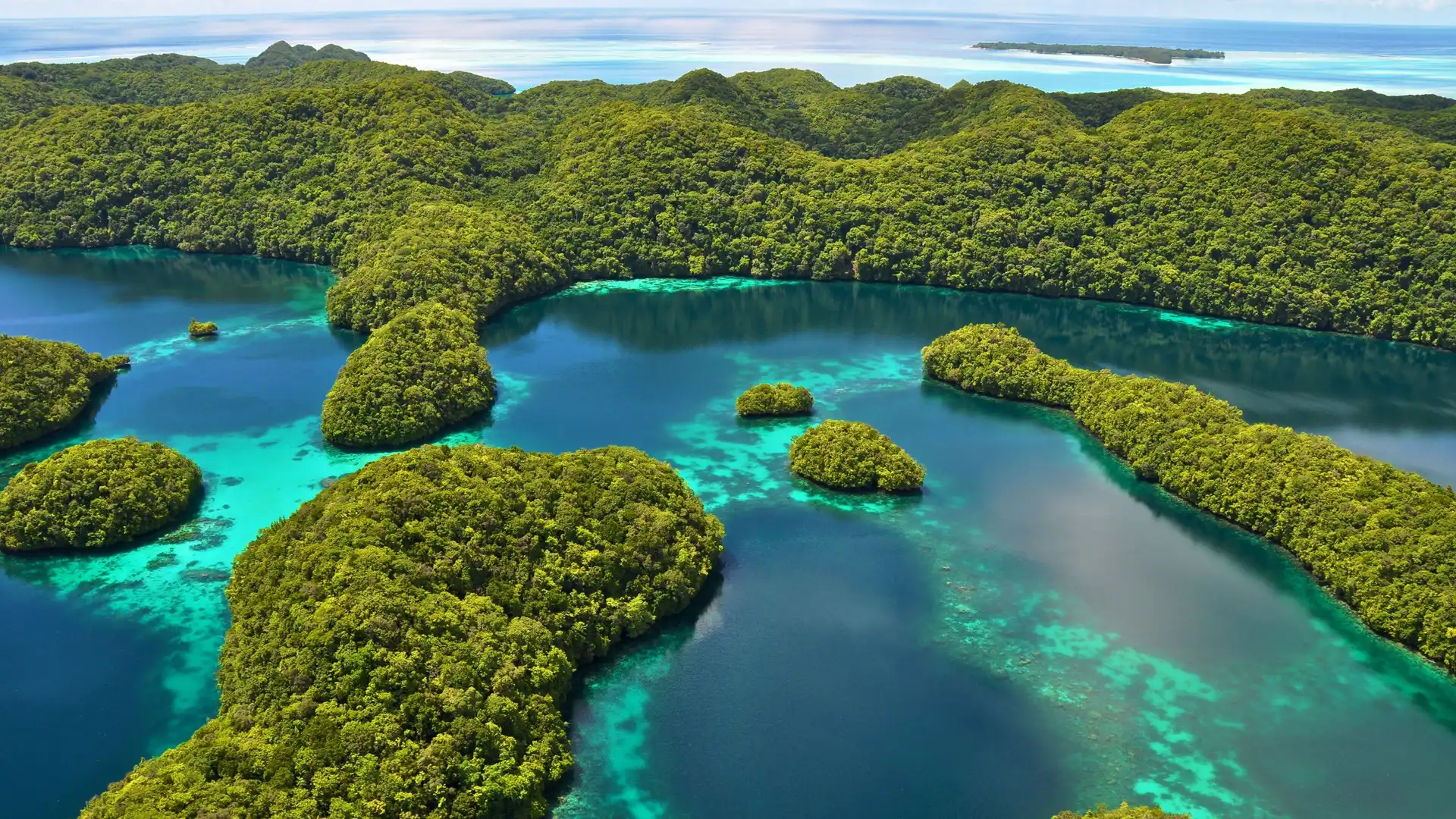
Palau's only town, built entirely around the water around it
Koror was the administrative capital of Japan's South Seas Mandate before WWII, and it still carries some of that scale relative to the rest of Palau: paved roads, a real commercial strip, grocery stores, banks. By the standards of a Pacific island town it is developed; by the standards of anywhere else it is small enough to see most of downtown on foot in twenty minutes. What Koror actually is, functionally, is a staging ground: the place where you sleep, eat, and organize gear between days spent on boats heading out to the Rock Islands, Jellyfish Lake, and the reef.
That orientation shapes everything about how to spend time here. Nobody comes to Koror to wander a historic old town, because there mostly isn't one; a few WWII-era Japanese buildings and the Belau National Museum are the closest things to conventional sightseeing. The real activity is almost entirely on or under the water, booked a day in advance through one of the dive shops clustered around the marina.
The honest complications
Koror is expensive relative to almost anywhere in Southeast Asia: hotel rooms, dive packages and restaurant meals all carry premium pricing, and there's no backpacker workaround because the infrastructure for one doesn't exist. The town itself is not conventionally beautiful, most of what's worth seeing is offshore, and rain is a year-round possibility given the tropical climate. Distances that look walkable on a map, particularly to Malakal Island's dive shops, are hotter and further than they appear; budget for taxis rather than assuming you'll walk everywhere.
A small town spread across a few connected islands
Koror is less a set of distinct neighbourhoods than a handful of connected areas, each oriented around a different piece of the visitor experience: sleeping, eating, or diving.
Downtown Koror
The commercial heart of town, along the main road running through the island: banks, the WCTC department store and supermarket, government buildings, and most of the mid-range restaurants and shops. This is the most practical base for a first visit, close enough to walk to dinner and close enough to the marina for an early boat pickup.
Malakal Island
Across a short causeway from downtown, Malakal holds the working harbor most Rock Islands and dive boats depart from, along with dive shops including Neco Marine and several of the marina-adjacent resorts. Staying here shaves ten to fifteen minutes off an early dive-boat departure; the tradeoff is being further from downtown's restaurant choice.
Meyuns & Echang
The residential areas north of downtown, where most Koror residents actually live, with a slower pace and fewer tourist-facing businesses. Not a base most visitors choose, but worth a drive-through for a sense of Koror beyond the hotel strip.
Dive resorts first, everything else a distant second
Koror's hotel scene is built for divers and honeymooners rather than budget travelers passing through: full-service resorts with dive packages sit at the top, and the mid-range below them is comfortable rather than cheap. There is essentially no hostel tier.
At the top end, Palau Royal Resort has direct beach access and on-site snorkeling and kayaking, a straightforward choice for a first Palau trip that wants everything arranged in one place, while Palau Pacific Resort offers a private beach and spa a short drive from downtown, both from roughly $250 a night and up.
In the mid-range, Palau Plantation Resort has garden bungalow-style rooms, a pool and an on-site restaurant at a noticeably gentler price point, and Palau Carolines Resort keeps you close to the dive and tour operators without full-resort pricing, both landing roughly in the $100-250 range depending on season.
A small scene, built around the day's catch
Koror's restaurant scene is compact enough that regulars name the same handful of places, and the good ones lean hard on whatever came off the reef that morning rather than an extensive menu.
Kramer's Cafe
Kramer's Cafe, on a waterfront balcony in downtown Koror, serves extremely fresh fish Monday through Saturday and is consistently rated among the top restaurants in town. Go for the fish of the day rather than the wider menu.
Elilai Seaside Dining
Elilai Seaside Dining is Palau's premier dining room, set on the water with sunset views across the harbor toward the Rock Islands, serving Palauan and Pacific Rim dishes built around local fish and organic greens. The closest thing Koror has to a special-occasion restaurant, and reviewers consistently note generous portions for the price.
Drop Off Bar & Grill
Drop Off Bar & Grill, near Neco Marine on Malakal Island, does marinated tuna poke, sashimi and its well-known Tsunami Burger in a casual open-air setting overlooking the water, with live local bands on Tuesday and Friday happy hours. The easy choice after a dive day, given the location right by the marina.
The town is the base; the water is the point
Almost everything worth doing from Koror happens on a boat, booked through one of the dive shops clustered around downtown and the Malakal marina. A couple of hours on land cover the museums and aquarium; the rest of your time here is spent arranging, and then taking, trips out onto the lagoon.
Book your Rock Islands and dive days
Sam's Tours, Fish 'n Fins and Neco Marine are Koror's three main dive and tour operators, all running daily Rock Islands snorkeling trips, Jellyfish Lake visits, and two-tank dive days to Blue Corner, German Channel and Ulong Channel. Fish 'n Fins has operated since 1972 and is Palau's longest-running dive shop; Sam's Tours pairs its dive trips with marine biologist-led commentary; Neco Marine sits right by Drop Off on Malakal, convenient if you're staying nearby. Book a day or two ahead in the December to April high season, since boat space and Rock Islands permits are finite.
Belau National Museum & Etpison Museum
The Belau National Museum, established in 1955 and the oldest continuously operating museum in Micronesia, is the best land-based orientation to Palauan history and the Japanese occupation before a Peleliu day trip. The Etpison Museum, a few minutes away, fills in more of the traditional culture across three floors: storyboard carving, udoud bead money, and the traditional canoes and fish traps that shaped daily life before the tourism economy. Both take under an hour each and pair well as a single overcast-morning outing.
Palau International Coral Reef Center & Aquarium
The Palau International Coral Reef Center, a working marine research institution, runs a public aquarium with ocean, mangrove and reef exhibits that make a good primer before your first Rock Islands snorkel, especially for kids. Entry is $5.50 for adults, $1.65 for children, open weekdays 8am to 5pm and closed weekends and holidays; plan around that if the aquarium specifically is on your list.
Cross the Japan-Palau Friendship Bridge
The KB Bridge connecting Koror to Babeldaob is worth a stop in its own right for the view over the channel, and it's the route to everything on Babeldaob: Ngardmau Waterfall, the Badrulchau stone monoliths, and the actual capital, Ngerulmud, none of which are walkable from Koror and all of which need a rental car or a guided day tour.
One, three or five days, planned around boat departures
Koror itself takes half a day to see; the rest of any itinerary here is really about how many boat days you can fit in. These routes assume you're basing entirely in Koror and day-tripping out.
- Morning
Rock Islands boat trip. A shared day tour with snorkeling stops and Jellyfish Lake if your operator includes it.
- Afternoon
Belau National Museum. An hour of context on the way back into town.
- Evening
Dinner at Kramer's Cafe or Elilai. Whatever came off the reef that morning.
- Day 1
Arrival and orientation. Belau National Museum and Etpison Museum, gear check with your dive shop, dinner downtown.
- Day 2
Two-tank dive or Rock Islands snorkel day. Blue Corner and German Channel if certified; a full Rock Islands and Jellyfish Lake circuit if not.
- Day 3
Peleliu day trip. The full battlefield circuit: Bloody Nose Ridge, the War Museum, and the relics scattered through the jungle.
- Days 1-2
The three-day route above, compressed into two: museums and gear check on arrival day, then the dive or snorkel day.
- Day 3
Peleliu. The full-day battlefield trip.
- Day 4
Babeldaob by rental car. Ngardmau Waterfall, the Badrulchau monoliths, and a stop at the capital, Ngerulmud.
- Day 5
A second dive day or rest day. Ulong Channel or the Blue Holes if you dove Blue Corner and German Channel already; otherwise a slow morning at the Coral Reef Center before departure.
Small enough to walk downtown, spread out everywhere else
Roman Tmetuchl International Airport (ROR) sits on Babeldaob, about 20 minutes from central Koror across the Japan-Palau Friendship Bridge. Most hotels arrange airport transfers; otherwise a taxi runs roughly $20-30. United Airlines is the main carrier, connecting via Guam and Manila, with a year-round nonstop from Tokyo Narita that began in October 2025; there are no direct flights from the US mainland or Europe.
Downtown Koror is walkable for restaurants and shops, but reaching Malakal Island's dive shops, the museums, or anywhere on Babeldaob is more comfortable by taxi or rental car. Taxis are not metered in the way Western visitors might expect; confirm a price before getting in, or ask your hotel to call one. A rental car, roughly $60-90 a day, makes the most sense if you're planning a self-driven Babeldaob day, since there's no public bus network to speak of. For the Rock Islands, Jellyfish Lake, Peleliu and Kayangel, transport is entirely by boat, arranged through your dive shop or tour operator rather than something you book independently.
Best time to visit
Palau's temperature barely shifts across the year, so the real seasonal variable is rainfall and sea state rather than heat. December through April is the classic dry season: calmer water, better underwater visibility, and the highest prices and boat traffic. May and November are reasonable shoulder months. June through October is wetter, quieter and cheaper, with diving still good below the surface even when the sky isn't cooperating.
A premium Pacific base, not a budget one
Koror doesn't have a cheap tier: there's no hostel scene, and the entire local economy is built around servicing a dive and resort market. Budget here means "modest," not "backpacker."
- Modest hotel room $50-100
- Casual meals at Drop Off or similar $10-20
- One shared Rock Islands day tour
- Walking downtown, occasional taxi
- Mid-range hotel $100-250
- A two-tank dive day, $150-180
- Restaurant dinners at Elilai or Kramer's
- A rental car day for Babeldaob
- Full resort with beach access
- Multiple dive days, private charters
- Fine dining every night
- Peleliu overnight add-on
Low crime, real ocean risk
Koror has a low crime rate and violent crime against visitors is rare; this is a small town where most people know each other. The practical risks that actually matter are ocean currents and diving beyond your certification level, not street safety. The emergency number nationwide is 911; Koror-specific lines are 488-1422 or 5000 for police and 480-1411 for fire.
The one specific, recent thing worth knowing: in August 2026, authorities investigated a report that the same man approached two women, separately, while hiking at Long Island Park in Ngermalk, just outside central Koror. Hike popular trails in pairs or groups where possible and let someone know your route. Beyond that, standard precautions, securing valuables at beaches and boat departure points, cover the rest of what petty theft exists.
Everything that makes Palau worth the flight is a boat ride from here
Koror's real value is as a launch point. Four trips are worth building a Koror stay around, and all four are arranged through the dive shops and tour operators downtown or on Malakal.
Rock Islands & Jellyfish Lake
The core Palau experience: a boat through the mushroom-shaped Rock Islands, snorkeling stops on some of the clearest water in the Pacific, and a swim among the reduced-sting golden jellyfish of Jellyfish Lake if numbers and conditions allow. Book through Sam's Tours, Fish 'n Fins or Neco Marine, who handle the Rock Islands permit as part of the trip.
Peleliu
Palau's WWII battlefield, largely untouched since 1944: Bloody Nose Ridge, tanks and gun emplacements in the jungle, and the small Peleliu War Museum. Local guides such as Peleliu Adventures run the standard day tour; basic overnight accommodation exists for those who want a second, unhurried morning at the sites.
Babeldaob
Micronesia's tallest waterfall at Ngardmau, the Badrulchau stone monoliths dated to around AD 161, and the capital Ngerulmud, all reachable by rental car across the Japan-Palau Friendship Bridge or via a guided day tour if you'd rather not navigate it yourself.
Kayangel
Palau's remote northern atoll, reached by boat charter and rarely visited by day-trippers given the distance involved. Worth arranging only if you have extra days and want lagoon snorkeling with essentially no other boats around.
Koror FAQ
Is Koror safe for tourists?
Yes. Koror has a low crime rate and violent crime against visitors is rare. The main practical risks are ocean currents on dive and boat trips rather than street crime.
How many days do I need in Koror?
Five to seven days lets you cover Rock Islands snorkeling or diving, Jellyfish Lake, a Peleliu day trip and a Babeldaob day trip without rushing. Serious divers often stay longer to work through the dive site list.
How much does Koror cost per day?
Budget travelers manage on $100-150 a day; mid-range with a daily dive trip runs $150-250. Koror has no hostel scene, so costs rarely drop much below the budget tier.
What is the best area to stay in Koror?
Downtown Koror for walkable restaurants and shops, or Malakal Island if you want to be steps from the dive shops and marina where most Rock Islands boats depart.
Do I need to book Rock Islands trips in advance?
Yes, especially in the December to April high season. Dive shops and tour operators need time to arrange the Rock Islands permit and organize boat space.
How do I get from the airport to Koror?
Roman Tmetuchl International Airport is on Babeldaob, about 20 minutes from central Koror across the Japan-Palau Friendship Bridge. Hotels typically arrange airport transfers, and taxis are available for around $20-30.
Is Koror walkable?
Downtown Koror is small enough to walk between hotels, restaurants and shops, but reaching Malakal Island's dive shops or Babeldaob sights is easier with a taxi or rental car.
Can I dive in Koror without a certification?
You can snorkel Rock Islands sites and Jellyfish Lake without certification. To scuba dive Blue Corner or German Channel you need at least Open Water certification; Koror's dive shops run PADI courses for travelers who arrive uncertified.
What Stays With You
Koror will not be the reason you remember your trip to Palau. It's the marina where the boat left at 8am, the balcony table at Kramer's where you ate dinner after a two-tank dive, the ten minutes in the Belau National Museum that made the tanks on Peleliu mean something the next morning. It does its job quietly and gets out of the way of the reason you actually came.
Book your dive days early, provision at WCTC before you head offshore, and let the town be exactly what it is: the place you sleep between the parts of Palau you'll actually talk about when you get home.