
Palau
A country that made every visitor sign a conservation pledge before entering. A reef system that National Geographic called one of the seven underwater wonders of the world. Jellyfish that have forgotten how to sting. And a WWII battlefield where the jungle has been quietly winning for 80 years.
What You're Actually Getting Into
Palau is a small island nation in the western Pacific — roughly 340 islands covering about 460 square kilometers of land, almost all of it uninhabited, surrounded by one of the most biodiverse marine ecosystems on earth. The population is around 18,000, concentrated in Koror. The capital, Ngerulmud, was purpose-built on Babeldaob in 2006 and has a population of a few hundred government workers. Koror is where everything actually happens: the hotels, the dive shops, the restaurants, the ferries to the Rock Islands.
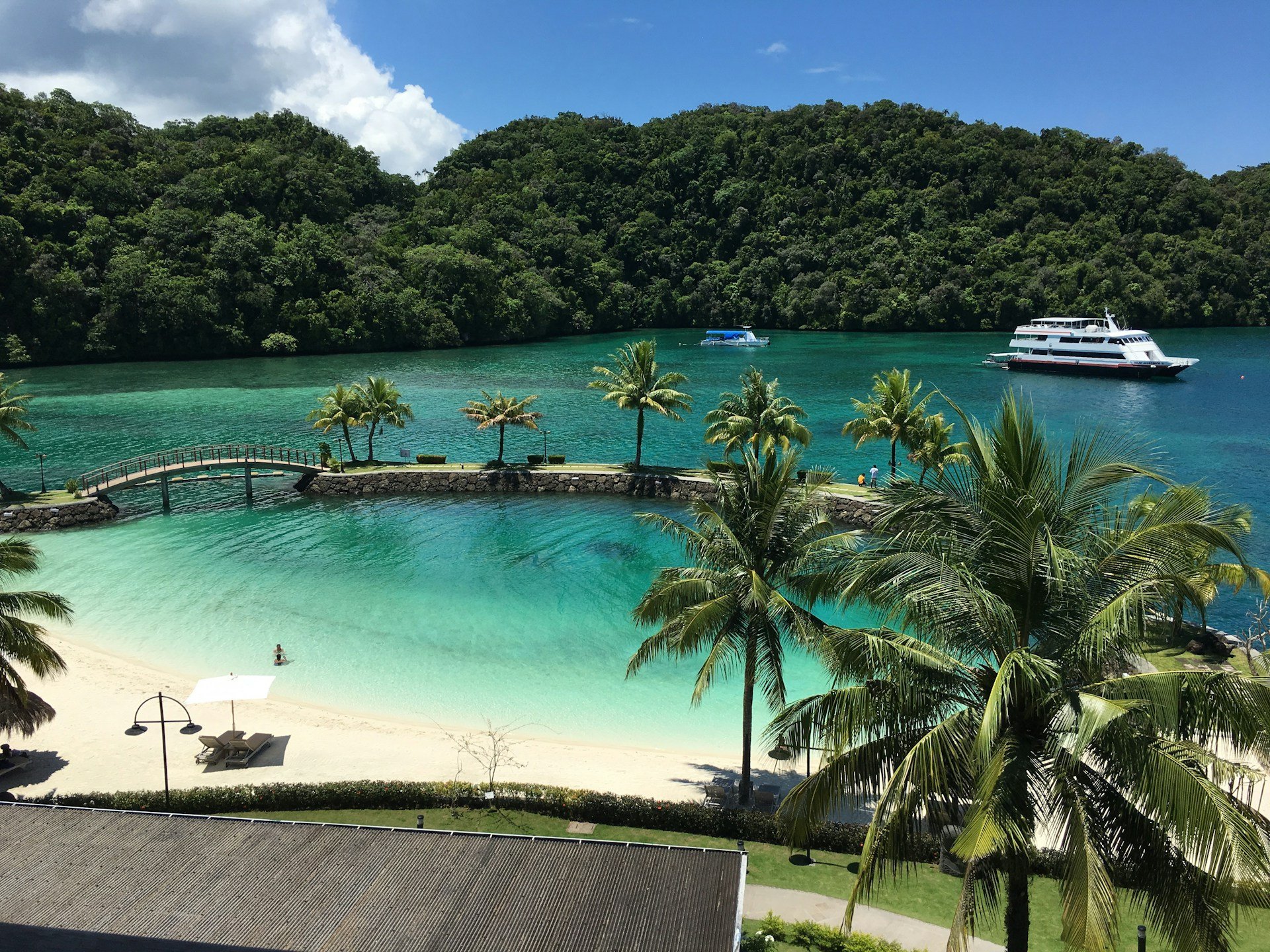
What makes Palau genuinely extraordinary is the reef. Over 1,300 species of fish and 700 species of coral have been recorded in Palauan waters — numbers that rival the Coral Triangle and exceed anywhere else in the western Pacific outside it. The Rock Islands Southern Lagoon, a UNESCO World Heritage Site since 2012, is 100 mushroom-shaped limestone islands rising from shallow turquoise water, each one undercut by wave erosion into an inverted bowl shape, clustered so densely that you navigate between them by boat through channels that barely fit a speedboat. In the middle of them, connected to the sea by underground tunnels and isolated long enough to evolve independently, is Jellyfish Lake — a marine lake containing millions of stingless golden jellyfish that migrate across the lake following the sun each day. It is one of the genuinely unclassifiable wildlife experiences in the world.
Palau made a decision about tourism that most countries with exceptional natural assets haven't had the political will to make: it capped visitor numbers, made every tourist sign a conservation pledge stamped into their passport, banned reef-toxic sunscreen, and established one of the largest marine protected areas in the Pacific. The Palau National Marine Sanctuary, established in 2020, closed 80% of Palau's territorial waters to commercial fishing. The country has decided, repeatedly and explicitly, that the reef is worth more intact than extracted. This is not a marketing position. It is reflected in the policies, the fines, the enforcement, and the quality of the diving.
The honest complication of Palau: it is expensive, moderately difficult to reach, and the non-diving offer for non-divers is limited by the standards of a major tourism destination. Snorkeling, kayaking, the WWII history of Peleliu and Angaur, and the cultural sites on Babeldaob fill a week comfortably. But if you don't dive, you're not getting the thing that makes Palau Palau. If you do dive, Palau may be the best diving trip of your life.
Palau at a Glance
A History Worth Knowing
The Palauan people are descendants of Austronesian migrants who arrived roughly 4,000 years ago, possibly from Island Southeast Asia, and developed one of the Pacific's most complex and stratified societies. Palauan traditional culture features an elaborate system of social hierarchy organized around clans and money — specifically, Palauan money, called udoud, which takes the form of glass and stone beads of different colors and patterns, each carrying specific ceremonial value inherited through centuries of exchange. Udoud is not decorative. It is still used today in ceremonies marking birth, death, and significant life transitions.
Spain claimed the islands in 1686 but made little practical use of them. Germany took formal control in 1899, establishing the plantation and phosphate extraction economy that would define the colonial period. Japan took over under a League of Nations mandate after World War I, and transformed Palau far more radically than any previous colonial power: building infrastructure, settling Japanese, Okinawan, and Korean migrants who eventually outnumbered Palauans, and beginning the military fortification of the islands that would make Palau a focal point of the Pacific War.
By 1944, Koror was the administrative capital of Japan's Pacific mandate and held considerable military significance. The American campaign to take the Palau Islands — Operation Stalemate II — focused primarily on Peleliu, a small island at Palau's southern end that Japan had fortified with an airstrip and a defensive system of reinforced coral caves. The Battle of Peleliu, fought from September 15 to November 27, 1944, became one of the most controversial engagements of the Pacific War. American commanders expected the island to fall in four days. It took 73. The 1st Marine Division suffered casualty rates that shocked even veterans of Guadalcanal and Tarawa. Japanese defenders under Colonel Kunio Nakagawa used the cave system so effectively that the battle dragged into November. When Nakagawa radioed that organized resistance had ended, the final position was taken by a last banzai charge. 1,794 Americans and approximately 10,900 Japanese died on an island eight kilometers long.
The strategic value of Peleliu has been questioned ever since. General MacArthur bypassed the Philippines in his original planning and Peleliu's airstrip was largely unused once taken. Whether the battle was necessary remains debated by military historians. What isn't debated is what was left behind: rusting tanks, unexploded ordnance, human remains, and enough material evidence of the fighting that the island has become one of the Pacific's most significant WWII memorial sites, maintained by the Japanese and American governments in cooperation with Palau.
Palau became a United Nations Trust Territory under US administration after WWII, gained independence in 1994 after extended negotiations over the Compact of Free Association, and has operated as a democratic republic since. Its most significant policy decisions since independence have been environmental: the world's first shark sanctuary in 2009, the Palau Pledge in 2017, and the Palau National Marine Sanctuary in 2020, which closed 500,000 square kilometers of ocean to commercial extraction. These decisions are not incidental. They represent a coherent national strategy built on the recognition that Palau's reefs are the country's most valuable asset, and that their value is contingent on their health.
Migrants from Island Southeast Asia settle Palau, developing a clan-based society with elaborate traditions of money exchange, tattooing, and seafaring.
Germany purchases the Carolines from Spain and begins phosphate extraction on Angaur. The colonial economy transforms the islands.
Japan takes control under League of Nations mandate. Koror becomes the Pacific mandate capital. Japanese settlers outnumber Palauans by the 1930s.
73 days of combat on a coral island. 1,794 American and ~10,900 Japanese dead. One of the Pacific War's most controversial and costly battles.
Palau becomes the world's newest sovereign state, entering a Compact of Free Association with the United States after a lengthy negotiation over nuclear provisions.
Palau bans all commercial shark fishing in its waters, the first country in the world to do so. A single reef shark is worth an estimated $1.9 million over its lifetime in dive tourism versus $108 caught.
Every visitor signs a conservation pledge stamped into their passport on arrival. First such policy in the world.
80% of Palau's waters — 500,000 km² — closed to commercial fishing and extractive industries. One of the largest fully protected ocean areas in the world.
Palau's Destinations
Palau's geography determines its itinerary structure. Koror is the base — all dive operations, most hotels, and all inter-island boat departures are here. The Rock Islands and Jellyfish Lake are 30–45 minutes by speedboat south of Koror. Peleliu is about 90 minutes by boat south of Koror or a short domestic flight. Babeldaob, the main island to the north, has cultural sites and waterfalls reachable by car. The outer islands of Angaur and Kayangel are day trips or overnights for those with time. Almost every day in Palau begins and ends by boat.
Jellyfish Lake / Ongeim'l Tketau
Eil Malk island in the Rock Islands contains a marine lake connected to the ocean only through porous limestone tunnels, isolated enough that the golden jellyfish population evolved without predators and eventually lost their stinging cells. Today the lake holds millions of them — pulsing golden orbs between 3 and 30 centimeters across, moving in a dense column that follows the sun across the lake each morning. Snorkeling through them is warm (the lake stratifies in distinct temperature layers), slightly eerie, and completely unlike anything else in the natural world. Scuba diving is not permitted in Jellyfish Lake — the depth is too great for snorkeling but dive equipment disturbs the delicate halocline layer below the jellyfish. A permit is required and must be arranged through your dive operator. The lake was briefly closed in 2016 when jellyfish numbers crashed due to El Niño; numbers have recovered strongly.
Blue Corner
A submerged reef ledge off the southwestern tip of Ngemelis Island in the Rock Islands, where the wall drops to open ocean and the currents concentrate marine life in a way that makes experienced divers run out of words. The standard procedure: descend to the ledge at around 25 meters, hook your reef hook into the coral (a Palau-specific technique that keeps you stationary without touching anything), and watch. Grey reef sharks patrol in numbers. White tip sharks rest on the ledge. Napoleon wrasse the size of small cars drift through. Schools of barracuda rotate in formation. Turtles appear and disappear. Bat fish hover. The fish density is the greatest most divers will ever encounter, concentrated by the current into one small space. The dive requires Advanced Open Water minimum, comfort with strong current, and ideally some prior experience with drift diving. It is not suitable for beginners, and beginners who push their limits here get into trouble. The visibility is typically 30+ meters. The sharks are not interested in you.
Rock Islands Southern Lagoon
The 70 marine lakes, the mushroom-shaped limestone islands undercut by wave erosion, the passages between islands that narrow to barely a boat width — the Rock Islands are extraordinary even before you get in the water. Snorkeling in the Milky Way, a shallow bay where the seafloor is powdery white limestone silt that gives the water its name, is accessible to all. Ngercheu Island has a beach that appears on every Palau photograph taken from above. The passages between islands at low speed, watching the islands' reflections in still water, is its own experience. Access is entirely by boat — all licensed dive operators and tour operators run day trips and liveaboards through the Rock Islands. The UNESCO inscription protects the landscape from development; the Palau National Marine Sanctuary protects the water.
Peleliu
The island where 12,000 people died in 73 days of combat in 1944 is now a quiet place of roughly 700 residents, coral paths, and jungle steadily reclaiming everything the battle left behind. The main tank road through the island passes rusting Sherman and Japanese tanks where they were destroyed, some barely visible under 80 years of vine growth. The Peleliu War Museum, run by locals with a collection of found equipment, weapons, and personal effects, is small and genuine in a way that large memorials rarely are. The Bloody Nose Ridge cave system that made the battle so costly is walkable with a guide. At the southern tip of the island, the concrete remains of the Japanese administrative building still stand. The airstrip the Americans fought to take is now overgrown. Day trips from Koror by boat take about 90 minutes each way. The island deserves more than a rushed day trip — if you can stay overnight with one of the small guesthouses, the island at dawn before the day-trippers arrive is a completely different experience.
German Channel
A channel cut by German phosphate miners in the early 1900s that now functions as a manta ray cleaning station. Oceanic and reef mantas visit the cleaning stations inside the channel year-round, with peak aggregations December through April when the plankton blooms are richest. The dive involves descending to the sandy bottom at 15–20 meters and waiting, motionless, while mantas circle and banks of small cleaner wrasse pick parasites from their cephalic fins. In peak season, 10 or more mantas may be circling at once. The current through the channel can be strong — drift in and let the dive master lead.
Chuyo Maru & Jake Seaplane
Palau's waters hold multiple WWII wrecks in addition to the world-class reef diving. The Iro Maru, a Japanese fuel tanker at 40 meters, is heavily encrusted and productive with marine life. The Jake Seaplane in Koror harbor sits upright in shallow water with its cockpit and fuselage intact, accessible to Open Water certified divers. Less famous than Chuuk's wrecks but easier to access and often combined with reef diving in the same day trip.
Babeldaob Island
Palau's largest island and the site of the purpose-built capital Ngerulmud is largely undeveloped and worth a day's exploration by rental car. The Badrulchau stone monoliths in the north — massive basalt pillars of unknown age and purpose, possibly over 1,000 years old — are Palau's most significant archaeological site. The Ngardmau Waterfall, the largest in Micronesia, is a 45-minute walk from the road through jungle. The island's cultural villages maintain traditional bai (community meeting houses) with painted decorations that encode Palauan oral history. Rent a car in Koror and cross the Koror-Babeldaob Bridge, which was the longest bridge in the Pacific when it was built in 1977 (the original collapsed in 1996 and the current bridge was built in 2002).
Blue Holes & Chandelier Cave
Blue Holes is a cathedral dive — four vertical shafts descending from 10 to 30 meters, converging at a cavern that opens onto the outer wall at 30 meters, the light from above creating pillars through the blue. Chandelier Cave in Koror Harbor is a guided cavern dive through four interconnected air chambers where stalactites formed during a past ice age when the cave was above water — the cave was later flooded by sea level rise. Both are regularly listed among Palau's top dives. Chandelier Cave requires good buoyancy control and is typically done as a guided experience with Koror-based operators.
Culture & Etiquette
Palauan culture is matrilineal — property, titles, and clan membership pass through the mother's line. This makes Palauan women the custodians of the traditional social system in a way that is reflected in political representation, land ownership, and community decision-making. The traditional chief system, organized by clan and village, operates alongside the elected government. On matters relating to land, customary resources, and community events, the traditional system remains authoritative.
Palau is a small community where the social networks connecting dive operators, government officials, hotel staff, and fishermen are dense and mutually observing. How you behave in one context is likely to be known in others. This is not a warning — it's just the reality of a country with 18,000 people where everyone has a cousin in every sector.
You signed it. It is stamped in your passport. The pledge asks you to act in an environmentally responsible manner: use reef-safe sunscreen, not collect or damage marine life, support local businesses, and not litter. These aren't formalities. The reef you're here to see depends on the quality of every visitor's behavior aggregated over time.
Chemical sunscreens containing oxybenzone and octinoxate are banned in Palau under the Responsible Tourism Education Act of 2018. The fine is $1,000. Bring mineral-based SPF 50+ before you arrive. Rash guards are the better solution for full-day boat days regardless.
Traditional meeting houses (bai) and village communal areas are not tourist attractions in the open-access sense. If you want to visit a village on Babeldaob, go through your hotel or a licensed cultural tour operator who has established relationships with the community.
Traditional fishing rights are complex in Palau — some reefs and lagoon areas are managed under customary tenure by specific clans. Do not fish without understanding exactly where you are and what the rules are for that area. Your dive operator will know.
Tipping is not customary in Palau in restaurants, but a tip specifically to your dive guide after an excellent dive is appropriate and appreciated. $10–20 per diver per day for a skilled guide who manages the briefing, the boat, and your safety is well earned.
Removing coral, shells, marine life, or any artifact from WWII sites is illegal and prosecuted. Peleliu and the wreck sites contain human remains and military equipment that are considered war graves. The Palauan government and Japanese and American veterans' organizations take this seriously.
Mandatory briefing content for every dive in Palau. The reef hook technique was developed here specifically so divers could remain stationary in current without grabbing coral. Even incidental contact damages the organisms that take decades to grow back. If you can't hover without touching, practice before your Palau trip.
Palau operates quality-focused dive operations with experienced guides, well-maintained equipment, and permit fees that fund conservation. A two-tank dive day costs $130–180. This is what properly managed, world-class diving costs. Operators who undercut significantly on price are typically cutting somewhere in their safety or environmental standards.
The Rock Islands have designated no-wake zones to protect the shallow coral and marine life in the inner lagoon passages. Boat operators know these. If you're chartering independently, learn them before you go.
Palau's dive sites are shared by hundreds of divers per week at peak season. Racing to sites, monopolizing anchor points, or failing to control buoyancy damages the ecosystem and affects every diver who comes after you. Palau's dive community is small enough that poor behavior is noticed and remembered.
Palauan Money (Udoud)
Glass and stone beads of specific shapes, colors, and histories constitute Palau's traditional currency, still actively used for ceremonies marking birth, first birth, and death. Each piece has a name, a rank, and a history of ownership. The value is in the narrative attached to the object rather than its material composition. Some pieces have been in circulation for centuries and have known ownership histories running back generations. Do not offer to buy udoud. It is not for sale in any meaningful sense.
Storyboard Carving
Palauan storyboard carving — flat wooden panels carved in relief depicting traditional stories and legends — was encouraged as an art form by the Japanese administration in the 1930s as a way of recording oral histories. The tradition has continued and developed into a sophisticated craft with significant cultural content. Buying a genuine storyboard from a Palauan carver is one of the few meaningful souvenirs available; cheaper machine-produced imitations are common and easily spotted by the lack of individual variation.
Rubak Eldebechel
The traditional system of respected elders — rubak — remains active in Palauan community governance. When you encounter someone identified as a traditional chief or clan elder in a village context, the appropriate posture is respectful deference, waiting to be acknowledged rather than initiating interaction. This is not ceremonial formality — it reflects a functioning social system that predates the government by millennia.
Bai Architecture
Traditional Palauan community meeting houses (bai) are built without nails on a canoe-hull structural principle, with elaborately painted gable ends depicting traditional stories. The paintings encode specific histories: stories of founding ancestors, significant battles, cultural teachings. The art is not decorative in the Western sense. Each panel has specific meaning that traditional knowledge keepers can read completely. The Airai bai on Babeldaob, one of the oldest surviving examples, is open to visitors through licensed cultural guides.
Food & Drink
Palau's food scene is modest relative to its reputation as a dive destination, which reflects the economics of a 18,000-person island nation that imports most of what it eats. The best food here is the simplest: fresh fish from the morning catch, taro prepared in traditional Palauan ways, and fruit from village gardens. Koror has a developing restaurant scene driven partly by Japanese, Taiwanese, and Filipino communities who make up a significant portion of the workforce and have brought their cuisines with them. Budget for higher prices than you'd expect — the USD currency and import costs make eating out comparable to mid-range US city dining.
Fresh Fish
Mahi-mahi, wahoo (ono), and tuna caught the same morning, grilled or pan-fried and served with taro or rice, is the best food Palau reliably offers. The Koror fish market near the harbor receives boats from 6am and is worth a visit regardless of whether you're cooking. Local restaurants serving fresh fish daily are easy to identify by asking at your hotel — the places without a printed menu are usually the ones with the freshest catch.
Taro & Traditional Foods
Taro (buuch in Palauan) is the staple starch and appears in multiple forms: boiled, pounded into a paste, fermented, or cooked in coconut milk. Fruit bat soup (belatong) is a traditional delicacy that genuinely divides opinion — the bat is served whole in broth and is a genuine cultural dish rather than a novelty. Pandanus fruit, breadfruit, and various seaweeds are used in traditional cooking that you're more likely to encounter at community events than restaurants.
Japanese & Asian Cuisine
Palau's long Japanese colonial history and significant Japanese tourist market means Japanese food is genuinely good here. Several Koror restaurants serve proper Japanese cooking — ramen, sashimi, yakitori — rather than approximations. Filipino and Taiwanese food is also well represented given those communities' presence in the workforce. The Penthouse Restaurant in Koror and several establishments along the main Koror strip are reliable for Asian cuisine.
Dive Resort Food
The major dive resorts — Sam's Tours, Fish n Fins, Palau Pacific Resort — serve buffet-style meals that are functional and filling but rarely exciting. The advantage is the convenience of eating where you dive. The disadvantage is that you're paying resort prices for food that is designed to be inoffensive to international guests rather than to showcase anything specific about Palau. Get out of the resort for at least dinner each day.
Tuba
Tuba is the Palauan version of palm toddy — sap tapped from the cut flowering stem of a coconut palm, mildly alcoholic when fermented overnight. It's consumed socially among Palauan men in the evenings and is not widely commercially available, but if offered, accept. The fermented version is mildly sour and gently intoxicating. Fresh tuba is sweet and non-alcoholic.
Practical Eating
WCTC and Surangel's supermarkets in Koror are the main supply points for self-catering and snack provisioning for dive days. Bring snacks from home for anything specific — imported goods are limited in variety and expensive. On dive day boats, most operators provide a simple lunch included in the day rate. Confirm what's included before booking and bring additional food if you're a large eater.
When to Go
Palau has a genuine dry season (November through April) and a wet season (May through October), though in practice you're looking at the difference between daily rain and occasional rain rather than a fundamental change in character. Diving is possible and excellent year-round. The specific seasonal considerations are manta ray aggregations at German Channel (December through April peak) and visibility, which is highest December through March when the northeast trade winds bring clear conditions.
Dry Season
Nov – AprBest diving visibility (often 30–40m at Blue Corner), peak manta ray aggregations at German Channel, calmer sea conditions in the outer reef. December through February is peak tourist season — book dive operators and accommodation well in advance.
Wet Season
May – OctMore rainfall but still excellent diving — visibility drops slightly (20–30m) but plankton blooms attract whale sharks, which are occasionally sighted June through September. Fewer tourists, lower prices, and equally good reef health. The lush green landscape is at its most impressive.
Trip Planning
Palau planning starts with choosing between liveaboard and land-based diving, because that decision shapes everything else. Liveaboards access the outer reef sites and southern atolls that day boats can't reach economically — including Peleliu's world-class south wall, Angaur, and sometimes the open-ocean sites where large pelagics appear. Land-based diving with day boats covers the Rock Islands sites, Jellyfish Lake, German Channel, and Blue Corner with accommodation comfort every night. Most visitors choosing a first Palau trip do land-based; returning divers often go liveaboard.
Seven days is the minimum for a meaningful Palau dive trip. Ten to fourteen days lets you do a thorough Rock Islands dive program plus Peleliu plus Babeldaob cultural sites without feeling rushed. The Jellyfish Lake permit, Rock Islands entry fee, and Peleliu transportation should all be factored into the budget before you arrive.
Arrival & Koror Orientation
Arrive, check in, meet your dive operator for a briefing and equipment check. Afternoon walk around Koror harbor and downtown. Dinner at the Carp Restaurant. Get a sense of the logistics before diving starts.
Rock Islands Dive Days
Two full days of Rock Islands diving: Blue Corner, Blue Holes, German Channel (if manta season), Ngercheu Garden. Three tanks per day. Jellyfish Lake snorkel included in Rock Islands day permit — do this on day two, morning, before the afternoon dive.
Peleliu
Early boat to Peleliu (6am departure, 90 minutes). Full day on the island: WWII Museum, tank walk, Bloody Nose Ridge, memorial sites. Return to Koror by late afternoon. Rest day from diving — required surface interval anyway.
More Rock Islands Diving
Chandelier Cave, Ulong Channel drift dive, Big Drop-Off wall (one of the longest vertical walls in the Pacific). Day six: full Rock Islands snorkel tour for a different surface perspective on the landscape you've been diving under.
Babeldaob & Departure
Morning rental car to Babeldaob: Badrulchau monoliths, Ngardmau Waterfall walk, Airai bai. Afternoon back to Koror for departure flight or final evening.
Full Rock Islands Dive Program
Six days of systematic Rock Islands diving covering all major sites at least once. Jellyfish Lake on day two. German Channel manta dive if in season. Blue Corner twice — once to orient, once to fully absorb it. Chandelier Cave, Blue Holes, Ngercheu, Big Drop-Off, Siaes Tunnel (a large cavern entrance on the outer reef).
Peleliu — Overnight
Boat to Peleliu on day seven, overnight with a local guesthouse. Day seven afternoon and evening on the island without day-trippers. Day eight: Peleliu south wall diving if arranged through a Koror operator who does the Peleliu run — one of Palau's most spectacular wall dives, only accessible from Peleliu.
Outer Reefs & Open Water
Arrange a three-day liveaboard from Koror covering the outer reef sites and possibly Angaur Island. Velasco Reef if a liveaboard extends north. Whale shark season encounters June through September.
Babeldaob, Rest & Departure
Full Babeldaob day including monoliths, waterfall, and village cultural visit (pre-arranged through hotel). Day thirteen: rest, shallow snorkel, storyboard shopping in Koror. Day fourteen: departure with mandatory surface interval from final dive completed.
Liveaboard — Full Palau Waters
Seven-day liveaboard covering Rock Islands, Peleliu south wall, Angaur, and outer reefs. The Palau liveaboard season runs year-round with operators including the Ocean Hunter and Palau Aggressor. Book months ahead in peak season. This covers every significant dive site in Palau's waters in one uninterrupted program.
Land-Based Rock Islands
Return to Koror for land-based week. Revisit favorite sites from the liveaboard with day boats. Add Jellyfish Lake (no scuba from the liveaboard, so this is the first snorkel visit). Chandelier Cave. Rest days interspersed for non-diving activities: Babeldaob, kayaking the Rock Islands lagoon independently, snorkel tour.
Deep Exploration & Cultural
Peleliu overnight for the south wall diving and battlefield time. Kayangel Atoll in the far north if weather permits — pristine reef, almost no visitors, requires a multi-day commitment by boat. Final days: Koror cultural sites, giant clam hatchery, storyboard carvers, and the mandatory 24-hour no-fly surface interval before departure.
Dive Certification
Open Water covers Jellyfish Lake snorkeling, Chandelier Cave, and moderate Rock Islands dives. Advanced Open Water is needed for Blue Corner and Blue Holes. Rescue Diver or Divemaster is ideal for managing yourself in the strong currents. Bring your certification card, logbook, and medical clearance if you have any relevant health conditions.
Reef-Safe Sunscreen
Chemical sunscreens are banned by law. Bring mineral-based (zinc oxide or titanium dioxide) SPF 50+ in sufficient quantity for your entire trip. It is available in Koror but expensive and limited in selection. Rash guards are strongly recommended for all snorkel and surface time. You will burn faster than you expect at this latitude.
Vaccinations
No mandatory vaccinations. Recommended: Hepatitis A, Hepatitis B, Typhoid, and routine vaccines. Dengue is present. Use repellent at dawn and dusk. No malaria risk in Palau. The nearest decompression chamber is at Belau National Hospital in Koror — verify it is operational before your trip with your dive operator.
Full vaccine info →Permits & Fees
The Rock Islands entry fee is $100 per person (included in most dive packages). The Jellyfish Lake permit is $100 per person (usually included in Rock Islands day packages but confirm). Babeldaob cultural sites have modest entry fees. The Palau Pledge is signed free of charge on arrival. Your dive operator should provide a complete breakdown of what is and is not included in their day rate.
Dive Insurance
DAN (Divers Alert Network) membership is strongly recommended before any Palau diving trip. The Belau National Hospital decompression chamber is available but has historically had reliability issues — confirm operational status with your operator on arrival. Medical evacuation to Guam or Manila is the backup for serious decompression accidents. DAN coordinates this. Save the emergency number: +1-919-684-9111.
Connectivity
PNCC (Palau National Communications Corporation) and Palau Mobile both offer SIM cards available at the airport. Data speeds are functional in Koror but drop on the water. An Airalo eSIM with a regional Pacific plan also works. WiFi is available at major hotels and most dive operators. Download offline maps and dive site briefings before heading out on the water.
Get eSIM →Transport in Palau
Getting around Palau is fundamentally a water transport question. The main island of Babeldaob is connected to Koror by bridge and has a road network worth exploring by rental car. Everything else — the Rock Islands, Peleliu, Angaur, the outer islands — requires a boat. Your dive operator provides the boat for all dive sites. Independent water transport is available by charter.
International Flights
VariableRoman Tmetuchl International Airport on Babeldaob serves United Airlines from Guam, Korean Air from Seoul, and Philippine Airlines from Manila. No direct flights from Europe or Australia. Connect through one of these hubs. Seoul is typically the most efficient connection from Europe; Guam from the US West Coast.
Domestic Flights
$60–120 one wayPalau Flights operates small aircraft to Peleliu and Angaur. Flights are 15–20 minutes. Schedules are limited and can be affected by weather and demand. Confirm 48 hours before departure. The boat is a more flexible option for Peleliu; the flight saves 90 minutes each way.
Dive Operator Boats
Included in dive packageAll Rock Islands sites, Jellyfish Lake, German Channel, and day-trip sites are reached by your dive operator's speedboats. Boats depart Koror harbor between 7 and 8am daily. You'll be on the water by 8:30am at the first site. The boats are typically fast, well-equipped, and driven by guides who know every passage through the Rock Islands by instinct.
Car Rental
$35–60/dayAvailable in Koror for exploring Babeldaob. Drive on the right. The Koror-Babeldaob Bridge connects the islands. The road network on Babeldaob is paved on the main loop but some secondary roads to cultural sites are gravel or unsealed. An international driving permit is required. Japanese-spec right-hand-drive vehicles are common despite right-hand traffic.
Charter Boats
$150–400/dayFor non-diving Rock Islands kayaking tours, Peleliu boat trips, or independent island exploration. Fish n Fins, Palau Ocean Adventures, and several other operators run non-dive day charters. The full Rock Islands snorkel and kayak day is worth booking as a structured tour rather than going independently unless you have experience navigating the passages.
Taxis
$3–10 per tripAvailable in Koror for short trips between the harbor, hotels, restaurants, and supermarkets. No meters. Agree the fare before getting in. The main island of Koror is small enough to walk most things but taxis are useful for airport runs and luggage transport.
Accommodation in Palau
Most visitors stay in Koror, which puts them closest to the dive operators and harbor departures. The accommodation range runs from basic guesthouses to the Palau Pacific Resort, the established five-star option on a private beach 10 minutes from Koror center. Liveaboards are the third option for dive-focused visitors who want maximum time on the water. Peleliu has a small number of basic guesthouses worth booking for an overnight if you want the island to yourself.
Palau Pacific Resort
$250–450/nightThe established luxury option with a private beach, pool, and dive center on-site. Japanese-oriented service standard, strong dive package deals when booked together with room. The beach is good for evening swimming. Located on Arakabesan Island connected to Koror by causeway — ten minutes to the harbor by taxi.
Dive Resort Packages
$180–320/night (room + diving)Sam's Tours, Fish n Fins, and Palau Diving Center all offer accommodation packages with their dive operations. Booking accommodation and diving together saves coordination time and often provides a slight cost advantage over booking separately. These are the standard format for dedicated dive visitors.
Guesthouses
$60–120/nightSeveral locally owned guesthouses in central Koror offer basic air-conditioned rooms at significantly lower prices than the dive resort packages. West Plaza hotels are the most established local chain with multiple Koror properties. Budget for the difference to go into your dive day budget rather than accommodation.
Liveaboards
$350–600/day all-inOcean Hunter III, Palau Aggressor, and several other vessels operate week-long liveaboard programs. All diving, meals, and accommodation included. Access to outer reef sites not reachable on day boats. The most efficient format for experienced divers with limited time. Book 6–12 months ahead in peak season.
Budget Planning
Palau is expensive. There is no way to get around this honestly. The dive packages, the permits, the accommodation, the imported food — everything costs more than equivalents in Southeast Asia or the Caribbean. The conservation fees are real costs with real purpose, and the dive quality you receive in exchange is unmatched. Budget approximately $350–500 per person per day for a standard land-based dive package trip in peak season, all in.
- Guesthouse accommodation
- Two-tank dive day with smaller operator
- Self-catering from WCTC supermarket
- Rock Islands + Jellyfish Lake permits
- One Peleliu day trip by boat
- Dive resort package (room + 2-tank day)
- All Rock Islands permits included
- Restaurant dinners in Koror
- Peleliu day trip + Babeldaob rental car
- Equipment rental if needed
- Liveaboard (all diving, meals, berth)
- All site permits included
- Outer reef access not possible on day boats
- Pre/post nights at Palau Pacific Resort
- Maximum time underwater per dollar spent
Quick Reference Prices
Visa & Entry
Most nationalities receive a visa on arrival in Palau, free of charge, for stays of up to 30 days. US citizens are entitled to stays of up to one year under the Compact of Free Association. Extensions are available through the Bureau of Immigration in Koror for stays beyond 30 days. Some nationalities require an advance visa — check the Palau Bureau of Immigration website for your specific country before booking.
Every visitor signs the Palau Pledge on arrival — it is stamped directly into your passport by the immigration officer. This is not optional and is not bureaucratic theater. It is the first policy of its kind in the world and the stamp in your passport is a genuine record of the commitment.
Free of charge. Valid passport, return ticket, and proof of funds required. US citizens: up to one year. Sign the Palau Pledge on arrival — it is stamped in your passport.
Family Travel & Pets
Palau works well for families where at least some members dive or snorkel, and less well for families where the ocean isn't a central interest. The Jellyfish Lake experience is accessible to any child comfortable snorkeling, and it's one of the most remarkable wildlife encounters available to non-divers anywhere in the world. The Rock Islands snorkel and kayak tours are suitable for children from around age eight with basic water comfort. Peleliu's WWII history is engaging for older teenagers with historical interest.
Jellyfish Lake for Kids
This is one of the few genuinely extraordinary natural experiences accessible to non-diving children. Any child comfortable snorkeling in open water can do it. The jellyfish are harmless, the water is warm, and the experience of floating among millions of pulsing jellyfish is something children genuinely remember. Confirm with the operator that snorkel equipment in smaller sizes is available.
Rock Islands Kayaking
Several operators run guided kayaking through the inner Rock Islands lagoon passages — suitable for children from around age eight who are comfortable in a sit-on-top kayak. The experience of paddling through limestone mushroom islands in clear water with fish visible below is accessible and extraordinary. Half-day tours avoid the heat of the middle of the day.
Snorkel Tours
The inner reef snorkel sites — particularly Ngercheu Garden and the passages within the Rock Islands — have calm, clear water with dense fish life at depths of 3–5 meters that are entirely accessible to confident young snorkelers. A dedicated snorkel day alternating with Jellyfish Lake gives families with non-diving children a full week of water activities.
Medical Planning
Belau National Hospital in Koror handles primary care. The decompression chamber's operational status should be confirmed with your dive operator on arrival. For serious medical emergencies, evacuation to Guam or Manila is required. Comprehensive travel insurance with medical evacuation cover is essential for the whole family.
Traveling with Pets
Bringing pets to Palau involves import permits, health certificates, and a quarantine period for most species. Given Palau's conservation focus, biosecurity at the border is taken seriously. For a dive-focused holiday, pet travel is not practical. Leave pets at home with appropriate care arrangements.
Safety in Palau
Palau is safe for visitors. Crime against tourists is rare and the community is small enough that incidents are conspicuous. The genuine risks are the same as in any serious dive destination: current, depth, and the consequences of exceeding your certification or experience level at sites like Blue Corner. The decompression chamber at Belau National Hospital is present but has had periods of reduced capacity — confirm operational status with your operator on the first day.
General Security
Very low crime. Palauans are hospitable and the tourist community is small enough to be self-aware. Basic precautions are sufficient. Don't leave valuables on dive boats or at beach stops.
Dive Currents
Blue Corner and the outer reef passages run strong, unpredictable currents. Always dive with a local guide who knows the site. If you miss the reef hook hold and get swept into open water, deploy your SMB (surface marker buoy) immediately and let the boat find you. Always dive with an SMB at current sites.
Decompression Risk
Multi-day, multi-dive schedules in Palau accumulate nitrogen load quickly. Follow conservative no-decompression limits, avoid flying for at least 18 hours (ideally 24) after the last dive, and dive conservatively on the last two days before departure. Your dive computer is mandatory, not optional.
Marine Hazards
The jellyfish in Jellyfish Lake are stingless for golden jellyfish specifically — other jellyfish species in Palauan waters do sting. Stonefish and lionfish are present on the reef. Don't touch anything. The sharks at Blue Corner are not a significant risk to divers — unprovoked attacks are rare and the sharks are reef species accustomed to divers.
Unexploded Ordnance (Peleliu)
UXO from the 1944 battle remains present on Peleliu, both on land and underwater. Do not leave marked paths on Peleliu. Do not pick up, move, or handle any metal object found on the island or underwater. Report sightings to local guides. This is not a historical footnote — periodic ordnance finds on Peleliu are ongoing.
Sun & Heat
Full-day boat days in equatorial sun with high UV index cause rapid sunburn. Rash guards are the most effective protection. Mineral SPF 50+ on all exposed areas. Stay hydrated — the combination of heat, diving, and air conditioning leads to dehydration faster than most visitors expect.
Emergency Information
Embassies & Consular Assistance
Most embassies covering Palau are based in Manila, Tokyo, or Washington. The US maintains an Embassy in Koror given the Compact of Free Association.
Book Your Palau Trip
Everything in one place. These are services worth actually using.
Mechesol
Mechesol is a Palauan word that carries the meaning of gratitude and respect offered to nature — a recognition that the natural world is not a resource to be used but a system to be maintained and respected for its own sake. It's the cultural root of the decisions Palau has been making since 2009: the shark sanctuary, the Palau Pledge, the Marine Sanctuary. These weren't policy innovations. They were the modern expression of something older.
You leave Palau having signed a pledge that is stamped in your passport as evidence that you were here and that you committed to something. Most visitors honor it. The reef is still there because enough people, over enough years, cared more about what they were looking at than what they could take from it. That is what mechesol looks like when a whole country applies it.