
Nauru
The world's smallest republic. Once the richest nation on earth per capita. Now a coral plateau of stripped moonscape, a single ring road, and a story about what happens when a country spends everything it has all at once.
What You're Actually Getting Into
Nauru is 21 square kilometers of raised coral limestone in the central Pacific, roughly halfway between Hawaii and Australia. The entire country fits inside a mid-sized European city's urban core. You can drive the single ring road that circles the island in about 20 minutes. There are no traffic lights. There is one main hotel. Most of the interior is a barren plateau of sharp coral pinnacles, the legacy of 90 years of phosphate strip mining that extracted the island's ancient seabird-guano deposits and left behind something that looks convincingly like the surface of another planet.
People visit Nauru for three reasons. The first is country collecting: Nauru consistently appears on lists of the hardest countries to visit and the least-visited nations on earth, and for travelers who tick off countries the way others collect stamps, the difficulty is the draw. The second is genuine historical and geopolitical curiosity. Nauru's story — colonial extraction, wartime occupation, sudden phosphate wealth, spectacular mismanagement, fiscal collapse, and the controversial Australian offshore detention centre that arrived as the government ran out of other options — is one of the most extraordinary national narratives of the 20th century compressed into a place small enough to see in a day. The third reason is diving: the reef that rings Nauru is largely undived, genuinely pristine, and produces encounters with grey reef sharks, turtles, and wall dives that would be celebrated if they were anywhere easier to reach.
What you will not find in Nauru: tourist attractions in any conventional sense, restaurants competing for your custom, a developed hospitality industry, or a government that has made welcoming visitors a priority. The island receives perhaps a few hundred genuine tourists per year. You will be noticed when you arrive, and you will be noticed when you walk around. That isn't threatening. It's just the reality of being a visitor in a place this small.
Come with realistic expectations, genuine curiosity about what happened here, and the flexibility to handle the fact that the flight may not run on schedule, the hotel may be full of contractors, and the single restaurant in the main hotel may be out of half the menu. Come anyway. Nauru is unlike anywhere else on earth, and that is not a marketing claim.
Nauru at a Glance
A History Worth Knowing
The Nauruan people arrived on the island roughly 3,000 years ago, likely from Micronesian and Polynesian origins, and developed a society of 12 clans living on the narrow coastal strip around the island's single freshwater lake, Buada Lagoon. The island's phosphate-rich interior plateau was not arable and was largely avoided. For millennia, Nauru was a functioning Pacific community of perhaps 1,500 people, fishing, fermenting toddy from coconut palms, and managing the island's resources through clan governance.
British captain John Fearn made European contact in 1798 and named it Pleasant Island, which in retrospect carries a particular weight. By the mid-1800s, beachcombers and escaped convicts had introduced firearms and alcohol, and a decade-long inter-clan war in the 1870s reduced the population from around 1,400 to fewer than 900. Germany annexed the island in 1888, imposed order by confiscating weapons, and set the pattern for what followed: external authority extracting what it needed and managing the Nauruan people as a secondary consideration.
In 1906, a New Zealand prospector named Albert Fuller Ellis identified the island's central plateau as one of the richest phosphate deposits ever found. The rock beneath Nauru was essentially fossilized seabird and bat guano accumulated over millions of years, some of the finest fertilizer raw material on earth. The British Phosphate Commission began mining operations in 1907, and for the next nine decades, the island's interior was systematically removed and shipped to Australia, New Zealand, and Britain to fertilize their farmland.
Japan occupied Nauru in August 1942. What followed was brutal: approximately 1,200 Nauruan men were transported to Truk Lagoon as forced labor, and many did not survive. The Japanese executed several Nauruan leaders and bombed the island's infrastructure. Allied bombardment added to the destruction. By the time Australian forces landed in September 1945, the Nauruan population had been reduced by about a third. The displaced workers at Truk were not repatriated for months after the war's end.
Nauru became a United Nations Trust Territory jointly administered by Australia, New Zealand, and Britain, with Australia holding effective control. Mining resumed and accelerated. In 1968, Nauru achieved independence under its first president, Hammer DeRoburt, who negotiated control of phosphate revenues for the Nauruan people. What came next was one of the most remarkable and ultimately tragic episodes in Pacific economic history.
Through the 1970s and into the 1980s, phosphate royalties made Nauru the world's highest per capita income nation. The government built free housing, free healthcare, free education, and zero taxation. Nauruan citizens flew business class as a matter of course. The country purchased real estate in Melbourne, Hawaii, and Guam. There was a musical in London's West End, backed by Nauru money, that ran for a few months. The Nauru Phosphate Royalties Trust accumulated over $1 billion at its peak. Nauruan citizens had no financial incentive to work, so most didn't. The country imported labor from Kiribati, Tuvalu, and the Philippines to run basic services.
The phosphate ran out in the early 1990s. The Trust's funds had been mismanaged, stolen through corruption, and spent on investments that returned nothing — the Melbourne real estate portfolio alone lost hundreds of millions through poor management decisions. The musical bombed. The jets were sold. The free services collapsed. By the early 2000s, Nauru was effectively bankrupt. The government could not pay wages. Phosphate residues were re-mined from the tailings. Nauru took the only economic lifeline available: in 2001, it agreed to house Australia's offshore asylum seeker processing centre in exchange for Australian financial support. The centre — known simply as the Nauru Regional Processing Centre — has been one of the most controversial immigration detention facilities in the world and remains central to the island's current economic situation and political relationship with Australia.
The island you visit today holds all of this in roughly 21 square kilometers. The stripped plateau is still there. The former phosphate cantilever loading structure still stands on the coast. The government building is modest. The ring road connects everything in under 20 minutes. And the Nauruan people, now around 10,000, are here, living on the narrow coastal strip around the same lagoon their ancestors fished from 3,000 years ago, in a place that the 20th century made and unmade and left changed in ways that are still being reckoned with.
Micronesian and Polynesian people settle the island, developing a clan-based society around the coastal fringe and Buada Lagoon.
Firearms introduced by outsiders trigger a decade of civil war. Germany annexes in 1888, confiscates weapons, imposes colonial order.
Albert Ellis identifies the central plateau as a vast phosphate deposit. Mining begins in 1907 and runs for nearly 90 years.
1,200 Nauruans deported to Truk as forced labor. Many die. Allied bombing further damages the island. Population reduced by a third.
Nauru becomes the world's smallest independent republic. Phosphate revenues begin flowing to the Nauruan people directly.
Nauru briefly holds the world's highest GDP per capita. The Royalties Trust reaches over $1 billion. Free everything. Zero taxes. Business class as standard.
Phosphate effectively exhausted. Trust funds depleted through mismanagement and corruption. The country approaches bankruptcy.
Australia establishes its offshore processing centre on Nauru in exchange for financial support. The arrangement continues today, controversially.
Nauru's Sights
Nauru is small enough that "destinations" in the conventional sense don't apply. You can walk from one end of the coastal strip to the other in under an hour. The ring road circles the entire island in about 19 kilometers. What the island offers instead is a set of experiences and landscapes that exist nowhere else, plus reef diving that is genuinely exceptional for anyone who makes it this far.
The Phosphate Plateau
The central plateau of Nauru is the most arresting landscape on the island, an 80-meter-high expanse of jagged coral pinnacles called "pinnacle rock" or "topside" by Nauruans, left behind when everything else was stripped away. The phosphate-bearing rock between the pinnacles was dug out and exported. What remains looks convincingly like a lunar surface: white and grey spires of bare limestone in every direction, broken by abandoned mining equipment rusting quietly in the heat. There are informal tracks into the plateau and you can walk among the pinnacles. Wear solid shoes. Take water. Go in the early morning before the reflected heat becomes brutal. There is nothing quite like it anywhere in the world, and it is impossible to stand in it without understanding exactly what happened here at a gut level that reading about it simply doesn't produce.
Nauru's Coral Wall
The reef that rings Nauru is one of the least-dived in the Pacific and one of the healthiest for it. The outer wall drops sharply from the reef flat to significant depth and produces encounters with grey reef sharks, turtles, eagle rays, and dense schools of pelagic fish that would attract serious attention if the island were remotely accessible. There is no dedicated dive shop operating permanently on Nauru — the arrangement changes — but the Menen Hotel periodically operates dive equipment and local guides can be arranged. Check current status directly with the hotel before planning a dive-focused trip. The snorkeling off Anibare Bay on the eastern coast is accessible without any equipment rental and is a good introduction to the reef's condition.
Anibare Bay
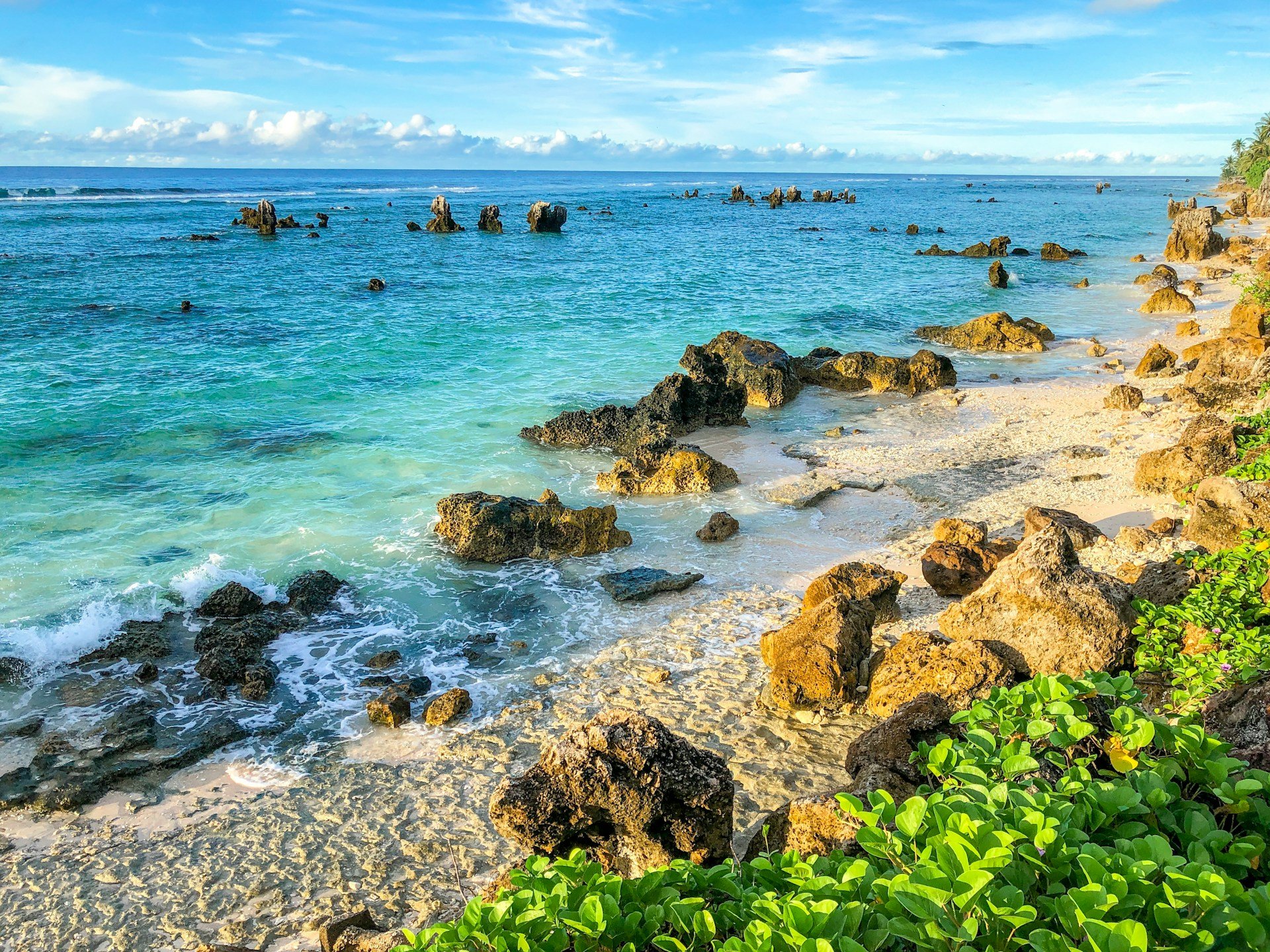
The widest and most sheltered beach on Nauru, on the eastern coast, with calm water on most days and good snorkeling directly off the shore. The bay faces east and catches the morning light cleanly. There are picnic shelters along the beach and local families use it regularly on weekends. It is the closest thing to a conventional tourist beach experience Nauru offers, and it is genuinely pleasant. The water is warm and clear. Don't expect facilities.
Buada Lagoon
The only body of fresh water on the island, an inland lagoon surrounded by coconut palms and pandanus, sitting in a depression in the central area. It's a quiet, shaded walk from the ring road and a striking contrast to the open coral devastation of the plateau immediately adjacent. Nauruan families fish here, though the lagoon's water quality has declined significantly from historical levels due to contamination from the mining era. Worth visiting for the shade and the incongruity.
Japanese Guns & War Relics
Japanese coastal defense guns remain in position at several points around the island's ring road, particularly near Command Ridge in the interior and along the southern coast. Rusting gun emplacements, bunker remains, and the remnants of Japanese infrastructure are visible from the road and on short walks from it. The Command Ridge gun site is the most accessible and has the best-preserved emplacement. There are no formal walking trails or signs — ask at your hotel for current access information.
Phosphate Cantilever
The rusting steel cantilever loading structure on the western coast, used to load phosphate onto ships anchored offshore, is one of the island's most photogenic relics. It no longer functions but still stands, a monument to the industrial operation that shaped the island's entire modern history. Visible from the ring road. The adjacent phosphate processing area, now largely decommissioned, gives a sense of the scale of the operation at its peak.
Culture & Etiquette
Nauru is a small, tight-knit community where everyone knows everyone and a foreign face is immediately conspicuous. That is not a warning — Nauruans are genuinely hospitable to visitors who engage respectfully. It's simply the reality of arriving in a place with around 10,000 residents and a handful of tourists per year. You will be noticed. How you carry yourself in the first 24 hours largely determines the quality of the interactions you'll have for the rest of your visit.
The country is predominantly Christian, with Congregationalist and Catholic communities the largest denominations. Sundays are observed. The clan structure that predates colonial contact is still socially relevant in land matters and community governance, though less visible to outsiders than comparable systems in Melanesia or Polynesia.
On an island of 10,000 where everyone knows everyone, walking past someone without acknowledging them is a social miss. A nod, a hello, or "eokwe" (a common Nauruan greeting) covers it. People will be genuinely pleased if you make any effort with the language.
The island is small and people are not accustomed to being photographed by strangers. Always ask. Almost everyone will say yes, and many will want to know where you're from and why you came, which is a conversation worth having.
Swimwear is for the beach. In Aiwo, Yaren, and around the government buildings, conservative casual dress is appropriate. Nauruan women generally dress modestly.
Nauruans will ask. "I wanted to see your country and learn about its history" is entirely sufficient and entirely true. It will be met with warmth and often with an offer to show you something.
The phosphate plateau is not a tourist attraction in the packaged sense. It is the physical scar of what was done to this place. Walk it with the gravity it deserves, not as an Instagram backdrop.
The Australian Regional Processing Centre is a working facility on sovereign Nauruan territory. Attempting to photograph it, approach it, or make contact with detainees is illegal under Nauruan law and will result in visa cancellation and deportation at minimum. This is not a grey area.
The country's decline is not an ironic travel experience. It is real people's lives. The phosphate history, the bankruptcy, the decisions that led here — Nauruans lived through all of it and continue living with the consequences. Engage with what happened here with the seriousness it deserves.
Nauru uses Australian dollars and has strong Australian cultural influences, but it is a Pacific nation with its own social codes. The informality of Australian beach culture does not automatically transfer.
Nauruan views on the processing centre are complex. Some see the income as necessary. Others have serious concerns about conditions and human rights. Don't enter this conversation with a predetermined political position that you plan to argue. Listen first.
The interior coral pinnacles are genuinely treacherous in low light. The sharp limestone can cause serious injuries. Stick to daylight visits and wear appropriate footwear.
Fishing Culture
Fishing is central to Nauruan identity and daily life. The island's waters are productive and the reef provides much of the local protein that doesn't come from imports. If a Nauruan offers to take you fishing, accept without hesitation. It will be one of the better experiences of your visit and the conversation that happens on a fishing boat is invariably the most honest.
The 12 Clans
Nauruan society is organized around 12 traditional clans, each associated with a particular area of the island and a set of traditional responsibilities. Clan membership passes through the mother's line. Land ownership is deeply tied to clan identity, which is one reason that the phosphate royalty negotiations were so complex and remain contested.
Toddy Culture
Palm toddy, tapped from the growing tip of coconut palms, is a traditional Nauruan drink that predates colonial contact. Fresh toddy is mildly sweet and slightly fizzy. Fermented overnight it becomes alcoholic. It remains part of social life on the island, though less central than it once was. Being offered toddy is an act of hospitality.
Church Community
The Nauru Congregational Church and the Catholic Church are the dominant religious communities and serve important social functions beyond formal worship. Sunday services are attended by a significant portion of the population. Church choir singing in Nauru is genuinely beautiful, and if you're on the island on a Sunday morning, the sound coming from the Congregational church in Aiwo is worth stopping for.
Food & Drink
Nauru's food situation is a direct consequence of its economic history. During the phosphate wealth era, imported food replaced traditional subsistence fishing and farming so completely that the skills and infrastructure for self-sufficient food production were largely lost. Today the island imports roughly 90% of its food from Australia and other Pacific nations, making everything expensive and supply irregular. Nauru has one of the highest rates of obesity and type 2 diabetes in the world, a direct result of the shift to processed imported food combined with the sedentary lifestyle that the phosphate wealth era encouraged.
As a visitor, your food options are essentially the Menen Hotel restaurant, a small number of takeaway shops selling fried food along the ring road, and whatever fresh fish someone catches that day. Managing expectations here is important. Bring some of your own food supplies from Australia or Fiji.
Fresh Fish
When a fisherman comes back with a good catch, fresh tuna or reef fish grilled simply is the best meal on the island by a significant margin. The Menen Hotel kitchen will sometimes prepare fresh fish if it's available. Alternatively, befriend someone with a boat. The fish that comes directly off a hook in Nauruan waters, grilled over coconut husks on the beach that evening, is the only genuinely excellent meal you'll have here.
Menen Hotel Restaurant
The hotel's restaurant is the only sit-down dining option on the island with any consistency. The menu is Australian-influenced comfort food: grilled meats, salads, pasta, seafood when available. Prices are higher than you'd expect for the quality, because everything is imported. Half the menu may be unavailable on any given day. Budget A$25–45 for a main course. It's functional and sometimes good. Don't arrive with high expectations and you'll be fine.
Takeaway Shops
Several small shops around the ring road sell fried chicken, fish and chips, and rice dishes at prices that are more in line with what Nauruan residents actually pay. The quality is what you'd expect from a takeaway operating in remote Pacific conditions. It fills a gap. Find the shop near the government building in Yaren that opens around 11am — the local workers eat there and it's the most reliable of the options.
Traditional Foods
Traditional Nauruan foods include freshly caught fish prepared multiple ways, coconut in various forms, and toddy. These are rarely available commercially. If you're invited to eat with a Nauruan family — and you may well be — you'll encounter food prepared closer to traditional methods. Eat what you're given, appreciate the hospitality, and don't comment on the quantity if it's modest.
Supplies & Self-Catering
There are a few small shops selling imported Australian goods at significantly inflated prices. A can of food that costs A$1.50 in Brisbane costs A$4–6 in Nauru. Bring a supply of snacks, coffee, and anything specific you rely on from Brisbane or Nadi before boarding your flight. The Menen Hotel has a small shop with basics but don't rely on it for variety.
Drinking
Alcohol is available at the Menen Hotel bar. There are no other bars operating reliably. Beer is Australian (VB, XXXX, Carlton Draught) and priced at Australian bar prices plus import costs, so expect A$8–12 a can. The hotel bar is the social hub of the island in the evenings for the contractor population and any visitors. It is worth an evening even if you don't drink, purely for the conversation.
When to Go
Nauru sits just south of the equator and has an essentially equatorial climate: hot and humid year-round, with temperature variation of only a few degrees across the year. The meaningful seasonal distinction is between the slightly drier period and the wetter monsoon months. For most visitors, the timing of available flights matters far more than climate when planning a trip to Nauru.
Drier Months
Apr – OctSlightly lower rainfall and somewhat more consistent diving and snorkeling visibility. Sea conditions are generally calmer on the eastern coast. Still hot and humid — expect 30–32°C with high humidity every day.
Wetter Months
Nov – MarHigher rainfall and more frequent squalls. The interior plateau becomes slippery in wet conditions. Diving visibility can drop. Nauru is not in the main typhoon belt but tropical storms can affect the region. Still manageable, but April through October is more comfortable.
Trip Planning
Planning a Nauru trip requires doing things in a specific order. First: confirm the visa process and apply. Second: book your Nauru Airlines flight and accept that the schedule may change. Third: book the Menen Hotel, which is the primary accommodation option. Fourth: figure out everything else. Reversing this order will result in wasted deposits and itineraries built around flights that no longer exist.
Three to four days is the right length for a Nauru visit. One day covers the ring road, the plateau, Anibare Bay, and the main sights. Two days adds time for the reef, more thorough plateau exploration, and the social interactions that develop organically when you're not rushing. Three to four days gives you enough buffer for the inevitable logistics surprises and time to actually absorb what you're seeing rather than just documenting it.
Arrival & The Ring Road
Arrive, check into the Menen Hotel, and do the ring road in the afternoon. Drive or taxi the full 19 kilometers, stopping at the phosphate cantilever loading structure, the Japanese gun emplacements near Command Ridge, Buada Lagoon, and the Anibare Bay beach. This gives you the geography of the entire country in an afternoon. Dinner at the Menen Hotel restaurant. Menen bar in the evening — the contractors and any other visitors will be there and the conversations are invariably good.
The Plateau
Early morning walk into the interior phosphate plateau before the heat peaks. Start by 6:30am. Two to three hours among the pinnacles is enough to understand the scale of what happened. Afternoon snorkeling at Anibare Bay or arranging a boat for the outer reef if dive equipment is available. Evening: walk the Aiwo waterfront as the sun drops, watch the frigate birds, and see who's around the small harbor.
Community & Departure Buffer
Walk into Aiwo and Yaren on foot. Visit the Nauru parliament building (small, publicly accessible exterior). If a cargo ship is due, be at the harbor. Spend the afternoon at Anibare Bay again if the previous day produced any social connections that lead to a fishing invitation, follow it. Keep day four as a full buffer in case of flight delays.
Full Island Orientation
Day one as above — ring road, cantilever, Buada Lagoon, Anibare Bay. Day two: the plateau at dawn, then a full afternoon on the eastern reef by snorkel or dive boat if available. The additional time lets you cover the plateau thoroughly rather than just the accessible edges.
Slow Time & Social Connection
Three extra days on an island this small is about people rather than new sights. Walk the ring road at different times of day. Go to the market if there is one. Accept any invitations that come. Spend mornings on the beach when the light is good for photography. Visit the church on Sunday if your timing allows. These days are unstructured and that is entirely the point.
Buffer Days
Two full days before your flight. Nauru Airlines schedules have been unreliable historically. Do not compress this. Use the time for anything the previous days suggested you should have done more of.
Vaccinations
No mandatory vaccinations for most visitors arriving from Australia or Fiji. Recommended: Hepatitis A, Hepatitis B, Typhoid, and routine vaccines. Dengue is present. Use repellent at dawn and dusk. No malaria risk.
Full vaccine info →Connectivity
Digicel operates mobile coverage across Nauru. An Airalo eSIM with a Pacific plan or a local Digicel SIM purchased on arrival are both options. Data speeds are limited. Coverage is generally functional in the coastal areas. The Menen Hotel has WiFi that is unreliable in quality.
Get eSIM →Power & Plugs
240V, Australian Type I plugs. Power outages occur irregularly. The Menen Hotel has generator backup. Bring a power bank for charging devices away from the hotel and for any plateau walks.
Medical Supplies
Nauru has a hospital in Yaren but facilities are limited. Bring a comprehensive first aid kit, any prescription medications in full supply, broad-spectrum antibiotics (get a GP prescription), and rehydration sachets. Serious medical emergencies require evacuation to Australia.
Travel Insurance
Medical evacuation from Nauru to Australia is expensive without insurance. Get comprehensive cover with medical evacuation before you leave. Verify the policy covers remote Pacific islands specifically. This is not optional.
Footwear
The phosphate plateau is sharp coral limestone that will destroy sandals and damage bare feet. Solid walking shoes or hiking boots are essential for the interior. Reef shoes or water shoes are useful for snorkeling access from rocky shore entry points.
Transport in Nauru
Getting to Nauru is the challenge. Getting around once you're there is straightforward by any standard: the entire country is a 19-kilometer ring road with a population of 10,000. There are no traffic lights. There is one airport. You can walk the ring road in a few hours or drive it in 20 minutes.
Nauru Airlines
A$800–1,500+ returnThe only airline serving Nauru. Operates from Brisbane, Melbourne, and Nadi (Fiji). Schedules are limited to a few flights per week and change frequently. Book directly through Nauru Airlines' website and confirm your booking by email. Cancellations occur. Always build a buffer day on each end.
Taxis
A$5–15 per tripAvailable and functional. Most trips on a 19-kilometer ring road are short. The Menen Hotel can arrange taxis. There is no ride-hailing app. Wave down a car or ask at the hotel. Fares are negotiated in advance. Drivers know the island's landmarks and are generally helpful.
Car Rental
A$80–120/dayAvailable through the Menen Hotel. A car is useful for flexibility and for reaching the plateau and southern gun sites at your own pace. Drive on the left. The ring road is well maintained. The plateau tracks are not — four-wheel drive is not necessary but a higher clearance vehicle is preferable for the interior.
Walking
FreeThe ring road is walkable. The coastal strip between Aiwo and Anibare Bay is a pleasant morning walk. Carry water — the heat and humidity make any walk more demanding than it looks on a map. Early morning and late afternoon are the only viable walking windows in terms of temperature.
Boat Charter
A$50–150/tripFor reef diving and offshore fishing. Arrange through the Menen Hotel or ask at the harbor. Availability is not guaranteed. Confirm at least a day ahead and have a backup plan if the boat or skipper is unavailable. There is no formal charter operation running consistently.
Cargo Ship
Not available to passengersNauru receives cargo ships from Australia and Fiji on a roughly weekly basis. Passenger berths are not generally available. Watching the cargo ship dock from the harbor is a genuine island event worth timing your day around, but it isn't a transport option for visitors.
Accommodation in Nauru
Accommodation options in Nauru are not a choice in any meaningful sense. The Menen Hotel is the primary option and occupies most of the market. A small number of guesthouses exist but are primarily used by long-stay contractors and government visitors. The Menen Hotel is adequate, has a pool, and is located on the eastern coast with ocean views. Book it directly and book it as early as possible, because it fills with contractors from the Australian detention centre and government project workers.
Menen Hotel
A$180–260/nightThe reference point for all Nauru accommodation. Ocean views from some rooms, a pool, a restaurant, a bar, and a small shop. Air conditioning that works most of the time. The hotel is managed to a functional Australian-Pacific standard. Book directly at menenhotel.nr or through the hotel's email. Don't expect boutique experience, do expect a reliable base.
Guesthouses
A$80–130/nightA small number of private guesthouses operate for long-stay visitors. Basic rooms, shared facilities in some cases, and limited availability. Ask the Nauru government tourism office or your visa contact for current options if the Menen is full.
Budget Planning
Nauru is expensive relative to what it offers, because everything — food, fuel, goods — is imported across significant ocean distances. The flight itself, exclusively operated by Nauru Airlines, carries no competitive pricing pressure. The hotel has no competition. Budget accordingly: this will not be a cheap trip by any measure, and the experience you're paying for is singular rather than luxurious.
- Menen Hotel room (unavoidable)
- Takeaway food and self-catered supplies
- Walking rather than taxis
- Snorkeling from shore (no operator costs)
- Supplies brought from Brisbane
- Menen Hotel with meals at the restaurant
- Car rental for flexibility
- Boat charter for reef diving
- Taxi for specific site visits
- Bar drinks in the evening
Quick Reference Prices
Visa & Entry
Nauru requires a visa obtained in advance. Unlike many Pacific nations, you cannot simply turn up and receive an entry stamp. The visa application process involves submitting a form, a letter stating your purpose of visit, and your itinerary to the Nauru consulate or high commission responsible for your region. Processing typically takes one to two weeks but can take longer.
For most nationalities, the responsible consular office is either the Nauru consulate in Brisbane, the Nauru High Commission in Suva (Fiji), or the Nauru Permanent Mission to the UN in New York. Check the current responsible office for your nationality before applying. Australia-based travelers have the most straightforward process.
Journalists, researchers, and media professionals should be aware that Nauru has historically scrutinized visa applications from these categories carefully, largely due to coverage of the detention centre. Apply as a tourist if you are visiting as one. Misrepresenting your purpose of visit is a poor strategy on an island where the government will notice what you're doing within hours of arrival.
No visa on arrival. Apply through the Nauru consulate responsible for your region. Allow at least two weeks for processing. Book flights only after visa confirmation.
Safety in Nauru
Nauru is safe for visitors by any international standard. The community is small, crime is low, and Nauruans are hospitable. The genuine hazards are environmental and logistical rather than social. The interior plateau is the main physical risk: sharp coral pinnacles cause serious cuts and ankle injuries if you're not wearing appropriate footwear and navigating carefully. The reef can have strong surge conditions on the windward side, particularly November through March. Medical facilities are limited.
General Security
Very low crime. The community is too small and too connected for petty crime to go unnoticed. Visitors are treated with curiosity and hospitality. Basic precautions are sufficient.
Plateau Hazards
Sharp coral pinnacles cause real injuries to unprepared visitors. Solid footwear is non-negotiable. Avoid the interior at night. In wet conditions the coral becomes slippery and the risk increases significantly.
Medical Limitations
Nauru Hospital in Yaren handles primary care but has limited specialist capacity. Serious medical emergencies require evacuation to Australia. Medical evacuation insurance is essential before arrival.
Ocean Conditions
The reef flat has surge on the windward (eastern) side in rough weather. Anibare Bay is the safest snorkeling and swimming area. Always check conditions locally before entering the water on the ocean side of the reef.
Heat & Dehydration
The equatorial heat and high humidity make dehydration a genuine risk for visitors not used to the conditions. Carry water whenever you leave the hotel. The plateau walk in the middle of the day without water is a medical incident waiting to happen.
Legal Boundaries
The area around the Australian detention facility is off-limits to unauthorized visitors under Nauruan law. This boundary is taken seriously and enforced. Stay on the ring road and respect the perimeter markings.
Emergency Information
Embassies & Consular Assistance
Nauru has limited permanent diplomatic representation on-island. Most embassies covering Nauru are based in Suva (Fiji) or Canberra (Australia).
Book Your Nauru Trip
Everything in one place. These are services worth actually using.
Naoero
The Nauruan name for the island is Naoero. The meaning is uncertain but one interpretation is "I go to the beach" — a description of how the island appeared to approaching canoes, a thin strip of coast at the edge of an enormous ocean. It is the right image to carry away from here.
You leave Nauru having understood something that economic theory describes but rarely makes visceral: what it looks like when a windfall arrives without the institutions to manage it, when the wealth is real and then gone and the landscape that produced it has been permanently altered in the process. The phosphate pinnacles don't let you intellectualize any of that. You stand among them and you understand it in your body. That understanding is what the trip to Nauru is for.