
French Polynesia
One hundred and eighteen islands across five archipelagos spread across an ocean area the size of Western Europe. The overwater bungalow was invented here. The idea of the South Pacific as paradise was assembled here by writers and painters who wanted something from the Pacific that the Pacific was not designed to provide. Both the bungalow and the paradise are real. Both require honest examination.
What You're Actually Getting Into
French Polynesia is expensive. This is the first thing to establish because it shapes every decision that follows. A beer at a hotel bar on Bora Bora costs 1,200 XPF ($10 USD). A night in a mid-range overwater bungalow costs $800–1,500 USD. A plate of poisson cru at a resort restaurant costs $25–40 USD. Everything that arrives by ship from France or the US carries the import duties of one of the world's most isolated supply chains. Even the budget options — the family pensions, the roulottes, the inter-island ferries — are not cheap by global standards. Plan honestly for this. The destination is worth its price in a specific way that almost nowhere else is, but only if you arrive knowing what you paid for.
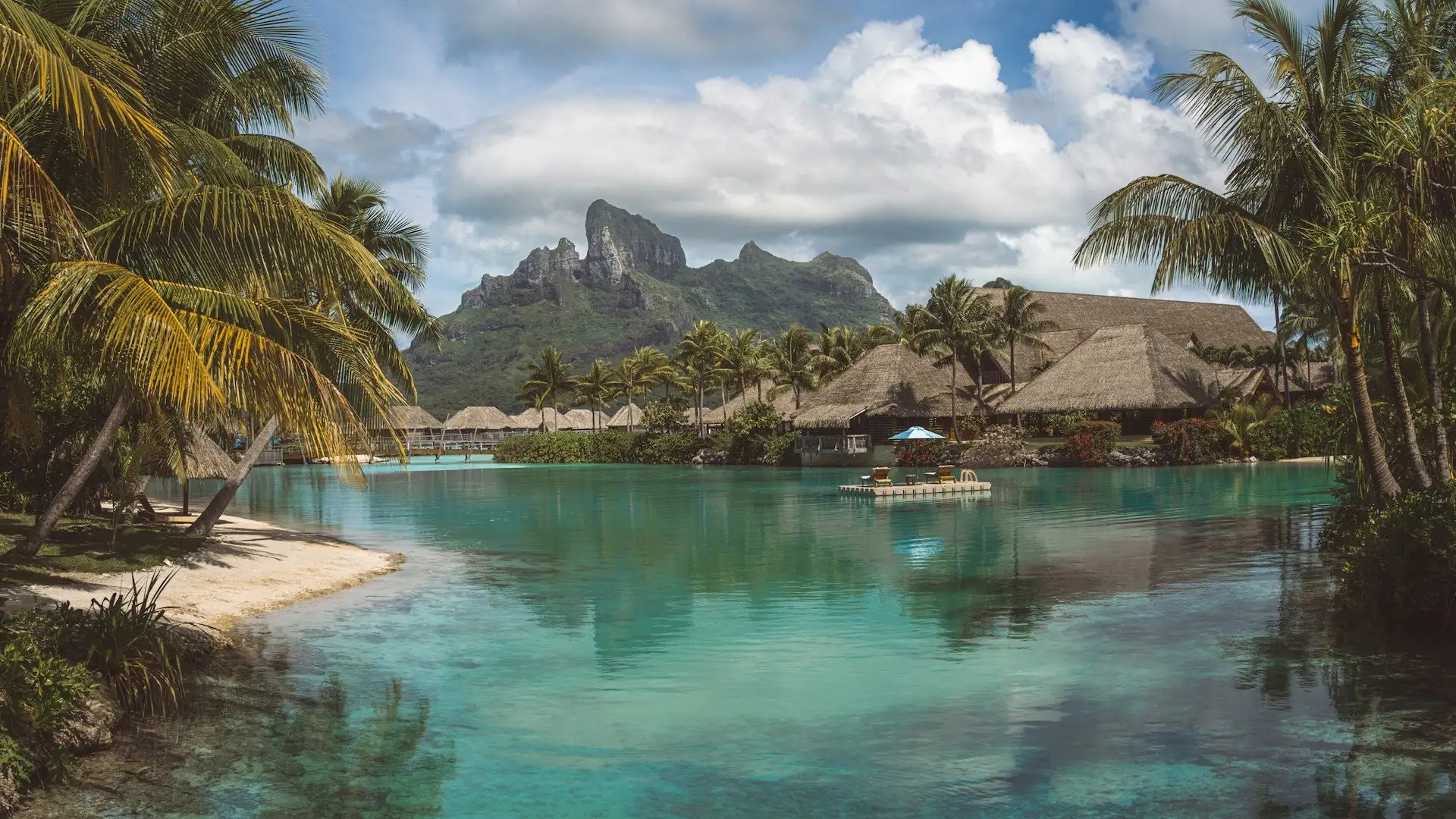
What you paid for is the lagoon. The Bora Bora lagoon specifically, seen at dawn from an overwater bungalow with the silhouette of Mount Otemanu behind it, is the most widely reproduced image of the South Pacific for a reason: it is genuinely that colour, genuinely that still, and genuinely that beautiful. The shade of turquoise over white coral sand inside the barrier reef has no equivalent in the Caribbean or the Indian Ocean. This is not marketing. It is a combination of depth, sediment, and light that only exists in the coral lagoons of French Polynesia's Society Islands at exactly this intensity. If you are going to spend the money on an overwater bungalow anywhere in the world, this is where the product was invented and where it is still best.
Beyond Bora Bora and the Society Islands — Moorea, Huahine, Raiatea, Taha'a — French Polynesia has destinations that most visitors never reach because the inter-island flights and the reputation of the main islands crowd them out. The Tuamotu atolls, particularly Fakarava and Rangiroa, have the finest drift diving in the Pacific: shark passes where dozens of grey reef sharks hold position against the incoming tide while divers fly through on the current. The Marquesas Islands, 1,400 kilometres northeast of Tahiti in the direction of nothing for another 4,000 kilometres, are among the most dramatic and most isolated inhabited islands on earth — volcanic cliffs, ancient tiki statues, and a Polynesian culture that retains depth because the distance from everything else preserved it. These are the parts of French Polynesia that reward visitors who plan beyond the obvious.
The political context is useful for understanding the place. French Polynesia is a French Collectivity — not an independent country but an autonomous territory of France. French citizens can live here without restriction. The CFP franc is pegged to the Euro. French law applies. The nuclear testing that France conducted at Mururoa and Fangataufa atolls in the Tuamotus between 1966 and 1996 — 193 tests in total, shifting from atmospheric to underground testing after the 1966–1974 period — is the defining historical grievance of the independence movement and the primary moral cloud over the Franco-Polynesian relationship. The testing is over but its effects on the people who were exposed during the atmospheric period are not.
French Polynesia at a Glance
A History Worth Knowing
The islands of French Polynesia were settled by the ancestral Polynesian people in one of the most remarkable navigational achievements in human history. The Polynesian settlement of the Pacific, which placed human communities on islands across an ocean area of 30 million square kilometres using only outrigger canoes and knowledge of stars, currents, waves, and birds, reached the Society Islands around 300–600 CE and the Marquesas Islands around the same period or slightly earlier. From the Marquesas, voyagers subsequently settled Hawaii to the north and Easter Island to the southeast, completing a migration triangle of extraordinary geographic ambition.
The Polynesian societies that developed across the archipelagos were hierarchical, with a system of chiefs and priests administering through the concept of mana — spiritual power and authority that resided in people, objects, and places and that governed social relationships across every dimension of life. The marae (heiau in some island groups) — ceremonial stone platforms where religious and social authority was asserted — were the physical expression of this system. Significant marae survive throughout the Society Islands; the Marae Taputapuatea on Raiatea is the most important in French Polynesia, the ceremonial centre from which the navigators who settled Hawaii, New Zealand, and Easter Island are believed to have departed, and it is a UNESCO World Heritage Site.
European contact began with the Spanish explorer Pedro Fernández de Quirós sighting the Marquesas in 1595 and Samuel Wallis reaching Tahiti in 1767. Louis Antoine de Bougainville arrived the following year in 1768 and named Tahiti "La Nouvelle Cythère" — the New Cythera, after the island in Greek mythology associated with Aphrodite — and returned to France with a report of extraordinary natural abundance and sexual openness that shaped the European imagination of the Pacific for a century. James Cook made three voyages to Tahiti (1769, 1773, 1777) and his accounts added scientific precision to the romantic mythology Bougainville had established. The European conception of the South Pacific as a paradise — a place of innocent pleasure outside history — was built almost entirely from these accounts of Tahiti and has never fully released its hold on either the marketing of the islands or the expectations of their visitors.
The Bounty mutiny occurred in Tahitian waters in April 1789, after William Bligh's crew had spent five months in Tahiti collecting breadfruit plants and a significant portion of them declined to leave. The mutineers who were not eventually captured and tried settled on Pitcairn Island with their Tahitian companions — Pitcairn is a British Overseas Territory today, located within French Polynesia's broad zone but not part of it. The tale fixed Tahiti in the Western imagination as a place where ordinary men abandoned duty for pleasure, which is a reading the islands' tourism industry has found useful ever since.
France formally established a protectorate over Tahiti in 1842 and annexed it in 1880. The Leeward Islands (Raiatea, Taha'a, Huahine, Bora Bora) were added in 1888. The Marquesas had been annexed in 1842. French control created the infrastructure of modern Polynesian life — the school system in French, the Catholic church alongside the pre-existing Protestant missions, the administrative capital at Papeete — while systematically dismantling the autonomous political structures of the traditional chiefs.
The nuclear testing period from 1966 to 1996 is the most politically charged episode of the French colonial relationship with Polynesia. France conducted 193 nuclear weapons tests at Mururoa and Fangataufa atolls in the southern Tuamotus — 46 atmospheric tests between 1966 and 1974, and 147 underground tests between 1975 and 1996. The atmospheric tests exposed Polynesian communities across a wide area to radioactive fallout. The French government has acknowledged health consequences in some workers at the test sites through a 2010 compensation law (the Morin Law), but the scope of eligibility has been repeatedly contested as too narrow. The independence movement, led by Oscar Temaru and his Tavini Huiraatira party, is based significantly on this history. French Polynesia votes in French presidential elections, receives significant financial transfers from the French state, and carries the unresolved tension of a colonialism that is ongoing in constitutional form and contested in political reality.
Paul Gauguin arrived in Tahiti in 1891 seeking the primitive paradise that Bougainville's account had planted in French artistic imagination. He found Tahiti already significantly colonised and moved progressively further from Papeete — first to the remote part of Tahiti, then to the Marquesas, where he lived until his death in Atuona on Hiva Oa in 1903. His paintings brought French Polynesia to global artistic attention and his personal history — the relationships with Tahitian women that produced most of his subjects — is the source of a contemporary reassessment that his paintings were produced from a position of colonial power and exploitation. The Musée Paul Gauguin in Tahiti and the Gauguin Cultural Centre and cemetery on Hiva Oa hold his legacy. Both are worth visiting; both merit the conversation about what that legacy actually represents.
The Society and Marquesas Islands are settled by the ancestral Polynesian navigators. From the Marquesas, further voyages reach Hawaii and Easter Island. The Marae Taputapuatea on Raiatea becomes the Pacific's most significant ceremonial centre.
Pedro Fernández de Quirós reaches the Marquesas. No sustained European contact follows for another 170 years.
Three voyages that construct the European idea of Tahiti as paradise. Bougainville names it La Nouvelle Cythère. Cook maps it with scientific precision. The mythology outlasts the science.
After five months collecting breadfruit in Tahitian waters, Fletcher Christian leads the mutiny against Bligh. The mutineers return to Tahiti and eventually to Pitcairn Island with their Tahitian companions.
France progressively annexes Tahiti, the Marquesas, and the Leeward Islands. The traditional chiefly system is dismantled. Papeete becomes the administrative capital.
Paul Gauguin arrives in Tahiti in 1891 seeking the primitive paradise. He moves progressively further from Papeete, dying on Hiva Oa in the Marquesas in 1903. His paintings make French Polynesia famous. His personal history makes that fame complicated.
193 nuclear tests at Mururoa and Fangataufa atolls. 46 atmospheric tests expose Polynesian communities to radioactive fallout. The testing is the foundation of the independence movement's grievance and the most significant unresolved issue in the Franco-Polynesian relationship.
French Polynesia gains expanded autonomy in 2004. Oscar Temaru's independence movement governs periodically but French Polynesia remains constitutionally part of France. The status question is unresolved and actively debated.
Top Destinations
French Polynesia's five archipelagos are radically different in character. The Society Islands (Tahiti, Moorea, Bora Bora, Huahine, Raiatea, Taha'a) are green volcanic peaks surrounded by turquoise lagoons and barrier reefs. The Tuamotu atolls are coral rings barely above sea level, with no interior mountains, their value in the extraordinary diving of their passes and lagoons. The Marquesas are mountainous, unrefined, dramatic, with no barrier reef and a culture that distance from everything else has kept more intact than any other island group in French Polynesia. The Gambier Islands in the far southeast and the Austral Islands to the south round out the archipelagos with destinations almost never visited by independent travellers.
Bora Bora
The most recognisable island in the Pacific. Mount Otemanu (727m) rises from the centre of the island — an extinct volcano whose peak is rarely cloudless and frequently wreathed in mist that the photographers wait for. The lagoon inside the barrier reef is the specific colour that every "tropical paradise" image attempts to replicate — a shallow-water turquoise over white coral sand that is produced by the exact combination of depth, sediment, and light available only here. The overwater bungalow, invented in French Polynesia in the 1960s, reaches its finest expression on Bora Bora's motu (coral islets) along the barrier reef — the view from a terrace at dawn across the lagoon to Otemanu is the product. It costs what it costs and is exactly what it advertises. Four Seasons, St Regis, Conrad, and InterContinental are the main luxury operators on the motu ring.
Fakarava, Tuamotu Atolls
Fakarava is a UNESCO Biosphere Reserve atoll in the Tuamotus with two passes where the Pacific tidal current runs through narrow coral gaps in the atoll ring. The South Pass (Tumakohua) during the winter grouper spawning season (June–July) aggregates several hundred grey reef sharks in a single dive — the fish come to feed on the spawning grouper, the sharks come to feed on the fish, and divers drift through on the current in the middle of it. Outside the spawning season the pass still has excellent shark and reef fish density. The North Pass (Garuae) is the widest atoll pass in French Polynesia and has reliable shark, ray, and napoleonfish populations year-round. Fakarava has no luxury hotels — it has simple guesthouses and dive lodges, which is part of what makes it remarkable.
Moorea
Tahiti's nearest neighbour — 17 kilometres across the water, 30 minutes by ferry — has the same volcanic green mountains and turquoise lagoon as Bora Bora, the same barrier reef, and the same overwater bungalow options at a significantly lower price point. The two deep bays on Moorea's north coast (Cook's Bay and Opunohu Bay) are the finest natural harbour views in the Society Islands. The interior — the Belvedere lookout giving the view over both bays and the pineapple fields below — is Moorea's best non-marine experience. The whale watching from August to October (humpback whales using Moorea's lagoon as a calving and mating ground) is among the best in the Pacific.
The Marquesas Islands
Nuku Hiva (the largest, administrative centre) and Hiva Oa (where Gauguin and Jacques Brel are buried) are the main islands. The Marquesas have no barrier reef — the ocean swell breaks directly on volcanic cliffs, waterfalls drop into the sea, and the landscape is more dramatic and more austere than anywhere else in French Polynesia. The tiki statues at Taiohae, Puamau (Hiva Oa), and the Taipivai valley (where Herman Melville jumped ship in 1842 and wrote his first novel, Typee, from the experience) are among the finest ancient Polynesian stonework remaining in the Pacific. The Aranui cargo cruise from Papeete to the Marquesas and back (bimonthly, 14 days) is the finest and most practical way to see the full archipelago.
Rangiroa, Tuamotu Atolls
The second-largest atoll in the world — a coral ring so large that Tahiti could fit inside it. The Tiputa and Avatoru passes provide the best dolphin encounters in French Polynesia: a resident pod of spinner dolphins rides the incoming morning tide through the Tiputa pass most days, and divers who time the current correctly are surrounded by them. The Blue Lagoon — a secondary lagoon inside the atoll, reached by a 30-minute boat trip through channels between coral islands — is a shallow paradise of mantas, sharks, and blinding clarity. Rangiroa is also the base for visiting the Fakarava group and has better inter-island connections than most Tuamotu atolls.
Huahine
Huahine is the Society Island that tourism forgot, in the best possible sense. The island retains most of its traditional character, has the largest concentration of intact marae (ceremonial platforms) in the Society Islands, and the vanilla cultivation in the interior produces the highest-quality vanilla in French Polynesia. The main town of Fare is a small village where cars stop to let ducks cross the road. The lagoon on the west coast is calm and snorkellable from the shore. Huahine is an hour's ferry ride from Raiatea and is almost always skipped by visitors who go directly to Bora Bora. This is a mistake. Huahine is the most genuinely Polynesian of the easily accessible Society Islands.
Raiatea & Taha'a
Raiatea and Taha'a share a single barrier reef and lagoon — an unusual geographical arrangement that makes them unique in French Polynesia and creates a sheltered inland sea between them. Raiatea holds the Marae Taputapuatea UNESCO World Heritage Site. Taha'a is the Vanilla Island — 80% of French Polynesia's vanilla production comes from this small island's interior plantations, and the scent of vanilla carried on the trade wind is a genuine sensory memory of the place. The sailing between Raiatea and Taha'a, inside the shared reef with both islands' green peaks above you, is the finest day's sailing in the Society Islands.
Papeete, Tahiti
Papeete is the port and capital — a working Pacific city that most visitors treat as a transit point to the other islands and underestimate. The Marché de Papeete (central market, open from 4am on Sundays for the freshest produce) sells tuna sashimi for 800 XPF, fresh tiare flowers, vanilla pods, monoi oil, and every local fruit from papaya to pamplemousse (the Tahitian grapefruit that is sweeter than any other variety). The roulottes (food trucks) along the Papeete waterfront open each evening and are the best and cheapest food in the territory. The Museum of Tahiti and Her Islands in Punaauia on the west coast of Tahiti provides the cultural and natural history context for everything else in French Polynesia.
Culture & Etiquette
French Polynesia operates between two cultural registers — the French colonial framework (the administrative language, the legal system, the school curriculum, the architecture of Papeete) and the Ma'ohi Polynesian identity that the French framework never fully displaced and that the independence movement seeks to assert as the primary political and cultural reality. For visitors, navigating this means understanding that French language competence is genuinely useful in a way it is not in most other Pacific destinations (English is widely spoken in tourist contexts but the outer island guesthouses often work primarily in French), and that the Tahitian cultural practices — the marae sites, the traditional dance, the tattooing tradition, the use of monoi oil — are not tourism products but living expressions of a culture that predates French presence by over a thousand years.
The Polynesian social culture is warm and generous but not effusive in the way that Fijian culture is — the Tahitian reserve is sometimes read as coldness by visitors accustomed to more demonstrative Pacific hospitality. It is not coldness. It is a different social register, and the warmth becomes available when you demonstrate genuine interest in the culture rather than treating the islands as scenery for your holiday photographs.
"Ia orana" (hello), "māuruuru" (thank you), "nana" (goodbye). French is more widely useful for practical purposes but Tahitian words deployed with genuine intention create immediate goodwill in communities where the language is under pressure from French. The effort reads as respect for what is being lost rather than convenience for what arrived with colonialism.
The marae (ceremonial stone platforms) at Maeva on Huahine, Marae Arahurahu near Papeete, and Marae Taputapuatea on Raiatea are sites of genuine significance. They are not ruins in the European sense — they are resting places of ancestral mana and are treated with appropriate seriousness by Polynesian people who visit them. Walk on them quietly, don't sit on the altar stones, and if a guided tour is available, take it.
The evening roulottes (food trucks) on the Papeete waterfront and in the main towns of the outer islands are the best and most honest food in French Polynesia. The tourist restaurants serve the same ingredients at three times the price. The cultural experience of eating poisson cru at a folding table next to a Tahitian family on a Tuesday evening is worth more than the same dish in a thatched-roof resort dining room.
The traditional Tahitian dance (ori Tahiti) is not the hula of Hawaii or the siva of Samoa. It is specific in its hip movement, its hand storytelling, and its musical accompaniment (the pahu drum and the nose flute). The Heiva Festival in July — the most significant cultural event in French Polynesia — includes competitions in traditional dance, outrigger canoe racing, and fruit-carrying that are the most authentic public expression of Ma'ohi culture available to visitors. If you are in French Polynesia in July, centre the Heiva.
The Aranui 5 cargo-passenger ship makes bimonthly voyages from Papeete to the Marquesas and back — 14 days, stopping at all the main islands, carrying both cargo for the island communities and passengers. The experience of arriving at Nuku Hiva or Hiva Oa by sea, watching the volcanic cliffs emerge from the ocean, is the correct way to experience islands that have no barrier reef and no tourist infrastructure designed to make arrival comfortable. The Aranui is not cheap but it is the most efficient and most immersive way to see the Marquesas.
Papeete has the central market, the Museum of Tahiti and Her Islands, the roulottes, the Arahoho Blowhole on the island circuit, the Point Venus lighthouse where Cook observed the transit of Venus in 1769 and the London Missionary Society landed in 1797, and the Faarumai Waterfalls. Tahiti also has the black sand beaches at Papenoo and the interior valleys that require a 4WD to reach. Spending one night in Papeete before catching the Bora Bora flight is the minimum standard approach to Tahiti. It deserves more.
Discussing the Mururoa tests with Polynesian people is not inappropriate — it is the most important political subject in the territory and Polynesian people have clear views on it that are worth hearing. The independence movement, the compensation law, the ongoing health monitoring, and the question of what France owes the people whose atolls were used as test sites are all active subjects. Engaging with this history is part of understanding where you are.
In Papeete and the main tourist islands, French and English both work. In the outer Tuamotu atolls and the Marquesas, French is the administrative language but Paumotu (Tuamotu language) or Marquesan are the home languages. Your pension host on Fakarava may have significantly better French than English but their primary cultural language is neither. A phrase of Tahitian in the outer islands goes further than fluent French.
French Polynesia's lagoons and reefs are the primary asset of the entire tourism economy and they are under pressure from warming ocean temperatures. Oxybenzone and octinoxate — the active UV-blocking chemicals in most standard sunscreens — are toxic to coral larvae and are now banned in several Polynesian islands. Use mineral-based (zinc oxide or titanium dioxide) reef-safe sunscreen for all water activities. The reef here is the reason you came. Help it survive your visit.
Bora Bora is the most recognisable island and the most expensive in a territory that is already extremely expensive. Moorea has 70% of the visual experience at 30–40% of the cost. Huahine has the most authentic Polynesian character. Fakarava has the best diving in the Pacific. Raiatea has the most significant archaeological site. Booking only Bora Bora means spending the most money for the most marketed experience and missing the places that justify the territory's existence as a travel destination beyond the photograph.
Heiva Festival
The Heiva i Tahiti is the most significant cultural festival in French Polynesia, held in July in Papeete at the To'ata amphitheatre. The festival encompasses traditional Tahitian dance competitions (groups from across the territory competing with months-rehearsed choreography telling traditional narratives), outrigger canoe races (va'a), stone-lifting competitions (carrying volcanic rocks), fruit-carrying races (carrying enormous loads of coconuts or fruits balanced on a shoulder pole), and archery in the traditional style. The Heiva was suppressed by the colonial administration in the 19th century as a sign of resistance to Christian mission influence, revived by the French in the 1950s as a controlled cultural expression, and has grown into the authentic assertion of Ma'ohi identity that its founders intended. If you are in French Polynesia in July, the Heiva is the cultural experience of the territory.
Tiare & Monoi
The tiare tahiti (Gardenia taitensis) — a small white flower with a scent that is the olfactory signature of French Polynesia — is the national flower and the basis of monoi oil, a combination of tiare flowers macerated in coconut oil that is used as a skin moisturiser, hair oil, and perfume throughout the islands. Monoi has been produced in French Polynesia for over 2,000 years and is now a registered geographic indication — only monoi made in French Polynesia from tiare tahiti and coconut oil can legally use the name. Wearing a tiare flower behind the left ear (taken) or the right (available) is a social signal understood throughout the islands. The Marché de Papeete sells fresh tiare garlands and monoi of every variation.
Polynesian Tattooing
The word "tattoo" comes from the Tahitian word tatau — the practice European sailors encountered here in the 18th century and brought back to Europe, where it spread globally. Traditional Polynesian tattooing is one of the most complex geometric art traditions in the world, with each pattern encoding social status, spiritual protection, genealogy, and personal history in its placement and design. The revival of traditional tattooing across Polynesia from the 1970s onward is one of the most significant cultural recoveries of the independence period — the practice had been suppressed by Christian missions and had largely died out in the early 20th century. Getting a traditional Polynesian tattoo from a trained practitioner in French Polynesia requires research to find someone doing genuine traditional work rather than tourist interpretations.
Polynesian Music & Himene
The himene (from the English word "hymn," adopted via mission contact) is the choral singing tradition of French Polynesia — unaccompanied four-part harmony that developed from Protestant mission hymns but has been entirely absorbed into Ma'ohi cultural expression. The Sunday church services at small Protestant temples on the outer islands produce himene singing of extraordinary quality — the congregation sings in full four-part harmony without accompaniment or conductor, having learned the parts from childhood. Arriving early for a Sunday service on Moorea, Huahine, or the Tuamotu atolls and sitting quietly at the back as a respectful guest is one of the most unexpected and genuinely moving experiences available in French Polynesia.
Food & Drink
French Polynesian food is a synthesis of Polynesian, French, and Chinese culinary traditions — the Chinese community that arrived as merchants and workers in the 19th century established the noodle and stir-fry dishes that are now as embedded in local food culture as the French baguette. The result is a cuisine that is distinctive and often excellent, though expensive in formal restaurant settings. The best food in French Polynesia is at the roulottes (food trucks) and in pension kitchens, not at resort restaurants. The pamplemousse (Tahitian grapefruit) served at breakfast on the outer islands — sweeter and less bitter than any mainland grapefruit, with a thin green skin — is one of the finest morning fruits available anywhere in the Pacific.
Poisson Cru
The national dish. Raw tuna cut into cubes, marinated in lime juice for 15–20 minutes until the acid firms the outer layer, then dressed with fresh coconut milk, chopped tomato, cucumber, spring onion, and salt. The balance of the acid-marinated tuna against the sweet richness of the coconut milk is the defining taste of French Polynesia. Available at the Papeete market tuna counter (pre-marinated, 800 XPF per container), at every roulotte, and at every pension meal. The tourist restaurant version at 3,000–4,000 XPF uses the same ingredients. The market version is better and costs one-fifth the price.
French Bread & Pamplemousse
The French boulangerie tradition arrived with colonisation and is now thoroughly Polynesian. Fresh baguettes and pastries delivered to the outer island pensions each morning by the supply boat or by motorbike from the village bakery are the standard breakfast. Eaten with pamplemousse — the Tahitian grapefruit, served halved with a small spoon and no sugar, because it needs none — and a cafe au lait, this is the correct breakfast in French Polynesia. The pamplemousse season peaks in August and September and the outer island version is significantly better than anything that reaches the Papeete market.
Chao Mein & Chinese-Polynesian Food
The Chinese-Polynesian food tradition produces chao mein (noodle stir-fries with shrimp, chicken, or vegetables), maa tinito (red beans with salt pork and vermicelli), and poe (a Polynesian banana or papaya pudding cooked in coconut cream and served with the Chinese sweet red bean paste influence). The chao mein from the Papeete roulottes at 1,000–1,200 XPF per plate is one of the most satisfying and most local meals available in the territory. The fusion of Pacific ingredients with Chinese technique produced something that is entirely Polynesian in character despite its dual heritage.
Marché Tuna
The Marché de Papeete sells yellowfin tuna caught the same morning, cut to order at the fish counter in the ground floor, for approximately 800–1,200 XPF per 200g serving — already sliced for sashimi or cut as fillets. The quality is extraordinary. Tahitian waters produce yellowfin tuna with a fat content and flavour profile that Japanese sushi restaurants pay premium prices to import. At the market, you pay the same price a local taxi driver pays. The market is open from 4am daily (5am most days); the best fish sells out before 8am.
Poe & Traditional Sweets
Poe is the traditional Polynesian dessert — a sticky, dense pudding made from banana, papaya, or breadfruit mixed with tapioca starch and coconut cream, baked in banana leaves. The texture is somewhere between a very dense jelly and a steamed pudding, the sweetness comes from the ripe fruit rather than added sugar, and the coconut cream gives it a richness that makes it satisfying in small portions. It is served at village feasts, at pension breakfasts, and at the Papeete market. The banana version is the most common. The papaya version is the most interesting.
Hinano Beer & Vanilla Rum
Hinano is the Tahitian lager — brewed in Papeete, available everywhere, drunk cold, priced at 400–600 XPF at a roulotte and 1,200–1,800 XPF at a resort bar. The label (a tiare flower and the silhouette of a Tahitian woman) is the most recognisable image in Tahitian street art and has been the same since the 1950s. The vanilla rum produced on Taha'a — locally distilled rum infused with vanilla pods from the island's plantations — is the distinctively local spirit of the territory and tastes nothing like vanilla extract. It is sweet but not cloying, fragrant but not artificial, and genuinely excellent on ice with coconut water.
When to Go
French Polynesia divides into a dry, cool season from May to October (the austral winter) and a warm, wet season from November to April. The dry season is the most comfortable for outdoor activities and the most popular for visitors. July is peak season — the Heiva Festival, the highest visitor numbers, and the most expensive accommodation. The wet season is hot and humid with some rain but is not the continuous rainfall that monsoon wet seasons produce elsewhere. The lagoon diving is good year-round; the Fakarava shark aggregation peaks in June and July during the grouper spawning season.
Dry Season
May – OctThe most comfortable conditions across all island groups — 22–28°C, lower humidity, consistent trade winds that cool the islands. The sea is at its clearest. The Heiva Festival in July is the cultural peak of the year. Moorea has humpback whale watching from August to October. Fakarava's shark aggregation peaks in June–July. Book accommodation 3–6 months ahead for July.
Shoulder Months
May, Sep–OctExcellent conditions with 10–20% lower accommodation prices than peak July–August. May has fresh conditions after the wet season. September and October are warm, clear, and the whale watching on Moorea is at its peak. The diving is excellent throughout the shoulder period.
Cyclone Season
Nov – AprFrench Polynesia is at the western edge of the South Pacific cyclone belt and receives fewer and less intense cyclones than Fiji or Vanuatu, but the risk exists — cyclone season runs November through April. The wet season brings higher humidity and intermittent heavy rain. Travel insurance with cyclone cancellation cover is essential if visiting during this period. Accommodation prices are 20–30% lower than peak season.
Trip Planning
Ten days is the minimum for a meaningful French Polynesia visit: Papeete transit, Moorea or Bora Bora for the Society Islands experience, and one Tuamotu atoll for diving. Two weeks allows the Society Islands properly plus two Tuamotu stops. Three weeks is the realistic minimum for including the Marquesas, which require either the 14-day Aranui cargo cruise (bimonthly departures from Papeete) or flying, which requires planning around Air Tahiti's twice-weekly service.
The Air Tahiti island pass is the single most important planning tool for multi-island French Polynesia travel. The Lagoon Pass ($531 USD) covers Tahiti, Moorea, Huahine, and Bora Bora. The Bora Bora & Tuamotu Pass ($588 USD) adds Rangiroa or Tikehau. The Discovery Pass ($797 USD) covers six destinations. Individual Air Tahiti flights are 50–100% more expensive than the pass rates. Buy the pass before arriving in French Polynesia from the Air Tahiti website.
Papeete & Tahiti
Arrive at Faa'a International Airport. Day one: the roulottes on the waterfront for dinner (poisson cru and chao mein), the Marché de Papeete the following morning (4am if you can manage it for the full market experience, 7am for the tourist-accessible version). Day two: the Tahiti circle road by hire car — Marae Arahurahu at PK 22, Point Venus at PK 10, the Arahoho Blowhole on the east coast, the Faarumai Waterfalls, the black sand beach at Papenoo, and the Taravao plateau viewpoint over the Tahiti Iti peninsula in the late afternoon.
Moorea
Ferry from Papeete to Moorea (30 min). Three days: the Belvedere viewpoint on day three (hire a scooter from the ferry dock, PK 0, and follow the signs up the interior road — 30 minutes to the top). Cook's Bay and Opunohu Bay by kayak on day four. The lagoon snorkel with rays and reef sharks on day five through a local guided tour. Moorea has an overwater bungalow option at the Hilton, Sofitel, and InterContinental at 40–60% of the equivalent Bora Bora price.
Fakarava, Tuamotus
Fly from Papeete or Moorea to Fakarava (Air Tahiti, 1 hour). Five days: two days diving the South Pass (arrange through the pension or dive operator on arrival — both passes have daily guided dive trips). The Blue Lagoon boat trip on day four — the secondary inner lagoon with manta rays and blinding shallow water. The final day: the village of Rotoava, the pearl farm visit, and the evening roulottes in the village. Return to Papeete and depart.
Papeete & Tahiti
Full Tahiti circuit including the Museum of Tahiti and Her Islands at Punaauia — the most important single institution for understanding the cultural and natural history of French Polynesia before visiting the other islands. Spend the second afternoon at the Musée Paul Gauguin in the Gauguin Cultural Centre at PK 51 on the south coast of Tahiti.
Moorea
Three days including a half-day whale watching (August–October only, book with Dr Michael Poole's dolphin and whale watching operation) and a full day at the interior valleys and pineapple fields. The Moorea Tropical Garden of the Moorea Distillery — pineapple and coconut liqueur tasting — is the best afternoon activity on the island for those not diving.
Bora Bora
Four days. The overwater bungalow experience — book the Four Seasons, St Regis, Conrad, or InterContinental. The first morning at dawn looking at Otemanu from the terrace is the experience. After that: the lagoon circuit by outrigger canoe on day seven, the snorkel with lemon sharks and mantas at the Anau village area on day eight, and Mount Pahia hike (guided, 3 hours, best panoramic view of the lagoon) on day nine.
Fakarava & Rangiroa
Fly Bora Bora to Rangiroa (Air Tahiti, 1.5 hours via Papeete). Two nights: the Tiputa pass for dolphins in the morning current on day ten, the Blue Lagoon boat trip on day eleven. Fly to Fakarava for two nights of South Pass diving. Return to Papeete for departure flight.
Papeete & Tahiti Deep
Three days: Museum of Tahiti, Gauguin Cultural Centre, the full Tahiti circuit, and the interior valley 4WD tour from Papenoo through the caldera to Teahupoo on the south coast (the venue for the 2024 Paris Olympics surfing — the most dangerous surf break in the world, accessible to spectators at the beach).
Moorea
Three days. Belvedere, whale watching (August–October), lagoon snorkel, the Opunohu archaeological site (marae in the forest above the bay), and an evening with the Sunday himene service at a village temple if timing works.
Huahine & Raiatea
Two days: Huahine for the Maeva archaeological complex (the largest concentration of marae in the Society Islands) and the genuine village pace of Fare. One day on Raiatea for the Marae Taputapuatea UNESCO site — the most important Polynesian archaeological site in the world, genuinely less visited than it should be. Optional: Taha'a vanilla plantation half-day tour by boat from Raiatea.
Bora Bora
Four days: the overwater bungalow sunrise, lagoon circuit, Anau snorkel, and Mount Pahia hike. The fourth day: a full-day sailing charter around the barrier reef motu — the view of Otemanu from the reef looking back is the second-finest view on the island, behind the view from the reef looking inward at the lagoon.
Tuamotu Diving
Five days split between Rangiroa (Tiputa pass dolphins, Blue Lagoon) and Fakarava (South Pass sharks, North Pass reef diving). The most diving-intensive section of the itinerary. Stay at the dive pensions on each island — the meals are included and the dive briefings happen at the dinner table.
Marquesas Sample
Fly from Fakarava to Nuku Hiva (2+ hours via Papeete, Air Tahiti). Three days: Taiohae Bay, the tiki statues at Hikokua and the Toovii plateau above the valley, the Taipivai valley where Melville hid among the Typee in 1842. The 21-day itinerary can only sample the Marquesas — the full archipelago requires the Aranui or a dedicated trip. But Nuku Hiva alone justifies the flight.
Air Tahiti Pass
The Air Tahiti island pass is essential for multi-island travel. The Lagoon Pass ($531 USD) covers Tahiti, Moorea, Huahine, and Bora Bora. The Bora Bora and Tuamotu Pass ($588 USD) adds one Tuamotu island. The Discovery Pass ($797 USD) covers six destinations. Buy before arriving from airtahiti.com. Individual fare prices are 50–100% higher than pass rates.
Currency
CFP Franc (XPF), pegged to the Euro at 119.33 XPF per Euro. Approximately 120 XPF per USD. ATMs at Papeete airport, in Papeete town, and in the main towns of the major islands. No ATMs on most Tuamotu atolls or in the remote Marquesas — withdraw sufficient XPF in Papeete before any outer island travel. Resorts accept credit cards; pensions and roulottes are cash-only.
Reef-Safe Sunscreen
Oxybenzone and octinoxate are banned in several Polynesian islands and are harmful to coral everywhere in French Polynesia's lagoons. Use mineral-based (zinc oxide or titanium dioxide) reef-safe sunscreen only. The reef is the reason you came. Standard chemical sunscreens are not banned at territorial level yet but their use on the reef is genuinely damaging. Pack reef-safe from home; the options available locally are limited and expensive.
Connectivity
Vini (Te mana o te fenua) is the main operator. Good coverage in Papeete and on the main Society Islands. Limited to no coverage on the outer Tuamotu atolls and in the Marquesas valleys. Download offline maps and any needed information before leaving Papeete for any outer island. The pension guesthouses on the Tuamotu atolls often have WiFi but it is slow and unreliable.
Get a French Polynesia eSIM →Health
No mandatory vaccinations. Recommended: Hepatitis A, Typhoid, and routine vaccines. Dengue fever is present — mosquito protection advisable. Ciguatera fish poisoning (from reef fish that have consumed toxic algae) occurs in French Polynesia — reef fish from specific areas carry risk; ask locally before eating large reef fish species including barracuda, grouper, and snapper in the outer islands. The symptoms of ciguatera are neurological and can be severe.
Full health info →Travel Insurance
Essential with medical evacuation cover. The main hospital is the Taaone Hospital in Papeete. Outer islands have basic infirmaries only. Medical evacuation from the Marquesas to Papeete is a serious logistical undertaking. Diving insurance (DAN) is strongly recommended for any diving activity — the nearest recompression chamber is in Papeete at the Taaone Hospital.
Transport in French Polynesia
Inter-island transport in French Polynesia is primarily by Air Tahiti (the domestic carrier, not to be confused with the international Air Tahiti Nui) and by inter-island ferry for the Society Islands. The Marquesas require Air Tahiti or the bimonthly Aranui cargo ship. Most Tuamotu atolls require Air Tahiti. Within each island, car hire, scooter hire, or bicycle is the standard option — public transport within islands is minimal outside Tahiti.
International Arrivals
Faa'a Airport (PPT), PapeetePapeete's Faa'a International Airport receives Air Tahiti Nui (direct from Paris, Los Angeles, Auckland, Tokyo), Air France (from Paris), United (from Los Angeles), Air New Zealand (from Auckland), and other regional carriers. The airport is 5km from downtown Papeete. Most flights arrive at night or in the early morning — plan transit accommodation in Papeete for the first night if your onward island flight departs the following day.
Air Tahiti (Domestic)
Pass: $530–800 USDAir Tahiti operates ATR-42 and ATR-72 turboprop aircraft to 48 destinations across French Polynesia. The island passes (Lagoon, Bora Bora and Tuamotu, Discovery) are the essential budget tool. Individual flights: Papeete–Moorea $80 USD, Papeete–Bora Bora $150 USD, Papeete–Fakarava $180 USD, Papeete–Nuku Hiva (Marquesas) $400+ USD. The planes are small and baggage limits are enforced strictly — soft-sided luggage only for most aircraft; 23kg total per person.
Ferry (Society Islands)
300–1,200 XPF per sectorThe Papeete–Moorea ferry runs multiple times daily (30 minutes, 900 XPF). The Vaeara'i ferry connects Papeete to Huahine, Raiatea, Taha'a, and Bora Bora (overnight, 10–16 hours depending on destination). The slow ferry is a genuine experience — the Society Islands passage at night, arriving at a leeward island at dawn with the mountains appearing above the reef — and is significantly cheaper than flying. Berth cabins available.
Aranui Cargo Cruise
$3,000–8,000 USD for 14 daysThe Aranui 5 is a combined cargo and passenger vessel that makes bimonthly voyages from Papeete to the Marquesas — 14 days stopping at Tahuata, Fatu Hiva, Hiva Oa, Ua Pou, Nuku Hiva, Ua Huka, and back. The cargo deliveries at each island give you 4–6 hours ashore while the crew unloads supplies for the community. The passenger cabins range from basic to comfortable. The meals are excellent. The experience of arriving at Fatu Hiva by tender through the sea swells, watching the waterfall-fringed bay of Hanavave resolve into detail, is one of the finest maritime arrivals in the Pacific.
Scooter & Bicycle Hire
$30–60 USD/dayThe standard transport within each island. Moorea, Huahine, Raiatea, and the Marquesas islands are best explored by scooter — the roads are paved and the scale is right for a day's circuit. Bora Bora's main island is small enough for a bicycle. The motu (reef islets) of Bora Bora require the hotel boat transfer. Drive on the right in French Polynesia.
Car Hire
$80–120 USD/dayAvailable on Tahiti, Moorea, and Raiatea. Necessary for the full Tahiti circle road and the Tahiti interior 4WD tour. Drive on the right. International driving licence required alongside home licence. The roads are generally good on the main islands and challenging on the outer islands and Marquesas. Fuel is expensive — approximately 200 XPF per litre ($1.70 USD), which is high even by French metropolitan standards.
Accommodation
French Polynesia's accommodation ranges from the Four Seasons Bora Bora (the finest overwater bungalow experience in the world by most measures, at prices that reflect it) to the family pensions of the Tuamotu atolls and Marquesas islands that include three meals and a diver's welcome at $150–200 USD per night. The middle ground — the boutique hotels and smaller resorts on Moorea, Huahine, and the outer Society Islands — provides genuine overwater bungalow and garden bungalow experiences at 40–60% of the Bora Bora price for an equivalent product.
Bora Bora Overwater Bungalow
$800–4,000+/nightThe Four Seasons Bora Bora (the finest overwater bungalow infrastructure available), the St Regis, the Conrad, and the InterContinental are the main luxury operators on the motu ring around the Bora Bora lagoon. Each has private decks over the water, direct lagoon access, and the Otemanu view. Book 3–6 months ahead. The minimum meaningful stay is 3 nights — anything less and the journey-time-to-experience ratio is unfavourable.
Moorea Overwater Bungalow
$350–900/nightThe Hilton Moorea, Sofitel Moorea, and InterContinental Moorea all have overwater bungalow options at 40–60% of equivalent Bora Bora pricing, with similar lagoon quality (Moorea's lagoon is excellent) and the Cook's Bay and Opunohu Bay mountain views that Bora Bora's flatter interior cannot match. The logical alternative to Bora Bora for visitors who want the overwater experience without the premium price.
Pension (Family Guesthouse)
$120–220 USD/night (meals inc.)The outer island pensions — family-run guesthouses on Huahine, Raiatea, Fakarava, Rangiroa, and throughout the Marquesas — are the budget accommodation of French Polynesia. Meals are typically included (breakfast and dinner), the rooms are clean and basic, and the owner usually provides the most useful local knowledge available anywhere on the island. The Fakarava dive pensions are particularly good — the meals are excellent, the dive operations are attached, and the island immersion is total.
Marquesas Lodge
$150–350 USD/nightThe Marquesas islands have a small number of simple hotels and pensions in the main towns (Taiohae on Nuku Hiva, Atuona on Hiva Oa). The Nuku Hiva Village on Taiohae Bay has the finest view available in the Marquesas from land — the bay, the volcanic cliffs, and the ocean all visible simultaneously. The pensions in the smaller Marquesan villages are genuinely basic but the immersion in Marquesan community life is complete.
Budget Planning
French Polynesia has a structural high cost that no strategy fully eliminates. Everything imported — which is nearly everything — arrives on ships or planes from France, the US, or New Zealand with the transport and import duty costs reflected in the retail price. A litre of milk costs 400 XPF ($3.30 USD). A standard baguette costs 100–120 XPF. A Hinano beer at a roulotte costs 500 XPF. These are the prices Polynesian people pay and they are expensive relative to their income levels. Visitors from higher-income countries find the cost manageable with planning; visitors expecting Southeast Asia prices will be consistently surprised in an unpleasant direction.
- Pension (meals included)
- Roulottes and market for food
- Air Tahiti pass for transport
- Free snorkelling and beaches
- Hinano beer at 500 XPF
- Moorea or Huahine overwater bungalow
- Mix of roulottes and restaurant dinners
- Guided lagoon snorkel and dive
- Whale watching or shark dive
- Vanilla plantation tour on Taha'a
- Four Seasons or St Regis overwater villa
- Resort dining and private excursions
- Private lagoon charter
- Helicopter island tour
- Sunset champagne on the terrace
Quick Reference Prices (XPF)
Visa & Entry
French Polynesia is a French Collectivity and follows French entry rules. EU citizens enter without a visa and can stay indefinitely as French territory. US, Canadian, Australian, New Zealand, Japanese, and most other Western nationals enter without a visa for up to 90 days. The entry rules are the same as for metropolitan France. No tourist card or arrival fee is charged.
French Polynesia follows French visa rules. EU citizens: unlimited stay. US, Canada, Australia, NZ, Japan, and most Western nationals: 90 days visa-free. Return or onward ticket required.
Family Travel & Pets
French Polynesia is an excellent family destination with the right planning. The calm lagoons of Moorea and Bora Bora are ideal for children who can swim. The whale watching on Moorea is accessible to children from age 8 or so — humpback whale calves are born in the Moorea lagoon and swim at the surface where snorkellers and boat-based viewers can see them. The cultural elements — the Heiva Festival performances, the vanilla plantation tours, the outrigger canoe rides — are engaging for children across a wide age range. The main limitation is the price: a family of four at a Bora Bora resort for a week costs more than most family travel budgets in a single line item, and Moorea becomes the obvious alternative.
Humpback Whale Watching (Moorea)
Between August and October, humpback whales use the Moorea lagoon as a calving and mating ground. Mother and calf pairs swim at the surface in calm lagoon water, and the boat-based and snorkel-based whale watching operations on Moorea are the most productive family marine encounter in French Polynesia. Children who have never seen a whale calf at close range from a small boat react with the specific astonishment that cannot be produced any other way. Operator Dr Michael Poole has run responsible whale watching here for decades.
Lagoon Snorkelling
The lagoons at Moorea and Bora Bora have calm, clear, shallow water with coral gardens at 1–3 metres accessible from the beach or by short boat trip. Blacktip reef sharks (very common in the lagoon, harmless, visually dramatic), green sea turtles, and enormous schools of reef fish make the lagoon snorkel the most productive family marine activity in the territory. Most resorts provide snorkel equipment; guided family snorkel tours operate daily from most properties.
Vanilla Plantation (Taha'a)
The day trip from Raiatea to Taha'a's vanilla plantations (30 minutes by boat) follows the vanilla pod from the hand-pollinated flower on the vine to the cured pod sold globally. Children who have only encountered vanilla as an extract or a powder have a specific reaction to the scent of a curing vanilla pod in the plantation shed. The tour includes a tasting of vanilla-infused products (coconut oil, juice, pastries) and is 2–3 hours total. It is one of the most educationally productive half-days in the Society Islands.
Outrigger Canoe (Va'a)
Outrigger canoe (va'a) is the traditional Polynesian vessel — the technology that navigated the Pacific and settled every island in French Polynesia. Guided outrigger canoe trips on the lagoons of Moorea and Bora Bora are available for families, usually 2–3 hours including a snorkel stop. Children old enough to paddle (generally 6+) can participate actively. The specific experience of crossing a turquoise lagoon in a traditional Polynesian vessel produces a memory that the resort pool does not.
Heiva Festival (July)
If visiting in July, the Heiva Festival in Papeete at the To'ata amphitheatre is one of the finest family cultural experiences in the Pacific. The traditional dance competitions, the fruit-carrying races (enormous loads balanced on a shoulder pole at running speed), and the outrigger canoe races are immediately comprehensible and genuinely spectacular without any prior cultural knowledge. The evening dance performances particularly engage children across a wide age range.
Nemo & the Reef
French Polynesia's lagoons have abundant clownfish (Amphiprion species) living in sea anemones at snorkel depth — the specific Pixar-accurate identification opportunity that children have been waiting for since the film. The lagoon around Moorea's inner reef edge is particularly productive for anemonefish, and the combination of clownfish, sea turtles, and blacktip reef sharks in the same snorkel session represents the Pacific lagoon in its most immediately engaging form for children familiar with any ocean wildlife at all.
Traveling with Pets
French Polynesia applies French biosecurity rules for pet imports, which are stricter than mainland French rules due to the island territory's disease-free status for several conditions. Dogs and cats require a European health certificate (or equivalent), current rabies vaccination, and a microchip. Pets from non-EU countries require additional documentation including a rabies antibody titre test. All animals are subject to inspection on arrival. Some categories of pets from non-EU countries may face a quarantine period.
In practical terms, the inter-island transport by Air Tahiti has strict live animal policies, and many pensions and outer island properties do not accept pets. French Polynesia is not a pet-friendly tourism destination. Leave pets at home.
Safety
French Polynesia is a safe destination. Violent crime against tourists is extremely rare. Petty theft occurs in Papeete, particularly around the market and ferry terminal areas. The main risks are natural — the ocean, the sun, and the specific hazards of atolls and remote islands. The French emergency services infrastructure means that response to serious incidents is significantly better than in comparable Pacific island nations.
Resort & Island Areas
The Bora Bora motu resorts, the Moorea resorts, and the outer island pensions are all very safe. Crime on the outer islands against tourists is essentially unheard of. Resort security is standard for the price point. The Society Islands generally have the same safety profile as comparable French overseas territories.
Papeete Market Area
The Marché de Papeete, particularly the early morning market, and the ferry terminal area have the highest incidence of opportunistic theft in French Polynesia. Keep bags close, don't display expensive cameras and phones visibly in crowded areas, and be aware of your surroundings after dark near the waterfront.
Ocean & Reef Hazards
Atoll pass currents are strong and directional — the drift diving that makes Fakarava famous also means that swimming against the current in a pass is dangerous. Never enter a pass without a guide during an active tidal flow. Stonefish on reef flats (wear reef shoes when walking on coral). Fire coral and sea urchins at snorkel depth. Ciguatera fish poisoning from large reef fish species in some areas — ask locally.
Cyclone Risk
French Polynesia sits at the western edge of the South Pacific cyclone belt and receives fewer direct cyclone impacts than Fiji or Vanuatu. Cyclone season runs November through April. The Tuamotu atolls are at greater risk from cyclone surge than the higher volcanic islands. Monitor the Météo-France French Polynesia service (meteofrance.pf) for current conditions during cyclone season.
Sun
French Polynesia sits between 8°S and 27°S — UV indices are very high, particularly in the dry season between May and October when the humidity is low and the UV feels less intense than it is. Use reef-safe SPF 50+ sunscreen (mineral-based, not chemical, to protect the lagoon coral), reapply every 90 minutes on water, and wear rash guards for extended snorkelling and surface activities.
Remote Island Preparedness
The outer Tuamotu atolls and the Marquesas are remote by any standard — the nearest serious medical facility is a Papeete hospital reached by Air Tahiti medevac flight. Travel insurance with medical evacuation cover is essential. Carry any required medication in sufficient quantity for the full trip plus 5 extra days. The pension hosts and village health posts have basic first aid but no surgical or specialist capability.
Emergency Information
Your Embassy
French Polynesia is a French territory — your home country's embassy in France in Paris handles consular matters. For urgent consular assistance in French Polynesia, contact the consulates based in Papeete where present, or the French High Commissioner's office (+689 40 46 86 00) for emergency direction to your nearest consular representation.
Book Your French Polynesia Trip
Everything in one place. Buy the Air Tahiti pass first. Pack reef-safe sunscreen. Go to the roulottes.
What the Lagoon Actually Is
Bougainville called it La Nouvelle Cythère — the New Cythera, the island of Aphrodite — and the name he chose reveals everything about the European project in French Polynesia. He arrived from a Europe that had run out of innocence and wanted to find it elsewhere. He looked at the Society Islands and saw what he needed to see: abundance, beauty, and people apparently unburdened by the history that was crushing Europe. He was wrong in his interpretation and entirely correct in his observation. The place was extraordinary. It still is. The reading of it as paradise — as the outside of history, as the place where the European exhaustion could be repaired by proximity to the original — was the projection, not the reality. The Polynesian people he encountered had their own history, their own social complexity, their own wars and famines and political hierarchies. They were not innocent. They were Polynesian.
The lagoon at Bora Bora at dawn is that colour. The tiare flower does smell like that. The himene singing in a small Protestant temple on a Tuamotu atoll, four-part harmony without accompaniment or conductor, carries a beauty that has nothing to do with whether you are a Christian or have any interest in religion. The Fakarava shark pass in June, with the groupers spawning in the channel and the grey reef sharks holding position against the current, is one of the most extraordinary things available to a person who is willing to put on a wetsuit and a tank and go into the water. The Marquesas cliffs dropping into the Pacific with no barrier reef between them and the open ocean have a grandeur that is not performed for visitors because there are almost no visitors and the cliffs don't care either way.
Go with honest expectations. The paradise is real and it is complicated and it is expensive and it is worth it, in the specific way that places worth it always are: not because they deliver what you imagined before you arrived, but because they give you something you couldn't have imagined, which is better.