

What You're Actually Getting Into
El Salvador is the smallest country in Central America and, for most of the last three decades, the one nobody put on an itinerary. A brutal civil war from 1980 to 1992 gave way to a gang crisis that made it one of the most violent countries on earth by the 2010s, with a murder rate that peaked above 100 per 100,000 people in some years. Then, starting in 2022, a mass-arrest crackdown on the MS-13 and Barrio 18 gangs changed the country's daily reality faster than almost any security transformation in modern history: the murder rate fell to roughly 2.4 per 100,000 by 2025, and the US State Department downgraded its travel advisory to Level 1, "exercise normal precautions," the same tier as Switzerland.
What that turnaround uncovered is a country that was quietly excellent to visit the whole time. The Pacific coast around El Tunco has been a serious surfer's secret for decades. The Ruta de las Flores through the western highlands delivers the coffee-country scenery Guatemala is famous for, minus the crowds. Santa Ana, the country's tallest volcano, has a turquoise crater lake at the summit that rivals anything in the region. And El Salvador is dollarized and genuinely cheap, which is not a combination most countries manage.
The honest complications
The security transformation came at a real cost that any honest guide has to name: the state of exception that made it possible suspended constitutional protections including due process and the right to legal counsel, and international human rights groups have documented mass arbitrary detention, deaths in custody and abuse in Salvadoran prisons among the roughly 1-2% of the adult population arrested since 2022. None of this changes the practical fact that El Salvador is safe for visitors right now, but it is the backdrop the low crime numbers sit on, and it's worth understanding rather than ignoring. Separately, heavy militarized policing means visible checkpoints and a request to show ID is a normal, not alarming, occurrence. Tourist infrastructure is also younger and thinner than in Guatemala or Costa Rica: English is less common outside San Salvador and the surf towns, and some rural roads and bus connections take patience.
A History Worth Knowing
El Salvador's story runs from the Pipil kingdom of Cuzcatlán through Spanish conquest, a colonial economy built on indigo and coffee, a brutal 1932 massacre of indigenous peasants, a twelve-year civil war, and a postwar gang crisis rooted in 1990s deportations from Los Angeles. The short version of how the country you're visiting got here, and why its recent history matters more to understand than most.
- Pre-1524
Cuzcatlán. The Pipil people, migrants from central Mexico, build the kingdom of Cuzcatlán across what is now central and western El Salvador.
- 1524-1539
Spanish conquest. Fifteen years of war subdue the Pipil. Smallpox, brought by the Spanish, cuts the indigenous population from roughly 500,000 to 75,000 within decades.
- 1821
Independence. El Salvador declares independence from Spain alongside the other Central American provinces; a landholding elite continues to run an economy built on indigo, then coffee.
- 1932
La Matanza. An indigenous and peasant uprising led by Farabundo Martí is crushed by the military government; as many as 30,000 people are killed in the reprisals.
- 1980-1992
Civil War. Government forces and the FMLN guerrilla movement fight a war that kills an estimated 75,000 people before the 1992 Chapultepec Peace Accords end it.
- 2019-present
The Bukele era. President Nayib Bukele's 2022 state of exception crackdown on MS-13 and Barrio 18 drives the murder rate from 53 to about 2.4 per 100,000, transforming the country's safety reputation.
Read the full history: Cuzcatlán, La Matanza, the civil war and the gang era
The Pipil built Cuzcatlán, a kingdom whose name (roughly "land of precious jewels") is echoed today in the colón, El Salvador's former currency, and in place names across the country. Spanish conquest between 1524 and 1539 was slower and bloodier here than in much of the region; smallpox did more damage to the indigenous population than the fighting itself. The colonial and early independence economy ran on indigo, then coffee, grown on land concentrated in a small number of families, a structural inequality that shaped every conflict that followed.
In January 1932, an uprising of indigenous peasants and labor organizers, led by the communist organizer Farabundo Martí, broke out against the military government of General Maximiliano Hernández Martínez. The military's response, La Matanza ("the massacre"), killed as many as 30,000 people, overwhelmingly indigenous Salvadorans, and effectively erased public indigenous identity in the western highlands for generations.
The 1980-1992 civil war pitted the US-backed military government against the FMLN (Farabundo Martí National Liberation Front) guerrilla coalition, named for the 1932 leader. Roughly 75,000 people were killed, including civilian massacres such as El Mozote, and the war ended in a negotiated settlement, the 1992 Chapultepec Peace Accords, that demobilized the FMLN into a political party, which later governed the country twice.
Why the gangs formed in Los Angeles, not El Salvador. Hundreds of thousands of Salvadorans fled the civil war to the United States, many settling in Los Angeles, where some young Salvadoran men formed or joined street gangs, including what became MS-13, partly for protection from existing Mexican-American and Black gangs. US deportation policy in the 1990s sent thousands of gang-affiliated men back to a postwar El Salvador with almost no capacity to reintegrate them, and MS-13 and Barrio 18 took root domestically, eventually extorting businesses and effectively controlling entire neighborhoods.
The 2022 state of exception. After a single weekend of 87 gang-linked killings in March 2022, President Bukele's government declared a state of exception, suspending due process and the right to legal counsel, and began mass arrests of anyone suspected of gang affiliation. More than 1% of the adult population has been detained since. The security results are real and well documented; so are credible reports of wrongful detention and prison conditions from Human Rights Watch and other monitors. Both things are true at once, and it's the honest context for the country's current calm.
Top Destinations
El Salvador is small enough that nothing is more than a few hours from the capital: the surf coast, the western highlands and Santa Ana volcano, and Suchitoto to the north are all workable as day trips from San Salvador, though each rewards an overnight more. A week covers the highlights; ten days lets you slow down.
San Salvador, the capital
San Salvador is where most trips start and a reasonable place to base yourself for day trips across the small country. The Centro Histórico holds the Metropolitan Cathedral and National Palace on Plaza Barrios; Zona Rosa and Colonia Escalón, the safer, walkable west-side neighborhoods, hold the best restaurants, hotels and nightlife. El Boquerón, the crater atop San Salvador volcano, and the Puerta del Diablo viewpoint near Panchimalco are both easy half-day trips from the center. Full details, including where to stay and eat, are in the complete San Salvador city guide.
Juayúa, Ataco & the coffee towns
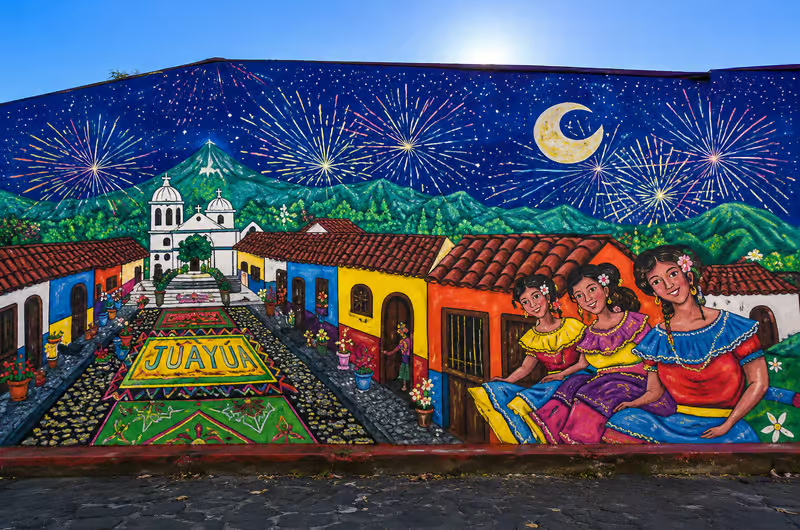
The Ruta de las Flores runs through the Apaneca-Ilamatepec mountain range in western El Salvador, linking Juayúa, Concepción de Ataco, Apaneca, Salcoatitán and Nahuizalco. Juayúa hosts a weekend food festival (feria gastronómica) around its central square that draws visitors from the capital for grilled meats, seafood and local specialties. Ataco is the most photogenic stop, its streets covered in murals depicting rural Salvadoran life, with small galleries and roadside coffee stands. The whole route sits at altitude, cool enough that you'll want a light jacket in the evenings, unusual for a country this close to the equator.
El Tunco, El Zonte & La Libertad
El Salvador's Pacific coast, about 45 minutes from San Salvador, has some of the most consistent surf in Central America. El Tunco, a black-sand beach town built almost entirely around surfing, is the liveliest base: hostels, beach bars and board rentals cluster along a short walkable strip, with a party atmosphere most nights. Punta Roca, a world-class right-hand point break, is a few kilometers east in La Libertad town itself. El Zonte, 20 minutes west of El Tunco, is quieter and better known these days as "Bitcoin Beach," the town where a 2019 grassroots Bitcoin circular economy experiment predated the country's national Bitcoin law by two years; some shops there still accept it happily even though it's no longer required anywhere.
Suchitoto, the colonial town on the lake
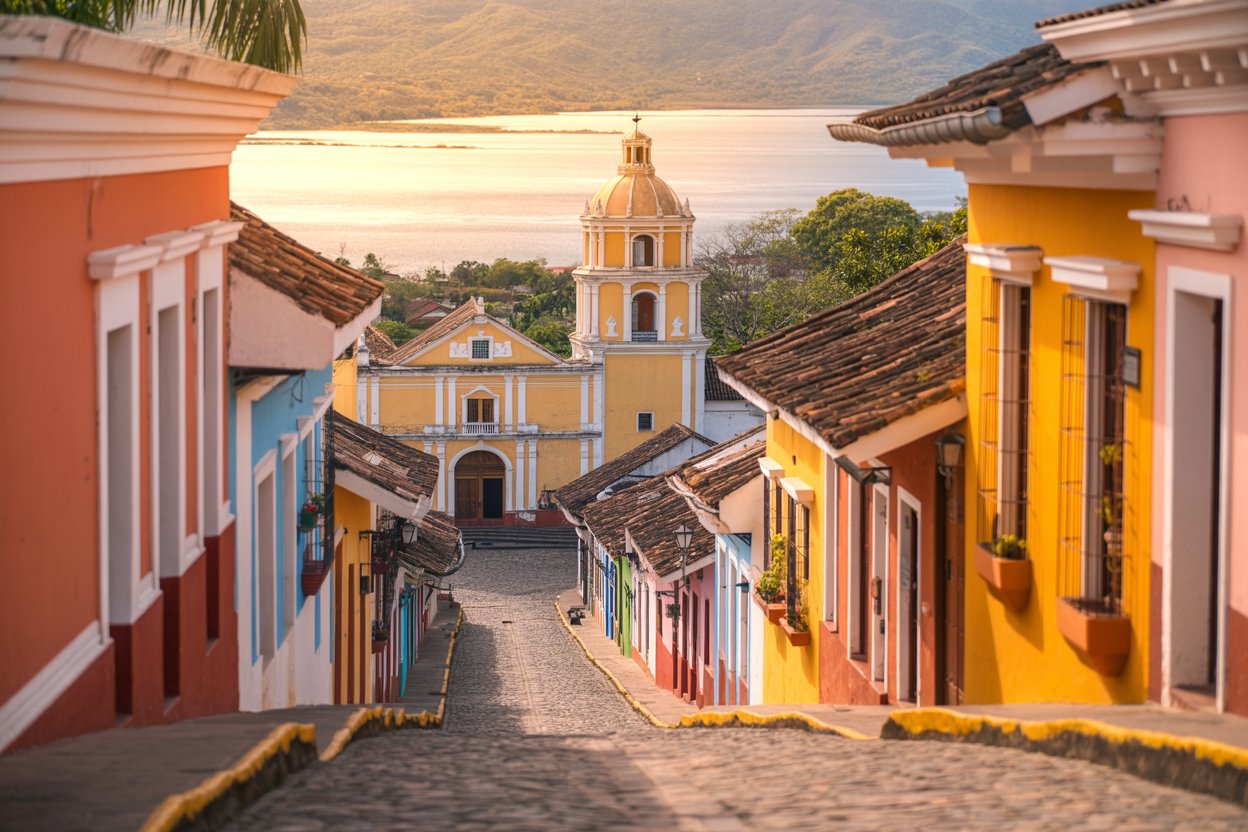
Suchitoto, about an hour north of San Salvador, is widely considered El Salvador's best-preserved colonial town: cobblestone streets, whitewashed walls, red-tile roofs and a hilltop church, Iglesia Santa Lucía, looking out over Lake Suchitlán. Boats from the town's dock or from the Centro Turístico Puerto San Juan run out to Isla de los Pájaros for birdwatching and past small lakeshore communities, typically 1 to 2 hours for $10-20 a person. The surrounding hills still practice traditional indigo dyeing, and workshops let visitors dye their own scarf. It's quiet enough that a weekday visit can feel like having the town to yourself.
Santa Ana Volcano & Lake Coatepeque
Santa Ana (also called Ilamatepec) is El Salvador's tallest volcano at 2,381 meters, and its most rewarding hike: a moderate two-hour ascent through forest and volcanic terrain to a rim overlooking a startling turquoise, sulfur-tinted crater lake, with Lake Coatepeque visible below on clear days. A local guide is mandatory in the national park; guided tours run from about $80 including transport, or budget travelers can take a shared van from Santa Ana town (around $21) and pay the trailhead guide fee separately. Lake Coatepeque itself, a volcanic crater lake near the base, is a popular weekend swimming spot for Salvadorans with lakeside restaurants on the water.
Joya de Cerén, the Pompeii of the Americas
El Salvador's only UNESCO World Heritage Site, Joya de Cerén preserves a Maya farming village buried, and perfectly preserved, under five meters of volcanic ash around 600 CE. Unlike most Maya sites, this was where ordinary people lived and worked, not a ceremonial center, and the preserved houses, sweat baths and kitchen gardens give an unusually intimate view of daily Maya life. Entry costs $10 plus $1 for parking, a guide is included and mandatory, and the site closes Mondays.
Hidden gems beyond the main circuit
The zones above cover a first trip well. With extra days or a second visit, these are the spots that rarely make the standard itinerary.
Tazumal
A Maya archaeological site in Chalchuapa with a 23-meter stepped pyramid, occupied from the Classic period into the post-Classic era with trade links as far as central Mexico. Far less visited than Joya de Cerén and easy to combine with Santa Ana volcano in one day.
Alegría & Laguna de Alegría
A hillside flower-growing town with a small volcanic crater lake tinted turquoise by sulfur content, ringed by hiking trails and viewpoint cafés. Cooler and quieter than the Ruta de las Flores towns, with a fraction of the visitors.
Perquín & the Museum of the Revolution
A mountain town in the department hit hardest by the civil war, with a museum built and run by former FMLN combatants covering the conflict's origins and course. A sobering, essential counterweight to the coast-and-coffee version of the country.
La Palma
The birthplace of Salvadoran naive art: painter Fernando Llort settled here in the early 1970s and taught the technique, bold, primary-colored, Maya-influenced folk scenes, to the whole town, which still makes and sells it today.
Cerro Verde National Park
An easy paved loop trail around an extinct crater, with views of Izalco and Santa Ana volcanoes and Lake Coatepeque, doable in under an hour without a guide requirement.
Culture & Etiquette
Salvadorans are, by wide traveler consensus, some of the warmest hosts in Central America, a warmth that stands out precisely because it coexists with the country's difficult recent history. Family is central to social life, Spanish is the only official language, and Catholicism remains a strong cultural thread alongside a growing evangelical Protestant population. Visitors who show basic curiosity about the country beyond the beach and the volcano tend to be met with real enthusiasm.
Do
- Carry ID. Under the state of exception, police and soldiers can and do stop people to check identification, including at road checkpoints. Carry your passport or a photocopy at all times; this is routine, not a sign anything is wrong.
- Greet before you ask. A "buenos días" or "buenas tardes" before any question, even to a shop clerk or driver, matters more here than in much of Latin America.
- Learn a few Spanish basics. English is limited outside San Salvador's tourist zones and the surf towns; gracias, por favor and cuánto cuesta go a long way.
- Carry small bills. Street vendors, buses and pupuserías rarely have change for a $20; keep ones, fives and coins on hand.
- Dress modestly for churches and for rural towns generally; the coast is more relaxed about beachwear than the highlands.
Don't
- Photograph police, soldiers or checkpoints. This can draw unwanted attention given the current security posture; ask before photographing anyone in uniform.
- Display visible cash, jewelry or expensive electronics on public buses or in the Centro Histórico market areas, where opportunistic theft, not violent crime, is the real remaining risk.
- Walk alone after dark, even in Zona Rosa or the surf towns. Use Uber or a hotel-arranged driver instead.
- Assume the calm means the underlying tension is gone. The security transformation is recent and enforced by a heavy, ongoing military and police presence, not a return to some earlier peaceful norm.
- Bring up gang tattoos, MS-13 or the state of exception casually with strangers. Almost every Salvadoran family has been touched by this history in one direction or another; let locals raise it if they want to.
Deeper culture: Bitcoin, remittances and the Salvadoran diaspora
The diaspora and remittances. An estimated two to three million Salvadorans, a figure close to a third of the population still living in the country, live abroad, overwhelmingly in the United States. Money sent home by that diaspora is one of the largest single contributors to El Salvador's economy, and it's common to meet Salvadorans with close family in Los Angeles, Houston or the DC area.
Bitcoin, briefly. In 2021 El Salvador became the first country to make Bitcoin legal tender nationwide, building on a grassroots project in El Zonte. A 2025 law tied to an IMF financing deal made acceptance voluntary rather than mandatory for businesses, and in practice the economy runs on dollars; Bitcoin is now more a curiosity and a pocket of genuine local enthusiasm in places like El Zonte than a everyday payment method visitors need to plan around.
Faith and festivals. Roman Catholicism remains the largest religious tradition alongside a fast-growing evangelical Protestant movement. Local patron saint festivals (fiestas patronales) happen year-round in different towns, with the August Fiestas Agostinas in San Salvador, honoring the Divine Savior of the World, the largest.
Food & Drink
Salvadoran food centers on corn, beans and cheese, cooked simply and cheaply, and built around one dish the whole country agrees on. It's some of the best-value eating in the Americas: a full meal rarely runs past eight dollars outside a tourist-facing restaurant.
Pupusas $0.60-1.25 each
El Salvador's national dish: a thick masa disc stuffed with cheese, beans, pork (chicharrón) or loroco, a local flower bud with a grassy flavor, griddled until the edges char. Served with curtido, a tangy vinegar-pickled cabbage slaw, and a mild tomato salsa. Three pupusas and a drink make a full meal for under $5.
Yuca Frita & Sopa de Pata
Yuca frita is fried cassava served with curtido and chicharrón, a common street-stall plate. Sopa de pata, a hearty cow's-foot soup with vegetables, tripe and corn, is classic weekend comfort food, heavier and more of an acquired taste for visitors.
Horchata & Coffee
Salvadoran horchata is made from morro seeds rather than rice, giving it a grey color and nutty flavor distinct from the Mexican version. Highland coffee from the Ruta de las Flores region, grown at altitude in volcanic soil, is genuinely excellent and cheap even at source.
Quesadilla Salvadoreña $1-3/slice
Despite the name, a dense, not-too-sweet cake made with cheese and rice flour, flavored with cinnamon and sesame seeds, sold by the slice at bakeries. The classic pairing with an afternoon coffee.
Ceviche & Seafood $8-15
The Pacific coast towns do a citrus-cured fish or shrimp ceviche well, along with grilled whole fish. La Libertad's fish market, next to the malecón, is the source for the coast's better seafood restaurants.
Atol de Elote
A warm, sweet corn drink, thick and comforting, sold from carts especially in the evenings and around the Centro Histórico. A good introduction if sopa de pata sounds like too much.
When to Go & Itineraries
December through March is the heart of the dry season: little to no rain, the clearest visibility for the Santa Ana crater and coastal views, and comfortable heat rather than the humid build-up of late spring. April is hot and dry but workable. May through October is the rainy season, which in practice means mostly clear mornings with a reliable afternoon downpour, greener landscapes, and noticeably fewer visitors and lower prices; it's a reasonable trade-off for budget travelers who plan outdoor activities for the morning.
All seasons compared, with temperatures
| Season | Verdict | Temps | Prices & crowds |
|---|---|---|---|
| Dec-Mar | Best | 22-32°C coast, 18-26°C highlands | Peak season around Christmas/New Year and Easter (Semana Santa); otherwise manageable |
| Apr | Good (hot, dry) | 25-35°C | The hottest month; Semana Santa week is the single busiest of the year domestically |
| May-Oct | Good (wet) | 23-32°C, cooler with rain | Lower prices, fewer visitors; plan outdoor activities for morning |
| Nov | Good | 22-30°C | Transition month, rains tapering off |
San Salvador sits at altitude and runs a few degrees cooler than the coast; the Ruta de las Flores highlands are cooler still, sometimes requiring a light jacket in the evenings even in the dry season.
Itineraries
A week covers El Salvador's main circuit comfortably. Ten to fourteen days lets you add Suchitoto and slow down on the coast rather than rushing the surf towns.
- Days 1-2
San Salvador. Centro Histórico, El Boquerón, Puerta del Diablo, dinner in Zona Rosa.
- Days 3-4
Santa Ana & the Ruta de las Flores. Morning hike up Santa Ana volcano, afternoon drive to Ataco or Juayúa for the night.
- Days 5-7
The surf coast. Three nights at El Tunco or El Zonte: surfing, beach time, and a day trip into La Libertad town before returning to San Salvador for the flight home.
- Days 1-2
San Salvador. Full two days: Centro Histórico, MARTE, El Boquerón, Puerta del Diablo.
- Day 3
Suchitoto. A day and night on Lake Suchitlán: the church, a boat trip, an indigo workshop.
- Days 4-6
Santa Ana & the Ruta de las Flores. Volcano hike, Tazumal ruins, then two nights working along the Ruta de las Flores towns.
- Days 7-10
The surf coast. Four unhurried nights split between El Tunco's energy and El Zonte's quiet, with a Punta Roca sunset at La Libertad.
- Days 1-3
San Salvador extended. Add Joya de Cerén as a half-day trip from the capital.
- Days 4-5
Suchitoto & the north. Extra day for a longer lake circuit and a side trip toward La Palma's folk-art workshops.
- Days 6-9
Western highlands. Santa Ana volcano, Cerro Verde, Tazumal, and a slower pass through every Ruta de las Flores town including Alegría's crater lake as a detour.
- Days 10-14
The surf coast, slow. Five days between El Tunco, El Zonte and La Libertad, with beginner surf lessons and no fixed plan.
Getting there & around
El Salvador International Airport (SAL), also called Comalapa, sits about 45 kilometers southeast of San Salvador, roughly 45 minutes by road. Uber operates from the airport and costs $16-22 into the city; official taxis from the stand outside Arrivals run about $35 and don't use meters, so agree the fare before getting in. Uber works reliably within San Salvador and the surf coast and is the recommended way to move around after dark. Outside the capital, intercity buses are cheap but slow; renting a car (from about $30-45/day) or booking a shuttle transfer is the more practical option for the Ruta de las Flores and Suchitoto on a tight schedule.
All transport options with prices: buses, shuttles, ride-hailing
| Option | Price | Notes |
|---|---|---|
| City buses (San Salvador) | ~$0.25-0.35 | Cheap and extensive but not always clearly signed for visitors; not recommended after dark. |
| Uber (San Salvador & coast) | $3-10 typical rides | The default for tourists; reliable coverage in San Salvador, El Tunco and El Zonte. |
| Tourist shuttles to El Tunco | $10-20 | Scheduled service from San Salvador hotels and the airport, about 45 minutes. |
| Public bus, San Salvador to El Zonte | ~$2.25 | Route 102A, air-conditioned, from Terminal de Occidente, about 50 minutes. |
| Rental car | $30-45/day | Most practical for the Ruta de las Flores and Suchitoto; roads are generally in reasonable condition. |
Practical prep: buy a local SIM (Tigo or Claro) at the airport for about $10-15 with several gigabytes of data, or arrange an eSIM before landing. Standard travel insurance is worth having as anywhere; there's nothing El Salvador-specific to add beyond making sure it covers adventure activities if you plan to surf or hike volcanoes.
Where to stay
Surf-town hostels
El Tunco and El Zonte are dominated by surf-focused hostels and lodges with board storage and early breakfasts. Vaquero Surf Lodge in El Tunco, run by local surfer Salvador "Vaquero" Morales, is a well-regarded budget pick a short walk from the beach.
Suchitoto colonial stays
Los Almendros de San Lorenzo, a 200-year-old colonial house restored by its French owner, pairs six A/C rooms with a pool and a French-leaning restaurant in the heart of Suchitoto.
San Salvador boutique hotels
Zona Rosa and Escalón have the best options, walking distance from the capital's best restaurants. See the San Salvador city guide for specific picks across every budget.
San Salvador full-service hotels
The Sheraton Presidente San Salvador in Zona Rosa is the established five-star address, with a pool, spa and two restaurants; the standard for business travel and comfort in the capital.
Budget Planning
El Salvador is one of the cheapest countries in the Americas, and being dollarized removes exchange-rate guesswork entirely: prices are exactly what they say. Inflation has nudged costs up modestly (around 4% year over year through early 2026), but the country remains noticeably cheaper than Costa Rica and comparable to, or slightly below, Guatemala and Nicaragua.
- Hostel dorm bed $10-15
- Pupusas and market meals $3-6
- Public buses between towns
- Free beaches and volcano viewpoints
- Boutique hotel or surf lodge private room
- Restaurant dinners $10-20/person
- Uber and shuttle transfers
- Guided volcano hikes and boat trips
- Sheraton-tier hotels in San Salvador
- Fine dining in Zona Rosa
- Private drivers and tours
- Suchitoto's best colonial stays
Quick reference prices: pupusas, coffee, entry fees
| Pupusa | $0.60-1.25 |
| Coffee (local café) | $1-2 |
| Restaurant meal (mid) | $8-15 |
| Uber, short city ride | $3-6 |
| Guided Santa Ana volcano hike | ~$80 |
| Joya de Cerén entry | $10 + $1 parking |
| Tazumal entry | ~$3 |
| Hostel dorm bed (surf coast) | $10-15/night |
| Lake Suchitlán boat trip | $10-20/person |
| Airport Uber to San Salvador | $16-22 |
Prices reflect August 2026 research and drift over time. Treat them as a planning baseline, not a quote.
Visa & Entry
El Salvador belongs to the CA-4 Border Control Agreement along with Guatemala, Honduras and Nicaragua: citizens of the US, EU, UK, Canada, Australia and most of Latin America enter visa-free for up to 90 days, and that single 90-day clock covers travel across all four CA-4 countries combined, not 90 days in each. Since October 2025 a subset of applicants who do need a visa can apply online through the Special Entry Permit (PEI) system rather than through an embassy. Rules change; the Salvadoran Dirección General de Migración y Extranjería is the authoritative source.
✓ Valid passport
At least six months validity recommended from date of entry. Keep a photocopy or photo of the photo page separate from the original; ID checks at checkpoints are routine.
✓ Return/onward ticket
May be requested at immigration for air arrivals.
✓ Accommodation address
Have your first night's hotel or hostel address ready for the immigration form.
✓ One visa, four countries
The CA-4 stamp lets you cross overland into Guatemala, Honduras or Nicaragua without a new visa or a fresh 90-day count.
| El Salvador | Guatemala | |
|---|---|---|
| Daily budget | $25-40 gets you far, one of the cheapest in the Americas | Similar range, $25-50, depending on the region |
| Colonial towns | Suchitoto: quiet, uncrowded, one main draw | Antigua: bigger, more polished, considerably more visited |
| Volcanoes | Santa Ana's turquoise crater lake, a mandatory-guide day hike | Acatenango and Pacaya, more volcanoes, more overnight-hike options |
| Coast | Consistent Pacific surf at El Tunco and Punta Roca | Shorter, less-developed Pacific coastline |
| Tourist infrastructure | Younger and thinner, growing fast post-2022 | Longer-established backpacker trail, more English spoken |
Safety, Solo Women & Family
El Salvador is safe for tourists as of 2026, and the change is not marketing spin: the US State Department rates it Level 1, "exercise normal precautions," the same tier as Switzerland, Japan and Australia, after the murder rate fell from 53 per 100,000 people in 2018 to roughly 2.4 per 100,000. That drop is the result of the 2022 state of exception, a mass-arrest crackdown that suspended normal due process protections, and it's worth reading the History chapter above for the full context before assuming the calm reflects a return to ordinary rule of law. For a visitor, the practical experience is a heavily, visibly policed country where violent crime against tourists is now rare.
Checkpoints & ID
Police and military checkpoints on highways are routine, not alarming. Carry your passport or a clear photocopy at all times, answer questions calmly, and never photograph checkpoints or personnel.
Petty theft & opportunism
Pickpocketing and bag-snatching happen on crowded buses and in Centro Histórico market areas, at the level of a typical Latin American capital. Keep valuables out of sight and bags zipped and in front of you.
After dark
Avoid walking alone after dark, including in Zona Rosa and the surf towns. Use Uber consistently rather than hailing street taxis, which don't use meters and require a price negotiated in advance.
Two more things worth knowing: rural areas and swimming safety
Rural and border areas away from the main tourist circuit carry more variable security conditions and less infrastructure generally; stick to well-traveled routes and daylight hours when exploring beyond San Salvador, the Ruta de las Flores, Suchitoto and the coast.
Ocean safety on the surf coast. Rip currents are a real hazard at El Tunco, El Zonte and other Pacific beaches, a bigger practical risk to visitors than crime is. Swim and surf within your ability, heed any warning flags, and take a lesson from a local instructor if you're new to the breaks.
The 3 scams to actually know about
El Salvador is not a high-scam destination for tourists, but a handful of patterns have grown alongside the tourism boom, and knowing them going in avoids nearly all of it.
Unofficial tour guides
Self-appointed "guides" approach visitors at popular sites and volcano trailheads offering services at inflated, undisclosed prices. Book through your hotel, a listed tour operator, or the official park guide system, and agree the total price in writing or clearly out loud before starting.
Unmetered fare inflation
Taxis in El Salvador don't use meters, and drivers sometimes quote inflated fares to visitors who look unsure. Use Uber wherever it operates, or agree a firm price before getting in any street taxi.
Overpriced "tourist menus"
A few restaurants in San Salvador's tourist zones and on the surf coast quietly run a higher menu for visitors. Check prices are posted and match what locals nearby are paying, and don't hesitate to ask to see a menu before sitting down.
Solo women travelers
Solo women travel El Salvador regularly without incident, particularly in San Salvador's Zona Rosa and Escalón, and in the surf towns where a steady stream of international visitors has normalized independent female travelers. Street harassment happens at a level comparable to elsewhere in Latin America, catcalling more than anything physical, and the heavy police presence that some visitors find unsettling in other ways does correlate with genuinely low violent crime. The sensible baseline: avoid walking alone after dark, use Uber rather than street taxis, dress with reasonable modesty outside the beach towns, and stay aware in market crowds where bag-snatching, not assault, is the realistic risk. Full detail on our Solo Woman Explorer pages.
Emergency numbers
Embassies in San Salvador
911 is the general emergency line and connects to police, fire and ambulance. POLITUR, the dedicated tourist police, can be reached at +503 2511-8302 or +503 2511-8300 and is trained specifically to assist visitors. Most embassies cluster in Colonia Escalón and neighboring Antiguo Cuscatlán.
- USA
- +503 2501-2999
- Canada
- +503 2133-1100
Family travel & pets
El Salvador suits families comfortable with an active, slightly rougher-edged travel style rather than a resort-style trip. El Boquerón's crater rim trails and the Cerro Verde loop near Santa Ana are both manageable for kids without requiring the volcano's full guided hike, and the surf towns run beginner lessons for children old enough to swim confidently. Joya de Cerén's compact, walkable ruins hold interest better than a larger, hotter archaeological site would for younger kids.
Practical family notes and bringing pets
With younger kids: the Santa Ana volcano hike itself (two hours up, two down, over uneven volcanic terrain) is realistically for kids roughly 8 and up who hike comfortably; Cerro Verde's paved loop is the better choice for younger children. Rip currents on the Pacific coast mean close supervision in the water matters more than on a calmer Caribbean beach.
Pets: entry requires a valid rabies vaccination certificate, a general health certificate issued by an accredited vet close to travel dates, and in most cases an import permit from El Salvador's agricultural authority (MAG), arranged in advance. Requirements shift, so confirm with the nearest Salvadoran consulate before traveling with an animal.
El Salvador FAQ
Is El Salvador safe to visit?
Yes, as of 2026. The US State Department rates El Salvador Level 1, Exercise Normal Precautions, its lowest advisory tier, after the murder rate fell from 53 per 100,000 people in 2018 to about 2.4 per 100,000. The country is heavily policed, which cuts violent crime but has also drawn human rights criticism over the methods used.
How much does El Salvador cost to visit?
One of the cheapest countries in the Americas. Budget travelers manage on $25-40 a day, mid-range on $50-85. Three pupusas and a horchata cost under $2, and dorm beds in surf towns start around $10.
Do I need a visa for El Salvador?
Citizens of the US, EU, UK, Canada and Australia can enter visa-free for up to 90 days under the CA-4 agreement, shared with Guatemala, Honduras and Nicaragua. The 90 days counts from first entry into any CA-4 country, not just El Salvador.
What currency does El Salvador use?
The US dollar, official since the country dollarized in 2001. Bitcoin is technically still legal tender but businesses are no longer required to accept it, so bring or withdraw dollars.
When is the best time to visit El Salvador?
December through March, the heart of the dry season: clear volcano-hike visibility, little rain and comfortable heat. November and April are good shoulder months; May through October brings regular afternoon downpours.
How many days do you need in El Salvador?
A week covers the main circuit: San Salvador, the Ruta de las Flores or Santa Ana volcano, and a few days on the surf coast. Ten to fourteen days adds Suchitoto and a slower pace on the coast.
What is the Ruta de las Flores?
A mountain road through coffee country in western El Salvador linking small towns including Juayúa, Ataco and Apaneca, known for murals, weekend food fairs and roadside coffee farms.
Is El Salvador good for surfing?
Yes. The Pacific coast around El Tunco and La Libertad has some of Central America's most consistent point and beach breaks, including the well-known right-hand point at Punta Roca, with a mix of beginner-friendly spots and serious swell.
Can I still use Bitcoin in El Salvador?
You can, but you don't need to. El Salvador made Bitcoin legal tender in 2021; a 2025 law tied to an IMF agreement made acceptance voluntary rather than mandatory, so most transactions now run on dollars, with Bitcoin still used in pockets like El Zonte.
Is El Salvador safe for solo female travelers?
Many solo women travel El Salvador without incident, especially in San Salvador's tourist zones and the surf towns, though it's still wise to avoid walking alone after dark and to use Uber rather than hailing taxis on the street.
Is El Salvador good for families with kids?
It works well for families comfortable with an adventure-travel pace: El Boquerón's crater trails and the Cerro Verde nature paths are manageable for kids, and the surf towns have beginner surf lessons for older children.
Is El Salvador cheaper than Costa Rica?
Considerably. Budget travelers spend $25-40 a day in El Salvador versus $50 or more for comparable quality in Costa Rica, which has a much larger, pricier eco-tourism industry built up around it.
What Stays With You
Every traveler who visits El Salvador comes back saying some version of the same thing: they didn't expect to like it this much. The turquoise crater lake at the top of Santa Ana after a two-hour climb. The mural-covered walls of Ataco with a coffee in hand and a jacket on at nine in the morning. A dawn session at Punta Roca with three other surfers instead of thirty. None of it feels like the country the headlines described for the last thirty years, and that gap between reputation and reality is exactly why it's worth going now, with clear eyes about how the calm was achieved.
El Salvador didn't get safer by accident, and the costs of how it happened are real and worth knowing before you go. What you'll find when you get there is a small, warm, startlingly cheap country that was worth visiting the entire time nobody could.