
What You're Actually Getting Into
Most people arrive in Slovakia by accident. They booked Prague, someone mentioned Bratislava is only an hour away by train, they spent a weekend, and they came back the following year on purpose. That's the standard Slovakia story, and it keeps repeating because the country consistently surprises people who come in with low expectations.
The country is small — about the size of Ireland — and compact in a way that actually works in your favor. In a single week you can walk the old town of Bratislava in the morning, be on a chairlift in the High Tatras by afternoon, sleep in a medieval mining town that evening, and visit a fairytale castle the next day. The distances between wildly different landscapes and experiences are measured in hours, not days.
Slovakia got separated from the Czech Republic in 1993 in what everyone calls the Velvet Divorce, and the two countries have spent the time since developing very distinct identities. Czech Republic got the reputation. Slovakia got the mountains, the caves, and 180 castles. The trade-off looks increasingly favorable the more time you spend here.
What to calibrate: Bratislava is genuinely compact and can feel thin after two days if you're used to capital cities with more metropolitan weight. The country is not set up for visitors who want everything handed to them. Some of the most rewarding places — Banská Štiavnica, Vlkolínec, the Slovak Karst — require planning and regional buses and a certain tolerance for things not being immediately obvious. That's also exactly what makes Slovakia worth it.
Slovakia at a Glance
A History Worth Knowing
Slovakia's history is largely the story of a people who spent centuries as part of someone else's empire and spent the 20th century finally sorting that out. Understanding this shapes everything: why Bratislava has streets named after people you've never heard of, why there's such pride in things that might look minor from the outside, and why Slovaks have a quietly particular sense of identity that they don't often announce but feel deeply.
The earliest major Slavic state in the region was Great Moravia, which flourished in the 9th century. In 863, Byzantine missionaries Cyril and Methodius arrived from Thessaloniki and created Glagolitic script to write down the Slavic language, giving the region a literary culture. That moment is considered foundational enough that Cyril and Methodius Day is still a national holiday. The alphabet they created became the ancestor of Cyrillic, which is why you can thank Slovakia, in a roundabout way, for Russian script.
In the 10th century, the Hungarian Kingdom absorbed what is now Slovakia, and the region remained part of Hungary for nearly a thousand years. This wasn't straightforward colonial subjugation — Slovak towns had considerable autonomy at various points, and Bratislava (called Pozsony in Hungarian) served as the capital of the Kingdom of Hungary for nearly 300 years when the Ottomans held Budapest. The coronations of Hungarian monarchs happened in St. Martin's Cathedral in Bratislava's old town. You can still see the coronation footprints in the pavement.
The 19th century brought Slovak national awakening. Intellectuals like Ľudovít Štúr codified standard written Slovak in the 1840s, creating a literary language from regional dialects. The national poem, Mor ho! — written in 1846 — is still memorized by Slovak schoolchildren today. This period is treated with the same pride that most nations reserve for founding revolutions.
After WWI, Czechoslovakia was formed in 1918, bringing Czechs and Slovaks together under one state for the first time. It was broadly successful but never without tension over the relative weight given to each nation. WWII brought a separate Slovak State that collaborated with Nazi Germany — a period Slovaks reckon with honestly in museums and public discourse. After 1945, the country became communist Czechoslovakia, part of the Soviet bloc until the Velvet Revolution of 1989.
The Velvet Divorce of January 1, 1993 split the country peacefully into two states — no referendum, minimal drama, a political negotiation that worked. Slovakia joined NATO and the EU in 2004 and adopted the euro in 2009. It is today a stable, middle-income democracy with a strong manufacturing base (Volkswagen, Kia, and Stellantis all have major plants here), and a cultural identity that feels increasingly comfortable with itself.
Byzantine missionaries create the first Slavic literary language. The ancestor of Cyrillic script is born in what is now Slovakia.
Great Moravia falls. Slovakia becomes part of the Hungarian Kingdom for the next thousand years.
Bratislava (Pozsony) serves as the capital of the Kingdom of Hungary while the Ottomans hold Budapest. Hungarian royals are crowned in St. Martin's Cathedral.
Ľudovít Štúr standardizes written Slovak. The national language becomes a unifying force for Slovak identity.
After WWI, Czechs and Slovaks join in one republic. Bratislava becomes the second city of the new state.
Communist rule ends peacefully. Crowds in Bratislava's SNP Square jingle keys in protest. It works.
Slovakia becomes an independent republic on January 1. No fighting, no referendum. Just a negotiated split.
Slovakia is in the EU, Schengen, and the Eurozone. One of Central Europe's most stable and overlooked travel destinations.
Top Destinations
Slovakia is compact enough that you genuinely can see the capital, a mountain range, two major castles, and a UNESCO-listed mining town in ten days without feeling rushed. The country runs roughly east to west, and a single route from Bratislava through central Slovakia to the Tatras and then Košice in the east covers most of what makes the country exceptional.
Bratislava
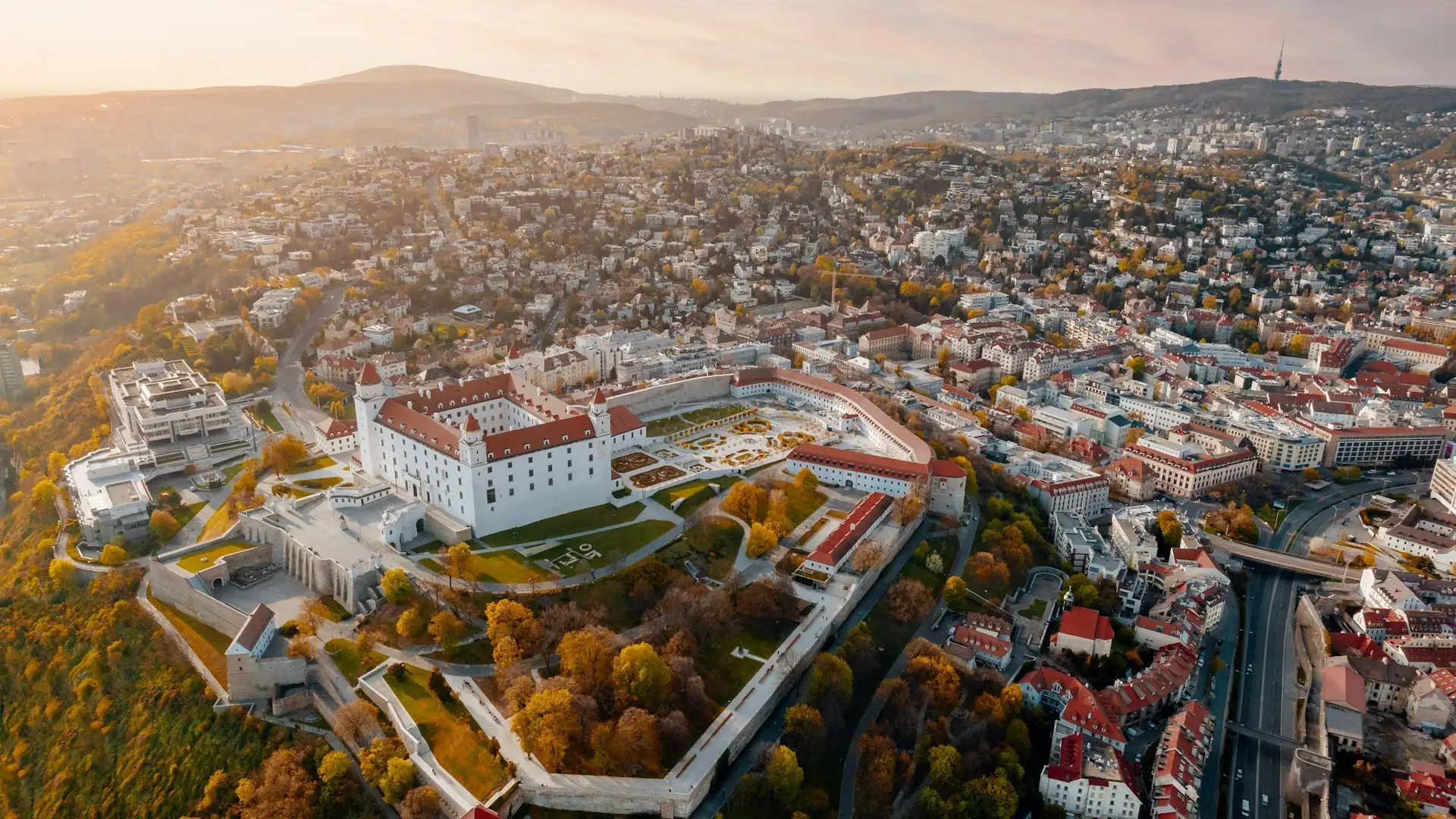
Europe's only capital that borders two other countries — Austria and Hungary are both within half an hour. The old town is compact, genuinely walkable in a morning, and cluttered with outdoor cafes by afternoon. The castle above the city is more interesting for the view than the museum inside. Hviezdoslavovo námestie square on a warm evening, with the opera house at one end and a row of restaurants at the other, is one of Central Europe's better places to sit and watch time pass. Plan two days. Three if you're combining it with a day trip to Devin Castle, 9 km west along the Danube.
High Tatras
The only truly alpine mountain range in Central Europe outside the Alps themselves. Peaks top 2,600 meters, glacial lakes sit at altitude in basins of grey rock, and the trails are well-marked enough that you don't need a guide for most of the popular routes. The resort town of Štrbské Pleso has a high-altitude lake that freezes solid in winter and reflects the peaks on still summer mornings in a way that looks implausible. Poprad is the gateway town at the base, with direct rail connections from Bratislava. Allow at least two full days in the mountains. Three gives you proper hiking without feeling rushed.
Bojnice Castle
Slovakia's most photographed castle, and fairly earned. The neo-Gothic turrets above a thermal spring look like someone commissioned a castle from a children's book illustrator and then actually built it. The interior is over-decorated in the way that 19th century romantic restorations tend to be, which is part of the charm. In late April and early May, the International Festival of Ghosts and Spirits fills the castle grounds with theatrical absurdity. Worth timing a trip around.
Spiš Castle
One of the largest castle complexes in Central Europe, sitting on a limestone ridge in eastern Slovakia with panoramic views across the Spiš region. It's been a ruin since a fire in 1780 and is listed as a UNESCO World Heritage Site. The whole surrounding area — including the medieval chapter town of Spišská Kapitula and the old town of Levoča — forms one of Europe's most intact medieval landscapes. Base yourself in Levoča and visit the castle on a morning walk.
Banská Štiavnica
A silver mining town that was once one of the most important cities in the Habsburg Empire and is now a UNESCO-listed time capsule with a population of 10,000 and a remarkably intact Baroque townscape. The triple-ring Holy Trinity column in the central square dates from 1764. The open-air mining museum at Slovenské Banské Múzeum lets you go underground into actual 18th century mine shafts. Stay the night: the town has good wine cellars and almost no tourist crowds after day visitors leave.
Slovak Karst Caves
The Slovak Karst region in the south of the country contains one of the highest concentrations of caves in Europe. Domica Cave is the largest and crosses into Hungary underground. Ochtinská Aragonite Cave contains formations found in only three places on earth. Both are UNESCO-listed. Combined with Aggtelek National Park just across the border, this is a cave system that will rearrange your sense of what underground means.
Košice
Slovakia's second city and the east's cultural hub. Hlavná Street, the main pedestrian boulevard, is one of the longest and widest in Central Europe and lined with Baroque and Art Nouveau facades that haven't been aggressively renovated. The 14th century St. Elisabeth Cathedral is the easternmost Gothic cathedral in the world of that scale. Košice was the European Capital of Culture in 2013 and hasn't entirely forgotten it, which is useful for the visitor.
Piešťany
Slovakia's most celebrated thermal spa resort, on an island in the Váh River about 80 km northeast of Bratislava. Romans were using these thermal sulphurous springs 2,000 years ago. The island has been a serious European spa destination since the 19th century and has some of the grandest pre-war spa architecture outside Karlovy Vary. The mud baths are medicinal and genuinely unpleasant in the best way. A full spa day costs a fraction of equivalent Swiss or Austrian options.
Culture & Etiquette
Slovaks tend toward reserve with strangers and warmth with people they know, which means the first conversation can feel cooler than you expected and the second feels like you've been friends for ten years. Don't mistake the initial formality for unfriendliness. It isn't. Shop workers and restaurant staff in smaller towns may not speak English; in Bratislava and major tourist areas you'll manage fine.
Folk culture runs deeper here than in most Central European countries and is actively maintained, not preserved in a museum sense. Villages in the Orava region still hold folk festivals with traditional dress and music that are genuine community events. If you happen to land in one, you're welcome to watch and you'll likely be offered something to eat.
"Dobrý deň" (Good day) when you walk in, "Ďakujem" (Thank you) when you leave. Basic courtesy that goes further than you'd think in smaller towns.
Flowers (odd numbers, not even), wine, or chocolates. Being invited to a Slovak home is not a casual offer and should be treated accordingly.
"Na zdravie" (to health) before the first drink. Make eye contact when clinking glasses. Drinking before the toast is mildly poor form and will be noticed.
Vy (formal you) rather than ty (informal) with anyone you've just met who is clearly older than you. Younger Slovaks are generally more relaxed about this but older generations appreciate it.
Czechs and Poles can understand Slovak to varying degrees, but Slovaks appreciate genuine attempts at their specific language. Even mangled pronunciation is received warmly.
This happens constantly and Slovaks are politely tired of it. They are different countries in different parts of Europe. Slovenia is southwest of Austria. Slovakia is northeast of Austria. This matters.
That country ended in 1993. Slovakia is 30+ years old as an independent republic. Using the old name suggests you haven't updated your mental map.
Rural buses run on schedules that reward checking twice. Some museums close on Mondays, some on Tuesdays. Some are closed for renovation with no clear reopening date. Verify before you travel specifically to see something.
They are related but distinct languages, and Slovaks are particular about the difference. Your Czech phrasebook will partly work but is not the same thing.
Slovakia has some of the finest folk craft traditions in Central Europe: hand-embroidered textiles, blue-dyed Modrotlač fabric, and carved wooden goods. These are the things worth bringing home.
Folk Music
Slovak folk music, especially from the Horehronie and Záhorie regions, involves string ensembles, fujara (a 2-meter bass flute), and vocal harmonies that are genuinely striking. The fujara is UNESCO-listed as intangible heritage. Folk festivals in July and August, particularly in Východná village, are the real thing.
Christmas Markets
Bratislava's Christmas market on the main square runs from late November to early January and is consistently rated among Europe's best. The mulled wine (varené víno) is served in ceramic mugs you keep as a deposit. The trdelník pastry wrapped around a cylinder and grilled is the correct thing to eat at 10am with your first mulled wine.
Religious Customs
Slovakia is predominantly Catholic and the faith is practiced actively. Easter Monday (Veľká noc) involves the tradition of young men sprinkling women with water or gently tapping them with willow twigs, which represents health and fertility. If you're in a village over Easter, this will happen and it's not a spectator sport.
Business & Formality
Meetings start on time. Business cards are handed with two hands and received the same way. Hierarchy matters more in professional settings than in social ones. Lunch meetings are more common than dinner meetings for first encounters. Slovak business culture is formal by Western standards but straightforward once you understand the conventions.
Food & Drink
Slovak cuisine is hearty Central European cooking with enough regional variation to stay interesting. The national dish is bryndzové halušky: soft potato dumplings tossed in sheep's bryndza cheese and topped with fried bacon. You should eat it at least once, ideally in a mountain chalet after a morning hike when the calorie logic is entirely sound. It is heavy, salty, and correct.
The good news: Slovak food has been quietly improving. Bratislava has developed an actual restaurant scene over the past decade, with chefs applying modern technique to Slovak ingredients. Bryndza shows up in forms beyond the halušky. Game meats — boar, venison, deer — are excellent and well-prepared in mountain restaurants. The wine is better than its reputation suggests.
Bryndzové Halušky
The national dish. Potato dumplings, sheep cheese, bacon. Non-negotiable on a first visit. Order it at a koliba — a traditional mountain inn with exposed timber beams and a fireplace — where the version will be better than anywhere in Bratislava. Expect to feel moderately immobilized afterward. Plan the hike for the morning, not the afternoon.
Game & Grilled Meats
Wild boar goulash, deer medallions, pheasant. Slovakia's forests are productive and the game appears on menus across central and eastern Slovakia from October onward. The version served in a hunting lodge in the Low Tatras with a side of bread dumplings and a glass of dark Zlatý Bažant beer is one of Central Europe's underappreciated meals.
Kapustnica
Sauerkraut soup with sausage, dried mushrooms, and cream. Traditional Christmas Eve dish and completely acceptable on other occasions. Found in traditional restaurants across the country from October to March. Warms you from the inside in a way that no amount of layering fully replicates.
Street Baking & Pastry
Lokše are thin potato pancakes, either savory with goose fat and cabbage or sweet with poppy seed filling, sold at markets and Christmas stalls. Šúľance with poppy seeds are potato noodles that function as dessert and defy easy categorization. Both are best from a market stall on a cold morning.
Slovak Wine
The Small Carpathian region north of Bratislava produces Riesling, Grüner Veltliner, and Welschriesling at quality levels that would cost twice as much with an Austrian label. The Tokaj region in eastern Slovakia overlaps with Hungary's famous Tokaj appellation and produces excellent late-harvest sweet wines. Pálava white and Frankovka modra red are the varieties to seek out.
Beer & Spirits
Zlatý Bažant (Golden Pheasant) is the standard Slovak lager and it's genuinely good. Bratislava's craft beer scene has expanded, with Golem Brewery and Urpiner among the better options. Slivovica — plum brandy — is the national spirit, produced domestically by half the grandmothers in central Slovakia and bought commercially for the other half.
When to Go
Honest answer: May and June are the sweet spot. The Tatras are clear of snow on the lower trails, the castle landscapes are in full green, and the crowds that arrive in July and August are still weeks away. Autumn — September and October — runs a close second, with foliage in the mountain forests and harvest festivals across the wine regions. December is worth considering for Bratislava specifically: the Christmas market is one of the most atmospheric in Central Europe and accommodation prices are lower than you'd expect.
Spring
May – JunHiking trails clear, castles crowd-free, wine region starting to wake up. The Tatras at their greenest. Bratislava's outdoor cafes open and the city finally looks the way it's supposed to.
Autumn
Sep – OctForest foliage in the mountains, grape harvest in the wine regions, cooler temperatures ideal for castle walks. September still warm enough for outdoor dining. October is for serious hikers with sturdy boots.
Winter
Dec – FebBratislava Christmas market is excellent. Jasná ski resort in the Low Tatras is the best skiing in Central Europe outside Austria. January and February are cold and quiet but genuinely beautiful in the snow-covered mountain towns.
Summer Peak
Jul – AugBratislava old town gets crowded. Tatras trails become busy on weekends. Accommodation in mountain resorts needs to be booked months ahead. That said, temperatures are pleasant by Central European standards and festivals run all summer.
Trip Planning
One week is enough to see Slovakia's highlights if you keep moving. Two weeks gives you time to slow down in places that reward it — Banská Štiavnica is considerably better with a night in it than as a day trip. Slovakia works well as a combination trip with Vienna (one hour from Bratislava by train), Budapest (2.5 hours), or Prague (4 hours by bus). Flying into one city and out of another cuts backtracking entirely.
Bratislava
Walk the old town in a morning. Castle in the afternoon, Hviezdoslavovo námestie for dinner. Day two: Devin Castle, 9 km along the Danube, accessible by bus from the city center. Afternoon wine bar in the old town cellars.
Bojnice Castle & Banská Štiavnica
Bojnice is three hours from Bratislava by train to Prievidza. Spend one night in or near Bojnice town, visit the castle in the morning. Continue by bus to Banská Štiavnica in the afternoon. One night in the mining town is mandatory.
High Tatras
Train from Banská Bystrica (nearest rail hub) to Poprad. Three days in the Tatras: day one to Štrbské Pleso and the high-altitude lake; day two for a serious hike toward Rysy or the Velická Valley; day three Ždiar village and a thermal bath at AquaCity Poprad before your train home.
Bratislava + Wine Region
Two full days in Bratislava with a day trip to the Small Carpathian wine region. Modra for cellar visits, Červený Kameň Castle (one of Slovakia's best-preserved) on the way back. Evening wine tasting in Pezinok.
Piešťany + Bojnice
One night in Piešťany for the thermal spa experience. A morning soak before continuing north to Bojnice Castle. Stay in Prievidza or Nitrianske Pravno if you want quiet countryside accommodation.
Banská Štiavnica + Banská Bystrica
Two nights in the UNESCO mining region. Underground mine museum, Baroque town square, cellar wine bars, the Calvary hilltop. Day trip to Banská Bystrica's SNP Museum about the 1944 Slovak National Uprising — honest and important.
High Tatras
Four days gives you proper mountain time. The full day hike to Rysy peak (Slovakia's highest accessible summit), the cog railway up to Tatranská Lomnica for the cable car view, and a rest day in Zakopane-adjacent Ždiar for folk architecture and local cooking.
Spiš Region + Košice
Train to Spišská Nová Ves, walk to Spiš Castle, spend the night in Levoča (medieval walls, Master Paul's altar). Continue to Košice for a final day in Slovakia's most underrated city. Fly home from Košice Airport.
Bratislava & Surroundings
With real time, explore Bratislava's outer neighborhoods and suburbs. Take the bus to Červený Kameň Castle. One evening across the border in Vienna for scale comparison — and to remind yourself how much cheaper Slovakia is.
West Slovakia: Wine & Castles
Modra wine cellars, Trenčín Castle (one of Slovakia's most dramatically positioned), and the wooden folk architecture of the Čičmany village — a UNESCO-listed village with white geometric patterns painted on every house facade.
Spa & Central Slovakia
Piešťany thermal baths for two nights. Drive or bus through the Váh River valley — one of Slovakia's most scenic routes — toward Banská Štiavnica and Banská Bystrica.
High Tatras: Depth
Four serious days in the mountains. Rysy summit, Téryho chalet overnight hike (a mountain hut at 2,015m), the full Magistrála trail section, and a rest day in the spa at Grand Hotel Kempinski Štrbské Pleso.
Eastern Slovakia: Spiš & Orava
Spiš Castle complex, Levoča, and then north into the Orava region — Oravský Castle perched 112 meters above the Orava River, and Vlkolínec, a preserved mountain village that looks unchanged since the 18th century and is UNESCO-listed accordingly.
Slovak Karst + Košice
Domica Cave boat trip, Ochtinská Aragonite Cave, Zádielska Canyon. Final two nights in Košice: St. Elisabeth Cathedral, Hlavná Street, the Košice Gold collection (the largest medieval gold treasure discovered in Central Europe). Fly home rested.
Vaccinations
No mandatory vaccinations for Slovakia. Routine vaccines recommended. Tick-borne encephalitis (TBE) vaccination is worth considering if hiking in forested areas May through October — Slovakia has Europe-relevant TBE risk in rural regions.
Full vaccine info →Connectivity
EU roaming rules apply for EU citizens. Non-EU visitors should get a Slovak SIM or a European eSIM before arrival. O2 Slovakia and Slovak Telekom have good coverage in cities and main highways, but mountain valleys can drop signal.
Get Europe eSIM →Power & Plugs
Type F (Schuko) plugs at 230V/50Hz, same as most of continental Europe. North American visitors need an adapter and possibly a voltage converter for older devices. Modern electronics handle EU voltage automatically.
Language
Slovak is the official language. English is widely spoken in Bratislava and tourist areas. In smaller towns and rural regions, German is often more useful than English. Download Google Translate with Slovak offline. Signs in mountain parks are well-marked without requiring language.
Travel Insurance
EU citizens can use their European Health Insurance Card (EHIC) for emergency treatment. Non-EU visitors need travel insurance with medical cover. Mountain rescue in the Tatras is expensive without insurance. TANAP (Tatra National Park) mountain rescue is excellent but not free for foreigners.
Highway Vignette
If renting a car, you need a highway vignette (diaľničná známka) to drive on Slovak motorways. Available at border crossings, fuel stations, and online. A 10-day vignette costs around €12. Driving without one results in a substantial fine.
Transport in Slovakia
Slovakia has a functional national rail network that connects major cities, but it's slow and the timetables require patience. The train from Bratislava to Košice takes around five hours and is comfortable but not fast. For covering distances quickly in central and eastern Slovakia, buses (RegioJet and FlixBus between major cities, regional SAD buses for smaller routes) are often faster and more direct than trains. For rural areas and castles off the rail line, a rental car transforms your options.
Within Bratislava, the tram and bus network covers everything you'd realistically need. Grab a 24-hour or 72-hour transit pass at the airport or any kiosk. The old town is compact enough to walk entirely.
National Rail (ŽSR)
€5–25/routeConnects Bratislava to Žilina, Poprad, Košice, and Banská Bystrica. Reliable but slow. Scenic through the mountain regions. Book in advance on the ZSSK website for cheaper tickets.
RegioJet / FlixBus
€5–20/routeFaster than trains on many intercity routes. RegioJet's coaches between Bratislava and Košice are comfortable and include wifi. Book online. More punctual than regional buses.
Car Rental
€30–60/dayEssential for reaching Bojnice, Oravský Castle, Slovak Karst caves, and rural folk villages. Roads are generally good. Mountain roads require care in winter. International driving permit not required for EU/UK license holders.
Tatras Electric Railway
€3–8/journeyThe narrow-gauge railway connecting Poprad to the High Tatras resort towns. Charming and functional. Runs frequently in summer, less so in shoulder season. The views on the climb into the mountains are worth the slow pace.
Danube Boat
€30–40 to ViennaTwin City Liner runs a fast catamaran between Bratislava and Vienna in 75 minutes. A genuinely good way to arrive or depart. Seasonal (April to October). Book ahead in summer.
Taxi / Bolt
€1.2/km approx.Bolt works in Bratislava and Košice. Regular taxis are reliable but always agree on the fare before getting in, especially at Bratislava Airport. Uber does not operate in Slovakia.
Cycling
€10–20/day rentalThe Danube Cycle Path runs through Bratislava and west into Austria. Flat, well-marked, and one of Europe's great cycling routes. Rental shops in Bratislava can set you up for a half-day to Vienna if the weather cooperates.
Domestic Flights
N/ASlovakia has no domestic commercial flights — the country is small enough that surface transport covers everything. Bratislava Airport and Košice Airport are the two main international gateways. Vienna Airport (1 hour from Bratislava) adds significantly more flight options.
Accommodation in Slovakia
Slovakia's accommodation ranges from international chain hotels in Bratislava to mountain chalets in the Tatras that serve halušky at 7am and smell pleasantly of pine. A night in a traditional horská chata (mountain hut) in the High Tatras — shared rooms, basic facilities, spectacular surroundings — is one of the more distinctive European sleeping experiences available for under €30 a person. Book weeks ahead for summer weekends.
City Hotels
€60–150/nightBratislava has solid mid-range options in and near the old town. Košice has good value business hotels along Hlavná Street. Booking.com has the widest selection; prices are considerably lower than equivalent Czech or Austrian cities.
Mountain Chalets
€25–60/personHorská chata huts in the High Tatras range from basic shared rooms to full-service mountain restaurants with private rooms. Téryho Chalet at 2,015m is the most atmospheric. Chata pod Rysmi is the highest staffed hut in Slovakia. Book months ahead for July and August.
Penzión (Guesthouse)
€30–70/nightFamily-run guesthouses are the standard option in small towns and villages. Usually includes breakfast. Service is personal and often includes advice on local trails, restaurant recommendations, and unsolicited opinions on neighboring villages. All excellent.
Wellness & Spa Hotels
€80–200/nightPiešťany has purpose-built spa hotels with thermal pool access included in the room rate. Tatralandia near Liptovský Mikuláš has resort-style accommodation adjacent to one of the largest waterpark and thermal complexes in Central Europe.
Budget Planning
Slovakia is one of the best value countries in the EU for travelers coming from Western Europe or North America. Meals at a sit-down restaurant cost €7–14 for a main course. A glass of local wine is €2–4. A night in a decent guesthouse in a small town is €35–55. By Austrian or Swiss standards next door, the difference is dramatic. This is a genuine advantage, not a trade-off against quality.
- Hostel or mountain hut dorm
- Lunch set menu (dvojchodové menu)
- Self-catering dinners from supermarkets
- Train and bus for all transport
- Free parks, most castle exteriors
- Penzión or 3-star hotel
- Restaurant lunch and dinner
- Occasional rental car for castle days
- Paid attractions and cave entries
- Wine tasting and local experiences
- 4-star hotel or spa resort
- Full restaurant dining, Slovak wine
- Rental car throughout
- Spa treatments and thermal access
- Private guided tours and experiences
Quick Reference Prices
Visa & Entry
Slovakia is a full Schengen Area member. EU citizens travel with just a national ID card and need no additional paperwork. Citizens of the US, UK, Canada, Australia, New Zealand, and most other Western countries can enter visa-free for up to 90 days within any 180-day period under the Schengen rules. Your 90 days covers the entire Schengen zone, not just Slovakia.
From 2025, travelers who don't need a visa for Schengen but are non-EU citizens need to register with ETIAS (European Travel Information and Authorization System) before visiting. It's a straightforward online process, not a visa, but you need to do it before you fly.
Most Western passport holders qualify. ETIAS registration required for non-EU visitors from 2025. Check the official Schengen visa requirements for your specific nationality.
Family Travel & Pets
Slovakia is an excellent family destination for reasons that aren't always obvious from the outside. The castles are the first argument: children who find museums tedious will happily spend two hours wandering the ruins of Spiš Castle and imagining the medieval life that happened inside the walls. Bojnice's ghost festival in late April and May adds theatrical spectacle that requires no translation.
The thermal spa parks deserve more attention from families planning Central Europe trips. Tatralandia near Liptovský Mikuláš is one of the largest waterpark and thermal complexes in Central Europe, with outdoor pools, slides, and heated sections that run year-round. AquaCity in Poprad is more compact but has natural geothermal water and is directly adjacent to the Tatras. Both are priced significantly below comparable facilities in Austria or Germany.
Castle Circuit
Bojnice, Oravský, and Spiš Castle all work well for children. Oravský in particular — perched dramatically above the Orava River in tiers of stone — looks like something from an animated film and holds children's attention in a way that flat museum galleries rarely manage.
Thermal Parks
Tatralandia is the main family draw — enormous thermal and leisure pool complex with hotel accommodation on-site. Seasonal outdoor sections open in warmer months. Year-round indoor pools. Slides that calibrate their ambition to the child's age. Budget a full day here. Children will want two.
Mountain Wildlife
The Low Tatras and Slovak Paradise regions have dedicated nature trails and wildlife observation points for chamois, marmots, and occasionally bears at safe distance. The Slovak Paradise's ladder-and-chain gorge trails in Suchá Belá require some physical confidence but are extraordinary for older children who can handle the scramble.
Folk Craft Workshops
Several cultural centers in Bratislava and in villages around Orava offer hands-on workshops in traditional crafts: pottery, egg decoration (kraslice), and folk embroidery. Booking through the regional tourist offices is the most reliable route. Better for children eight and older who can sustain focused attention.
Winter Activities
Jasná ski resort in the Low Tatras is Slovakia's main alpine destination and has a ski school with English-speaking instructors. The resort has dedicated children's slopes with snow carpets and helmet rentals for young skiers. Toboggan runs near Štrbské Pleso are the right level of excitement for younger children who aren't skiing.
Food Strategy
Children tend to approve of Slovak food: potato dumplings, grilled meats, goulash, and the bread that comes with everything. The sweet lokše pancakes with jam filling are the correct bribe at any market. Allergies and dietary restrictions are understood in Bratislava and larger towns; in rural restaurants, communication is easier than it looks with Google Translate's camera mode.
Traveling with Pets
Slovakia is a reasonably pet-friendly EU destination. Dogs require a microchip, EU pet passport, and up-to-date rabies vaccination to enter and move freely within the Schengen zone. EU-issued pet passports are accepted directly; non-EU owners need to convert documentation at an authorized Slovak vet on arrival, which is straightforward but takes time.
Within Slovakia, dogs are allowed in many outdoor dining areas and on trains in a carrier or muzzled and leashed. Most national park hiking trails permit dogs on a leash. High Tatras national park (TANAP) has specific rules about leashing on designated trails — check the TANAP website before setting out, as some sensitive mountain zones restrict dogs seasonally.
Accommodation: many penzións and guesthouses accept dogs with a small surcharge. Advance communication is recommended. Larger chain hotels are less reliably pet-friendly. Airbnb properties in Slovakia often have more flexibility for pets than standard hotels.
Safety in Slovakia
Slovakia is a safe country by any European measure. Violent crime against tourists is rare. Bratislava's old town is walkable at any reasonable hour. The main practical risks are the kind that any mountain country presents: weather changing rapidly above the treeline, trails that look navigable on a map but require more scrambling in practice, and remote areas where a twisted ankle is more serious than it would be in the city.
Bears are genuinely present in the Low Tatras and Malá Fatra mountains. They rarely present danger to groups of hikers on marked trails, but making noise while hiking in dense forest is recommended. The Slovak Mountain Rescue Service (HZS) operates professionally and can be reached on 18 300 from anywhere in Slovakia.
Urban Safety
Bratislava and Košice are safe by European standards. Petty theft in tourist-heavy areas is the main concern, particularly around the old town and transport hubs. Standard precautions apply.
Solo Women
Slovakia is comfortable for solo female travelers. Bratislava's old town has no areas you'd want to avoid at night. Mountain hiking solo is fine on busy trails; let someone know your route for less-frequented terrain.
Mountain Hazards
Weather in the High Tatras can deteriorate extremely quickly. Cloud cover, lightning, and afternoon thunderstorms are serious risks above the treeline from June to September. Start hikes early and descend before noon on longer routes.
Wildlife
Brown bears are present in central and northern Slovakia. Follow standard bear country practices: hike in groups, make noise, don't approach or feed wildlife. Bear encounters on busy trails are uncommon but not impossible.
Ticks
Tick-borne encephalitis risk exists in forested areas. Use DEET-based repellent, check after hikes, and consider TBE vaccination if spending significant time in forests. Lyme disease is also present.
Road Safety
Slovak roads are generally good. Mountain roads require care. Blood alcohol limit for driving is 0.0% — zero tolerance. Speed cameras are common. Winter driving in mountain areas requires winter tires, legally mandated from November 15 to March 31.
Emergency Information
Your Embassy in Bratislava
Most embassies are in the Bratislava city center and Staré Mesto district.
Book Your Slovakia Trip
Everything in one place. These are services worth actually using.
The Country That Rewards the Curious
Most people who spend real time in Slovakia come back with the same observation: they expected less and found more. The castles are more numerous and more dramatic than the tourist industry has managed to convey. The mountains are serious mountains. The food is better than its reputation. The people, once past the initial reserve, are generous and quietly proud of a place they know most visitors underestimate.
Slovaks have a word, výdrž — endurance, perseverance — that they use to describe a particular kind of quiet determination. It applies to hiking a difficult summit, navigating a bureaucratic problem, or simply getting through a hard winter. Spend enough time here and you'll understand why the word comes up often. There's something in the landscape that requires it, and something in the people that has it.