
What You're Actually Getting Into
Portugal is a long, narrow country facing the Atlantic, with a history out of all proportion to its size: for two centuries its navigators led Europe's Age of Discovery, building an empire that stretched from Brazil to Macau. The wealth of that era built the Manueline monasteries of Belém and the palaces of Sintra; the long decline that followed, and a dictatorship that lasted until 1974, kept much of the country quietly old-fashioned until EU membership in 1986 changed it rapidly.
Today Portugal is one of the most popular destinations in Europe, and it is easy to see why. Lisbon and Porto are two of the continent's most characterful cities, Sintra's palaces are pure fantasy, the Algarve has some of the best beaches in Europe, and the Douro Valley is one of the most beautiful wine regions in the world. Inland, the Alentejo is a slow, sunbaked landscape of cork oaks, white villages and Roman ruins, while the Atlantic islands of Madeira and the Azores feel like a different country entirely.
The honest complications
Portugal's popularity has a cost. Lisbon and Porto have seen housing prices soar with tourism and short-term rentals, and locals have protested about being priced out of their own neighbourhoods. The Algarve can be heavily built up and crowded in July and August. The Atlantic is cold, even in summer (around 17-21°C in the Algarve, colder in the north), and the sea has strong currents on many beaches. Lisbon's hills are steep and its cobbles slippery when wet, so bring proper shoes.
A History Worth Knowing
Portugal is one of Europe's oldest nation-states, with borders largely unchanged since the 13th century. From a small Christian kingdom carved out of Moorish Iberia, it became the first global maritime empire, then spent the 20th century under a long dictatorship, before the peaceful Carnation Revolution of 1974 turned it into the democracy it is today.
- 711-1249
Moors and the Reconquista. Moorish rule lasts five centuries in the south, leaving castles, place names starting with "Al" and the Algarve's name (from Arabic al-Gharb, the west).
- 1143
The Kingdom of Portugal. Afonso Henriques is recognized as the first King of Portugal; Lisbon is captured from the Moors in 1147.
- 1415-1580
The Age of Discovery. Prince Henry the Navigator sponsors voyages down Africa; Vasco da Gama reaches India in 1498, Cabral reaches Brazil in 1500, and Portugal builds an empire of trading posts across the globe.
- 1755
The Great Lisbon Earthquake. An earthquake, tsunami and fires destroy much of Lisbon on All Saints' Day; the Marquis of Pombal rebuilds the Baixa on a modern grid.
- 1933-1974
The Estado Novo. António de Oliveira Salazar's authoritarian regime keeps Portugal isolated and poor while fighting costly colonial wars in Africa.
- 1974-present
The Carnation Revolution and the EU. A near-bloodless military coup on 25 April 1974 restores democracy; colonies gain independence, and Portugal joins the EU in 1986 and the euro in 1999.
Read the full history: the navigators, the earthquake and the Carnation Revolution
Portugal's maritime explorers changed the world map. Bartolomeu Dias rounded the Cape of Good Hope in 1488, Vasco da Gama opened the sea route to India a decade later, and Ferdinand Magellan, a Portuguese navigator sailing for Spain, led the first expedition to circumnavigate the globe. The spice trade made Lisbon one of Europe's richest cities, and its legacy is everywhere in the ornate, rope-and-shell carved Manueline style of the Jerónimos Monastery and the Belém Tower. That empire also made Portugal a central player in the Atlantic slave trade, a history the country is only beginning to confront publicly.
The earthquake of 1 November 1755, estimated at magnitude 8.5 or higher, was followed by a tsunami and fires that killed tens of thousands and destroyed most of Lisbon. It shook European philosophy too: Voltaire wrote about it in Candide. The rebuilding under the Marquis of Pombal produced one of the first earthquake-resistant building systems in the world and the elegant grid of the Baixa you walk through today.
On 25 April 1974, junior army officers overthrew the Estado Novo almost without a shot. Crowds filled the streets and placed red carnations in soldiers' rifles, giving the revolution its name. The bridge over the Tagus, once named after Salazar, was renamed the 25 de Abril Bridge, and the date is still a national holiday.
Top Destinations
Portugal is small enough that Lisbon to Porto takes under three hours by train and Lisbon to the Algarve about the same. Most trips combine Lisbon and Porto with Sintra, and add either the Algarve's beaches or the Douro Valley's vineyards. Madeira and the Azores need their own flights and their own trip.
Lisbon, the city of seven hills
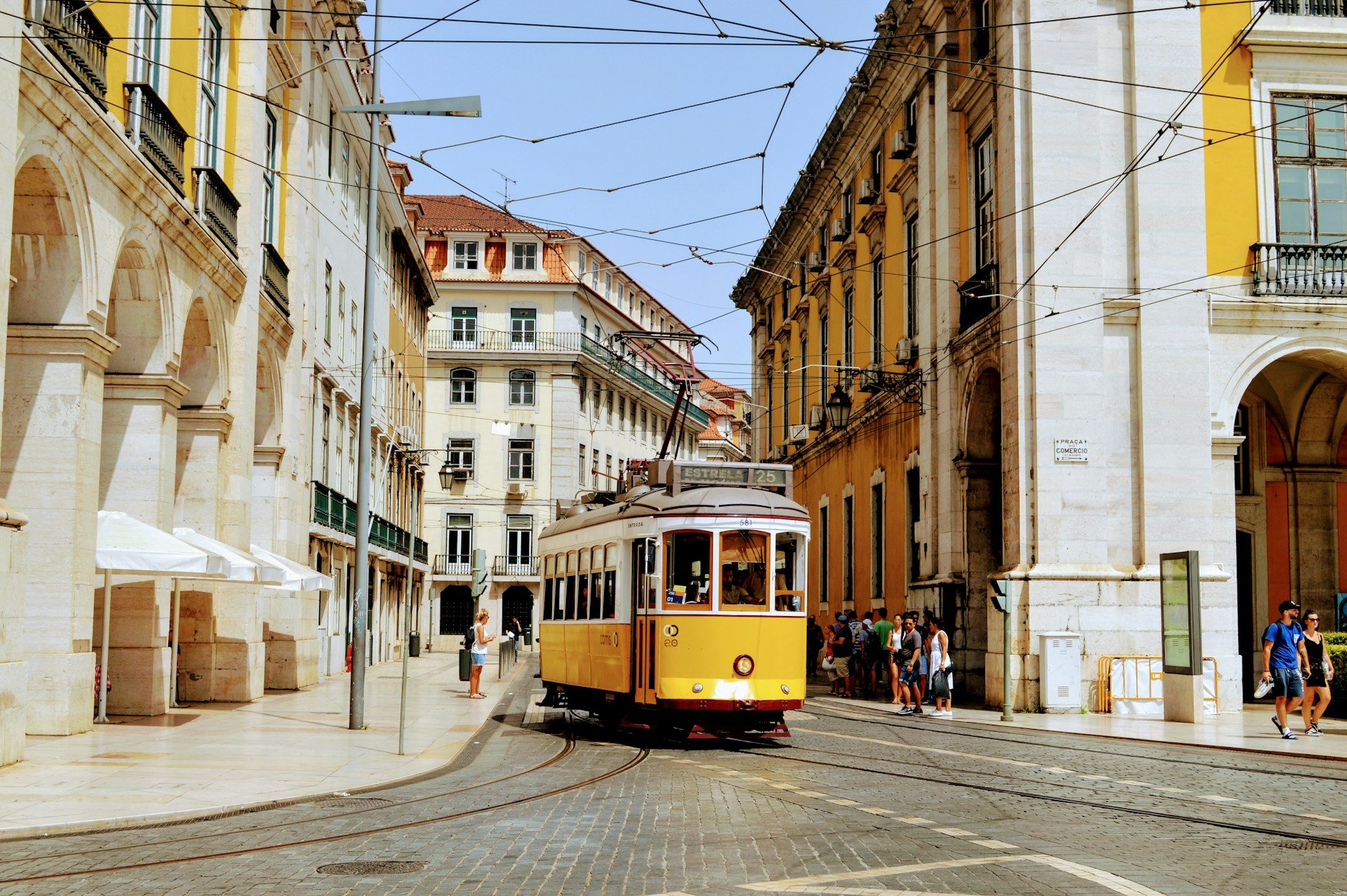
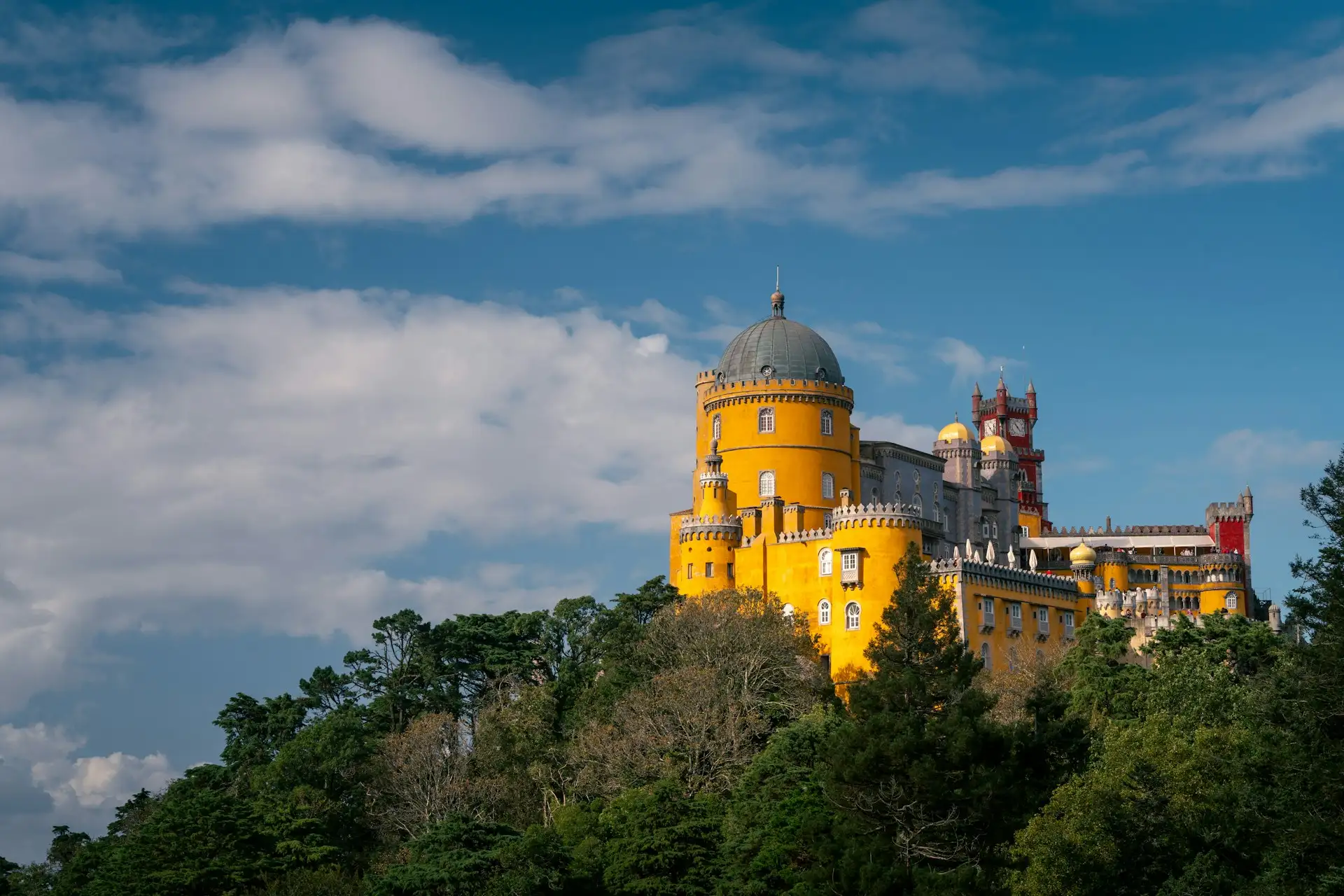
Lisbon spreads over steep hills above the wide Tagus estuary. Ride the historic Tram 28 through the old Moorish quarter of Alfama, where fado drifts out of tiny restaurants at night, climb to São Jorge Castle and the miradouros (viewpoints), and wander the elegant grid of the Baixa. In Belém, the Jerónimos Monastery and Belém Tower celebrate the Age of Discovery, and the original Pastéis de Belém bakery has served custard tarts since 1837. Forty minutes away, Sintra's fairy-tale palaces, Pena, Quinta da Regaleira and the Moorish Castle, deserve a full day. Budget three to four days.
Porto and the Douro Valley
Porto is grittier and more atmospheric than Lisbon: a steep tumble of tiled houses down to the Douro river, crossed by the iron Dom Luís I Bridge. Explore the riverside Ribeira, the azulejo-covered São Bento station and the Livraria Lello bookshop, then cross to Vila Nova de Gaia to tour the port wine lodges. Upriver, the Douro Valley, the oldest demarcated wine region in the world, has steep terraced vineyards and wine estates (quintas) best reached by the scenic train to Pinhão or a river cruise. See our Porto city guide for the full detail.
The Algarve, golden cliffs and sea caves
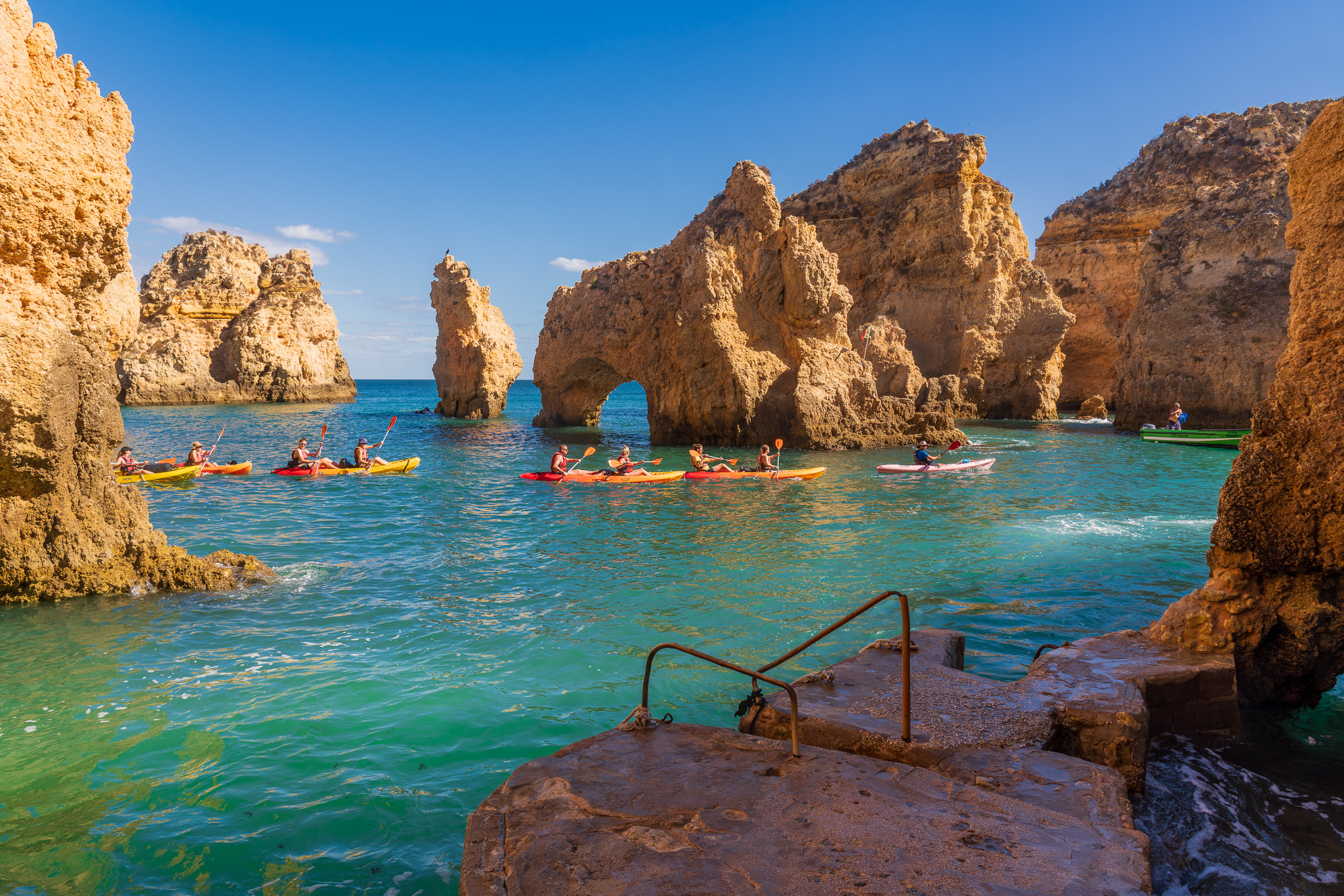
Portugal's southern coast has dramatic ochre cliffs, sea stacks and hidden coves. The western Algarve around Lagos has the most spectacular scenery, from Ponta da Piedade to Praia da Marinha, one of the most beautiful beaches in Europe. Take a boat or kayak into the Benagil sea cave (since 2024, swimming into the cave, landing on its beach and unguided kayak rental are all banned), and walk the Seven Hanging Valleys Trail along the clifftops. The eastern Algarve around Tavira is calmer, with long sandy island beaches and the Ria Formosa lagoon. Wilder still, the Costa Vicentina on the west coast is a surfers' paradise.
Coimbra, Óbidos, Évora and the Alentejo
Coimbra, Portugal's medieval capital, has one of the oldest universities in Europe and its spectacular Baroque Joanina Library. The walled village of Óbidos is famous for ginjinha (cherry liqueur) served in chocolate cups, and surfers head to Nazaré, where winter waves reach over 25 metres. South of Lisbon, the Alentejo is rolling plains of cork oaks and olive groves, with the Roman temple and Chapel of Bones in Évora, the hilltop village of Monsaraz and excellent, inexpensive wine.
Madeira and the Azores
Madeira, 1.5 hours by plane from Lisbon, is a subtropical island of cliffs, laurel forests and levada walking trails that follow old irrigation channels, with a spring-like climate all year. Funchal is its charming capital. The Azores, nine volcanic islands in the middle of the Atlantic, are among Europe's best nature destinations: crater lakes on São Miguel, whale watching off Pico and Faial, hot springs and hydrangea-lined roads. Both are worth at least a week of their own.
Hidden gems beyond the main circuit
Lisbon, Porto and the Algarve cover a first trip well. With extra days, these places rarely make the standard itineraries but reward the detour.
Ponte de Lima and Peneda-Gerês
Portugal's oldest town and its only national park: granite villages, waterfalls and wild horses near the Spanish border.
Tomar
The Convent of Christ, headquarters of the Knights Templar in Portugal, with an extraordinary round church.
Comporta and Vila Nova de Milfontes
Long empty beaches, rice fields and stork nests, an hour or two south of Lisbon.
Piódão and the schist villages
Slate-built mountain villages clinging to hillsides, and Portugal's highest peaks.
Lamego and Guimarães
Guimarães, the birthplace of Portugal, and Lamego's Baroque sanctuary stairway are both easy detours from Porto.
Monchique and Silves
Cool mountain air, a red sandstone Moorish castle and quiet villages a short drive from the crowded coast.
Culture & Etiquette
The Portuguese are warm, courteous and more reserved than their Spanish neighbours, with a strong sense of politeness and a melancholy streak captured in the untranslatable word saudade, a longing for something lost. Family, food and long lunches matter, and football (Benfica, Sporting or Porto, choose carefully) inspires real passion.
Do
- Learn a few words of Portuguese. "Bom dia" (good morning), "obrigado" (thank you, said "obrigada" by women) and "por favor" are always appreciated.
- Greet properly. A handshake for strangers; two kisses on the cheek between friends and when women are introduced in social settings.
- Accept or refuse the couvert. Bread, olives and butter put on the table are charged if eaten. It is fine to send them back.
- Tip modestly. Rounding up or 5-10% for good table service is appreciated but never expected.
- Dress up a little. Portuguese people dress smartly in cities; beachwear is for the beach, and churches expect covered shoulders.
Don't
- Speak Spanish and assume it is the same. Many Portuguese understand Spanish, but opening in English is often better received than opening in Spanish.
- Call Portugal part of Spain. Portugal has been independent for almost 900 years and is proud of its separate identity.
- Rush meals. Lunch can last two hours; asking for the bill too soon or eating on the go can seem rushed.
- Buy drugs from street sellers in Lisbon. Men offering hashish or cocaine in the Baixa and Bairro Alto are selling bay leaves or crushed aspirin; drug use is decriminalized, not legal.
- Underestimate the Atlantic. Strong currents and big waves catch out swimmers every year. Swim at lifeguarded beaches and respect the flags.
Deeper culture: fado, azulejos and saudade
Fado. Portugal's mournful folk music, sung to the 12-string Portuguese guitar, is on UNESCO's intangible heritage list. Lisbon's Alfama and Mouraria are its home; the best experiences are in small tascas where locals sing (fado vadio), and the Museu do Fado gives the background. Coimbra has its own version, sung by men in student capes.
Azulejos. The blue-and-white glazed tiles covering churches, stations and house fronts arrived with the Moors and became Portugal's signature art form. Lisbon's National Tile Museum, in a former convent, tells the full story, and Porto's São Bento station is a masterpiece.
Saudade. This word for a nostalgic longing for what is absent runs through fado, poetry and everyday conversation, and is often said to be the key to the Portuguese character. Fernando Pessoa, Lisbon's great poet, is the best guide to it.
Food & Drink
Portuguese food is simple, generous and built on superb ingredients: fresh fish grilled over charcoal, salt cod in hundreds of ways, rich stews, excellent bread and some of the best pastries in Europe. Prices remain low by Western European standards, and the wines, from green vinho verde to the reds of the Douro and Alentejo and, of course, port, are outstanding value.
Pastel de nata €1.20-1.80
Flaky custard tarts with a caramelized top, eaten warm with cinnamon. Pastéis de Belém has guarded its original recipe since 1837; Manteigaria rivals it in the city centre.
Bacalhau €12-22
Dried salt cod, said to have a different recipe for every day of the year. Try bacalhau à Brás (shredded with eggs and fried potatoes) or pastéis de bacalhau (cod fritters).
Grilled sardines €10-16
The taste of Lisbon's June festivals: charcoal-grilled sardines on bread, best in summer when they are fattest.
Francesinha €10-15
Porto's monster sandwich of meats, covered in melted cheese and a beer-tomato sauce, usually with fries. Best shared.
Bifana €3-5
A thin pork steak marinated in garlic and white wine in a soft roll, the classic Portuguese snack.
Port and vinho verde €2-6 a glass
Port from the Douro, aged in the lodges of Gaia, and light, slightly sparkling vinho verde from the Minho, perfect in summer.
When to Go & Itineraries
Spring (April to June) and early autumn (September and October) are the best times to visit Portugal: warm, sunny weather, wildflowers or harvest season, and fewer crowds than summer. July and August are hot inland and busy on the coast; winter is mild in the south and rainy in the north, with low prices and quiet cities.
All four seasons compared, with temperatures
| Season | Verdict | Temps | Prices & crowds |
|---|---|---|---|
| Apr-Jun & Sep-Oct | Best | 18-27°C | Moderate prices; Douro harvest in Sep |
| Jul-Aug | Hot and busy | 25-35°C | Peak Algarve prices; Lisbon festivals in June |
| Nov-Mar (south) | Mild | 12-18°C | Lowest prices; Algarve quiet but sunny |
| Nov-Mar (north) | Rainy | 8-14°C | Porto wet and grey; big waves at Nazaré |
The Atlantic stays cool all year, around 15-21°C, and strong winds can make west-coast beaches chilly even in summer. The Algarve's south-facing coast is warmer and calmer.
Itineraries
Portugal is easy to tour by train and bus along the Lisbon-Porto axis. A car helps for the Douro Valley, the Alentejo and the western Algarve.
- Days 1-3
Lisbon and Sintra. Alfama, Baixa, Belém and the miradouros, plus a full day in Sintra.
- Days 4-5
Porto. Train north (about 3 hours), the Ribeira, port lodges in Gaia and São Bento station.
- Days 1-3
Lisbon and Sintra. As in the five-day route, with a fado evening in Alfama.
- Day 4
Óbidos and Coimbra. Stop in the walled village of Óbidos, then overnight in Coimbra for the university.
- Days 5-7
Porto and the Douro. Two days in Porto and a day trip by train or tour to the Douro Valley.
- Days 1-7
The seven-day route above, flying or training back to Lisbon from Porto.
- Day 8
Évora. A day in the Alentejo's Roman and medieval capital on the way south.
- Days 9-10
The Algarve. Base in Lagos: Ponta da Piedade, a guided Benagil cave kayak and the Seven Hanging Valleys Trail.
Getting there & around
Lisbon (LIS), Porto (OPO) and Faro (FAO) are the main international airports, with Madeira (FNC) and Ponta Delgada in the Azores (PDL) linked by frequent flights. From Lisbon Airport, the metro red line reaches the centre in about 20 minutes for €1.90 plus a €0.50 reusable card; Porto's airport is on the metro (line E), and Faro's has buses to the city. Between cities, CP trains are comfortable and cheap: the Alfa Pendular takes about 2h40-3h15 from Lisbon to Porto. Buses (Rede Expressos and FlixBus) fill the gaps, especially in the Algarve.
All transport options with prices: airport transfers, trains, buses, car rental
| Option | Price | Notes |
|---|---|---|
| Lisbon airport metro | €1.90 (+ €0.50 card) | About 20 minutes to the centre; zapping credit on a Navegante card is slightly cheaper. |
| Lisbon-Porto train | ~€36 (promos from ~€21.50) | About 2h40-3h15 on the Alfa Pendular; Intercidades are a little slower and cheaper. |
| Lisbon-Faro train or bus | €20-30 | About 3 hours. |
| Lisbon-Sintra train | ~€2.40 each way | About 40 minutes from Rossio station. |
| Porto-Pinhão (Douro) train | €12-17 each way | About 2.5 hours, the last hour along the river; check CP for engineering works. |
| Car rental | €25-70/day | Electronic tolls on motorways; get a transponder with your rental. |
City transit: Lisbon's metro, trams, buses and ferries use the reusable Navegante card; a 24-hour pass covers them all. Tram 28 and the funiculars are charming but slow and crowded; walk or use the metro for real journeys. Porto's metro, buses and trams use the Andante card.
Practical prep: an eSIM before landing saves the airport queue, and EU roaming rules mean an EU SIM works seamlessly. Trip.com offers fixed-price airport pickups in Lisbon, Porto and Faro.
Where to stay
Lisbon, Chiado & Príncipe Real
Elegant, central and hilly. Bairro Alto Hotel and Verride Palácio Santa Catarina have some of the best rooftop views in the city.
Lisbon, Alfama & Graça
Atmospheric old neighbourhoods with guesthouses and apartments; steep and noisy on festival nights.
Budget & hostels
Portugal has some of the best hostels in Europe, including Lisbon's Home Lisbon Hostel and Porto's Gallery Hostel.
Douro quintas & Algarve
Wine-estate stays in the Douro and cliff-top hotels and villas in the Algarve, much cheaper outside summer.
Budget Planning
Portugal is one of the best-value destinations in Western Europe, though Lisbon and Porto have become noticeably more expensive, especially for accommodation. Food, wine, transport and coffee remain cheap: an espresso is often under €1, and a good lunch with wine costs €12-15.
- Hostel dorm €25-40
- Prato do dia lunches €10-14
- Trains, metro and buses
- Free miradouros, beaches and churches
- 3-star hotel or guesthouse
- Restaurant meals with wine €25-40
- Sintra palaces and museum entries
- Port tastings and a Douro tour
- Boutique hotels and wine estates
- Tasting menus and Michelin dining
- Private Douro boat trips
- Rental car and Algarve villas
Quick reference prices: coffee, wine, entry fees
| Espresso (uma bica / um cimbalino) | €0.80-1.50 |
| Pastel de nata | €1.20-1.80 |
| Glass of house wine | €2.50-5 |
| Prato do dia lunch | €10-14 |
| Pena Palace and park, Sintra | ~€14-20 |
| Jerónimos Monastery | ~€18 |
| Lisbon-Porto train | ~€36 |
| Port lodge tour with tasting | €20-35 |
| Mid-range hotel double, Lisbon | €110-180/night |
Prices reflect October 2026 research and drift over time, especially Lisbon and Algarve accommodation in summer. Treat them as a planning baseline, not a quote.
Visa & Entry
Portugal is a full Schengen Area member, so citizens of the US, UK, Canada, Australia and other visa-exempt countries can stay up to 90 days in any 180-day period, counted across all Schengen countries. Since 10 April 2026 the EU's Entry/Exit System (EES) has been fully running, registering fingerprints and a photo at the external border instead of passport stamps. ETIAS, a €20 online travel authorization valid for three years, is still to come: the EU dropped its late-2026 launch target and now expects it in 2027, with the date to be announced months in advance. Portugal's D7 and digital nomad visas are popular for longer stays.
✓ Valid passport
At least 3 months validity beyond your departure from the Schengen Area, issued within the last 10 years.
✓ ETIAS (expected 2027)
Not yet required. Once it launches, apply online on the official EU site before travel; €20, valid 3 years, covers the whole Schengen Area.
✓ 90/180-day tracking
Days spent in Spain, France or any other Schengen country count against the same 90 days.
✓ Longer stays
The D7 passive-income visa and the digital nomad visa allow longer residence for remote workers and retirees.
| Portugal | Spain | |
|---|---|---|
| Daily budget | €60-80 for budget travelers; slightly cheaper | Similar, Madrid and Barcelona pricier |
| Beaches | Atlantic: dramatic cliffs, cooler water | Mediterranean: warmer, calmer, busier |
| Cities | Lisbon and Porto, hilly and atmospheric | Many more big cities, from Madrid to Seville |
| Food and wine | Seafood, pastries, port and great-value wine | Tapas culture and more regional variety |
| Pace | Quieter, gentler, more reserved | Livelier nightlife, later dinners |
Safety, Solo Women & Family
Portugal carries a Level 1 "Exercise Normal Precautions" advisory from the US State Department and regularly ranks among the ten safest countries in the world in the Global Peace Index. Violent crime against tourists is rare. The practical risks are pickpocketing in Lisbon and Porto, strong Atlantic currents and summer wildfires.
Pickpocketing
Concentrated on Lisbon's Tram 28, the Santa Justa Lift, Baixa and Rossio, and around Porto's Ribeira. Keep bags zipped and in front on crowded trams.
Sea safety
Atlantic beaches often have strong rip currents. Swim only at lifeguarded beaches, obey the red and yellow flags, and keep clear of cliff edges, which can collapse.
Wildfires
Hot, dry summers bring wildfire risk, especially in the centre and north. Follow local warnings and never light fires outdoors.
One more thing worth knowing: Lisbon's fake drug dealers
In Lisbon's Baixa, Rossio and Bairro Alto, men quietly offer "hashish, cocaine" to tourists. What they sell is almost always bay leaves, oregano or crushed tablets, which is why police largely ignore them. Drug use is decriminalized in Portugal, but buying and carrying drugs can still result in fines, so simply say no and walk on.
The 3 scams to actually know about
Portugal is not a high-scam destination, but three patterns concentrate around the busiest tourist spots. The full country list lives on our Portugal travel alerts page.
The couvert surprise
Bread, olives, cheese and pâté appear on your table unasked, then show up on the bill. It is legal, but you can send it back or ask the price first.
Taxi overcharging
Unlicensed drivers and taxis at the airport sometimes take long routes or skip the meter. Use Uber, Bolt or Free Now, or the official taxi rank.
Fake drug sellers and petty hustles
Sellers of fake drugs and "free" bracelets or rosemary sprigs in central Lisbon. Politely decline and keep moving.
Solo women travelers
Portugal is one of the best countries in Europe for solo women travelers, with low levels of harassment, friendly locals and safe, lively cities. Standard precautions apply in nightlife areas like Bairro Alto and Cais do Sodré in Lisbon, where drinks should not be left unattended, and on isolated beaches at night. Full detail on our Solo Woman Explorer pages.
Emergency numbers
Embassies in Lisbon and practical health notes
112 is the single emergency number in Portugal, with English-speaking operators. Most embassies are in Lisbon; check your embassy's website for the current address. Several countries also have consulates in Porto, Faro and Funchal.
- USA
- +351-21-727-3300
- UK
- +351-21-392-4000
- Canada
- +351-21-316-4600
- Australia
- +351-21-310-1500
Health: tap water is safe to drink throughout mainland Portugal, Madeira and the Azores. No special vaccinations are required. Pharmacies (farmácia, green cross) are excellent, and the SNS 24 line (808 24 24 24) gives health advice in English. EU citizens can use their EHIC card.
Family travel & pets
Portugal is a superb family destination: safe, relaxed and welcoming to children, with beaches, castles, the Lisbon Oceanarium (one of Europe's largest aquariums), trams and funiculars, and easy food. Portuguese families often eat out late with their children, so kids are welcome in nearly every restaurant.
Practical family notes and bringing pets
With kids: the Algarve's calm, south-facing beaches suit young children best; west-coast Atlantic beaches can have big waves and strong currents. Lisbon's hills and cobbles make strollers hard work, so a carrier is more practical. Children under 4 often travel free on trains and some public transport.
Pets: EU pet passport holders can bring dogs, cats and ferrets with a valid rabies vaccination and microchip. Non-EU visitors need an EU animal health certificate. Dogs are not allowed on many beaches in summer, but there are designated dog-friendly beaches.
Portugal FAQ
Is Portugal safe to visit?
Yes, very. Portugal carries a Level 1 advisory and ranks among the safest countries in the world. Pickpocketing in Lisbon and Porto and strong Atlantic currents are the main practical concerns.
How many days do you need in Portugal?
A week covers Lisbon, Sintra and Porto. Ten days adds the Algarve or the Douro Valley, and two weeks lets you include the Alentejo or a few days on Madeira.
How much does Portugal cost per day?
Budget travelers manage on €60-80 a day; mid-range runs €120-180. Portugal is one of the cheapest countries in Western Europe, though Lisbon accommodation has become expensive.
Do I need a visa for Portugal?
Not for US, UK, Canadian, Australian and many other passports: Portugal is in the Schengen Area, with 90 days visa-free in any 180-day period. ETIAS, a €20 online authorization, is not required yet; its launch has been postponed to 2027.
When is the best time to visit Portugal?
April to June and September to October, for warm, sunny weather and fewer crowds. Summer is hot and busy; winter is mild in the Algarve but rainy in the north.
Lisbon or Porto?
Both if possible. Lisbon is bigger, sunnier and has more to see, plus Sintra on the doorstep. Porto is smaller, more atmospheric and has port wine and the Douro Valley. They are under three hours apart by train.
Do I need a car in Portugal?
Not for Lisbon, Porto and Sintra, which are well served by trains and public transport. A car is very useful for the Douro Valley, the Alentejo and exploring the Algarve's beaches.
Is the water warm in Portugal?
Not really. The Atlantic stays around 15-21°C even in summer. The Algarve's south coast is the warmest; the west and north coasts are chilly.
Is Portugal safe for solo female travelers?
Yes, it is one of Europe's best destinations for solo women. Take normal care with drinks in nightlife areas and avoid isolated beaches at night.
Is Portugal good for families with kids?
Very. It is safe, relaxed and child-friendly, with calm Algarve beaches, castles, the Lisbon Oceanarium and restaurants that welcome children late into the evening.
Do people speak English in Portugal?
Yes, widely, especially among younger people and in tourist areas. Portugal has some of the best English proficiency in Southern Europe, partly because films and TV are subtitled rather than dubbed.
What is Portugal known for?
Lisbon and Porto, pastel de nata, port wine, fado music, azulejo tiles, the Algarve's cliffs and beaches, Sintra's palaces, the Age of Discovery and Cristiano Ronaldo.
What Stays With You
Portugal does not shout. Its magic is in the small things: the yellow tram squealing round a corner in Alfama, the warm custard tart eaten standing at a bakery counter, the fado singer who silences a tiny room, the Atlantic light that makes every tiled facade glow. The country has changed fast in the last decade, but its gentleness, generosity and quiet pride have survived the attention.
Watch the sun set from a miradouro over Lisbon's red roofs on your last evening, a glass of something local in hand, and you will understand what the Portuguese mean by saudade long before you have left.