
North Macedonia
A lake older than almost any in Europe, a capital city covered in statues of itself, and grilled meat so good it might restructure your priorities. Almost nobody goes here. This is the correct time to change that.
What You're Actually Getting Into
North Macedonia is not on most people's European travel radar, and this is both its greatest flaw as a tourist destination and its most compelling feature as a travel experience. The infrastructure is improving but uneven. The roads outside the main cities require patience. English is spoken by younger people in Skopje and Ohrid and not reliably anywhere else. None of this should put you off. What you get in exchange is a country that hasn't been smoothed out for international consumption yet.
Lake Ohrid is genuinely one of the great natural and cultural treasures of Europe. It's one of the oldest lakes on earth, possibly three to five million years old, with endemic species found nowhere else and a shoreline dense with Byzantine-era churches, some dating to the 9th and 10th centuries, sitting quietly above the water with no entrance queues and no gift shops. In high summer the lake fills with Macedonian and Kosovar holidaymakers. In May or September you can walk the old town of Ohrid for an hour without seeing another foreign tourist.
Skopje, the capital, requires its own mental adjustment. The center was redesigned by a government project between roughly 2010 and 2014 that installed hundreds of neoclassical statues, triumphal arches, colonnaded buildings, and a giant Alexander the Great on horseback in the central square. It is either magnificent kitsch or an architectural disaster depending on who you ask, and it is absolutely unlike anything else in Europe. The old Ottoman bazaar, the Čaršija, a ten-minute walk away, is the genuine historical center of the city and one of the best-preserved bazaar districts in the Balkans. Both are worth your time.
The biggest planning mistake visitors make: flying in, seeing Skopje for a day, and leaving without going to Ohrid. Ohrid is what you came for. Don't skip it.
North Macedonia at a Glance
A History Worth Knowing
The territory that is now North Macedonia has been contested, occupied, and renamed more times than almost anywhere in Europe, which goes a long way toward explaining both the complexity of its modern identity and why its capital filled itself with statues of ancient Macedonian kings.
Ancient Macedonia, the kingdom of Philip II and Alexander the Great, centered on what is today northern Greece and extended into the present-day country. Whether Alexander and the ancient Macedonians were culturally Greek, distinct from the Greeks, or something more complex is a live historical and political debate. What is not disputed is that the ruins at Stobi, a Greco-Roman city in the south of the country, and the artifacts in the Skopje Archaeological Museum, trace a continuous human presence here going back well beyond recorded history.
The Slavic peoples who settled the region in the 6th and 7th centuries CE brought a different heritage. In the 9th century, Saints Cyril and Methodius, born in nearby Thessaloniki, developed the Glagolitic alphabet specifically to translate Christian scripture for Slavic peoples. Their disciples, Saints Clement and Naum, refined this into what became the Cyrillic alphabet, largely at the literary school they established in Ohrid. The alphabet used today across Russia, Ukraine, Bulgaria, Serbia, and dozens of other languages was invented, in meaningful part, on the shore of Lake Ohrid. This is not a minor historical footnote.
The medieval period saw the region pass through the Bulgarian Empire, the Byzantine Empire, and the Serbian Empire, each leaving layers of church building and monastery construction that account for the extraordinary density of Orthodox religious architecture you'll encounter around Ohrid and throughout the countryside. The monastery of Saint Naum, built in 905 CE, is still an active monastery with monks in residence.
In 1371, the Ottoman Empire took control of the region and held it for over 500 years, until 1912. The Čaršija in Skopje, the old Ottoman bazaar, dates from this period and was for centuries the commercial and cultural center of the city. The Ottoman period also explains the significant Albanian Muslim population in western North Macedonia, particularly in Tetovo, which has a distinct cultural character from the Slavic Orthodox east.
After the Balkan Wars of 1912 to 1913, the territory was divided among Serbia, Greece, and Bulgaria. It became part of Yugoslavia as the Socialist Republic of Macedonia in 1944. Independence came peacefully in 1991 when Yugoslavia dissolved, but the decades that followed were complicated: a brief armed conflict in 2001 between the government and ethnic Albanian insurgents, a long diplomatic dispute with Greece over the use of the name "Macedonia," and the EU and NATO accession processes that drove the eventual 2019 Prespa Agreement, which renamed the country North Macedonia and cleared the path to NATO membership in the same year.
The name dispute with Greece is recent enough that some locals still use "Macedonia" without the "North" qualifier. You'll hear both. The political sensitivity around questions of Macedonian versus Bulgarian cultural identity is also real: the two countries have had a separate dispute over historical interpretation that complicated North Macedonia's EU accession. None of this needs to dominate your visit, but it helps explain a country that is genuinely still working out its relationship with its own history.
Philip II and Alexander the Great build an empire stretching to India. The region's ancient identity remains politically contested today.
Saints Clement and Naum establish the school at Ohrid. The Cyrillic alphabet is developed here. A world-historical moment on a quiet lake.
The Ottoman Empire takes the region. Five centuries of rule leave deep architectural, cultural, and demographic marks.
Ottoman rule ends. The territory is divided among Serbia, Greece, and Bulgaria. Modern borders begin to take shape.
Becomes the Socialist Republic of Macedonia within Tito's Yugoslavia. Skopje develops as a modern capital.
Peaceful independence from Yugoslavia. A 27-year dispute with Greece over the name "Macedonia" begins.
The country is renamed North Macedonia. Joins NATO the same year. EU accession negotiations ongoing.
Top Destinations
North Macedonia is a small landlocked country of about 25,000 square kilometers, roughly the size of Vermont. The main road between Skopje and Ohrid takes about two and a half hours. You can see the major sights in a week comfortably or in five days if you move efficiently. The terrain is mostly mountainous, the valley floors are where the cities are, and the roads through the mountains, while beautiful, require care especially after rain.
Skopje
Skopje is two cities that happen to share a river. On one side: the Čaršija, the old Ottoman bazaar, a maze of covered market streets, mosques, hans (caravanserais), and craft workshops that have been running since the 15th century. On the other: Macedonia Square, dominated by the Skopje 2014 architectural project, a government-funded neoclassical makeover that installed a 22-metre equestrian statue of Alexander the Great, triumphal arches, and fountains on a scale usually reserved for imperial capitals. Together they make Skopje one of the strangest and most memorable capital cities in Europe. Allow two days.
Ohrid
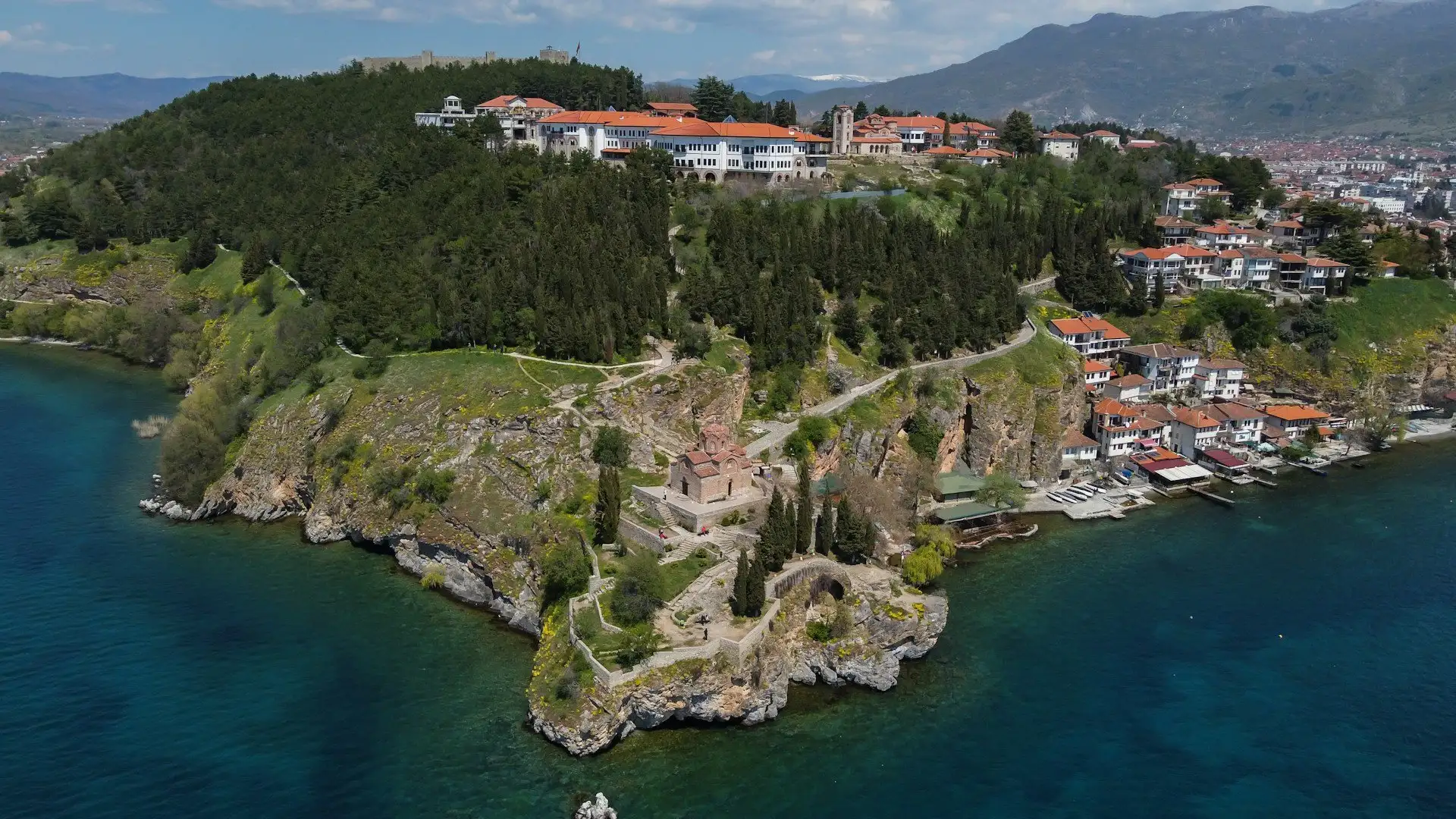
Lake Ohrid is 30 kilometres long, up to 288 metres deep, and between three and five million years old. The town of Ohrid on its northeastern shore is a UNESCO World Heritage site: a compact old city of cobbled streets, medieval churches, Roman amphitheater ruins, and a fortress above it all. The Church of Saint John at Kaneo on the cliff is where every photograph of the country comes from. The waterfront promenade fills with locals in the evening regardless of season. The lake is cold enough to swim comfortably in July and August. Allow at least two to three days. You will probably want more.
Saint Naum Monastery
At the far southern end of Lake Ohrid, 29 kilometres from Ohrid town, the monastery of Saint Naum was founded in 905 CE and is still an active Orthodox monastery. The church interior has extraordinary frescoes. Peacocks wander freely in the grounds. The springs of the Black Drin River emerge here in pools of startling clarity. Reach it by boat from Ohrid (the most scenic option, around 90 minutes each way) or by taxi. A half-day round trip from Ohrid town.
Mavrovo National Park
Northwest of Skopje, Mavrovo is the largest national park in North Macedonia, covering the Šar and Bistra mountain ranges. In summer it offers good hiking and the eerie sight of a partially submerged church tower rising from an artificial lake, the old village of Mavrovo flooded in the 1950s when the dam was built. In winter it's the country's main ski resort. The mountain village of Galicnik, above the park, has a famous annual wedding festival in July where couples still marry in traditional costume.
Tetovo
Tetovo is a predominantly ethnic Albanian city at the foot of the Šar mountains, with a distinct cultural character from Skopje or Ohrid. The Šarena Džamija, the Painted Mosque, is one of the most ornately decorated mosques in the Balkans, its exterior covered in intricate floral patterns. The Arabati Baba Teke, a Sufi dervish lodge just outside town, is one of the few functioning tekkes remaining in the region. An honest half-day from Skopje.
Stobi
A Greco-Roman city at the confluence of the Vardar and Crna rivers, occupied from the 2nd century BCE through the 6th century CE. Stobi has a bishop's palace, a theater, bathhouses, and floor mosaics, most of which you can walk through with minimal supervision and no crowds. It's accessible as a stop between Skopje and Bitola on the main road south. Entry costs around €4 and archaeology fans will easily spend two hours here.
Bitola
North Macedonia's second city, close to the Greek border, with a wide pedestrian boulevard called Sirok Sokak lined with 19th-century Austro-Hungarian consular buildings. The city has an atmosphere quite different from Skopje: more relaxed, more elegant, with a strong cafe culture. The ancient city of Heraclea Lyncestis, just outside town, has remarkable Roman mosaics. Atatürk attended military school here; there's a small museum dedicated to this. Four hours from Skopje by bus.
Lake Prespa
Shared by North Macedonia, Albania, and Greece, Lake Prespa is quieter and less visited than Ohrid. The Macedonian shore has a handful of fishing villages, a 10th-century hermit cave church carved into a cliff above the water, and pelicans. The Prespa Agreement, signed here in 2018, resolved the name dispute with Greece. The lake itself feels genuinely remote in a way that Ohrid no longer does in summer.
Culture & Etiquette
Macedonian hospitality is genuine and occasionally overwhelming. Being invited for coffee means being invited for coffee, food, more coffee, rakija, and a conversation that lasts two hours. Declining these invitations is entirely acceptable and entirely misses the point of visiting. Locals genuinely want to talk to foreign visitors, partly out of curiosity and partly because tourism here is still new enough that it hasn't become a transactional exchange.
North Macedonia is a predominantly Orthodox Christian country with a significant Muslim minority, primarily Albanian. The two communities coexist mostly peacefully but with their own distinct neighborhoods, restaurants, and social spaces. As a visitor, being aware of which context you're in, Orthodox church versus mosque, Macedonian restaurant versus Albanian one, shapes how you should dress and behave, though in practice the thresholds are fairly relaxed for tourists who show basic respect.
Coffee, rakija, food. When someone offers, accept if you possibly can. Macedonian hospitality is not performative. People mean it and value you accepting it.
Both Orthodox churches and mosques require shoulders and knees covered. Scarves are often available at church entrances. Remove shoes before entering mosques. This is basic and expected.
Blagodaram (thank you), molam (please/excuse me), zdravo (hello) will be received with disproportionate warmth. The effort is noticed everywhere.
Markets, village restaurants, taxis, and smaller guesthouses are cash only. A 500 denar note (about €8) is useful. 1,000 denar notes can be hard to break in small establishments.
Light negotiation is expected at the Čaršija and outdoor markets. Not aggressive haggling, just a polite counter-offer. The vendor expects it and the starting price often reflects this.
In Skopje and Ohrid's tourist areas, younger people generally do. Outside these zones, very few do. Google Translate's camera function for Cyrillic menus and signs is genuinely useful here.
Whether the country should have been renamed North Macedonia, whether ancient Macedonians were Greek, and related historical questions are genuinely sensitive and can provoke strong reactions. Listen if locals bring it up. Don't raise it yourself as small talk.
Particularly older people at markets, women in traditional dress, and people at religious ceremonies. A nod and gesture toward your camera before shooting is the minimum courtesy and almost always results in a yes.
A 50km mountain road in North Macedonia can take 90 minutes. Road quality varies significantly. Do not drive mountain passes at night without checking conditions.
Tap water in Skopje and Ohrid is generally fine. In smaller villages and rural areas, stick to bottled water to avoid gastrointestinal surprises that will ruin your hiking plans.
The Churches
The density of Byzantine and medieval churches around Lake Ohrid is remarkable. Many are small, unlocked, and contain original frescoes from the 11th to 14th centuries. The Church of Saints Clement and Panteleimon, rebuilt on original 9th-century foundations above Ohrid old town, houses some of the finest medieval frescoes in the Balkans. Admission is usually 50 to 100 denar (under €2). There are no crowds, no timed entry, and often a local woman selling homemade jam at the door.
Coffee Culture
Macedonians drink coffee slowly and socially. A turska kafa (Turkish coffee) arrives in a small copper džezva with a glass of water and a piece of lokum. You drink it unhurriedly, and nobody pressures you to leave. Sitting in a cafe for an hour over one coffee costs 60 to 100 denar (about €1). The terrace culture along Ohrid's waterfront and Skopje's Macedonia Square is the heartbeat of social life here.
Macedonian Music
Traditional Macedonian music uses odd time signatures, particularly 7/8 and 11/8, that sound initially irregular to Western ears and then become addictive. Live folk music appears at weddings, village festivals, and some restaurants in Ohrid. The tapan (double-sided drum) and zurla (a shawm, a reed instrument) are the core of outdoor music. If you stumble onto a village wedding, you have almost certainly been noticed and will almost certainly be invited in. Go.
Skopje 2014: A Word
The Skopje 2014 urban redesign project, which covered the city center in neoclassical statues and pseudo-baroque facades, was enormously controversial: estimated to have cost €500 million to €680 million in a country with significant poverty, and widely criticized internationally. Many locals are embarrassed by it. Others defend it as an expression of national identity. As a visitor, the correct response is probably to find it fascinating, take the photographs, and read the criticism before forming an opinion.
Food & Drink
Macedonian cuisine sits at a crossroads of Ottoman, Balkan, and Mediterranean influences, and it does most of them well. Grilled meat is the backbone: kebapčinja (minced meat sausages), pleskavica (a thick spiced meat patty), and tavče gravče, a baked bean dish cooked in a clay pot that is as close to a national dish as the country has. The food is hearty, the portions are large, and the prices are astonishing by Western European standards. You will eat very well for very little.
The local wine deserves more attention than it gets internationally. The Tikvesh wine region in the south of the country has been producing wine since antiquity. Vranec, the dominant red grape variety, produces full-bodied tannic wines that pair well with grilled meat and cost €3 to €5 a bottle in shops. The white Žilavka from the Tikveš winery is worth trying with Ohrid trout.
Skara (Grilled Meat)
The Macedonian grill is the foundation of restaurant culture here. Kebapčinja, small skinless sausages of mixed beef and pork, come in portions of five or ten with raw onion, ajvar (roasted red pepper relish), and flatbread. A full portion at a good skara restaurant costs 150 to 250 denar, around €2.50 to €4. The best are in the Čaršija in Skopje and in the lakeside restaurants of Ohrid. Order and eat standing at the grill counter for the authentic experience.
Ohrid Trout
The Ohrid trout (Salmo letnica) is endemic to Lake Ohrid, found nowhere else on earth, and is the fish you order when you're sitting at a lakeside restaurant in Ohrid. Grilled simply with lemon and local olive oil, it's exceptional. It's also protected: the wild population is carefully managed, so what you'll eat is farmed but from the same endemic stock. Budget 400 to 700 denar (€6 to €11) per fish at a good waterfront restaurant.
Tavče Gravče
White beans, onions, tomatoes, paprika, and dried peppers, slow-cooked in a clay pot and served directly in the vessel, blistered and fragrant from the oven. This is the unofficial national dish and it is better than it sounds. Every restaurant makes a version. Order it as a side dish or a vegetarian main. It costs 100 to 150 denar (€1.50 to €2.50) almost everywhere and never disappoints.
Ajvar
Roasted red pepper relish, made in large batches every autumn when the peppers are ripe and jarred for the year. The best ajvar is homemade and you'll encounter it on every table as a condiment. The town of Strumica in the southeast is considered the ajvar capital of the country. Buying a jar from a village market or a local woman outside a church is both possible and recommended. It travels well and costs almost nothing.
Burek
Phyllo pastry filled with meat, cheese, or spinach, baked in large round trays and sold by weight from bakeries that open at 6am. A 200-gram slice of burek with a glass of kiselo mleko (sour yogurt to pour over it) costs 60 to 80 denar (around €1) and is the correct Macedonian breakfast. Every town has a burek bakery. Find it by following the smell of pastry and queuing locals.
Wine & Rakija
Vranec is North Macedonia's signature red: deep, tannic, and underpriced. The Tikvesh and Popova Kula wineries offer tours and tastings. Rakija, the Balkan fruit brandy, is distilled from plums, grapes, quince, or whatever fruit the maker had most of. Homemade versions are fiery and extraordinary. Commercial versions are more consistent. Either way, a small glass before a meal is both traditional and metabolically efficient.
When to Go
Honest answer: May to June or September to October. The weather is warm but not brutal, the lake is swimmable by June, and you avoid the intense domestic summer tourism that fills Ohrid's waterfront in July and August. North Macedonia's summers are hot, regularly exceeding 35°C in the valleys. The mountains are cooler and hikeable all summer, but Skopje in August is genuinely uncomfortable if you're planning to walk around the city. Spring and early autumn give you the country at its most pleasant.
Late Spring
May – JunWarm, wildflowers in the mountains, the lake clear and cold. Ohrid town is busy on weekends but manageable. Hiking in Mavrovo and Galicnik is at its best. Few foreign tourists.
Early Autumn
Sep – OctHarvest season, grape picking, ajvar production, excellent light. The lake is still warm enough to swim in early September. Ohrid empties of domestic summer tourists. Wine region visits are particularly rewarding.
Summer Peak
Jul – AugLake Ohrid fills with Kosovar, Albanian, and Macedonian holidaymakers. Prices at lakeside hotels double. The waterfront is excellent if you like energy and chaos. Skopje is very hot. If hiking is your plan, the mountains are fine.
Winter
Dec – FebMavrovo ski resort is the main draw. Skopje has a modest Christmas market. Ohrid is almost entirely closed: the lakeside restaurants shut for the season and the old town is very quiet. Snow in the mountains from December onward.
Trip Planning
Five to seven days is the right length for a first North Macedonia trip. Two days in Skopje, three days in Ohrid, and a day for something in between, whether Mavrovo, Bitola, or Stobi, covers the essentials without feeling rushed. Renting a car for at least part of the trip gives you the freedom to stop at roadside viewpoints, visit smaller churches off the main road, and reach destinations that don't have regular bus service. Car rental is cheap and driving is manageable outside Skopje city center.
Skopje
Day one: walk from Kale Fortress down through the Čaršija. Find the Old Bazaar, the Daut Pasha Hamam (now an art gallery), the Mustafa Pasha Mosque. Lunch at a skara grill in the bazaar. Cross the Stone Bridge. Afternoon: absorb Skopje 2014 in a spirit of open-minded bewilderment. Evening in the bar district around City Park. Day two: National History Museum, then bus or rent a car for Ohrid.
Ohrid
Arrive and walk the old town before the afternoon heat. Day three: Church of Saint John at Kaneo at dawn, Samuel's Fortress, the old bazaar, dinner on the waterfront with Ohrid trout. Day four: boat to Saint Naum monastery and back. Day five: Church of Saints Clement and Panteleimon, the Classical Era Museum, swim at a public beach. Bus or fly back to Skopje.
Skopje
Two full days. Add the Museum of the Macedonian Struggle, a walk through the Debar Maalo residential neighborhood, and an evening at one of the wine bars in the city center that stock the full range of Tikvesh wines.
Mavrovo
Rent a car. Drive northwest to Mavrovo National Park. See the submerged church tower. Walk around the lake. Drive the mountain road through Bistra. Overnight in Mavrovo village or continue to Ohrid via the mountain route, which adds 45 minutes but is extraordinary.
Ohrid Region
Four days around Ohrid. Day four and five: the old town, Saint John at Kaneo, boat to Saint Naum. Day six: drive south along the lake shore to the quieter beaches and the village of Peštani. Day seven: Lake Prespa, an hour from Ohrid, for the pelicans and the cave church at Konjsko.
Skopje
Two full days including a half-day trip to Tetovo to see the Painted Mosque and the Šar mountain foothills. Return to Skopje for dinner in the new part of the city.
Mavrovo + Galicnik
Two days in the mountains. Hike in Mavrovo National Park, stay overnight in the village of Galicnik above the park, where the stone houses and mountain views are exceptional. Drive the mountain passes with daylight to spare.
Ohrid
Four full days. Enough time to slow down, swim daily, visit all the main churches at the right time of day (early morning for empty interiors), take the boat to Saint Naum twice if you want, and eat at every waterfront restaurant at least once.
Bitola + Stobi
Drive south to Bitola via the Roman ruins at Stobi. An afternoon in Bitola for the Heraclea mosaics and a coffee on Sirok Sokak. Overnight in Bitola. Drive back to Skopje for your flight the next day via the Vardar valley, stopping at the Tikvesh wine region for a winery visit if your flight is late.
Vaccinations
No mandatory vaccinations required. Recommended: hepatitis A and B, tick-borne encephalitis if hiking in forested areas, and routine vaccines up to date. Ticks are present in mountain forests from spring through autumn.
Full vaccine info →Connectivity
North Macedonia is not in the EU, so EU roaming deals do not apply. Buy a local SIM card on arrival at Skopje airport: T-Mobile and A1 both offer tourist SIMs for under €5 with a reasonable data allowance. Coverage is good in cities and towns, patchy in mountains.
Car Rental
Strongly recommended for anything beyond the Skopje-Ohrid corridor. Budget €25 to €40 per day from local companies or international agencies at Skopje airport. An international driving permit is technically required but rarely checked. Full insurance is worth the extra cost on mountain roads.
Language
Macedonian uses the Cyrillic alphabet. Learning to read Cyrillic takes about two hours and opens up menus, street signs, and transport boards significantly. Google Translate's camera function works well on Macedonian Cyrillic. English is spoken by most people under 35 in Skopje and Ohrid.
Travel Insurance
Healthcare quality varies. Skopje has decent private clinics. Rural areas have limited facilities. For hiking or mountain activities, ensure your insurance covers mountain rescue. World Nomads is well-suited to adventure travelers here.
Money
The Macedonian denar (MKD) is not widely available outside North Macedonia. Exchange at the airport or at exchange offices in Skopje (better rates than banks). ATMs are plentiful in cities, sparse in rural areas. Carry enough cash before leaving a major town.
Transport in North Macedonia
Public transport in North Macedonia is functional but not frequent. The bus network is the backbone: intercity buses connect Skopje to Ohrid, Bitola, Tetovo, and the border crossings reasonably reliably, though schedules can be irregular and online booking is not always available. For maximum flexibility, especially outside the main cities, a rental car is the honest recommendation. The roads are better than their reputation but mountain passes require care. Plan for journeys to take longer than the map suggests.
Intercity Bus
€3–8/routeThe main link between cities. Skopje to Ohrid takes 2.5 to 3 hours and costs around 500 denar (€8). Departs from Skopje's main bus station adjacent to the train station. Book the morning departure for best availability.
Rental Car
€25–45/dayThe best way to see rural North Macedonia. Local companies at Skopje airport are cheapest. Roads in valleys are good; mountain roads require confidence. Drive on the right, speed limits are enforced with cameras on main highways.
Skopje Airport
€5–10 to centerAlexander the Great Airport is 20km east of the city. Taxis are metered and run around 600 to 800 denar (€10 to €13) to the city center. Agree on the fare or insist on the meter before getting in.
Taxi
50 MKD start + meterTaxis in Skopje are metered and cheap. Insist on the meter. From the city center to most destinations within Skopje costs 150 to 300 denar (€2.50 to €5). In smaller towns, taxis are shared or negotiated. The Yandex app works in North Macedonia for booking.
Lake Boats
€10–15 one wayBoats from Ohrid's main port to Saint Naum run in summer. The journey takes 90 minutes each way through beautiful lake scenery. Taxi boats can be hired for shorter trips to less accessible shoreline churches. Negotiate the price and time before boarding.
Train
Skopje to Bitola: €4The train network is limited and slow but scenic. The Skopje to Bitola line passes through the Vardar valley and stops near Stobi. It takes 3.5 hours for what a car covers in 2. The journey is pleasant if you have time and the window seats are worth the schedule.
City Bus (Skopje)
35 MKD/tripSkopje's urban bus network covers the main areas. Routes are posted at stops but apps and real-time tracking are minimal. For getting around Skopje center, walking or taxi is often simpler. The bus is useful for reaching the outskirts and residential areas.
Shared Minibus (Kombi)
VariesShared minibuses (kombis) run between smaller towns and villages on semi-regular schedules. Ask at bus stations or in cafes about departure times. They leave when full, not on a fixed timetable. Cheap and an authentic travel experience.
For a 7-day trip: take the bus from Skopje to Ohrid (book the morning departure, around 2.5 hours, 500 MKD), use taxis and walking within Ohrid, hire a local boat for Saint Naum, then rent a car for one or two days to explore Mavrovo or Bitola independently. This covers the full range of transport options without requiring a car in Skopje city center, where parking is more trouble than it's worth.
Accommodation in North Macedonia
Accommodation in North Macedonia is good value and improving. Ohrid has the widest range: everything from guesthouses above the lake in the old town to modern hotels on the waterfront. Staying in the old town, within walking distance of the churches and the fortress, is the right choice over the anonymous hotel strip along the lake's eastern shore. In Skopje, the Debar Maalo and Kapistec neighborhoods are quieter than the center and still walkable to everything.
Old Town Guesthouse
€25–60/nightThe best Ohrid experience. Stone houses in the old town, some with lake views from the terrace, run by local families who serve breakfast and dinner. The food is often as good as any restaurant in town. Book directly when possible: Booking.com listings exist but owners often prefer direct contact.
Boutique Hotel
€50–120/nightSkopje has a growing boutique hotel scene in converted Ottoman-era buildings near the Čaršija. Ohrid's better hotels on the old town hill offer lake views and genuine character. Quality has improved significantly since 2020.
Apartment Rental
€30–70/nightApartment rentals in both Skopje and Ohrid are excellent value and practical for self-catering. Many are in traditional stone buildings. Particularly good for groups or for longer stays in Ohrid where you want a base rather than a hotel.
Mountain Lodge
€20–45/nightBasic but comfortable mountain huts and guesthouses in Mavrovo and on the Šar mountain slopes. Meals included in most. Often the only option in rural areas, and typically the most memorable accommodation of any trip here.
Budget Planning
North Macedonia is one of the cheapest countries in Europe to travel. A good meal for two with wine costs €12 to €20. A guesthouse room in Ohrid old town runs €25 to €45. Museum entry is rarely more than €3. The bus from Skopje to Ohrid is €8. Budget travelers who want to eat and drink well can do so here for €30 to €40 per day. This is not roughing it. This is a country that simply hasn't inflated its prices to match its quality.
- Guesthouse dorm or cheap private room
- Burek breakfast (70 MKD), skara lunch (200 MKD)
- Bus transport between cities
- Free churches, lake walks, fortress views
- Wine at 200 MKD per bottle from a shop
- Private room in old town guesthouse
- Sit-down restaurants for all meals
- Car rental for 1–2 days
- Museum entry and boat trips
- Ohrid trout dinner with lake view
- Boutique hotel with lake view
- Best restaurants and wine selection
- Private car hire with driver for day trips
- Guided tours and winery visits
- Private boat charter on the lake
Quick Reference Prices
Visa & Entry
North Macedonia is not a member of the Schengen Area, which means that days spent here do not count toward your 90-day Schengen allowance. This is actually useful: you can visit North Macedonia as part of a Balkan trip without eating into your Schengen days for neighboring countries like Greece or Croatia.
Citizens of the US, UK, EU member states, Canada, Australia, New Zealand, and most Western countries can enter visa-free for up to 90 days. The EU's ETIAS pre-travel authorization, if active, would apply to non-EU visitors to Schengen countries but not to North Macedonia specifically. Check current requirements before you travel.
US, UK, EU, Canada, Australia, and New Zealand citizens among many others. North Macedonia is not Schengen: days here do not count against your Schengen limit. Verify your specific passport at the Ministry of Foreign Affairs of North Macedonia.
Family Travel & Pets
North Macedonia is genuinely good for family travel, with some practical caveats. Children are welcomed warmly everywhere and Macedonian culture is family-centered in a way that means children in restaurants, cafes, and public spaces are greeted with affection rather than mild irritation. The lakes, the mountains, and the low-key towns are suited to families who want outdoor space and low-stress travel rather than theme parks and structured activities.
The practical caveats: the road infrastructure outside the main corridors requires confident driving. The summer heat in Skopje and the valleys can be genuinely challenging for young children. Medical facilities outside Skopje are limited. Plan around these realities and the country offers an excellent and affordable family experience.
Lake Ohrid
A large, clean, swimmable lake with calm waters along most of the shoreline, free public beaches, and a town compact enough for family walks. Children who can swim will spend most of the day in the water. The lake bottom is visible to 20 metres in many places. One of the genuinely child-friendly natural environments in Europe.
Saint Naum Monastery
The free-roaming peacocks at Saint Naum, the boat trip to get there, and the clear spring pools of the Black Drin River combine to make this one of the most child-memorable experiences in the country. The monastery itself is calm and beautiful. The peacock encounter is always a highlight for children of all ages.
Mavrovo Wildlife
Mavrovo National Park has wolves, bears, deer, and lynx. You are unlikely to see wolves or bears on a casual day hike, but the park rangers offer guided walks and the chances of deer and birds of prey are high. The park is also the most accessible mountain environment in the country for families with older children.
Kale Fortress, Skopje
The Kale Fortress above Skopje's old bazaar is free to walk around and offers 360-degree views over the city. The walls and towers are accessible and the scale appeals to children who like climbing things. Combine with a walk through the bazaar below for an accessible half-day of Skopje history.
Food for Families
Macedonian food is universally child-friendly: grilled meat, flatbread, french fries, grilled cheese, and simple salads. Vegetable dishes are plentiful. Dessert culture involves baklava and ice cream in quantities that make children immediately loyal to the country. Eating out is cheap enough that family restaurant meals are not a budget anxiety.
Boat Trips
The boat from Ohrid town to Saint Naum and back is one of the great short lake journeys in the Balkans. Small taxi boats can be hired for shorter trips to shoreline churches or quieter swimming spots. Children find boat travel self-evidently superior to buses, a position that is defensible on the evidence.
Traveling with Pets
North Macedonia accepts pets entering from EU countries with a valid EU pet passport, microchip, and up-to-date rabies vaccination. Pets from outside the EU need an official health certificate from an authorized vet, issued within 10 days of travel. Rabies vaccination must be current. Check the specific requirements of the Ministry of Agriculture of North Macedonia before travel, as these can update.
On the ground, the situation is practical: most guesthouses outside large hotels will accept pets if asked, particularly in rural areas where dogs are a normal part of daily life. Restaurants with outdoor terraces generally tolerate dogs. Veterinary facilities in Skopje are adequate; outside the capital they are limited in both equipment and availability.
One genuine hazard: stray dog populations exist in some areas, particularly around smaller towns and rural roads. They are generally not aggressive but can be persistent. Keep your own pet on a leash in areas where strays are present, particularly around food markets.
Safety in North Macedonia
North Macedonia is generally safe for tourists. Violent crime against visitors is rare. The country's 2001 armed conflict between the government and ethnic Albanian insurgents, while a significant moment in the country's history, ended over two decades ago and has no bearing on current travel conditions. Ethnic and political tensions between communities exist, but they do not manifest as danger for foreign tourists.
The more realistic risks are petty theft in Skopje's busy areas, poor road conditions in rural and mountain areas, summer heat, and the occasional infrastructure gap (limited medical facilities outside Skopje, unreliable mobile coverage in mountains). Plan for these and you'll travel safely.
General Safety
Good. North Macedonia is safer than its regional reputation sometimes suggests. Tourist-targeted crime is uncommon. Locals are friendly and genuinely helpful to visitors who are clearly lost or in difficulty.
Solo Women
Generally safe, with the caveat that conservative attitudes in some rural areas and in the Muslim west of the country mean solo women may attract more attention than in Western Europe. Ohrid and Skopje's tourist areas are comfortable. Use standard urban awareness after dark.
Road Safety
The most significant practical risk for self-driving visitors. Mountain roads are narrow, sometimes poorly surfaced, and shared with trucks. Night driving on mountain passes is not recommended. Driving under the influence of alcohol is common among locals and should be accounted for defensively.
Petty Theft
Present in Skopje's bus station area and busy market streets. Standard urban precautions apply: don't display expensive electronics, keep wallets in front pockets, and be aware of your surroundings at transport hubs. Ohrid is very low-crime.
Hiking Safety
Mountain trails in Mavrovo and Pelister are marked but not always well-maintained. Mobile coverage can drop entirely above 1,500 metres. Tell someone your route and expected return time. Carry water, a map, and more layers than you think you need. Weather changes fast in the mountains.
Healthcare
Adequate in Skopje, limited elsewhere. The Skopje City General Hospital handles emergencies. Private clinics in Skopje offer better English-language service. Outside the capital, medical facilities are basic. Travel insurance with medical evacuation cover is strongly recommended.
Emergency Information
Embassies in Skopje
Most embassies are located in central Skopje. Some smaller nations handle North Macedonia from Belgrade or Sofia.
Book Your North Macedonia Trip
Everything in one place. These are services worth actually using.
The Lake Stays With You
Most travelers who come to North Macedonia for a week leave wishing they had planned for ten days. The country has a quality of unhurried depth that reveals itself slowly: a Byzantine fresco you almost walked past, a conversation in a lakeside cafe that runs long past the time you meant to leave, a mountain road at sunset that you'll struggle to photograph adequately and never forget.
There's a Macedonian word used at meals: na zdravje. It means, roughly, to health, and it's what you say when you raise a glass. But in Macedonian culture it carries a broader meaning, something closer to: may this moment be good for all of us. Said over a table of skara and rakija, surrounded by lake and mountains and people who are genuinely glad you came, it lands differently than you'd expect.