
Ireland
A small island with an outsized literary tradition, Atlantic cliffs that actually earn the photographs, passage tombs older than Stonehenge, and a pub culture that is genuinely one of the great social inventions of human civilization. Also: it will rain. Pack accordingly.
What You're Actually Getting Into
Ireland arrives pre-packaged with more tourist mythology than almost any country of its size: shamrocks, red-bearded men on stools, the craic, rolling green hills all the way to a thatched cottage. Some of this is real. The hills are genuinely green — it rains enough to guarantee it. The pubs are genuinely good — not the tourist-trap ones in Temple Bar where a pint costs €9 and a DJ plays Oasis covers, but the ones that don't advertise themselves, where a session started organically at 9pm and is still going at midnight and nobody is performing for anyone.
What the mythology underplays: Ireland is a young country still working through the weight of its history. Independence came only in 1922, and even then for only 26 of the island's 32 counties. The remaining six — Northern Ireland — are still part of the United Kingdom, and the relationship between the two states is a live political and cultural question. The Famine of the 1840s, which killed a million people and drove another million into emigration, is not ancient history in Ireland. It shaped the country's demographics, its diaspora, its relationship with Britain, and a deep-seated melancholy that runs through the literature, the music, and the occasional conversation in a quiet pub if you get talking to the right person.
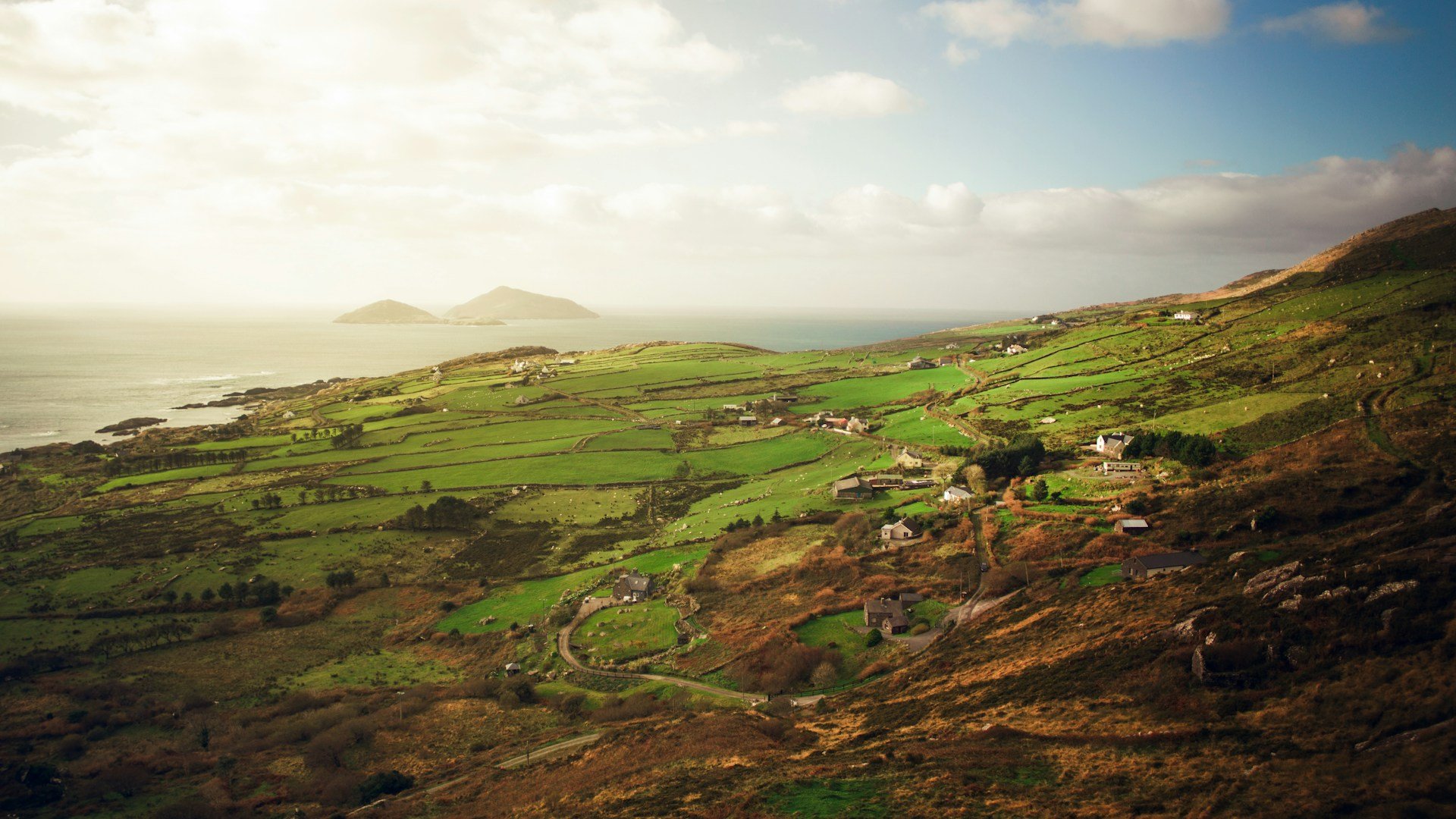
The countryside is genuinely spectacular and genuinely uncrowded once you get off the main tourist routes. The Cliffs of Moher on a July afternoon have a thousand people at the viewing platform. The Cliffs of Moher at dawn, before the buses arrive, with the Atlantic below you and the Aran Islands visible in the distance, are one of the great European views. The Wild Atlantic Way — the marked coastal route running 2,500km from Donegal to Cork — contains stretches of the Beara Peninsula, the Slieve League cliffs in Donegal (nearly three times the height of Moher and a fraction of the crowds), and the Connemara coast that are among the most dramatic and empty Atlantic landscapes in Europe.
Two planning decisions that determine most of the trip: whether you stay in Dublin the whole time (fine for a long weekend; limiting for anything longer), and whether you rent a car (yes, for anything west of the Shannon river). The west of Ireland without a car is a collection of things you read about. With a car, it's a place you actually inhabit.
Ireland at a Glance
A History Worth Knowing
Ireland's recorded history begins in the Neolithic, with the passage tomb at Newgrange in the Boyne Valley constructed around 3200 BCE — five centuries before the Great Pyramid at Giza, a thousand years before Stonehenge. The builders aligned the entrance passage with the winter solstice sunrise so precisely that on the five mornings surrounding December 21st, a shaft of light penetrates the 19-meter passage and floods the inner chamber for 17 minutes. This was not an accident. It required astronomical knowledge and engineering precision that most people, confronted with it, find impossible to believe. Go there if you can. It is one of the strangest and most affecting places in Europe.
Celtic culture reached Ireland around 500 BCE, and with it the Irish language — the oldest written vernacular language in Europe north of the Alps. The druids, the Brehon law system, and a highly sophisticated oral culture preceded Christianity by centuries. When St. Patrick arrived in the 5th century CE (he was a British Roman, not Irish, captured as a slave and returned as a missionary), Christianity was absorbed without displacing the existing culture so much as layering onto it. The Irish monasteries of the 6th through 9th centuries became the most important centers of learning in Europe during the period when continental scholarship collapsed after Rome's fall. The monks copied and preserved classical texts while simultaneously producing works of art — the Book of Kells, now in Trinity College Dublin's Long Room, is a manuscript from around 800 CE that contains illuminations of such intricacy that their production required more than 20 years of dedicated work.
The Vikings raided and then settled, founding Dublin (Dubh Linn — "black pool"), Waterford, and Limerick in the 9th and 10th centuries. The Normans arrived in 1169 and gradually took control, though never fully — Ireland remained a patchwork of Gaelic clans and Norman lordships for centuries. English attempts to fully subjugate Ireland intensified from the 16th century. The Plantation of Ulster in the early 17th century — settling Protestant colonists from Scotland and England on land confiscated from the native Catholic Irish — planted the ethnic and religious division that still structures Northern Ireland's politics today.
The Penal Laws enacted through the 17th and 18th centuries banned Catholics from owning land over a certain value, entering professions, bearing arms, or practicing their religion openly. The cumulative effect was the systematic dispossession and impoverishment of the Catholic Irish majority. The United Irish Rising of 1798, inspired by the American and French revolutions, was brutally suppressed. The Act of Union in 1800 abolished the Irish Parliament and brought Ireland directly under Westminster rule — a decision whose consequences lasted 122 years.
The Great Famine of 1845–1852 is the defining catastrophe of modern Irish history. A potato blight destroyed the crop that the impoverished tenant-farm population depended on for survival. Between starvation, disease, and emigration, Ireland's population fell from 8 million to 5 million in a decade. It has never fully recovered — Ireland's pre-Famine population has not been matched since. The British government's response, prioritizing the laws of political economy over relief while food exports continued from Ireland during the height of the starvation, became a source of enduring grievance. Whether the Famine constitutes a genocide remains contested among historians but is part of how many Irish people understand their own history. Walk through the Famine memorial on Dublin's Custom House Quays and let the figures speak for themselves.
The 1916 Easter Rising — a small, militarily unsuccessful rebellion in Dublin that the British executed its leaders for, turning them into martyrs and shifting public opinion toward independence — is the founding event of the Irish Republic. Michael Collins, the guerrilla war from 1919 to 1921, the Treaty of 1921 that created the Irish Free State but partitioned the island, and the civil war that followed between pro- and anti-Treaty forces are the complicated birth of the modern state. The border created in 1921 between the Free State and Northern Ireland was intended as temporary and became permanent — a source of conflict that exploded into the Troubles from 1968 to 1998, a thirty-year low-intensity war between republican paramilitaries, loyalist paramilitaries, and the British security forces that killed over 3,500 people and affected every family in Northern Ireland in some way.
The Good Friday Agreement of 1998, signed by both governments and endorsed by referendum in both parts of the island, ended the armed conflict. Belfast today is one of the most remarkable post-conflict cities in the world — genuinely transformed, with a museum scene, food culture, and creative energy that has no precedent in the city's history. The mural-covered walls of the Falls and Shankill Roads remain, now as political art and historical record. The peace is durable. The underlying political questions are not fully resolved.
Modern Ireland is wealthy, urban, and deeply changed from the country it was fifty years ago. EU membership brought infrastructure investment; the Celtic Tiger economic boom of the 1990s brought prosperity and transformation; the 2008 financial crisis brought collapse and austerity; recovery has followed. The influence of the Catholic Church — once totalizing — has collapsed dramatically following revelations about institutional abuse and cover-up. Same-sex marriage was approved by referendum in 2015 with 62% in favor. Abortion was legalized in 2018 after a referendum. A country that was the most conservative in Western Europe by many measures has changed faster than almost anywhere else in a generation.
Passage tomb constructed, aligned to winter solstice sunrise. Older than Stonehenge and the pyramids.
Christianity arrives. Irish monasteries become the most important centers of learning in Europe during the Dark Ages.
Anglo-Norman lords arrive. Begin 750 years of contested English presence in Ireland.
Protestant settlers planted on confiscated Ulster land. The ethnic-religious divide that still structures Northern Ireland begins here.
A million dead. A million emigrated. Ireland's population collapses from 8 million and never recovers.
Small uprising in Dublin, militarily failed but politically transformative. The Republic declared from the GPO steps.
Irish Free State established. Six Ulster counties remain in the United Kingdom. The border is drawn.
The Troubles end. Belfast begins its transformation. The question of reunification remains open.
Top Destinations
Ireland divides naturally into Dublin and the east, the Wild Atlantic West from Donegal to Cork, and Northern Ireland as a distinct entity with its own character and currency. For a first trip, Dublin plus one or two regions of the west is the right scale. The country is small enough that you can drive coast to coast in three hours, but the west repays slow travel in a way that rushing between landmarks does not.
Dublin
A compact, walkable Georgian city of red-brick terraces, a river bisecting it, and enough literary history per square kilometer to make any English-speaking visitor feel slightly guilty for not reading more. Trinity College's Long Room, housing the Book of Kells, is genuinely magnificent and requires booking ahead. The Guinness Storehouse is expensive and worth it once for the rooftop bar view. The National Gallery on Merrion Square is free and contains Vermeer and Caravaggio with no queue. For the evening: avoid Temple Bar's overpriced tourist traps entirely. Walk five minutes south to Kehoe's on South Anne Street, Mulligan's on Poolbeg Street, or the Stag's Head on Dame Court — pubs that have been doing this correctly since the 1800s. Allow three days minimum.
Galway
Ireland's most charismatic city, built around a medieval core with a river running through it and a bay beyond. Galway punches far above its size of 80,000 people in music, food, and atmosphere. The pedestrianized quarter between Shop Street and Quay Street is one of the more pleasant concentrated urban spaces in Ireland. The Spanish Arch, a remnant of the medieval city wall on the river, is the correct place to sit with a takeaway pint on a summer evening. The Tuesday and Saturday markets on Market Street are excellent for cheese and bread. The Cliffs of Moher are 50 minutes south. The Aran Islands are a 45-minute ferry from Rossaveel. Connemara starts 20 minutes west. Galway is the correct base for exploring a third of Ireland.
Cliffs of Moher
214 meters of vertical cliff face dropping into the Atlantic along 8km of County Clare coastline. At full tourist peak — 11am on a July Sunday — there are 3,000 people at the main viewing area. At 7:30am on any morning in May, there might be 30. The Cliffs of Moher coastal walk extends beyond the main visitor center and becomes genuinely empty within 2km in either direction. The view south from O'Brien's Tower toward the Aran Islands in the morning light is the poster image of the Irish Atlantic coast for reasons that hold up in person. Entry costs €8–10. Arrive early. Walk further than the car park. Come back at different light.
Newgrange & the Boyne Valley
An hour north of Dublin, the Brú na Bóinne complex contains three passage tombs — Newgrange, Knowth, and Dowth — built between 3300 and 2900 BCE. Newgrange is the famous one: the 19-meter passage aligned to the winter solstice sunrise, with a roof-box above the entrance engineered to admit the light. Access is by guided tour from the visitor center, limited daily, book weeks ahead in summer. The lottery for the five mornings of actual winter solstice illumination is oversubscribed by thousands each year. Even without the solstice event, standing in the passage while the guide extinguishes the lights and describes what happens on those five December mornings is affecting in ways that are hard to predict in advance.
Donegal & Slieve League
Donegal is Ireland's most undervisited county relative to its quality. The Slieve League cliffs on the southwest coast rise 601 meters above the Atlantic — nearly three times the height of the Cliffs of Moher, with a fraction of the visitor numbers. The drive to the viewing area takes you through bogs and heather mountains that feel like the end of Europe. Glenveagh National Park in the north of the county is the largest national park in Ireland, centered on a Victorian castle on a loch with red deer on the surrounding hills. Donegal Town has a castle and the best chipper in the country according to a significant number of people who have eaten in a lot of chippers. The Irish spoken in the Gaeltacht areas of the southwest is the last living daily Irish-language community of significant size.
The Burren
A 250 square kilometer plateau of exposed grey limestone pavement in County Clare, cracked into slabs called clints and grykes, and supporting a flora that is botanically impossible: Arctic, Alpine, and Mediterranean species coexist because the limestone stores daytime heat and prevents frost. In May and June, orchids, gentians, mountain avens, and bloody cranesbill grow directly from the rock. The Burren is adjacent to the Cliffs of Moher and most visitors drive through it in half an hour. Walking into it — the Burren Way, the Caher River trail, any of the hill tracks above Ballyvaughan — is the correct approach. It takes time to understand what you're seeing and then it is unforgettable.
Belfast & the Causeway Coast
Northern Ireland is part of the United Kingdom and uses the pound sterling, but there is no border infrastructure — you drive across without formality. Belfast is the most improved city in Europe over the last 25 years. The Titanic Belfast museum on the slipway where the ship was built is one of the finest purpose-built museums in the world. The black taxi tours of the Falls and Shankill Roads — narrated by drivers from each side of the conflict — are uncomfortable and necessary. The Giant's Causeway on the north Antrim coast, 40,000 basalt columns formed by a volcanic eruption 60 million years ago, is UNESCO World Heritage and genuinely extraordinary. The Coastal Causeway Drive connects it with the Carrick-a-Rede rope bridge and the whiskey distilleries of Bushmills in a day.
Kerry & the Dingle Peninsula
The Ring of Kerry is Ireland's most heavily toured scenic drive — fine, but crowded with coach tours from June to August all heading clockwise. The Dingle Peninsula immediately north is more dramatic, less crowded, and has better food. Slea Head Drive on Dingle's western tip passes early Christian beehive huts (clochán), sea stacks, and a coastline that looks more like the edge of the world than a tourist route. Dingle town has the best concentration of good restaurants relative to size outside Dublin. Brandon Creek, on the peninsula's north coast, is where St. Brendan allegedly departed in a leather boat for a voyage that may have reached America in the 6th century. The Kerry Way walking trail circles the Ring in seven to eight days and is one of Ireland's finest long walks.
Culture & Etiquette
Ireland operates on a social register that is unusually easy for most English-speaking visitors to navigate — same language, left-hand drive, recognizable institutions — but has enough distinct cultural DNA to reward attention. The Irish relationship with understatement, self-deprecation, and the sideways approach to complimenting someone is its own art form. Direct enthusiasm is fine. Excessive earnestness about Ireland's charm will be received with polite deflation. The correct response to "how are you?" is "not bad, yeah" regardless of how you actually are.
The pub is the central cultural institution and it is worth understanding correctly. An Irish pub is not primarily a place to get drunk. It is a social space that serves drinks. Conversations start easily between strangers. A person sitting at the bar alone is not anti-social — they are open to company. The round system (everyone in the group buys a round in turn) is a real social obligation: if someone buys you a drink, you are expected to reciprocate when it's your turn. Leaving before your round comes around is mildly bad form and will be noted.
Irish conversational culture rewards participation. The ability to hold a conversation, tell a story, and respond to banter is genuinely valued. Being funny helps but is not required. Being present and engaged matters more. If someone at a bar starts talking to you, talk back — they are not selling anything.
If someone buys you a drink, you buy the next round when it comes. This is the social contract of the Irish pub. If you don't want another drink, say so clearly when the round is being bought — not after you've accepted it. The round system is how the economics and social mechanics of a pub evening work. Opt out gracefully if needed; don't quietly accept rounds you have no intention of reciprocating.
The political murals in the Falls Road and Shankill Road areas are not street art installations for tourist photographs. They are memorials and political statements in communities that have strong feelings about them. If in doubt about context, a black taxi tour with a local guide is the correct way to engage with this material.
Irish rural roads are narrow — genuinely narrow, often one-lane with passing places — and have hedgerows on both sides that block sightlines. The speed limit is 80km/h on these roads. This is optimistic. Drive at the speed the road actually demands, use the passing places properly (pull in to let oncoming cars through), and do not tailgate. Tractors appear without warning.
Ireland's history with Britain is complicated and still live in ways that visitors sometimes underestimate. Questions about "the Troubles," partition, the Famine, and Irish unification are not abstract historical topics — they have living personal relevance to Irish people of various backgrounds. Engage seriously if the topic comes up. Do not reach for simplifications.
Ireland and Britain are different countries. "British Isles" as a geographical term is contested in Ireland. "The UK" refers only to Northern Ireland from these islands. Conflating Ireland with Britain — even accidentally — touches a nerve that runs deep in Irish history. It is corrected gently the first time and with less gentleness subsequently.
Dublin's Temple Bar area has roughly a dozen pubs that charge €8–9 for a pint, have DJs playing pop music, and are full of tourists and stag parties. They are not Irish pub culture in any meaningful sense. They exist to extract money from visitors who don't know better. Walk ten minutes in any direction and find a proper pub serving a €5.50 pint in peace.
Arriving with a detailed knowledge of your Irish grandmother, an overfamiliarity with Gaelic phrases learned from a YouTube video, and strong opinions about the GAA is the fastest way to signal that you don't actually know Ireland. Irish people are warm to genuine curiosity. Performed enthusiasm is recognized immediately and deflated with humor.
A traditional music session in a pub is musicians playing for each other. You happen to be in the same room. You are not the audience in any formal sense. Do not request songs, do not film the musicians without asking, do not applaud individual songs when sets are being played together, and do not attempt to join in vocally unless genuinely invited. Sit close, listen respectfully, and enjoy being in the room.
Irish pubs do food — sometimes very good food — but typically kitchen hours end at 9pm and often earlier in rural areas. If you want dinner at 10pm in a small town in Clare or Donegal, find a restaurant, not a pub. Food in rural Ireland operates on time that would alarm most southern Europeans and confuse most Americans used to all-night options.
Traditional Music
Irish traditional music is a living tradition with distinct regional styles: Clare is known for its flowing jig style, Sligo for the ornamented fiddle playing of Michael Coleman's legacy, Donegal for its driving bow technique and Scottish influences, Galway for its flute and accordion work. The instruments are fiddle, uilleann pipes (bellows-blown, uniquely Irish), flute, tin whistle, button accordion, and bouzouki. Comhaltas Ceoltóirí Éireann (the national organization for Irish traditional music) maintains session listings at comhaltas.ie. The Willie Clancy Summer School in Miltown Malbay, County Clare, every July, is the world's largest gathering of traditional musicians.
Literary Culture
For a country of five million people, the Irish literary tradition is so disproportionate it verges on the inexplicable: Swift, Wilde, Shaw, Yeats, Synge, O'Casey, Beckett, Joyce, Flann O'Brien, Seamus Heaney — four Nobel Prizes in literature from a country the size of Indiana. Reading even one of them before arriving changes how you see the place. Dubliners by Joyce is fifteen stories, takes a weekend, and transforms a walk around Dublin's south inner city into something entirely different. Heaney's poems — particularly the ones about County Derry, his homeland — do the same for the northern landscape.
GAA — Gaelic Games
Gaelic football and hurling — both played in the same stadiums under the Gaelic Athletic Association — are not minority sports in Ireland. They are the national sports, with county rivalries as intense as anything in European football. A summer afternoon in Croke Park in Dublin watching an All-Ireland Championship game between two counties is a genuinely great sporting experience. Hurling is the faster, more skillful, genuinely ancient game — a field sport played with wooden sticks (hurleys) and a small leather ball (sliotar) at speeds that require attention to follow. Get tickets for either. The atmosphere is distinctive and entirely Irish.
Weather as Character
The Irish relationship with weather is not resignation — it is something more like philosophical acceptance with a dark sense of humor. "Soft day" means it's raining but gently. "Grand" means acceptable, which in weather context means it's not currently raining. The light in Ireland after rain — the specific quality of a clearing Atlantic squall on the west coast, when everything is washed and saturated and the green becomes almost violent — is something photographers travel specifically to capture and that no photograph quite reproduces. Embrace the rain. Dress for it. Then be in it when it stops.
Food & Drink
Irish food has a reputation problem abroad that is partly historical and partly deserved, but increasingly outdated. The traditional Irish diet — potatoes, bread, butter, bacon, and cabbage, all produced locally and of high quality — was shaped by poverty and colonial land structures that limited what most people had access to. What Ireland has now is different: a food culture built around some of the finest raw ingredients in Europe (the grass-fed beef, the wild Atlantic seafood, the farmhouse cheeses, the soda bread from a local bakery) and a restaurant scene that has matured significantly in the last twenty years, particularly in Cork, which runs Dublin close for the best eating in the country.
The single most important food truth about Ireland: the seafood along the west coast is extraordinary and the restaurants serving it in small harbor towns are better value than comparable seafood anywhere in Western Europe. Oysters from Clarinbridge in Galway Bay, crab from the Beara Peninsula, smoked salmon from a smokehouse on the Connemara coast — these are products of specific place and they are at their best at source.
Oysters
Galway Bay oysters — specifically native flat oysters (Ostrea edulis) rather than Pacific oysters — are among the best in the world and have been harvested here since prehistoric times. The Galway International Oyster Festival in late September is the oldest in the world and still a good reason to time a visit. A dozen Clarinbridge oysters with a pint of Guinness at Moran's of the Weir in Clarinbridge, 15 minutes south of Galway city, costs €22–26 and is the most authentically Irish meal you can eat on the west coast.
Irish Breakfast
The full Irish — rashers (back bacon), sausages, black and white pudding, eggs, grilled tomato, mushrooms, soda bread, and brown bread with butter — is a meal that the Irish eat for breakfast with no apology and that should be eaten in a café rather than a tourist hotel. The black pudding in particular (blood sausage, made with barley and oatmeal, produced regionally with distinct recipes) at a good address — Jack McCarthy's from Kanturk in Cork, for instance — is a food product of serious quality that bears no relationship to the grey cylinder served abroad.
West Coast Seafood
Smoked salmon from a connemara smokehouse. Crab claws from a Kerry harbor. Mussels from the clean cold bays of Donegal. Dublin Bay prawns (langoustines) from Skerries or Howth, 30 minutes north of Dublin, where you can buy them directly off the boat. Seafood chowder — the cream-based version loaded with local fish and shellfish, served with brown soda bread — is the correct lunch anywhere on the west coast. It costs €10–14 in a harbor-side café and has no reliable equivalent in any landlocked city in Ireland.
Soda Bread & Brown Bread
Irish soda bread uses bicarbonate of soda as the leavening agent rather than yeast, requiring buttermilk rather than water — a product of necessity in a country where the soft water and humid air made yeast-based baking unreliable. A fresh loaf of white soda or dense wholemeal brown bread from a local bakery, still warm, with Irish butter and smoked salmon, is simple to the point of being just ingredients — and better than most food in Ireland for that reason. Supervalu supermarkets often have a bakery section with good local bread. Buy it there.
Guinness
Guinness genuinely tastes different in Ireland — specifically in pubs that store and pour it correctly, which requires the right temperature, the correct two-stage pour, and ideally a keg that has been through a substantial number of pints already today. The Guinness in the Guinness Storehouse in Dublin is a tourist experience at tourist prices. The Guinness in a mid-afternoon quiet pub where the barman has been pulling pints for twenty years and the line moves quickly — that version exists across Ireland for €5.20–6.00 and is a different drink from what you've had before.
Irish Whiskey
Irish whiskey was the dominant whiskey category globally in the 19th century and nearly disappeared in the 20th. The revival since 2010 has been remarkable: from three distilleries to over forty, with new producers in Waterford (terroir-focused single malt), West Cork, Lough Ree, and elsewhere making whiskeys that have won international recognition. Jameson remains the dominant brand; Redbreast 12-year Single Pot Still and Green Spot are the entry points to the more complex end of the category. A whiskey trail taking in Dingle Distillery (Connemara Single Malt), Slane Castle, and Kilbeggan makes a legitimate road trip itinerary.
When to Go
May and early June are the best months. The evenings are long — sunset doesn't come until after 9:30pm in late May — the wildflowers are at their peak in the Burren and on the Atlantic headlands, accommodation prices haven't peaked, and the tourist volumes on the Wild Atlantic Way and Ring of Kerry are still manageable. September is the second-best choice: the light softens, the crowds have thinned, and the evenings are still reasonable. The weather is Irish in all seasons — meaning unpredictable and frequently wet — so the choice of season is more about light, crowds, and prices than about avoiding rain, which is not fully avoidable.
Late Spring
May – JunLong evenings into late light. Wildflowers at Burren peak. Atlantic cliffs without coach tours. Pre-peak accommodation prices. Puffins arrive at the Skellig Islands in mid-April and are at Cliffs of Moher from May. The tourism infrastructure is fully open. Book ahead for Newgrange and popular guesthouses — this is no longer a secret season.
Early Autumn
Sep – OctCrowds gone from the west coast. Softer light and occasional amber afternoons. Galway Oyster Festival in late September. The beaches of Kerry and Clare are still swimmable for the hardy (15–17°C water). October brings the Wexford Opera Festival and the Cork Jazz Festival. Accommodation prices drop across the board.
Winter
Nov – FebDramatically empty west coast. The Atlantic storms that batter the Connemara and Donegal coasts in winter are spectacular if you're dressed for them and not trying to drive through them. Dublin and Belfast are excellent in winter — the cultural life is fully running and accommodation is cheapest. The Newgrange winter solstice lottery is December. Dark, atmospheric, and authentic.
Peak Summer
Jul – AugThe Ring of Kerry traffic in August is genuinely unpleasant. The Cliffs of Moher have 1.5 million visitors annually and the majority come in these two months. Accommodation on the Wild Atlantic Way is expensive and scarce without booking months ahead. If July or August is your only option, focus on Donegal and the northwest — they are less crowded relative to their quality.
Trip Planning
The fundamental decision in Ireland planning: how much of the island do you want to cover? Ireland is deceptively small on a map but the road network — particularly in the west and northwest — is slow. A hundred kilometres in Connemara takes two hours not because the roads are bad but because they are narrow, scenic, and full of things that make you stop. Plan for roughly 60–70km per hour of actual driving time on rural western roads, not the map distance.
The two most sensible formats: a week in Dublin and the west (fly in and out of Dublin, pick up a car, drive to Galway, explore from there), or a ten-to-twelve day loop (Dublin, Newgrange, up to Donegal, down the Wild Atlantic Way to Cork, back to Dublin). The second version covers more but works only with adequate time. Rushing the Wild Atlantic Way produces beautiful photographs and no actual experience of the places.
Dublin
Day one: Trinity College and Book of Kells (book ahead), walk south across the Grand Canal through Georgian squares, find a proper pub for the evening — Kehoe's, Mulligan's, or the Long Hall on George's Street. Day two: National Museum (free — the Iron Age bog bodies and the early Christian gold are the unmissable rooms), EPIC Emigration Museum on the north quays in the afternoon, walk the Ha'penny Bridge to the north side for dinner in Phibsborough or Stoneybatter where the food scene has improved dramatically.
West to Galway
Pick up the car and drive to Galway (2.5 hours). Stop at Athlone for a coffee at Sean's Bar — one of the oldest pubs in the world, dating to 900 CE, on the Shannon. Arrive Galway by mid-afternoon, walk the city, find the Spanish Arch. Day four: drive the Connemara loop — Clifden, the Sky Road above the Atlantic, Kylemore Abbey, the Roundstone bog road back. Dinner in Galway. Find the session at Tigh Coilí or Monroe's.
Cliffs of Moher & the Burren
Early start: arrive at Cliffs of Moher by 8:30am before the buses. Walk south past the main platform toward Hag's Head for the view that isn't on every postcard. Drive through the Burren in the afternoon — take the coast road through Ballyvaughan rather than the main road, stopping at Poulnabrone dolmen (a portal tomb from 4000 BCE, free, in an open field). Stay in Doolin for the evening: Gus O'Connor's pub has been running sessions reliably for decades.
Back to Dublin
Return drive, 3 hours. Stop at Clonmacnoise on the Shannon — a 6th-century monastic settlement on the river, one of the most important early medieval sites in Ireland, usually with very few visitors despite its extraordinary quality. Return the car in Dublin and fly home, having seen perhaps 15% of Ireland and already planning to come back for the rest of it.
Dublin & Boyne Valley
Three days in Dublin plus a day trip to Newgrange and the Boyne Valley (book Newgrange tour in advance — the OPW official tour is the only way into the passage). Also: the Hill of Tara, the high seat of the Irish High Kings, 15 minutes from Newgrange — a windswept hill with circular earthworks and a view over the Meath plain that requires imagination rather than intact ruins. The context from the National Museum makes both sites come alive.
Donegal & the Northwest
Drive north: stop at the walled city of Derry/Londonderry (the naming is political — both names are used depending on community), walk the 17th-century walls, see the murals of the Bogside including the famous "You Are Now Entering Free Derry." Then north into Donegal: Glenveagh National Park, Slieve League cliffs (park at Bunglass viewpoint), and a night in Ardara or Glencolmcille in the Irish-speaking southwest.
Wild Atlantic Way South to Galway
Drive the Wild Atlantic Way south: Sligo (Yeats country — the mountain of Ben Bulben is unmistakable, Yeats' grave at Drumcliffe is five minutes from the road), through Mayo and the dramatic coast at Achill Island, down through Connemara to Galway. This stretch in good light is the most spectacular mainland coastal drive in Ireland. Allow three days to do it without driving past everything.
Clare, Kerry & Cork
Cliffs of Moher and the Burren properly, Dingle Peninsula, and then into Cork. Out of the Blue restaurant in Dingle for fish dinner if in season. The English Market in Cork city for breakfast provisions. Kinsale — a pretty harbor town 25 minutes south of Cork with the highest concentration of good restaurants outside Dublin — for one night. East Cork for local producers: Ballymaloe Cookery School's farm shop, the Midleton Farmers' Market on Saturday morning.
Back North to Dublin
Drive the inland route through Cashel — the Rock of Cashel, a Romanesque cathedral complex on a limestone outcrop above the Tipperary plain, is one of Ireland's most dramatic medieval sites and usually less crowded than coastal attractions. Kilkenny, a preserved medieval city with the country's best castle, for a lunch stop. Return to Dublin. Fly home having covered roughly a third of what Ireland offers.
Dublin Properly
Four days to do Dublin without rushing. Add: the Chester Beatty Library in Dublin Castle (free — one of the finest collections of Islamic, East Asian, and European manuscripts in Europe, in a city library that most visitors walk past), Glasnevin Cemetery where Daniel O'Connell, Parnell, Collins, and de Valera are buried and where the history of the state can be read in the headstones, and a day trip to the Wicklow Mountains — the Glendalough valley with its 6th-century monastic settlement in a glacial lake setting is 50 minutes by bus from the city.
Northern Ireland
Three days across the border: Belfast properly (Titanic museum, black taxi tours, Cathedral Quarter food scene, the Crown Liquor Saloon — a Victorian gin palace on Great Victoria Street that is National Trust-protected and serves excellent pints), then the Causeway Coast (Giant's Causeway, Dunluce Castle ruins, Bushmills distillery for a tour). The Glens of Antrim on the drive back are extraordinarily beautiful and empty of tourists.
Donegal Deeply
Four days in Donegal takes you into the most remote and Irish-speaking part of the country. Stay in Gweedore or Glenties where Irish is the everyday language in shops and pubs. The Donegal Gaeltacht traditional music scene — less well-known than Clare's — is centered on the Teach Jack pub in Gweedore. Arranmore Island is 15 minutes by ferry from Burtonport and has a small population, dramatic cliffs, and the best pub views in Ireland at Arranmore Island Hotel.
Wild Atlantic Way: Sligo to Galway
The full northern Wild Atlantic Way at a pace that allows walks rather than drives. Achill Island deserves two nights — the deserted village above the cliffs, the 2,000-year-old bog road, the dramatic Atlantic drive. Clare Island. Westport — a planned Georgian town on Clew Bay, with Croagh Patrick above it (the mountain where St. Patrick allegedly fasted for 40 days, pilgrimaged annually in July). Into Connemara, staying at Clifden.
South: Kerry, Cork, Wicklow
The Aran Islands by ferry from Rossaveel — Inis Mór by bike is a full day. Dingle Peninsula. Kerry Way walking section if time allows. Cork city for two nights — the best restaurant-per-capita city in Ireland. Drive home through Waterford (oldest city in Ireland, Viking foundations) and up the Wicklow coast. Return the car in Dublin. The twenty-one days you've spent have covered the island's main headings. Ireland is still not finished with you.
Vaccinations
No mandatory vaccinations required for Ireland. Recommended: routine vaccines up to date. No malaria, no significant tropical disease risk. Ireland is a low public-health-risk destination. Standard travel precautions apply.
Full vaccine info →Northern Ireland Currency
Republic of Ireland uses the Euro (€). Northern Ireland uses Pound Sterling (£). If crossing the border — and you should — carry both currencies or use a card with no foreign transaction fees. The physical border has no infrastructure but the currency changes the moment you cross.
Driving on the Left
Ireland drives on the left. For visitors from continental Europe, North America, or Asia, this requires adjustment. The most dangerous moment is typically pulling out of a petrol station, a car park, or a T-junction — when habit takes over. Rent automatic if possible. Rural Irish roads are narrower than they look on the map. Factor this in.
Connectivity
EU roaming applies for European carriers in the Republic of Ireland. Northern Ireland has UK rates. US and other non-EU visitors should get an Irish eSIM via Airalo. Mobile coverage is good in cities and along main routes; patchy in Donegal's mountains and Connemara's interior. Download offline maps for any remote driving.
Get Ireland eSIM →Waterproof Gear
A proper waterproof jacket — fully seam-sealed, not "water resistant" — is the most useful item you can bring to Ireland. Not for surviving storms (though that helps) but for the light Atlantic drizzle that lasts twenty minutes, clears, and is followed by extraordinary low Atlantic light. Be ready to be in it when it stops.
Travel Insurance
EU EHIC covers emergency medical care in the Republic of Ireland for EU citizens. Non-EU visitors should carry travel insurance with medical coverage. Irish private hospitals are excellent; public A&E waits can be long. Northern Ireland operates under NHS — UK health coverage applies for eligible visitors.
Transport in Ireland
Dublin has the Luas tram system (two lines crossing the city center), the DART coastal rail line running from Greystones in the south to Howth in the north, and a bus network that covers greater Dublin well. Outside Dublin, transport drops off sharply. Bus Éireann covers intercity routes and some rural services but schedules are infrequent. Irish Rail connects Dublin to Cork, Galway, Limerick, Waterford, and Sligo with reasonable frequency. The west of Ireland beyond these corridors is genuinely a car rental country.
Dublin Luas
€1.60–3.10/rideTwo lines (Red and Green) connecting Dublin's main hubs. Green Line useful for Sandyford and the south suburbs. Red Line connects Heuston Station to the docklands. A Leap card reduces fares and handles all Dublin public transport including DART and Dublin Bus.
DART
€2.15–4.50The coastal rail service running 40km of Dublin Bay coastline. Essential for reaching Howth (seafood, cliff walks) to the north and Bray, Dún Laoghaire, and the Saturday market to the south. Runs every 10–15 minutes. Buy tickets with the Leap card app.
Irish Rail (Iarnród Éireann)
€15–45/routeDublin to Cork (2h30m), Dublin to Galway (2h15m), Dublin to Limerick (2h), Dublin to Sligo (3h). Comfortable and reliable. Book on irishrail.ie. The Cork to Cobh branch line (20 minutes from Cork Kent station) reaches Cobh — the port from which millions emigrated — and is worth a half-day.
Bus Éireann
€8–25Intercity buses run frequently between main cities and reach many smaller towns. Slower than rail but often cheaper. The Expressway coaches are comfortable. Rural local buses can have two departures a day in some areas — check schedules carefully before planning a countryside day using public transport.
Car Rental
€40–90/dayEssential for Connemara, Donegal, Kerry, and anywhere on the Wild Atlantic Way. Book in advance — popular summer weeks sell out. Automatic cars are more expensive but strongly recommended for visitors not used to left-hand drive with a manual gearbox simultaneously. Full insurance coverage is standard practice. Check your home insurance and credit card coverage first.
Ferries
€15–40/routeAran Islands from Rossaveel (45 mins, year-round). Clare Island from Roonagh Quay near Louisburgh. Arranmore from Burtonport. Skellig Michael from Portmagee or Ballinskelligs (boat landing, strictly weather-dependent, book months ahead). Stena Line and Irish Ferries connect Dublin and Rosslare to the UK and mainland Europe for longer itineraries.
Taxi & Rideshare
€4.10 start + meterFree Now (FreeNow) is the dominant taxi app in Dublin and major cities. Uber operates in Dublin but uses licensed taxi drivers under Irish regulations. Taxis are metered and regulated. In rural areas, there are often local taxi numbers posted in pubs and guesthouses — worth saving when you arrive at a rural destination.
Cycling
€3–20/dayDublin Bikes (city hire scheme) is cheap and practical for short city trips. The Greenway network — off-road cycling paths converted from old railway lines — is expanding and includes the Great Western Greenway in Mayo (42km from Achill Sound to Westport, the most popular in Ireland). Inis Mór on the Aran Islands is the classic island cycling experience.
A Leap card covers all Dublin public transport — Luas, DART, Dublin Bus, and commuter rail within the Dublin zone — at reduced fares compared to single tickets. Buy one at Dublin Airport arrivals (€5 deposit, top up with however much you need) and use it for the duration of your city stay. The 90-minute transfer feature means connecting journeys within 90 minutes count as one fare. A €20 top-up covers three to four days of urban travel.
Accommodation in Ireland
Ireland's accommodation market runs from Georgian townhouse hotels in Dublin (expensive but genuinely good) to family-run B&Bs in farmhouses on the Wild Atlantic Way (excellent value, personal, and usually the best source of local knowledge about where to eat and what to avoid). The B&B tradition in Ireland is real and useful: a double room with a full Irish breakfast included typically costs €80–130 outside Dublin, covers the most important meal of the day, and comes with a conversation that can change the direction of your day if you pay attention to what the host says about the road conditions and the best pub in the next village.
Boutique Hotel
€120–300/nightDublin has excellent boutique hotels in the city center: the Devlin in Ranelagh, the Merrion Hotel in Georgian splendor on Merrion Street, the Hendrick in Smithfield. In Galway, the House Hotel on Lower Merchant's Road. In Cork, the River Lee. These are distinctly Irish properties rather than international chain hotels.
B&B / Guesthouse
€70–130/nightThe backbone of Irish rural accommodation. Quality is uneven but the best are genuinely excellent: warm rooms, enormous breakfasts, hosts who know everyone in the county. Failte Ireland's green leaf certification is a reliable quality indicator. Book directly with the property when possible — they keep more of the money and you get local knowledge that no booking platform provides.
Castle Hotel
€180–500/nightIreland has genuine castle hotels that are neither theme parks nor pretension: Ashford Castle in Cong (extraordinary, expensive), Ballynahinch Castle in Connemara (excellent fishing and walking, more accessible in price), Dromoland Castle in Clare (the most photographed). One night in a converted Irish castle is a specific experience that Ireland delivers better than anywhere else in Europe.
Hostel
€20–40/nightDublin has a strong hostel scene. Generator Dublin near Smithfield and Jacobs Inn on the northside are reliably good. In Galway, Sleepzone on Bothar na mBan and the Galway City Hostel on Eyre Square. Rural independent hostels — particularly on the Wild Atlantic Way in Kerry and Galway — are often converted farmhouses and are the social center of the local traveler community in those areas.
Budget Planning
Ireland is expensive by European standards — on par with Germany and noticeably more than Spain, Portugal, or Eastern Europe. Dublin in particular has hospitality prices that reflect a tight city hotel market and high operational costs. The west of Ireland is somewhat better value: a pub meal in Clare costs €14–18 where the equivalent in Dublin would be €22–28. The single biggest saving available to Ireland visitors is staying in B&Bs rather than hotels and eating pub food rather than restaurant food — both of which are high quality and genuinely Irish experiences rather than compromises.
- Hostel dorm or cheap B&B
- Pub food for lunch and dinner (€12–18/meal)
- Pint of Guinness: €5.20–6.20 outside Dublin
- Leap card for Dublin transit
- Free sites (most ancient monuments, National Museum)
- B&B with full Irish breakfast included
- One restaurant dinner, pub lunch
- Car rental (split between 2 makes it viable)
- Paid attractions (Book of Kells €16, Cliffs €10)
- Occasional whiskey at the distillery
- Boutique hotel or quality guesthouse
- Restaurant dining for every meal
- Car rental (sole driver, better vehicle)
- Private distillery tours and food experiences
- One castle hotel night
Quick Reference Prices
Visa & Entry
Ireland is emphatically not part of the Schengen Area. This is a source of periodic confusion. A Schengen visa does not permit entry to Ireland. An Irish visa does not permit entry to Schengen countries. They are entirely separate visa systems. EU citizens can enter Ireland freely. UK citizens also travel freely to Ireland under the Common Travel Area arrangement that predates both countries' EU relationships.
Citizens of the US, Canada, Australia, New Zealand, Japan, and most Western nations can visit Ireland visa-free for up to 90 days. Ireland does not require ETIAS — Ireland is not part of the Schengen system and therefore not part of ETIAS. This is worth knowing if you're planning an itinerary that combines Ireland with mainland European Schengen countries: they operate independently, and time spent in Ireland does not count against your Schengen 90 days.
Northern Ireland is part of the United Kingdom and follows UK entry requirements rather than Irish ones. UK and EU citizens can move freely between the Republic and Northern Ireland without any passport check — there is no border infrastructure. Visitors from countries requiring a visa for either jurisdiction should check both the Irish and UK requirements before traveling.
Ireland has its own visa waiver system separate from Schengen. Most Western passport holders enter visa-free. ETIAS does NOT apply to Ireland. Time in Ireland does NOT count against Schengen allowances. Always check the current Irish Naturalisation and Immigration Service (INIS) list for your specific nationality.
Family Travel & Pets
Ireland is an excellent family destination for children of almost any age. The landscape is accessible — the beaches on the Wild Atlantic Way are spectacular without being dangerous (Atlantic surf aside on exposed western beaches), the ancient monuments engage children who are given the right context, and the Irish warmth toward children in restaurants, pubs, and even late-evening settings means there is none of the social friction that travel with children produces in some European countries.
Children under 5 travel free on Irish public transport. Most national monuments and heritage sites have family ticket discounts. The Heritage Card (€50 per adult, free for under-12s) covers most OPW-managed sites and pays for itself in 3–4 visits.
Rock of Cashel
A 12th-century Romanesque cathedral and round tower complex on a dramatic limestone outcrop in County Tipperary. The scale is immediately comprehensible to children, the medieval architecture is well-preserved, and the views across the Golden Vale are extraordinary. Less crowded than Dublin's main sites and better value. The OPW Heritage Card covers entry.
Wild Atlantic Wildlife
Puffins nest at the Cliffs of Moher from late April through July. Grey seals haul out on the beaches of Connemara and the Aran Islands year-round. Basking sharks (harmless, up to 10 meters, filter feeders) appear off the west coast in summer. Dolphins ride the bow waves of the Aran Islands ferries regularly. Wild Ireland in the west is genuinely accessible from a car or boat without specialist tours.
Beaches
Ireland's Atlantic beaches — Inch Strand in Kerry, Barleycove in Cork, the beaches of Achill Island, the long arc of Mullaghmore in Sligo — are spectacular. Atlantic water is cold by Mediterranean standards (14–17°C in summer) but perfectly swimmable for children with any degree of stubbornness. The Blue Flag beach certification applies to most major Irish beaches. The water quality is among the highest in Europe.
Newgrange for Older Children
Children aged 10 and up who have been given basic context about the Neolithic period will find Newgrange genuinely extraordinary — the guided tour explains the engineering behind the solstice alignment, the spiral carvings on the kerbstones, and the burial practices of the people who built it. It is not a passive museum visit. It is a passage tomb five thousand years old that you walk inside.
Food for Children
Irish pub food is almost universally accessible for children: fish and chips, chicken tenders, burgers, pasta, baked potatoes. Children's menus are standard in pubs with kitchens. The full Irish breakfast is usually a hit. Ice cream shops — proper Irish ice cream shops, not soft serve — are a feature of every coastal town in Kerry and Clare. Murphy's ice cream in Dingle has been making intensely flavored small-batch ice cream since 2000 and has a cult following that is entirely justified.
Great Western Greenway
The 42km off-road cycling trail from Achill Sound to Westport in County Mayo is the longest in Ireland and one of the best in Europe for families. The terrain is gentle (converted railway line), the scenery is Clew Bay and the Nephin mountains, and the route passes through villages with pubs and cafés. Bike rental is available at both ends and multiple points along the route. Two days at a family pace covers the route comfortably.
Traveling with Pets
Ireland follows EU Pet Travel Scheme rules for pets entering from EU countries: microchip, valid rabies vaccination, and an EU pet passport. Pets from non-EU countries (including post-Brexit UK) have more complex requirements — a health certificate, timing requirements for rabies vaccination, and in some cases tapeworm treatment within specific timeframes. Check with the Department of Agriculture, Food and the Marine (agriculture.gov.ie) for current requirements as these change periodically.
Ireland is reasonably dog-friendly. Dogs are permitted in many outdoor areas, on beaches (subject to seasonal restrictions), and increasingly in pub beer gardens. The interior of most pubs does not permit dogs. National Park access with dogs varies by park — most require dogs on leads in areas with ground-nesting birds. Farmland walking (common in Ireland given the network of looped walks) requires dogs to be controlled around livestock, which is a legal requirement.
The Irish weather works in dogs' favor: the mild, damp climate that makes Ireland green makes it excellent walking country for dogs, and the west coast is genuinely spectacular walking terrain. The Dingle Peninsula, Connemara, and Donegal's hills are among the finest dog-walking landscapes in Europe if you don't mind the rain.
Safety in Ireland
Ireland is a very safe country for tourists. Violent crime is low and tourist-targeting crime is limited to petty theft in Dublin's tourist areas and the standard scams found near any major European attraction. The west coast, rural Ireland, and Northern Ireland are all effectively safe. The Troubles in Northern Ireland ended in 1998 and political violence — while not entirely absent — is rare and not a practical risk for tourists. Belfast is as safe as any UK city.
Street Safety
Good throughout Ireland. Dublin has the usual urban crime pattern of any European capital — pickpocketing in crowded tourist areas, bag snatching near the main attractions. Normal urban awareness applies on O'Connell Street, at Temple Bar, and on the DART. The rest of the country is genuinely very safe.
Solo Women
Ireland rates well for solo female travelers. The pub culture is genuinely sociable and relatively safe for solo women compared to many European drinking cultures. Normal late-night awareness applies. Accommodation in rural B&Bs is particularly safe — family homes running a few rooms.
Atlantic Cliff Hazards
The Cliffs of Moher, Slieve League, and other Atlantic cliff tops have unfenced sections where falls have been fatal. The official paths are safe. Leaving the paths near cliff edges in wet or windy conditions is not. Signs exist. Read them. The Atlantic wind can be sudden and significantly stronger than expected at cliff edges.
Driving on Left
For visitors from right-hand-drive countries, left-hand driving is a genuine adjustment. The most dangerous moment is typically at junctions and car park exits when habit takes over. Rural roads have sightline-blocking hedgerows. Take the first day's driving slowly and consciously.
Tourist Pricing in Dublin
Temple Bar pubs charging €8–9 per pint, "traditional Irish" souvenir shops selling mass-manufactured goods at inflated prices, and overpriced tourist restaurants are the main financial hazard in Dublin. None of these are dangerous — they are simply poor value. Walk away from any pub that has a menu board in four languages and a DJ.
Northern Ireland Context
Belfast is safe and the Causeway Coast is safe. The residual tensions between communities in specific Belfast neighborhoods are real but not a risk to tourists. The black taxi tours of the murals are a guided and contextualised way to engage with the political geography. Avoid political statements in pubs in areas that are clearly identified with one community or the other.
Emergency Information
Your Embassy in Dublin
Most embassies are in the Ballsbridge and Merrion Road areas of Dublin 4.
Book Your Ireland Trip
Everything in one place. These are services worth actually using.
The Conversation Is the Point
Every country in this series has something it does better than anywhere else. Iceland does geology. Greece does ancient history. Hungary does thermal baths and complicated national feeling. Ireland does conversation. Not because Irish people are more talkative or friendlier than people elsewhere — though they often are — but because the culture places a specific value on the quality of exchange between people that shows up in the literature, the music, the pub, and the way a stranger will stop on a wet Connemara road to ask if you're lost and end up twenty minutes later still talking about the townland you're in and its history and the family that farmed it before the Famine.
The Irish word for this is craic — a word borrowed from Scots English but now entirely Irish, meaning the quality of fun, conversation, and social pleasure that a situation has. "Good craic" is the highest compliment a pub or an evening can receive. It is not planned. It is not performed. It happens when people stop doing anything except talking to each other, and it is the reason people come to Ireland once and find themselves booking again before they've left.