
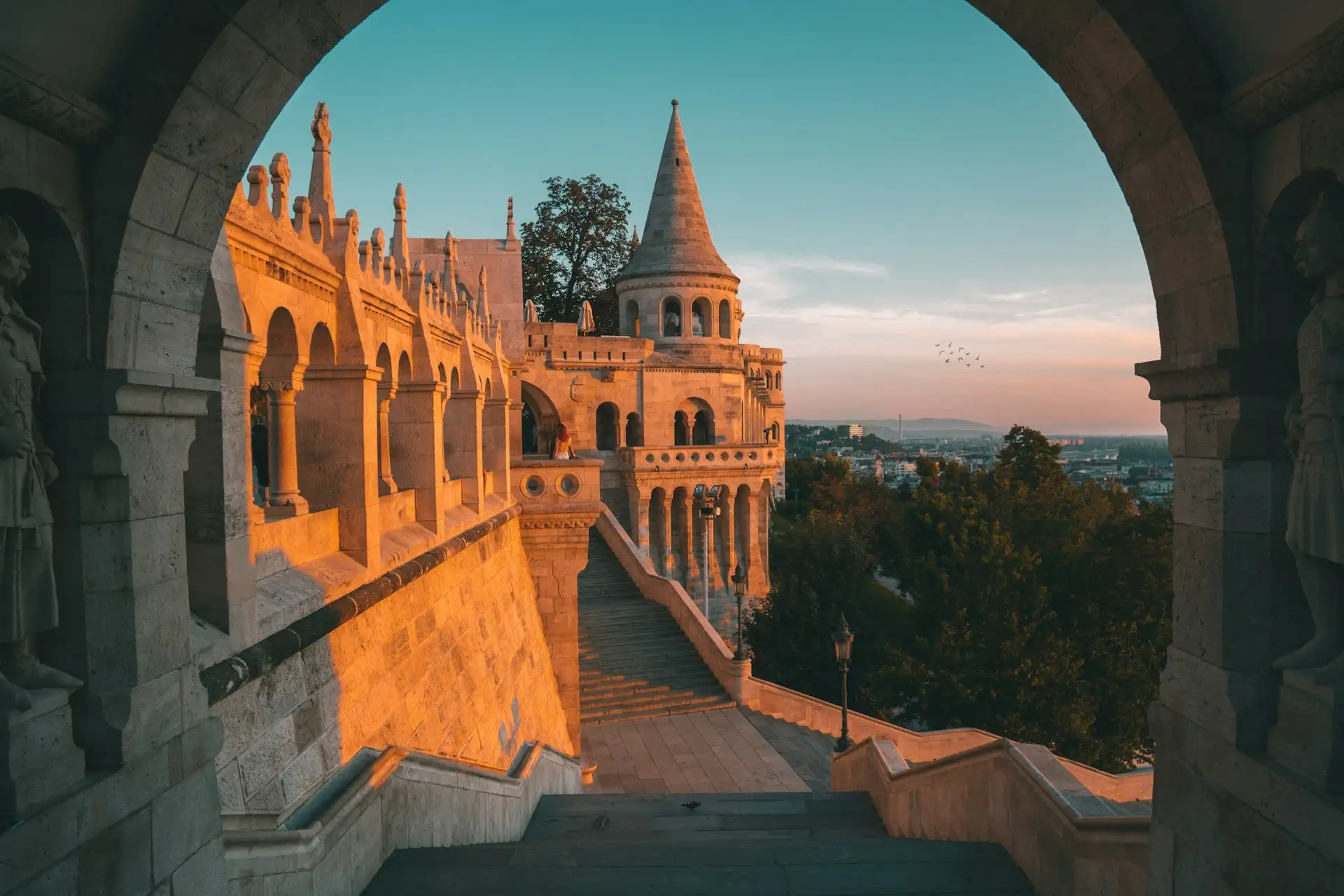
Hungary
A landlocked country with one of Europe's most dramatic capitals, thermal water under every street, wine that deserves far more international attention, and a national character that oscillates between profound melancholy and intense celebration. Often simultaneously.
What You're Actually Getting Into
Budapest is one of the great underplayed capitals of Europe. It has the bones of a 19th-century imperial city — grand boulevards, baroque thermal bath palaces, a parliament building on the Danube that is arguably more impressive than Westminster — and the energy of a place that spent four decades under Soviet rule and has been making up for lost time ever since. The ruin bars in the old Jewish quarter, carved out of derelict buildings in the 2000s, are now internationally famous. That doesn't make them worse. It just means you should go on a weeknight.
The country around Budapest is equally worth your time and gets a fraction of the attention. Eger, with its wine cellars cut into volcanic rock and the fortress that held off the Ottoman army in 1552, is one of the most complete provincial Hungarian towns you'll find. The Tokaj wine region produces Aszú dessert wine that has been poured for European royalty for four centuries and still costs less than €15 a bottle at the winery. Lake Balaton in summer is where every Hungarian goes on holiday — it's the largest lake in Central Europe, warm enough to swim, and surrounded by a specific August cheerfulness that is infectious if you let it be.
One thing to state plainly before you go: Hungary's political situation is a real part of the context of visiting. Since 2010, Viktor Orbán's government has systematically weakened independent media, the judiciary, and civil society institutions, in ways that have put Hungary in repeated conflict with the EU and that affect the daily lives of Hungarian citizens — particularly those from minority communities and the LGBTQ+ community. You will see evidence of this in the architecture of public life: government billboards, state media dominance, monuments with particular political readings of history. Knowing this doesn't mean not going. It means going with your eyes open, which is always the better way.
What Hungary offers that no other country quite replicates: the feeling of being in a place with deep, specific, slightly melancholy cultural identity — a language spoken nowhere else on earth, a musical tradition that runs from Liszt and Bartók to the most vital folk music scene in Central Europe, a thermal bath culture that is genuinely ancient, and a cuisine that is far more interesting than its export reputation. Come for a long weekend, leave planning to come back for longer.
Hungary at a Glance
A History Worth Knowing
Hungarian identity begins with an arrival. In 895 CE, a confederation of seven Magyar tribes rode out of the eastern steppe — from somewhere around the Ural Mountains — and settled the Carpathian Basin, the fertile plain ringed by mountains that is now Hungary. This migration, called the Honfoglalás (conquest of the homeland), is the founding event in Hungarian national consciousness. The Magyars were not European in origin. Their language, still completely unlike any other language in Europe except Finnish and Estonian, is the daily reminder of that fact.
King Stephen I, crowned on Christmas Day in 1000 CE, converted the Magyar people to Christianity and established the Kingdom of Hungary as a recognized Christian state. His crown — the Holy Crown of Saint Stephen — became the most sacred object in Hungarian political culture, a symbol of statehood so important that it was smuggled to the United States in 1945 to keep it from the Soviets, returned only in 1978, and is now on permanent display in the Parliament building in Budapest. The crown is on Hungarian banknotes. It is on the coat of arms. It is a live symbol in a way few historical objects anywhere in the world remain.
The medieval Kingdom of Hungary was a major European power, at its peak controlling territory stretching from the Adriatic to Transylvania. The catastrophe that ended it arrived at the Battle of Mohács in 1526, where the Ottoman army of Suleiman the Magnificent destroyed the Hungarian forces in less than two hours, killing the king and most of the nobility. What followed was 150 years of Ottoman occupation of central Hungary, Habsburg control of the northern and western edges, and a Transylvanian principality playing the two powers against each other. Budapest's thermal bath culture dates to this period — the Ottomans built many of the bathhouses still in use today.
Habsburg rule after the Ottomans was resented but transformative. The great 19th-century building boom that gave Budapest its current appearance — the Parliament, the Chain Bridge, the Opera House, Andrássy Avenue, the thermal bath palaces — happened under the compromise settlement of 1867, which created the Austro-Hungarian Empire and gave Hungary substantial autonomy. Budapest in 1900 was the fastest-growing city in Europe, producing an extraordinary concentration of intellectual, artistic, and scientific talent. The list of people born in Budapest or Hungary between 1880 and 1920 who shaped 20th-century science, mathematics, film, and music is so long it starts to seem implausible: von Neumann, Teller, Wigner, Kertész, Houdini, Korda, the founders of Hollywood's studio system. This is not coincidence. It is what happens when a dense, multi-ethnic, intellectually charged culture runs into the 20th century all at once.
The 20th century treated Hungary badly. WWI ended with the Treaty of Trianon in 1920, which stripped Hungary of two-thirds of its pre-war territory and a third of its ethnic Hungarian population, leaving millions of Hungarians outside the new borders. Trianon is still a live wound in Hungarian national consciousness in a way that visitors should understand — the map showing "Greater Hungary" appears on car stickers, on shop walls, and in political rhetoric regularly. WWII brought a fascist alignment, the murder of over 550,000 Hungarian Jews in 1944, and Soviet occupation. The Communist period lasted until 1989, with the 1956 Revolution — when Hungarians rose against Soviet rule and were crushed by tanks in 12 days — as its defining moment of heroism and tragedy.
Communism ended in 1989 in a negotiated transition. Hungary joined NATO in 1999 and the EU in 2004. Then, after the 2010 elections, Viktor Orbán's Fidesz party won a two-thirds parliamentary supermajority that allowed it to rewrite the constitution and reshape the legal and media environment. The government's direction since then — nationalist, socially conservative, increasingly hostile to EU norms on press freedom and judicial independence — has made Hungary a genuinely contested political case study in the meaning of democratic backsliding within the EU. This context is woven into the country you're visiting. The grand statues, the rewritten museum narratives, the government media that dominates broadcast news, and the simultaneous existence of a vibrant civil society and opposition culture that thrives especially in Budapest: all of this is part of what you're seeing when you walk through the city.
Seven Magyar tribes settle the Carpathian Basin. Hungarian identity and language arrive in Europe.
King Stephen I crowned. Hungary enters Christendom as a recognized European state.
Ottoman victory ends the medieval Hungarian kingdom. 150 years of Ottoman occupation follow.
The Dual Monarchy created. Budapest's great building boom begins. The city becomes a world capital.
Hungary loses two-thirds of its territory. The trauma shapes Hungarian national identity ever since.
Over 550,000 Hungarian Jews murdered. Soviet army occupies Hungary. Communist era begins.
Uprising against Soviet rule crushed in 12 days. Becomes a defining moment in Cold War history.
Communism ends peacefully. Hungary becomes a republic. EU membership follows in 2004.
Top Destinations
Budapest dominates Hungary's tourist map so completely that most visitors barely leave it. That's understandable — it's a genuinely exceptional city. But Hungary outside Budapest is worth two or three days on any itinerary longer than a long weekend. The country is small enough that everywhere is reachable by train or bus in under three hours from the capital.
Budapest
Two cities — Buda on the hilly west bank of the Danube, Pest on the flat east — unified in 1873 and still distinct in character. Buda has the Castle Hill, the Fisherman's Bastion, the Matthias Church, and the quiet lanes of the castle district. Pest has the grand boulevards, the Parliament, the Jewish quarter with its Great Synagogue (the largest in Europe), the ruin bars of the VII district, and the Central Market Hall where you should buy paprika and salami before you fly home. The view from Fisherman's Bastion at night across to the Parliament is one of the great European panoramas. See it twice: once at dusk, once before dawn when there is no one else.
Eger
Two hours by train northeast of Budapest. A Baroque town of pastel-colored buildings, a hilltop fortress that the Hungarian commander István Dobó held against the Ottoman army in 1552 with 2,000 men against an army ten times that size, and the Valley of Beautiful Women — a real street name for a road lined with wine cellars cut into volcanic tuff where you drink Egri Bikavér (Bull's Blood) directly from the barrel at 11am and this is considered entirely appropriate. Eger is the best day trip from Budapest and a serious competitor for an overnight stay.
Tokaj
Three hours northeast of Budapest by train. The Tokaj wine region produces Aszú, the golden dessert wine that Louis XIV called "the wine of kings and the king of wines." The region is UNESCO-listed. A bottle of 5-puttonyos Aszú from a good producer costs €15–30 at the winery and €80–150 abroad if you can even find it. Visit the Rákóczi cellar under the town, taste across several producers, and buy as much as your luggage allows. The surrounding landscape of volcanic hillsides and neat vineyard rows is beautiful in October during harvest.
Lake Balaton
Hungary's sea substitute: a 77km-long freshwater lake that warms to 25°C by July and is surrounded by vineyards, holiday towns, and the kind of cheerful August activity that makes you feel good about humanity. Tihany peninsula juts into the lake with an 18th-century abbey and excellent lavender fields. The northern shore has better wine and more interesting landscape; the southern shore has better beaches and more families. Take the Badacsony wine trail on the northern shore. Swim in the evening when the light is low. The thermal baths at Hévíz, 10km west of the lake, operate year-round in an outdoor volcanic lake that stays at 33°C in winter.
Szentendre & the Danube Bend
Forty minutes by suburban rail (HÉV) from Budapest. Szentendre is a small Baroque town settled by Serbian refugees fleeing the Ottomans in the 18th century, painted in warm Mediterranean colors and with more functioning churches per square meter than anywhere else in Hungary. It can feel tourist-heavy on summer weekends. Go midweek in May, drink coffee in one of the Serbian Orthodox church courtyards, and then take the ferry across to Visegrád where a 14th-century royal citadel overlooks one of the most dramatic Danube views in Central Europe.
Pécs
Five hours south of Budapest, near the Croatian border. One of the oldest continuously inhabited cities in Hungary, with early Christian underground burial chambers from the 4th century (UNESCO-listed), a cathedral that's been rebuilt six times on the same foundations, a mosque turned church from the Ottoman period that is one of the most striking interiors in Hungary, and a university that has been operating since 1367. Pécs has the warmest climate in Hungary, a vibrant student population, and a regional cuisine influenced by centuries of multicultural occupation. Far too few visitors come here.
Hortobágy National Park
Two hours east of Budapest. The Puszta — the flat, treeless Hungarian steppe — is the original homeland of Hungarian pastoral culture. UNESCO-listed, it's one of the largest continuous grassland areas in Europe, home to grey cattle, spiral-horned racka sheep, and Hungarian grey horses. The csikós (horsemen) demonstrating traditional riding at the Nine-Arch Bridge have been doing it for generations. Not a theatrical recreation — the skills are real and the landscape is genuinely vast and otherworldly. In spring, the migratory bird concentrations are extraordinary.
Aggtelek & the Northern Hills
Near the Slovak border, 3 hours from Budapest. Aggtelek National Park contains the Baradla Cave system — a 25km stalactite cave shared with Slovakia, UNESCO-listed, and one of the largest in Europe. The nearby Zemplén hills are covered in forest, dotted with castle ruins, and almost entirely unvisited by international tourists. The town of Tokaj sits at the foot of the hills. The combination of caves, forests, castle ruins, and wine makes for a genuinely unusual few days.
Culture & Etiquette
Hungarians are often described as reserved or even melancholy to first-time visitors, and there is something to this — the national temperament leans reflective rather than effusive. The Hungarian word búcsú means both "farewell" and "pilgrimage." The national anthem is about suffering. The folk songs are about love lost. The most celebrated Hungarian literary figure of the 20th century, Imre Kertész, wrote about surviving the Holocaust. Even the wine, Bikavér, is named "Bull's Blood" after the legendary defense of a besieged castle.
And yet. A Hungarian dinner table at 10pm with good wine and the right company will go until 2am with increasing joy. The folk dance culture is joyful and participatory. Budapest's nightlife is genuinely world-class. The temperament contains both — what the Hungarians call bús magyarok, the melancholy Magyars, is a self-aware national mood that coexists with enormous capacity for celebration.
This bears repeating because it saves real money. Paying in Euros where it's offered almost always costs you 10–20% extra through unfavorable conversion. Withdraw Forints from OTP Bank or K&H Bank ATMs immediately after arriving. Ignore the exchange kiosks on the main tourist streets.
Eye contact during the toast is important in Hungary. The toast is "Egészségére" (formal) or "Egészségedre" (informal) — "to your health." Westerners sometimes attempt this and Hungarians genuinely appreciate it, even badly pronounced.
Tipping is expected and standard in Hungarian restaurants and bars. Say the amount you want to pay total when the server arrives with the bill — they don't bring change back, so announce it in advance. Saying "Köszönöm" (thank you) and the total is the correct method.
Széchenyi and Gellért baths have online ticketing that saves queuing. Entry in the morning (before 10am on weekdays) means you'll get changing cabin access. Arriving after noon on weekends in summer means lockers only and a wait. Plan accordingly.
"Köszönöm" (thank you), "Kérem" (please), "Jó napot" (good day), "Elnézést" (excuse me), "Igen/Nem" (yes/no). Hungarian is legendarily difficult but the effort signals respect. Locals respond warmly to any attempt, however mangled.
After the 1849 suppression of the Hungarian revolution, Austrian officers clinked beer glasses to celebrate. Hungarians swore not to clink beer for 150 years. The 150 years ended in 1999 and most younger Hungarians do it freely now, but some older Hungarians still don't. In traditional settings, don't clink beer unless your host initiates it.
Hungarians have a very distinct national identity and are sensitive about it. The language, culture, and history are entirely their own. Saying "isn't this like Vienna?" about anything in Budapest will be received with polite but genuine irritation.
Hungary is politically divided in ways that run deep. Budapest tends to be opposition-leaning and critical of the current government. Rural Hungary tends more toward Fidesz. Tourists raising politics in either direction can quickly find themselves in a conversation they aren't equipped to navigate. Listen more than you talk on this one.
Budapest in July and August reaches 35–38°C with high humidity and almost no sea breeze. The city is extremely walkable in spring and autumn. In peak summer heat, use the metro aggressively and plan thermal baths and indoor time for midday.
Unlicensed taxi drivers around the main station and airport charge three to ten times the legitimate rate. Use the Bolt or FreeNow apps (both work well in Budapest) or ask your accommodation to call a legitimate taxi. The official taxi companies are yellow and metered.
The Táncház
The dance house movement began in Budapest in the 1970s as a way of preserving Hungarian and Transylvanian folk music during the Communist period and has never stopped. A táncház is a community folk dancing and music event held in various venues across Budapest most weekends. You don't need to know the dances — people teach you. The music is live, the atmosphere is inclusive, and it costs €3–5 to get in. The Fonó Music House on Sztregova utca in the XI district runs them regularly and is the best address for this in the city.
Thermal Bath Culture
Budapest sits above 123 thermal springs producing over 70 million liters of thermal water daily. The bath culture predates the Ottomans — the Romans had baths here too — but it was Ottoman rule from the 1540s that established the bathing tradition in its current form. The Rudas baths were built in 1566 and the original Ottoman pool, an octagonal space under a dome with star-shaped skylights, is still in use. Going to a thermal bath is not a tourist experience. It's what Budapestians do several times a week and have done for five centuries.
Football & Sport
Hungary was one of the great football nations of the 1950s — the "Magical Magyars" were considered the best team in the world from 1950 to 1956 and only narrowly lost the 1954 World Cup Final. That period is a source of immense national pride. A Ferencváros match at the Puskás Aréna is a good way to spend an evening if you can get tickets. The ultras are loud, the stadium is modern, and understanding the passion requires knowing the context of those years.
Christmas Markets
Budapest's Christmas markets around Vörösmarty Square and the Basilica are among Central Europe's best — smaller than Vienna's but more authentic in their food and craft offerings. The kürtőskalács (chimney cake) is a spit-roasted spiral of dough dusted in cinnamon sugar that is the correct thing to eat while walking around the market at 7pm in December. The mulled wine (forralt bor) is served hot and strong. Come for the early December evenings when the city is cold and lit and not yet at peak tourist volume.
Food & Drink
Hungarian cuisine has a reputation for being heavy, paprika-saturated, and pork-forward that is accurate in its broad strokes and misleading in its implications. Yes, lard was the cooking fat of choice for centuries. Yes, paprika goes in almost everything. But Hungarian cooking at its best — a bowl of gulyás made correctly from beef shin and bone marrow with good paprika and homemade csipetke dumplings, or a fogas (pike-perch) from Lake Balaton grilled simply with butter and dill, or the Transylvanian influenced töltött káposzta (stuffed cabbage in sour cream sauce) — is deeply satisfying in ways that hotel breakfast buffet versions of these dishes do not begin to suggest.
One thing almost no visitor expects: the Hungarian restaurant scene in Budapest has evolved enormously in the last decade. Alongside the traditional étterems and vendéglős, there is now a genuinely sophisticated bistro scene producing updated Hungarian classics with serious technique, a growing natural wine bar culture, and some of the best Jewish deli food in Central Europe.
Gulyás (Goulash)
Not a stew. A soup: beef and onion simmered with sweet paprika, caraway seeds, and root vegetables until rich and brick-red. It originated as a cattle herder's dish on the Puszta, cooked in a bogrács (cauldron) over an open fire. A good gulyás has depth, slight heat, and no cream. The tourist-restaurant version often has both. Find a place where it's ordered by the bowl from a menu with no photographs. The Central Market Hall's upper floor has a row of canteens doing it correctly at about 1,500 Ft a bowl.
Lángos
Deep-fried dough, pulled into a rough circle, topped with sour cream (tejföl) and grated cheese. A market staple and genuinely addictive. The correct place to eat lángos is standing up at a market stall — the Central Market Hall, the Bosnyák tér market in the XIV district, any village market anywhere in the country. A large lángos costs 600–1,000 Ft. Ignore any version that costs significantly more or comes with artisanal toppings.
Halászlé (Fisherman's Soup)
A fiery, deep-orange fish soup made from freshwater fish — carp, pike-perch, catfish — with an amount of hot paprika that is not a suggestion. There are regional variations: the Bajai version uses wide pasta noodles and is cooked entirely on the bone; the Paksi version is smoother. Both are better at a fisherman's taverna on the Danube than anywhere in Budapest. If you're in the city, Spíler Bistro on Király utca does a credible version.
Pastries & Cake
Hungarian confectionery culture is serious. The Gerbeaud on Vörösmarty Square has been operating since 1858 and is worth a coffee and a cake despite the tourist density. The Dobos torta — six layers of sponge with chocolate buttercream and a caramel top layer — was invented in Budapest in 1884 by József Dobos and won a world exhibition prize. The kürtőskalács (chimney cake) has been made in Transylvania for centuries. A rétes (strudel) from a good neighborhood bakery, still warm from the oven, is the correct way to start a November morning.
Hungarian Wine
Hungary has 22 wine regions and an almost completely unknown-internationally wine culture that is one of the genuine surprises of visiting. Tokaji Aszú is the crown jewel: a botrytized dessert wine made from Furmint grapes infected with noble rot, ranging from 3 to 6 puttonyos (levels of sweetness). Dry Furmint from Tokaj — mineral, tense, long-finishing — is a serious white that competes directly with Chablis Premier Cru at a fraction of the price. Egri Bikavér (Bull's Blood) is a robust red blend. The natural wine scene in Budapest, particularly at Bortársaság wine shops and the DiVino wine bar on Basilica Square, is worth several evenings.
Pálinka
Hungary's fruit brandy, made from plum, apricot, pear, quince, or cherry. By law, pálinka must be made in Hungary from Hungarian fruit with no additives. A good pálinka — clear, smooth, intensely fruited — is not a spirit to shoot. It's to sip. The bad versions will remove paint. The good versions are extraordinary. A bottle of quality apricot pálinka from the farmers' market costs about 3,000–5,000 Ft and makes a far better souvenir than a goulash mug. Zwack Unicum, the bitter herbal digestif in the black spherical bottle, is the other Hungarian spirit that requires trying at least once. Probably once is enough.
When to Go
May and October are the answers for most travelers. May: chestnut trees in bloom on Andrássy Avenue, outdoor café culture coming alive, comfortable temperatures for walking the castle district without sweating through your shirt, and none of the peak-season pricing. October: the grape harvest in Tokaj and Eger, golden light on the Danube, the start of the thermal bath season in earnest as temperatures drop, and a city that is absolutely itself again after summer's tourist peak.
Spring
Apr – JunBudapest wakes up. Outdoor terraces open. The Danube runs high and fast from snowmelt. Chestnut trees bloom on the grand avenues. Temperatures are ideal for walking 15km a day without difficulty. Book ahead: May weekends fill fast as the city becomes the weekend break of choice for Central Europeans.
Autumn
Sep – NovHarvest season in wine country. Cooling temperatures send people back to the thermal baths. Golden foliage in the Buda hills. October is arguably the most beautiful month in Budapest — the light on the Parliament from the Chain Bridge at 5pm is extraordinary. November is quieter, cheaper, and atmospheric in a melancholy way that suits the city.
Winter
Dec – FebChristmas markets in December are genuinely excellent and worth the cold. January and February are the cheapest months in Hungary by a significant margin — hotels drop 30–40% and the ruin bars are full of locals rather than tourists. The thermal baths are best in winter: steam rising from outdoor pools in sub-zero temperatures is a specific pleasure. Pack properly: Budapest gets cold, occasionally very cold.
Peak Summer
Jul – AugBudapest becomes extremely hot (35–38°C) and the ruin bars fill with stag parties. The city is not unlivable in summer — the thermal baths become outdoor pools, Lake Balaton is excellent, and the Budapest Sziget Festival in August is one of Europe's great music events. Just know what you're walking into and book accommodation far ahead.
Trip Planning
Budapest alone warrants four days — long enough to do the thermal baths properly, cover both Buda and Pest, spend an evening in the ruin bars, and take a half-day to Szentendre without feeling rushed. A week lets you add Eger or Tokaj. Ten days gives you Tokaj, Lake Balaton, and the Danube bend. Hungary is small and the rail connections from Budapest are good; nowhere in the country is more than four hours away.
Budapest
Day one: arrive, walk from Keleti station through the VII district, find dinner in a vendéglő on Kazinczy utca, walk to the ruin bars. Day two: Széchenyi baths at 8am, Castle Hill after lunch. Day three: Great Market Hall and Central Market in the morning, Terror Háza on Andrássy Avenue in the afternoon, Jewish quarter in the evening. Day four: Gellért Hill and Citadella for the panorama, Rudas baths for sunset swimming on the rooftop terrace.
Szentendre & Danube Bend
HÉV suburban rail from Batthyány tér to Szentendre (40 minutes, €1.50 with Budapest transit pass). Walk the Serbian Orthodox church circuit. Lunch on the riverfront. Optional: ferry to Visegrád in the afternoon for the citadel views. Return to Budapest by bus from Visegrád (faster than the ferry back).
Eger
Train from Budapest Keleti, 2 hours. Arrive in time for lunch. Afternoon: Eger Castle and the siege museum. Evening: Valley of Beautiful Women for wine from the barrel. Stay one night in the town center. Next morning: Baroque walk and the Turkish minaret before the train back. The minaret is the northernmost Ottoman minaret in Europe and you can climb it for 200 Ft.
Budapest
Five days gives you Budapest properly. Add the Hungarian National Museum, an evening at the Hungarian State Opera (standing tickets from €5, one of the most beautiful opera houses in Europe), a Sunday morning at the Ecseri flea market on the edge of the city for antiques and Soviet-era memorabilia, and the Memento Park where all the Communist-era statues removed from Budapest's streets in 1989 have been collected into a kind of outdoor museum 20 minutes by bus from the center.
Tokaj Wine Region
Train from Budapest Keleti to Tokaj, 2.5 hours. Two nights in Tokaj town. Day one: walk the vineyards, visit the Rákóczi cellar for a tasting, drink Furmint at sunset overlooking the Bodrog river. Day two: rent a bike and cycle the vineyard road to Mád, a small village with several of the best Tokaj producers, each with a tasting room. Buy as much Aszú as you can carry.
Eger
Train from Tokaj to Eger via Miskolc, 2.5 hours. Two nights. More time for the Valley of Beautiful Women, a day trip to the Bükk National Park for hiking in the forested hills, and the Baroque core of the city which deserves a slower look than a day trip allows. The Domus Hotel in the castle district has rooms in a genuine medieval building.
Lake Balaton
Train from Eger via Budapest to Balatonfüred or Badacsony, 3–4 hours total. Two nights on the northern shore — the wine side. Cycle the Badacsony wine trail. Swim from the pier at Balatonfüred in the evening. Visit the Tihany abbey and lavender fields if you're there in June. Return to Budapest for the flight home.
Budapest Deeply
Six days in Budapest including everything above plus: a concert at the Liszt Academy (one of the great concert halls in Europe, €5–30 tickets), a visit to the Kerepesi Cemetery where Hungarian national heroes are buried in extraordinary mausolea, the Zwack Unicum Museum, a cooking class in a Hungarian home through a local food tour operator, and an evening at the táncház at Fonó Music House.
Northeast Hungary: Tokaj & Aggtelek
Tokaj wine region as above, plus a day trip to the Aggtelek Baradla Cave — UNESCO-listed stalactite caves, one of the largest in Europe. The 2km tourist route takes 90 minutes and costs about 3,500 Ft. The cave maintains a constant 10°C regardless of outside temperature, which is welcome in summer and bracing in winter.
Eger & Northern Hungary
Eger with time to explore the Bükk hills properly. The village of Hollókő, UNESCO-listed as one of the best-preserved traditional Hungarian villages, is 1.5 hours from Eger by bus. Its Easter celebration (in April) is one of the most authentic folk traditions still performed in Hungary, with traditional costumes, music, and egg decorating that has continued uninterrupted for generations.
Southern Hungary: Pécs, Villány, Balaton
Train to Pécs (5 hours from Budapest). Two nights: the UNESCO catacombs, the mosque-church, the Csontváry Museum. Day trip to Villány wine region 30 minutes south — different red wines from Eger, more international styles, warmer climate. Then west to Lake Balaton for the final days. Hévíz thermal lake in winter or Keszthely and the Festetics Palace in summer. Return to Budapest and fly home.
Vaccinations
No mandatory vaccinations required for Hungary. Recommended: routine vaccines up to date. Tick-borne encephalitis vaccine recommended for hiking in forested areas of Hungary (Bükk, Zemplén hills, northern lake areas), particularly May through October. Hungary has a moderate TBE risk in wooded areas.
Full vaccine info →Connectivity
EU roaming applies for European phone plans in Hungary. Non-EU visitors should get a Hungarian or EU eSIM from Airalo. Coverage is excellent in Budapest and all cities. Rural areas and forest regions have patchier coverage. Download offline maps before leaving Budapest for any countryside trip.
Get Hungary eSIM →Currency Warning
Hungary uses the Forint (HUF), not the Euro. 1 EUR ≈ 385–410 HUF (check the current rate). Prices look large in Forints — a meal costing 4,000 Ft is roughly €10. Use OTP Bank or K&H Bank ATMs for the best rates. Avoid exchange kiosks on Váci utca and at the airport — they charge 10–15% commission.
Language
Hungarian is genuinely one of the world's harder languages for Indo-European speakers and is worth learning absolutely nothing of, except the five words that make a measurable difference to how people treat you. Younger Hungarians in Budapest speak excellent English. Outside Budapest and among older generations, German is often the better fallback than English.
Travel Insurance
EU EHIC cards cover emergency treatment in Hungary at Hungarian citizen rates. Non-EU visitors should carry travel insurance with medical coverage. Healthcare quality in Budapest is good; outside the capital it can be more variable. Dental tourism is a major industry in Hungary — Hungarian dentists are excellent and significantly cheaper than Western Europe.
Power & Plugs
Hungary uses Type F plugs (Schuko) at 230V/50Hz, the standard European format. UK and US visitors need adapters. The standard two-pin European plug works everywhere. Most modern electronics handle the voltage automatically without a converter.
Transport in Hungary
Budapest has one of the best urban transit systems in Central Europe: three metro lines (including Line 1, the oldest electric underground railway on the European continent, opened in 1896), extensive tram networks, buses, and the HÉV suburban rail system that connects to Szentendre, Gödöllő, and the Csepel Island. A 24-hour transit pass costs 1,650 Ft and covers all of it. A 72-hour pass costs 4,150 Ft and is worth it for anything over two days.
For the rest of the country: MÁV, Hungary's national rail company, connects all major cities. Trains are generally reliable, sometimes old, and always cheap by Western European standards. A Budapest to Pécs train costs about €8. Budapest to Eger costs about €5. Budapest to Tokaj costs about €6. The MÁV Start website (jegy.mav.hu) takes a moment to navigate but sells tickets online with a seat reservation included.
Budapest Metro
400 Ft/singleThree lines (M1, M2, M3) plus the M4 connecting the southern rail hub. M1 (yellow line) runs directly under Andrássy Avenue and is a heritage railway. Buy a 24-hour or 72-hour pass from the yellow ticket machines at any station.
Trams & Buses
400 Ft/singleTram 2 along the Pest embankment of the Danube is one of the great urban tram rides in Europe — the view of the Castle and Parliament from the river takes your breath away every time. Covered by the same day passes as the metro.
MÁV Trains
€4–15/routeHungary's national rail connects all major cities from Budapest. Intercity trains to Pécs, Debrecen, and Győr are comfortable and punctual. Regional trains are slower. Book at jegy.mav.hu. Seat reservations are required on IC trains and included in the ticket price.
Volánbusz
€3–12Intercity buses run where trains don't. More useful for the Danube Bend (Visegrád, Esztergom), some lake Balaton towns, and direct routes between provincial cities. Station is at Népliget in Budapest. Buy tickets on board or at the station.
Taxi & Rideshare
450 Ft/kmUse the Bolt app (works throughout Hungary) or FreeNow. Both show price upfront and prevent overcharging. Licensed taxis are yellow with yellow plates. Never get in an unlicensed taxi — rates of 5–10x are common near tourist areas and the airport.
Car Rental
€25–60/dayUseful for the wine regions (Tokaj, Villány, Balaton north shore), Hortobágy National Park, and any multi-day countryside trip where train schedules are limiting. Hungary drives on the right. Motorway vignette required (e-matrica): buy online before driving on motorways.
Danube Ferries
€5–15Seasonal ferry services connect Budapest with Szentendre, Visegrád, and Esztergom on the Danube Bend from April to October. The Mahart Passnave service runs daily in season. Slower than the bus but considerably more scenic.
Bicycle
€8–20/dayMOL Bubi is Budapest's bike share scheme — good for short hops in flat Pest. The Danube cycle path runs the length of Hungary. The Balaton circumference cycle route (210km) is a manageable multiday ride with accommodation at every town. Bike rental is cheap and widely available at Balaton resorts.
A single BKK ticket costs 400 Ft (about €1). A 24-hour pass costs 1,650 Ft. A 72-hour pass costs 4,150 Ft. A 7-day pass costs 5,500 Ft. The 72-hour pass is the correct purchase for most 4–5 day Budapest visits — it covers metro, trams, buses, the HÉV to Szentendre, and the airport bus (which otherwise costs a supplement). Buy at any yellow BKK vending machine in metro stations. Inspectors are frequent and fines are 16,000 Ft. Buy the pass.
Accommodation in Hungary
Budapest has excellent accommodation value compared to Vienna, Prague, or Western European capitals. A good 4-star hotel in the VII district costs €80–120 a night. A well-reviewed boutique hotel near the Basilica runs €60–100. Hostels in the heart of the Jewish quarter start at €15–20 for a dorm. Outside Budapest, prices drop further — a well-rated guesthouse in Eger or Tokaj costs €40–70 for a double with breakfast.
The choice of neighborhood in Budapest matters. The V district (around Parliament and Vörösmarty Square) is central but tourist-facing. The VI and VII districts (around Andrássy Avenue and the Jewish quarter) are where the city actually lives and are the correct areas to stay. The IX district around the new National Museum campus is up-and-coming and well-connected. Buda's castle district is beautiful but isolated — staying there means a cable car or significant walking to reach most of Pest.
Grand Hotel
€120–350/nightBudapest has genuine grand hotels from its imperial period: the Boscolo Budapest (the former New York Café building — stay here or at least visit the café), the Corinthia Hotel on Erzsébet körút, the Kempinski on the Danube. These are working examples of 19th-century hotel architecture that still function at high standard.
Boutique Hotel
€60–130/nightBudapest's mid-range boutique hotel scene is strong. The Brody House in the VIII district, Lanchid 19 Design Hotel on the Buda waterfront, and the Casati Budapest in the VI district are all distinctly Hungarian in character rather than generic European hotel. These are where to stay for a first or second visit.
Apartment
€40–90/nightBudapest is well-served by apartment rentals in the Jewish quarter and surrounding districts. Self-catering works well here given the quality of the Central Market Hall and the neighborhood food shops. For stays over four nights, an apartment often provides better value and a more authentic experience than a hotel.
Hostel
€15–35/nightBudapest has one of the best hostel scenes in Central Europe. Maverick City Lodge in the V district and Kapital Inn in the VII district are reliably recommended. Many hostels are in genuine Hungarian apartment buildings with high ceilings and ornate staircases that no amount of hostel décor can diminish.
Budget Planning
Hungary is one of the best-value destinations in the EU. Budapest is significantly cheaper than Vienna (3 hours west), Prague, or any Western European capital. The Forint has weakened against the Euro in recent years, making Hungary even better value for Euro and Dollar holders. A full three-course dinner with wine at a good Budapest restaurant costs €20–35. The same quality meal in Vienna costs €45–70. This matters over the course of a week.
- Hostel dorm or cheap private room
- Lángos and gulyás from market canteens
- 72-hour Budapest transit pass (4,150 Ft)
- Széchenyi baths weekday morning ticket (5,400 Ft)
- Half-liter draught beer: 600–900 Ft
- Boutique hotel or well-rated apartment
- Lunch at a local étterem, dinner at a bistro
- Transit pass plus the occasional Bolt taxi
- Multiple bath visits and a wine tasting
- Day trip to Eger or Szentendre by train
- 4-star hotel in the VI or VII district
- Good restaurant dining for every meal
- Private tour of a Tokaj winery
- Opera, concert, or festival tickets
- Rental car for countryside day trips
Quick Reference Prices
Visa & Entry
Hungary is a full member of the Schengen Area. EU and EEA citizens can enter and stay indefinitely with a national ID card. Citizens of the US, UK, Canada, Australia, New Zealand, Japan, South Korea, and most Western nations get 90 days within any 180-day Schengen period visa-free. As always with Schengen, the 90-day clock runs across the entire zone — time spent in Austria, Slovakia, or any other Schengen country before entering Hungary counts against the same allowance.
ETIAS (European Travel Information and Authorisation System) is now in operation and required for most non-EU nationals who previously entered visa-free. This includes UK, US, Canadian, Australian, and New Zealand passport holders. It's a short online pre-registration (not a full visa), costs €7, is valid for three years, and takes minutes to complete. Check the current requirement for your specific nationality before booking.
Most Western passport holders qualify. ETIAS registration required for most non-EU visitors. The 90-day count applies across all Schengen countries combined. Track your days if combining Hungary with other Schengen destinations.
Family Travel & Pets
Hungary is a good family destination with some specific strengths that make it particularly well-suited to certain types of family travel. The thermal baths at Széchenyi and Palatinus (on Margaret Island in the Danube) have outdoor pools and waterslide sections that children genuinely enjoy. Lake Balaton is shallow, warm, and perfectly sized for families with young children — the southern shore in particular has gentle, sandy entry points and the infrastructure of a well-established domestic resort area. Children under 6 travel free on all public transit in Hungary.
Budapest itself is very walkable and the transit system is reliable enough for families. The main challenge is the heat in July and August, which is genuine. Plan outdoor activities for morning, use the cool of the baths or museums in the afternoon, and find dinner late when the day has cooled. The Budakeszi Wildlife Park, 30 minutes from Budapest by bus, has Hungarian indigenous animals including wisent (European bison), deer, and raptors in a large natural park that children find more interesting than most city museums.
Széchenyi Baths
The grand yellow Neo-Baroque bath complex in City Park has outdoor pools with temperatures from 27 to 38°C, a covered thermal pool section, and a warm, kid-friendly atmosphere that makes it one of the best family half-days in Budapest. Children under 14 have a reduced entry price. Go on a weekday morning to avoid the weekend crowds.
Lake Balaton
The largest lake in Central Europe, shallow enough (average 3.2m deep) for small children to wade out far from shore, warm enough (25°C in July) for comfortable swimming, and surrounded by ice cream stands, playgrounds, and mini-golf that have been serving Hungarian families for generations. Siófok on the southern shore is the most resort-developed. Tihany on the northern shore is quieter and more beautiful.
Visegrád Castle
The Royal Palace at Visegrád hosts medieval games and tournaments in summer, with archery, sword fighting demonstrations, and period craft workshops that hold children's attention far more effectively than a standard museum visit. The 90-minute boat ride from Budapest to get there is part of the experience for children who find water transport inherently exciting.
Hortobágy Horseback
The Puszta steppe experience works well for families with older children (roughly 8+). Horse carriage rides across the Great Plain, feeding the long-horned grey cattle, watching the csikós horse-standing demonstrations: it's a genuinely different landscape from anything in Western Europe and makes for a memorable day from Budapest. The drive or bus trip east is 2–2.5 hours.
Food for Children
Hungarian food is generally accessible for children: bread, cheese, soup, grilled meats, and pasta all feature prominently. Lángos (fried dough with cheese and sour cream) is universally approved. The bakeries produce good pastries at low prices. Hungarian hot chocolate is thick, dark, and available everywhere in autumn and winter. The main challenge is paprika — some Hungarian dishes are genuinely spicy, so ordering on behalf of heat-sensitive children requires asking.
Budapest's City Park
Városliget, the large park in central Pest, contains the Széchenyi baths, the Vajdahunyad Castle (a decorative castle built for a millennium exhibition in 1896, free to enter the courtyard), the Budapest Zoo and Botanical Garden, the Circus, a skating rink in winter, and a boating lake in summer. It's the correct answer to the question of what to do with children on a full day in the city.
Traveling with Pets
Hungary follows EU pet travel regulations. Dogs and cats entering from EU countries need a microchip, a valid rabies vaccination, and an EU pet passport. Pets from non-EU countries need an accredited health certificate and may require a rabies antibody titre test depending on their country of origin — check with the Hungarian National Food Chain Safety Office (NÉBIH) before travel.
Hungary is moderately dog-friendly. Dogs are welcome in most outdoor settings including parks, many outdoor restaurant terraces, and on street terraces of cafés and ruin bars. The BKK transit system allows small dogs in carriers for free; larger dogs need a half-price ticket and a muzzle on public transit. Most national parks allow dogs on leads. The Bükk and Zemplén hills are excellent walking terrain with dogs.
Tick risk: Hungary has moderate to significant tick-borne encephalitis (TBE) and Lyme disease risk in forested and grassy areas, particularly in the Bükk, Zemplén, and areas around Lake Balaton. Check dogs for ticks after any countryside walk. The same advice applies to human walkers — long trousers in wooded areas and a tick check at the end of the day.
Safety in Hungary
Hungary is a safe country for travelers. Violent crime is low. Budapest ranks as one of the safer capitals in Europe by most measures. The risks are the familiar urban ones: petty theft in tourist areas, taxi overcharging, and ATM scams — all of which are avoidable with basic awareness. The ruin bar district on weekend nights gets boisterous but is not genuinely dangerous.
One specific note: as with several Central and Eastern European countries, Hungary has documented issues with anti-LGBTQ+ discrimination, particularly outside Budapest, and the current government's legislation restricts LGBTQ+ rights in ways that affect public expression. Budapest itself has an active LGBTQ+ scene and community, particularly in the inner city districts, but public displays of affection between same-sex couples in more conservative or rural areas may draw unwanted attention.
Street Safety
Good throughout Budapest and major cities. Normal urban awareness applies in the VIII district (Józsefváros) and around Keleti station late at night. Violent crime against tourists is rare. Budapest is considerably safer than most Western European capitals of similar size.
Solo Women
Hungary is reasonably safe for solo female travelers. Budapest is generally fine. Some street harassment can occur in nightlife areas late at night. Normal awareness applies. Rural areas and smaller cities are generally quieter and less likely to involve any issues.
Taxi Scams
The most significant tourist risk in Budapest. Unlicensed drivers at the airport and major train stations charge 5–10x legitimate rates. Use the Bolt or FreeNow app exclusively. Legitimate yellow taxis are metered at 450 Ft/km. Never get in an unmarked car near tourist areas.
ATM Fraud
Card skimming has been reported on standalone ATMs in tourist areas. Use bank-branded ATMs inside banks or in shopping centers. Always cover the PIN pad. Use contactless payment where possible to minimize card exposure.
LGBTQ+ Considerations
Budapest has an active LGBTQ+ community and annual Pride. Outside the capital, the environment is more conservative. Hungary's 2021 law restricting LGBTQ+ content in schools and media has created a climate that LGBTQ+ travelers should be aware of when traveling outside Budapest.
Healthcare
Adequate to good in Budapest; more variable in rural areas. EU EHIC covers emergency treatment. Non-EU visitors should carry insurance. Dental care in Hungary is high quality and significantly cheaper than Western Europe — this is a major industry. Hungarian pharmacies (gyógyszertár, marked with a green cross) are well-stocked.
Emergency Information
Your Embassy in Budapest
Most embassies are in the II, XII, and XIV districts of Budapest.
Book Your Hungary Trip
Everything in one place. These are services worth actually using.
A Country That Gets Under Your Skin
Hungary is not an easy country to summarize. It has a language that is an island unto itself in Europe. A history of catastrophic losses and astonishing resilience. A capital that contains centuries of architecture from empires it outlasted and a ruin bar scene that emerged from the rubble of the last one. A wine culture that has been producing extraordinary things in obscurity for so long that discovering it feels like finding something that was hidden on purpose.
There is a Hungarian word — összetartozás — that translates as "belonging together," the sense of shared community and mutual bonds that hold a people through difficulty. It's embedded in Hungarian culture in ways that visitors often feel without being able to name. You notice it in the way a whole neighborhood turns out for a summer evening, in the intensity of a folk dance circle, in the toast raised around a table of strangers who, by the end of the night, are not strangers anymore. Come for the baths and the wine. Stay for what you didn't expect to find.