
What You're Actually Getting Into
France is the most visited country on earth and has been for most of the last three decades. About 100 million foreign visitors arrive each year, which works out to roughly 1.5 tourists for every French person. This figure both explains and slightly distorts the experience of traveling here: the sites that attract those numbers are genuinely extraordinary, but the infrastructure built around them has a thickness of tourism that can make the Eiffel Tower feel like a theme park version of itself and the Champs-Élysées feel like an airport duty-free corridor scaled to city block dimensions.
The France worth finding is the one that requires a few additional decisions. It starts the moment you turn off the main road in Provence onto a departmental route lined with plane trees, or walk into a Lyon bouchon at noon on a Tuesday and realize that the €18 formule includes three courses and a carafe of Côtes du Rhône and that the family at the next table has been coming here every week for twenty years. It continues when you drive the Route des Crêtes in Alsace and find that half-timbered villages producing Riesling have been doing so for 600 years and have not adjusted their opinion of tourism significantly in that time. It is complete when you sit on a Corsican beach in early June and understand that the rest of the Mediterranean has been charging twice the price for approximately half this quality.
The structural mistake most first-time visitors make is Paris-only. Paris is worth four days minimum and is inexhaustibly good. It is also a city of 2.1 million people in a country of 68 million covering 552,000 km² with eleven distinct regional cuisines, five mountain ranges, three major coastlines, and a wine culture so geographically specific that the label on a bottle tells you exactly which hillside it came from in a village of 200 people. Spend time in Paris. Then rent a car and leave.
The other structural mistake is treating France as expensive by default. It can be. A hotel on the Place Vendôme and dinner at a three-Michelin-star restaurant will cost what you'd expect. But a rented farmhouse in the Dordogne for a week costs less than a mid-range Paris hotel room, and the village market on Saturday morning with a wheel of local cheese and a bottle of Bergerac costs less than a supermarket anywhere in Western Europe. France rewards the traveler who slows down.
France at a Glance
A History Worth Knowing
France is one of those countries where the landscape is inseparable from the history, and the history keeps arriving whether you're looking for it or not. The chalk cliffs of Normandy are where Allied forces landed in June 1944. The Pont du Gard is a Roman aqueduct that has been standing for 2,000 years and still looks implausibly good. The Palace of Versailles is what absolute monarchy looks like when it runs out of restraint. Everywhere you drive in France, something happened, and usually several things, across several centuries.
The pre-Roman period left megalithic monuments — the standing stones of Carnac in Brittany, where 3,000 menhirs arranged in parallel rows stretch for four kilometers and remain genuinely unexplained — and some of the earliest cave paintings on earth. The Lascaux caves in the Dordogne, discovered in 1940, contain 17,000-year-old paintings of horses, aurochs, and deer executed with a technical sophistication that prompted Picasso, on seeing them, to say that humanity had invented nothing since. The original is closed to preserve the paintings; a precise replica called Lascaux IV opened in 2016 and is the right way to experience them.
Julius Caesar completed the Roman conquest of Gaul between 58 and 50 BCE, in a campaign he documented himself with a directness that makes it the most readable military history of the ancient world. The Roman period left infrastructure all over southern France — the arena at Nîmes, still used for bullfighting and concerts, the theater at Orange, the aqueduct at Pont du Gard — that makes the south feel fundamentally different from the north. Arles, where Van Gogh painted his most famous works, was once larger than Rome.
The medieval period gave France its cathedrals. Notre-Dame de Paris, begun in 1163 and under restoration since the 2019 fire, is the most visited. But Chartres, 90km southwest of Paris, has the finest medieval stained glass in the world and far fewer tourists, and the cathedral at Reims, where French kings were crowned for 900 years, is architecturally superior to either. The period also gave France the first universities, the troubadour tradition that invented romantic love as a literary concept, and the Hundred Years' War with England, during which Joan of Arc became the most unlikely military commander in European history and was executed by the English in 1431 at age 19.
The Renaissance came from Italy through the Loire Valley, carried by artists and architects brought north by François I in the 16th century. The châteaux of the Loire — Chambord, Chenonceau, Villandry, Amboise — are the physical evidence of this cultural transfer, and they remain some of the most extraordinary buildings in Europe. Versailles came a century later, Louis XIV's demonstration that France had absorbed and surpassed its Italian teachers.
The Revolution of 1789 remains the hinge on which modern European political history turns. The storming of the Bastille on July 14 — Bastille Day, France's national holiday — is the symbolic event, but the substance was more complex and considerably more violent. The Terror of 1793–94, during which the Revolutionary Tribunal sent somewhere between 16,000 and 40,000 people to the guillotine, remains one of the most contested episodes in French historical memory. Napoleon, who emerged from the chaos to dominate Europe for fifteen years, reorganized French law into the Napoleonic Code that still underlies legal systems across three continents.
The 20th century was brutal in the north. The First World War killed 1.4 million French soldiers — roughly a tenth of all French men between 18 and 45 — in trenches that ran through what is now Belgium and northeastern France. The war cemeteries and battlefields of the Somme, Verdun, and the Chemin des Dames are among the most affecting places in Europe and are visited by French school groups every year in a tradition of collective remembrance that has not wavered. The Second World War added the particular complexity of Occupation and Collaboration — the French state under Marshal Pétain actively cooperated with Nazi Germany in the deportation of Jewish citizens — alongside the Resistance, De Gaulle's Free French, and the Liberation. This history is taken seriously in France in ways that are still evolving in public discussion.
Post-war France built the Fifth Republic, the EU, and the TGV, and became simultaneously the world's most visited tourist destination and the country most likely to go on strike at any given moment. Both of these facts are expressions of the same national character.
Among the oldest and finest cave art in the world. Picasso's response on seeing them: humanity had invented nothing since.
Caesar defeats Vercingetorix at Alesia. Roman infrastructure transforms the south. Nîmes, Arles, and Orange still show it.
Construction starts on Paris's cathedral. Chartres and Reims follow. France becomes the center of Gothic architecture.
Burned at the stake in Rouen at age 19. Canonized in 1920. Still the most potent symbol in French national identity.
The Sun King builds Versailles and makes France the dominant European power. Absolute monarchy at its apex.
Bastille Day, the Terror, the guillotine. The modern concepts of left, right, liberty, equality, and fraternity all emerge from this decade.
From Corsican artillery officer to Emperor of France to exile on Saint Helena. The Napoleonic Code still shapes law on three continents.
1.4 million French dead. The Somme, Verdun, the Chemin des Dames. The war cemeteries of northeastern France are obligatory history.
Allied landings on the Normandy beaches, June 6. The liberation of Paris follows two months later. De Gaulle walks down the Champs-Élysées.
100 million tourists per year, the world's most Michelin-starred restaurants, and a country that takes its right to strike, protest, and argue extremely seriously.
Top Destinations
France is large enough that any single trip covers a subset of it, and the country divides naturally into regions with distinct characters, cuisines, and climates. Paris is the anchor. Beyond it, the country opens into southwest Atlantic coast, the Mediterranean south, the Alpine east, the Celtic northwest, and the heartland of Burgundy and the Loire. Plan around geography — the TGV handles north-south; a rental car handles everything else.
Paris
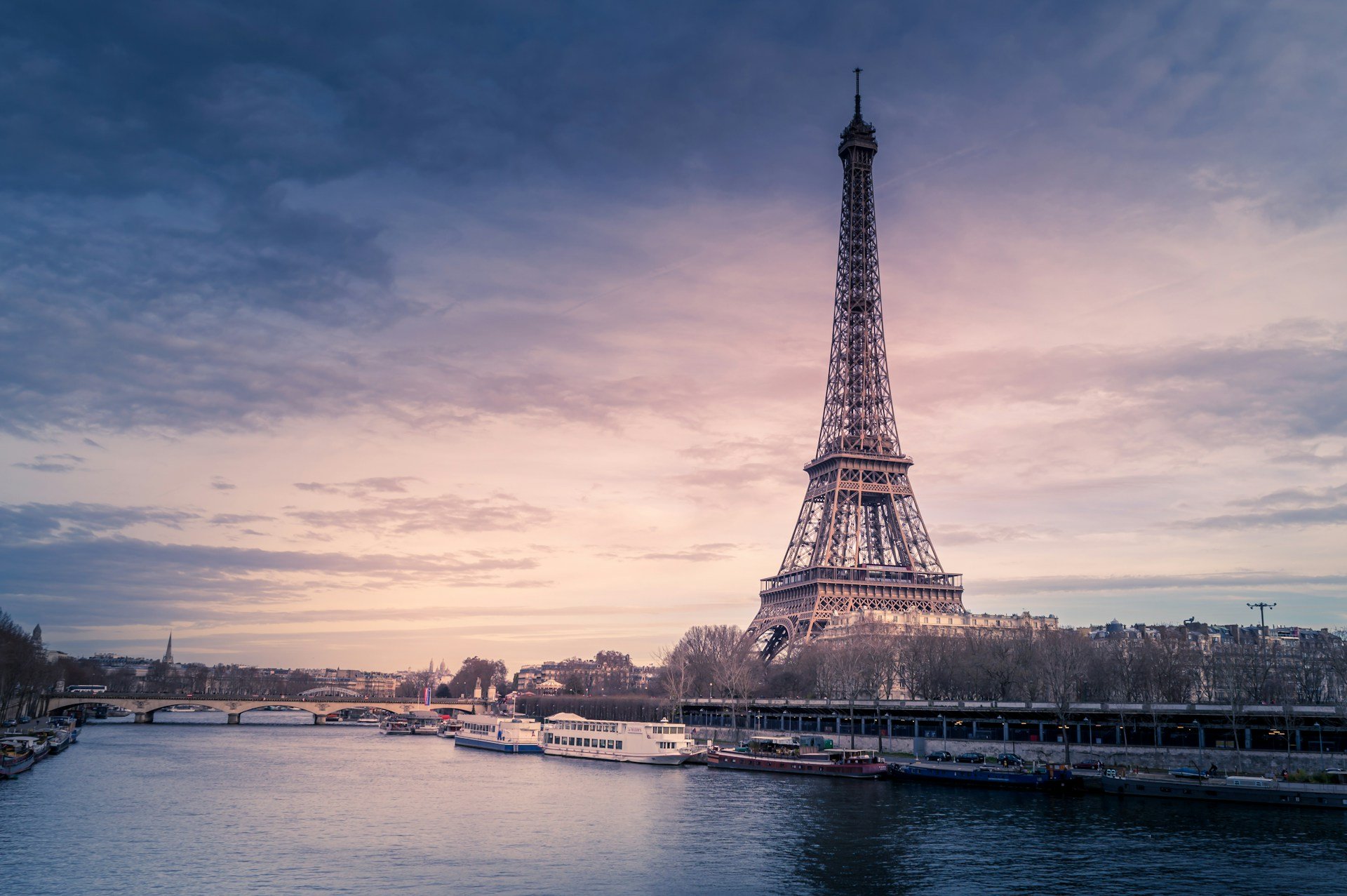
Paris is one of those places that actually lives up to its reputation, which is not something you can say about many cities that carry this much expectation. The Louvre, the Musée d'Orsay, and the Centre Pompidou would each anchor a great city individually; Paris has all three plus 130 other museums. The neighborhoods are the real texture: the covered passages of the 2nd arrondissement, Saint-Germain-des-Prés where the literary cafes operated since the 1940s, the Canal Saint-Martin in the 10th where young Paris actually spends its Sunday afternoons with a picnic and a bottle of Languedoc. Four days minimum. Six is better. The Eiffel Tower is worth seeing once; avoid it at noon in July and see it from a distance instead — the view from the Trocadéro across the river at dusk with a glass of wine from the kiosk nearby costs nothing and looks exactly like a film set.
Lyon
Lyon has a stronger claim to being France's gastronomic capital than Paris and makes this argument loudly, proudly, and with considerable justification. The bouchons — traditional Lyonnais restaurants serving quenelles de brochet, tablier de sapeur, andouillette, and salade de lentilles du Puy — are the culinary tradition the city built its identity on. Paul Bocuse spent 50 years elevating this cooking to international recognition. The covered market at Les Halles de Lyon Paul Bocuse has 60 stalls and is the reference market of France. The old town (Vieux-Lyon) is UNESCO-listed and the largest Renaissance neighborhood outside Italy. Two days minimum; food lovers should allow four.
Provence
Provence is lavender fields and Roman ruins and village markets and rosé wine and the specific quality of light that Van Gogh and Cézanne came specifically for. Aix-en-Provence is the elegant university town where Cézanne was born and painted Mont Sainte-Victoire from every angle for forty years. Arles has an amphitheater from 90 CE still in use, the best Saturday market in the south, and Van Gogh's yellow house (rebuilt; the original was demolished). The Luberon villages — Gordes, Roussillon, Ménerbes, Bonnieux — are uniformly beautiful and tourist-facing in summer; go in May or September for the version the French actually prefer. A rental car is essential.
Bordeaux
Bordeaux is one of the most elegantly proportioned 18th-century cities in Europe, a UNESCO-listed ensemble of limestone neoclassical architecture built on the wealth of the wine trade. The Cité du Vin museum is genuinely excellent — immersive, non-pretentious, and free of the snobbery that makes wine culture inaccessible — and is worth a half day even for people with limited wine interest. The Médoc peninsula north of the city passes Pauillac and the First Growth châteaux: Latour, Margaux, Mouton Rothschild. Saint-Émilion, 40km east, is a medieval wine village on a limestone plateau that has been producing exceptional wine since the Romans arrived. Allow three days for the city plus vineyard visits.
Loire Valley
The Loire Valley is UNESCO-listed in its entirety — not one château but 300 châteaux, 300 gardens, and 300km of river that was once the playground of French kings. Chambord has 440 rooms and a double-helix staircase attributed to Leonardo da Vinci, and when you arrive at dawn before the tour buses, with mist on the moat and deer grazing in the park, it looks like it was conjured rather than built. Chenonceau spans the river itself. Azay-le-Rideau rises out of the water on an island. A car is essential; the châteaux are spread over 200km. Allow three days to do it seriously.
Normandy
The D-Day beaches, the American Cemetery at Colleville-sur-Mer above Omaha, the Mémorial de Caen, the German fortifications at Pointe du Hoc — this is the most historically significant landscape in Western Europe for understanding the 20th century, and the Norman countryside around it is some of the most beautiful in France. Mont-Saint-Michel, 130km west, is a tidal island with a 1,300-year-old abbey on a granite outcrop, and it is exactly as extraordinary as every photograph suggests. Arrive at low tide when the bay is fully exposed and the island rises from sand rather than sea.
Alsace
Alsace is the region that looks like it was designed by someone who had heard Germany and France described separately and decided to combine the best of both. Half-timbered houses in pink, ochre, and pale blue. Stork nests on church towers. Villages producing Riesling, Gewurztraminer, and Pinot Gris from the same slopes that have been doing so since Charlemagne. Colmar's old town is the most photographed Alsatian village and is genuinely beautiful; Ribeauvillé and Riquewihr on the Route des Vins have the same visual quality with fewer tour buses. The Christmas markets here are among the most authentic in Europe, running from late November through December.
Corsica
Corsica is the Mediterranean island that the rest of the Mediterranean can't match for landscape and does match for price only in shoulder season. Mountains rising to 2,706 meters that are still snow-covered in June. Beaches of water so clear and turquoise they look retouched. A wine tradition (Patrimonio, Ajaccio appellation) that has nothing to do with mainland France. The GR20, a 180km traverse of the island's spine, is ranked among the most demanding long-distance trails in Europe. For non-hikers: the Calanques de Piana on the west coast and the beaches of Palombaggia near Porto-Vecchio are reason enough. Go in May or June, before the July–August price surge and crowd surge.
Culture & Etiquette
French culture has a reputation for difficulty that is approximately 40% accurate and 60% the result of visitors not understanding the operating system. The French are not unfriendly. They are, however, operating on social protocols that are real, consistent, and learnable, and which they apply to everyone including each other. The visitor who arrives knowing these protocols will find France genuinely warm and hospitable. The visitor who arrives expecting the world to rearrange itself into English-language informality will find it resistant.
The single most important rule is also the simplest: say bonjour. Every time. Before any transaction, any request, any interaction with any French person in any context. Entering a boulangerie without saying bonjour is considered rude in the way that cutting the queue would be considered rude elsewhere — not dramatically rude, but notably rude, and it will color the entire subsequent interaction. This is not about pleasing tourists. This is how French people interact with each other, and they extend the same expectation to everyone.
Not optional. Not negotiable. Not dependent on whether anyone seems to be looking. This one act differentiates the visitor who has a good experience from the visitor who concludes that the French are unfriendly.
"S'il vous plaît" (please), "merci" (thank you), "l'addition s'il vous plaît" (the bill please), "parlez-vous anglais?" (do you speak English?). Attempting French, however imperfectly, is received with genuine appreciation even when the response comes back in English.
The midday meal in France is cultural infrastructure. Restaurants are full noon to 2pm for a reason. Sitting down to a proper lunch with a carafe of wine and two courses is not an indulgence — it's the correct use of the day.
The French take appearance moderately seriously without being vain about it. Nobody needs to dress up for a village market, but activewear in a Parisian restaurant or at a historic site reads as an effort deficit. A clean shirt changes the dynamic.
French service has its own rhythm. A waiter who doesn't rush to take your order is not ignoring you — they are giving you time. Flagging them impatiently will slow things down, not speed them up. Order when you're ready and signal quietly. Patience is interpreted as confidence.
Even "bonjour, parlez-vous anglais?" is infinitely better than simply starting in English. The French will almost always switch to English willingly once you've acknowledged that French exists and they speak it.
Acceptable at a market or a beach kiosk. Eating a sandwich while walking down a Parisian boulevard reads as vaguely uncivilized by French standards. Find a bench, a café terrace, or a park.
French restaurants are not set up for extensive menu customization. The chef has assembled the dish as a considered whole. Asking to hold the sauce or substitute the garnish will be accommodated in tourist restaurants and received with visible distress in traditional ones.
Paris's residential streets after 10pm are quiet. The gap between the energetic late-night terrace culture and the quiet of the surrounding buildings is real and the French respect it. Noise complaints in French apartment buildings are taken seriously.
Service is included in French restaurant bills (service compris). A small additional tip — rounding up, or leaving €2–5 for excellent service — is appreciated. Large American-style tips are unusual and can occasionally make the staff uncomfortable rather than grateful.
The Boulangerie
The French baguette is legally defined: wheat flour, water, salt, yeast, nothing else. A bakery making baguette tradition — the gold standard — cannot use additives or frozen dough. The law is a statement of cultural values. There are about 35,000 boulangeries in France, one every few hundred metres in any city. The correct time to buy a baguette is right before you need it. It will be stale in four hours. This is not a flaw. It is the design.
Café Culture
The French café is a social institution, not a coffee shop. You pay for the chair as much as the coffee, and nobody expects you to leave. An espresso at the zinc bar costs €1.50. The same espresso at a terrace facing the Place des Vosges costs €5. The price difference is the view and the chair. Neither is wrong; choose which one you're buying. The correct French coffee order for a foreigner is "un café" (espresso) or "un café crème" (with milk). "Un latte" is not a recognized order in traditional cafes and will produce polite confusion.
Cheese Culture
France produces between 1,000 and 1,600 distinct cheeses depending on how you count regional variations. De Gaulle's famous observation that it is impossible to govern a country with 246 varieties of cheese was made at a moment of political frustration, but it captures something real about French regionalism. The correct time to eat cheese is after the main course and before dessert, with wine. Asking for cheese as a starter or dessert is not wrong, but it is unusual and may prompt gentle inquiry.
French Intellectualism
France is a country where philosophers regularly appear on television prime time, where strikes are treated as legitimate political expression rather than inconvenience, and where the state both funds and argues with the arts in equal measure. The French take ideas seriously as a national characteristic, which means conversations can be energetic, disagreement is not personal, and a good argument over dinner is one of the pleasures of the culture rather than a social emergency. Engage with confidence and expect to be engaged with in return.
Food & Drink
French cuisine is UNESCO intangible cultural heritage, which is an unusual designation for food but reflects an unusual commitment to it. The French gastronomic meal — the sequence of courses, the relationship between food and wine, the rituals of the table — has been formally recognized as part of world cultural heritage in the way other countries preserve monuments. This is either endearing or grandiose depending on your perspective; either way, it means that eating in France is not incidental to the trip but a core part of the experience, and approaching it with seriousness rather than efficiency produces proportionally better results.
The most important French food concept for travelers to understand is not the three-Michelin-star restaurant. It is the menu du jour — the fixed-price lunch served noon to 2pm at virtually every restaurant in France. Entrée (starter), plat (main course), and dessert for €15–22, including a pichet of wine at many establishments. The quality is often as good as the evening à la carte service, using the same kitchen and the same produce. This is how France feeds itself at midday. It is the single most effective thing a visitor can do to eat well without spending a lot of money.
The Croissant
A properly made French croissant is one of the most technically demanding baked goods on earth, requiring 27 layers of laminated dough, 48 hours of preparation, and a precision in butter temperature that most home bakers never achieve. A bad croissant is flaky and hollow. A good croissant is honeycombed inside, slightly chewy, with a caramelized exterior that shatters cleanly. The difference is immediately apparent and the good ones are extraordinary. Aux Merveilleux de Fred in Paris and Thierry Mulhaupt in Alsace are reference standards. Any bakery displaying the label Artisan Boulanger is legally committed to traditional methods.
French Wine
French wine geography is one of the most complex knowledge systems in food culture, which is both its appeal and its intimidation factor. The shortcut for travelers: in any French restaurant, the house wine (vin de la maison) or the carafe du jour is almost always a perfectly appropriate choice at €5–8 for a half-litre, chosen by the proprietor to accompany their food. Ordering the cheapest wine on a French list is not embarrassing — it reflects an understanding that the restaurant has selected it for its pairing value, not as filler.
Cheese
The cheese board in France is not a supplement to dinner — it is a course. Camembert from Normandy, Comté from the Jura (aged 18 months, the most complex version), Roquefort from the Aveyron caves, Époisses from Burgundy (which Napoleon reportedly called the king of cheeses), Brie de Meaux, Reblochon from Savoie. Each of these is a region in a rind. Buying directly from an affineur at any French market is the way to understand this — they will let you taste, explain the aging, and cut exactly what you want.
The Classics
Escargots de Bourgogne in garlic butter. Soupe à l'oignon in a Paris brasserie at midnight after a concert. Duck confit in the Périgord, slow-cooked in its own fat, served with sarladaise potatoes and a glass of Cahors. Bouillabaisse in Marseille — the real version, with rouille and croutons and the correct variety of rock fish from the Mediterranean, emphatically not the version served in tourist restaurants in Paris. Tarte Tatin from the Sologne valley it was invented in. These are not museum pieces. They are still the everyday food of the regions they come from.
North African & Global Food
France's North African community — Moroccan, Algerian, Tunisian — has produced a food culture that is now thoroughly integrated into French daily eating. Couscous is one of France's most popular dishes by consumption. The Belleville and Barbès neighborhoods in Paris have some of the best North African restaurants in Europe, at prices that make the city's other restaurant districts look expensive. Tagines, merguez, harissa, and pastilla appear across French menus not as novelties but as part of the national eating landscape.
Pâtisserie
The French pastry tradition is as technically complex as the savory kitchen and produces at its best things that are genuinely difficult to replicate elsewhere. The éclair. The Paris-Brest (choux pastry ring with praline cream, invented for a 1910 cycling race). The kouign-amann from Brittany — a laminated pastry soaked in caramelized butter that has been systematically adopted by bakeries worldwide. Pierre Hermé's macaron collections in Paris are the industry standard. But the best village pâtisserie in any small French town, operating Tuesday through Sunday with a counter of eight items made fresh each morning, is where this tradition lives most naturally.
When to Go
France in August is France at maximum capacity and maximum temperature, with a large proportion of the French population also on holiday, which means many small businesses and restaurants close. The experience is not bad — the atmosphere is genuinely festive — but prices are at their peak and the most popular sites are at their most crowded. May, June, and September are the structural sweet spots: good weather, most things open, significantly lower prices, and the version of France that the French themselves prefer.
Late Spring
May – JunLong evenings, markets at peak produce, the Loire Valley in full bloom. Lavender in Provence begins mid-June. Fewer crowds than July. Temperatures are ideal for walking châteaux grounds and Normandy beaches. The French school calendar means the real peak hasn't started yet.
Early Autumn
Sep – OctHarvest season — vendanges in Burgundy, Bordeaux, and Alsace. Warm days, cool evenings. The Riviera remains warm through October. Summer crowds have gone. Restaurant terraces at their most civilized. The best time to eat in France by general consensus.
Winter
Dec – FebAlsace Christmas markets are among the best in Europe. Paris in winter is uncrowded and has the best museum access of the year. The Alps and Pyrenees are for skiing. The south of France — Nice, Marseille, Montpellier — remains mild and operational. Prices are lowest of the year outside Alpine ski resorts.
August
AugPeak crowds at every monument. Peak prices. The French themselves are on holiday, meaning many local restaurants and small businesses close entirely. The Riviera in August is hot, expensive, and extremely crowded. If you must go in August, aim for Brittany, Normandy, or Alsace, which are more manageable than the south.
Trip Planning
France is large enough that a two-week trip covers one region properly or two regions in outline. Paris plus one region — Normandy, Provence, the Loire Valley, Alsace — is the standard first visit structure and works well. The TGV handles Paris to Lyon, Paris to Marseille (for Provence), and Paris to Strasbourg (for Alsace). A rental car handles the region once you've arrived.
Paris
Day one: arrive, settle, walk from your accommodation to the nearest café for dinner. Don't try to see everything on day one. Day two: Musée d'Orsay in the morning (book in advance), the Left Bank in the afternoon, dinner in Saint-Germain. Day three: the Marais — Place des Vosges, the Picasso Museum, the covered passage Galerie Vivienne. Day four: Montmartre at 8am before the crowds, Sacré-Coeur, and walk down through the 18th arrondissement to the Grands Boulevards.
Loire Valley
TGV from Paris Montparnasse to Tours (1 hour). Rent a car. Day five: Chambord in the morning, Cheverny in the afternoon. Day six: Chenonceau at 9am before the first tour buses, then Amboise for lunch and the Clos Lucé (Leonardo da Vinci's final home). Day seven: Villandry's extraordinary formal gardens and back to Paris by early evening. Three days is the minimum to do the Loire properly.
Paris
Five days gives you Paris without rushing: the Louvre (allow a full day, book in advance), the Centre Pompidou, a day trip to Versailles (get the first entry slot at 9am when the gardens are still empty), and enough time to find your own Paris — the wine bar in the 11th, the bookshop on Rue de l'Odéon, the Saturday market you walk through on the way somewhere else.
Normandy
Train to Caen (2 hours). Rent a car. Mémorial de Caen museum on arrival — allow four hours. Day seven: Omaha Beach and the American Cemetery in the morning, Pointe du Hoc, lunch in Bayeux and the Tapestry. Day eight: Mont-Saint-Michel. Drive back to Paris via the A13 motorway. Return the car at a Paris agency or the Gare de Lyon train station.
Provence
TGV from Paris to Avignon (2h40m). Collect rental car. Three days in the Luberon — Gordes, Roussillon's ochre cliffs, the village market at Apt on Saturday. Two days around Aix-en-Provence and Arles. Final day: drive to Marseille, eat bouillabaisse at Chez Michel (book ahead), return car at Marseille-Saint-Charles and TGV back to Paris or fly home from Marseille Provence airport.
Paris in Depth
Six days: all major museums, neighborhood by neighborhood exploration. A day to Fontainebleau or Reims (90 minutes by TGV — the Champagne region, the coronation cathedral, and a cave tour at Taittinger). One evening at a proper Paris bistrot with a pre-reservation — Bistrot Paul Bert in the 11th or Le Servan in the 11th are the current references for doing this at a reasonable price without ceremony.
Loire Valley
TGV to Tours, rental car, three days to do the châteaux properly: Chambord, Chenonceau, Azay-le-Rideau, Villandry, Amboise. Lunch picnics from village boulangeries and fromageries. One dinner at a Touraine restaurant working with local Vouvray and Chinon wines.
Bordeaux & the Atlantic Coast
TGV from Tours to Bordeaux (2 hours). Two days: Cité du Vin, the city center, an evening in Saint-Émilion. Day twelve: drive the Médoc route past the Grand Cru châteaux. Day thirteen: drive south to Arcachon for oysters at the harbor and the Dune du Pilat — Europe's tallest sand dune, 110 metres of sand above the Atlantic, with views over the Landes forest stretching to the horizon.
Provence & the Riviera
Train from Bordeaux to Marseille (4 hours). Five days: Arles, the Luberon villages, Aix-en-Provence. Day eighteen: drive the Gorges du Verdon — the Grand Canyon of Europe, 700 metres deep, with a road following the rim above turquoise water. Spend two days on the Riviera — Nice's old town market, the Matisse Museum, lunch at a beachside restaurant with a carafe of Provençal rosé. Fly home from Nice Côte d'Azur.
Vaccinations
No mandatory vaccinations required for France. Routine vaccines should be up to date. Tick-borne encephalitis vaccination is recommended for hiking in forested areas of Alsace and the Alps from April through October.
Full vaccine info →Connectivity
EU roaming applies for EU/EEA SIM cards. Non-EU visitors: Airalo eSIMs work well throughout France. Coverage is excellent in cities and along major routes; rural areas in the Massif Central and remote Alpine valleys can have gaps. Free wifi is widely available in hotels and cafes.
Get France eSIM →Power & Plugs
France uses Type C and Type E plugs (the French variant of the standard European two-pin with a male earth pin projecting from the socket). UK visitors need an adapter. North American visitors need an adapter. Most modern electronics handle the 230V voltage automatically.
Language
French. English is widely spoken in Paris, tourist areas, and by anyone under 40 in major cities. In rural France, small villages, and among older generations, French is the only language available. Google Translate's camera function handles menus, signs, and labels effectively. The three most important words: bonjour, merci, pardon.
Driving in France
France has excellent roads and a complex toll (péage) system on motorways. The Vignette system for urban zones (ZFE — Zones à Faibles Émissions) in Paris and major cities requires checking your rental vehicle's emissions rating. Speed cameras are extensive and actively enforced. Priorité à droite (priority to the right) applies on roads without markings, which surprises many visitors. Carry a breathalyzer kit — it's legally required in your vehicle.
Travel Insurance
EU/EEA/UK visitors with EHIC or GHIC receive emergency healthcare. Non-EU visitors need travel insurance. For skiing in the Alps or Pyrenees, confirm your policy covers mountain rescue and helicopter evacuation — standard policies often exclude these without specific adventure sports riders.
Transport in France
The TGV (Train à Grande Vitesse) high-speed rail network is the most impressive in continental Europe and the right way to cover France's major cities. Paris to Lyon in 2 hours. Paris to Marseille in 3. Paris to Bordeaux in 2 hours. Paris to Strasbourg in 1h47m. The Eurostar connects London to Paris in 2h15m (and Brussels, Amsterdam from the same terminal at Gare du Nord). Once in a region, a rental car is the tool that unlocks it — Provence, the Loire Valley, Alsace, and Normandy are not adequately served by public transport for the style of exploration they reward.
Paris Métro
€2.15/trip or €17.35/day pass16 lines, 302 stations, serving every corner of Paris and inner suburbs. The Navigo Liberté+ card (loaded with carnet tickets) is the cheapest option for short visits. Weekly Navigo pass (€30) is better for stays of 5+ days. Works on buses and RER trains too.
TGV / Intercity Rail
€25–120 booked aheadBook at sncf-connect.com or via the Rail Europe platform. Prices increase closer to departure — booking 6–8 weeks ahead for peak summer gives the best fares. The Prem's fare (cheapest tier, non-refundable) starts from €19 on many routes.
Eurostar (London–Paris)
€60–200 one wayLondon St Pancras to Paris Gare du Nord in 2h15m. Once you include airport check-in and transit time, this is faster than flying for city-center to city-center travel. Book at eurostar.com ideally 6+ weeks ahead. The Paris Gare du Nord station also serves Brussels, Amsterdam, and Lille.
Paris Airports (CDG / ORY)
€12–15 by RER BCDG (Charles de Gaulle) is the main international airport. RER B train to central Paris takes 35 minutes, €12.10. Taxis cost €55–75 fixed rate (to Right Bank) or €62–83 (Left Bank). Orly Airport is connected by OrlyBus or the Orlyval tram-metro link.
Car Rental
€35–80/dayEssential for the countryside. All major companies operate from CDG, regional airports, and city centers. Note: Paris's ZFE emissions zone requires a Crit'Air vignette (€3.71 sticker) for driving in the city. Most rental cars qualify; check with the agency. Motorway tolls add €20–50 for long intercity routes.
Intercity Bus (FlixBus / BlaBlaBus)
€5–25FlixBus and BlaBlaBus cover most intercity routes at significantly lower cost than TGV. Paris to Lyon from €9. Slower, less comfortable, but a genuine option for budget travelers on longer routes. Book at flixbus.com or blablacar.com.
Vélib' (Paris Bike Share)
€3/day passParis's bike-sharing scheme with 1,400 stations and 20,000 bikes (including electric). The €3 daily pass gives unlimited 45-minute rides between stations. The banks of the Seine and the Canal Saint-Martin are best explored by Vélib'. The app (Smovengo) handles registration and unlocking.
Taxi / Ride-Hailing
€8–20 across ParisUber and Bolt both operate in Paris and are generally cheaper than licensed taxis outside fixed-rate airport runs. Licensed taxis are identifiable by the rooftop light and are metered. The Grand Taxi from CDG to Paris city center is a fixed rate — agree it before getting in.
The Eurail France Pass offers 3–8 travel days within a month for €140–330. For a multi-city trip covering Paris, Lyon, Bordeaux, and Marseille, it can pay for itself — but French TGV prices booked six weeks ahead often undercut the pass price on individual routes. Compare specific route costs at sncf-connect.com before buying a pass. The pass has more value in summer peak season when individual ticket prices are highest.
Accommodation in France
France has one of the widest accommodation ranges in Europe, from palace hotels in Paris and Riviera mega-resorts to rented farmhouses in the Périgord for €80/night that include a private pool and a weekly market three kilometres away. The choice of where to stay is as much about the style of travel as the budget. Staying in a Parisian apartment via a rental platform gives a different experience than a boutique hotel in the Marais, which gives a different experience than a palace hotel on the Rive Droite — and all three are valid choices at very different price points.
Paris Boutique Hotels
€120–300/nightThe Marais (4th arrondissement) and Saint-Germain (6th) have the best concentration of boutique hotels in character buildings. Hôtel du Petit Moulin, designed by Christian Lacroix in a former boulangerie on Rue de Poitou, and Hôtel des Grandes Écoles in the Latin Quarter are the kind of properties that make Paris accommodation feel like part of the experience rather than the logistics.
Châteaux & Manors
€150–600/nightThe Relais & Châteaux association represents the best château hotel network in France. In the Loire Valley, several Renaissance châteaux operate as hotels — Château des Briottières, Château de la Commanderie. In Provence, the Bastide de Moustiers (Alain Ducasse's Provençal inn) is the reference for what a working farm hotel can achieve at the top end.
Gîtes (Rural Rentals)
€500–1,500/weekThe gîte — a self-catered rural holiday rental — is the standard French countryside accommodation and is exceptional value. Gîtes de France and Airbnb both list them. A stone farmhouse with a terrace and views over the Luberon for a week costs what a Paris hotel costs for three nights. For groups or families, this is the obvious choice for any countryside region.
Hostels & Budget Hotels
€25–80/nightParis has a strong hostel scene — Generator Paris in the 10th and Le Village Hostel in Montmartre are well-run. Budget hotel chains (ibis, Première Classe) are functional and cheap but should be chosen for location rather than experience. The best budget accommodation strategy in Paris is a small hotel in the 11th or 20th arrondissement, within Métro distance of everything, for €80–100/night without the tourist premium of the 1st–8th.
Budget Planning
France costs what you let it cost, which is more true here than almost anywhere else in Europe. Paris at a luxury level is equivalent to London or Zurich. Paris on a budget — supermarkets, the menu du jour, a room in the 11th or 20th — is genuinely manageable. The regions are significantly cheaper than Paris across all price points, and the quality of food and experience in rural France at low budget is arguably higher than in the capital at the same spend.
- Hostel dorm or budget hotel in outer arrondissements
- Bakery breakfast (€4–6)
- Menu du jour lunch (€14–18)
- Supermarket dinner or cheap bistrot
- Navigo Liberté+ for Métro
- Boutique hotel in central Paris
- Café breakfast, menu du jour lunch
- Proper bistrot dinner with a carafe
- Major museum entries (Paris Museum Pass)
- TGV intercity travel (booked ahead)
- Character hotel in prime Paris location
- Château or manor hotel in the countryside
- Gastronomic restaurant dinner
- Wine estate visits and private tours
- Riviera or Corsica summer accommodation
Quick Reference Prices
Visa & Entry
France is a full Schengen Area member. Citizens of the US, Canada, Australia, New Zealand, UK, and most Western countries can enter visa-free for up to 90 days within any 180-day period across all Schengen countries combined. EU and EEA citizens have unrestricted freedom of movement. The 90-day Schengen allowance is shared — if you've spent 30 days in Spain before France, you have 60 days remaining in France and any other Schengen country in that 180-day window.
The EU's ETIAS pre-travel authorisation system for non-EU visa-exempt visitors was being phased in as of 2026. Check current requirements at etias.ec.europa.eu before booking, as implementation has shifted multiple times.
US, UK, Canadian, Australian, New Zealand, and most Western passport holders qualify. The 90 days is shared across all Schengen countries in any 180-day period.
Family Travel & Pets
France is an outstanding destination for families, with one important caveat: the French concept of what constitutes appropriate child behavior in restaurants and public spaces is more formal than what many visitors expect. French children are generally expected to sit at a table and eat a proper meal, and the restaurant culture reflects this rather than accommodating it as a special request. The good news is that French food is excellent for children — the market culture, the bakeries, the pizza-and-crêpe informal options — and the country's outdoor spaces, beaches, and château grounds are among the most child-friendly in Europe.
Disneyland Paris
35km from central Paris at Marne-la-Vallée, directly on the RER A train line. The European Disney resort is genuinely well-executed and the park capacity means shorter queues than Orlando in most seasons. Book tickets and hotels months ahead for summer and school holidays. The Disney Village restaurants are average; eat at the resort restaurants inside the parks instead.
Atlantic Coast Beaches
The Atlantic coast from La Baule south to Biarritz has wide, sandy beaches with strong surf and excellent family infrastructure. Arcachon, the Île de Ré, and the Vendée beaches are the key family destinations. The Dune du Pilat — 110 metres of sand above the Atlantic — is a reliable hit with children of all ages. The Atlantic is colder than the Mediterranean but the beaches are emptier and the waves are real.
Cité des Sciences, Paris
In the Parc de la Villette in the 19th arrondissement, the Cité des Sciences et de l'Industrie is the best science museum in France and one of the best in Europe. The Géode IMAX theater next door and the full-size submarine in the park constitute a full day for families. The park itself has excellent outdoor play areas along the Canal de l'Ourcq.
French Alps in Summer
The ski resort infrastructure of Chamonix, Annecy, and Megève converts to hiking, mountain biking, and lake swimming in summer, at significantly lower prices than winter. Cable cars up to glaciers (the Mer de Glace at Chamonix is accessible year-round) work for children from around age 5. Lake Annecy is one of the cleanest lakes in Europe and has reliable swimming beaches from June through August.
Puy du Fou, Vendée
A history theme park in the Vendée that wins the European Theme Park of the Year award so consistently that Disney has sent teams to study it. Puy du Fou runs spectacular historical spectacles — a Viking village, a Roman circus, a medieval jousting tournament, a French Revolution night show — all with production values that exceed what the ticket price suggests. Children remember it. So do adults. Book well ahead.
Food Strategy for Families
French children eat French food, which means that the restaurant options available to families are the same as for adults at a reasonable price point. Crêperies (Brittany-style sweet and savory crêpes) are universally accepted by children. The menu enfant at most family restaurants is €8–12 for a small version of the adult menu with a drink. French bakery culture — baguette, croissant, pain au chocolat — handles all snack emergencies with excellence.
Traveling with Pets
France is one of the most pet-friendly countries in Europe by any practical measure. Dogs are allowed in an extraordinary range of contexts that would be unusual elsewhere: in cafes and restaurants (often welcomed under the table and occasionally brought a water bowl without being asked), in small shops, on most intercity trains (in a carrier or on a lead with a half-price ticket purchased at the station), and on most beaches outside the peak summer season. The French relationship with dogs in public space is accommodating in a way that consistently surprises visitors from the UK and North America.
For entry: France follows EU pet travel rules. Dogs and cats from other EU countries need a microchip, valid rabies vaccination, and EU Pet Passport. Pets from outside the EU — including the UK post-Brexit — require additional documentation: a rabies antibody titre test (for UK pets entering from Great Britain), an Animal Health Certificate issued within 10 days of travel, and compliance with tapeworm treatment requirements. UK visitors should check the current requirements at the French Embassy's pet travel guidance, as the post-Brexit rules apply even for temporary visits. The process takes time — begin at least three months before travel.
Safety in France
France is a safe country for travelers by any global standard. The risks that exist are overwhelmingly concentrated in specific areas and specific behaviors that are predictable and avoidable. Paris has a higher crime rate than most French cities but compares favorably to comparable global capitals; the concentrated tourist infrastructure around the major sites creates the specific conditions for pickpocketing and scams that are well-documented and largely avoidable.
The security context requires a brief note. France has experienced terrorist attacks, most notably the November 2015 Paris attacks and the 2016 Nice truck attack. The French security apparatus has significantly upgraded since these events, and the visible military and police presence around major sites and transport hubs is part of the Opération Sentinelle ongoing deployment. This is context worth having, not a reason to reconsider travel. France's security level is high and its threat management is serious and well-resourced.
General Safety
France is safe by global standards. Violent crime against tourists is uncommon. Most incidents are property crime — pickpocketing, bag snatching — concentrated in tourist areas and on public transport in Paris.
Paris Pickpockets
Concentrated around the Eiffel Tower, the Louvre, Notre-Dame, Sacré-Coeur, and on Métro lines 1 and 13. Organized gangs operate with distraction techniques. Keep bags in front, use inside pockets or a money belt for documents and cards, and be suspicious of unsolicited approaches near tourist sites.
Common Scams
The "gold ring" scam (someone "finds" a ring near you and offers it for sale), the petition scam (clipboard-carrying people asking for signatures who simultaneously pickpocket), and the Eiffel Tower miniature sellers who become aggressive when you decline. All operate predictably and are avoidable by not engaging.
Marseille
Marseille has a higher violent crime rate than other major French cities, concentrated in specific northern arrondissements (13th–16th) that tourists have no reason to visit. The Vieux-Port, the city center, and tourist areas are generally fine with normal urban awareness. Don't walk alone in the Belsunce area at night.
Protests & Strikes
France has a constitutionally protected right to strike and exercises it vigorously. Transport strikes (SNCF, RATP) can affect train and Métro services with limited notice. Fuel depot strikes can affect petrol station availability. Check grève.info or the SNCF app before any travel day. Building flexibility into intercity schedules is sensible, especially in spring when social movements peak.
Solo Women
France is generally safe for solo female travelers. Paris has street harassment issues that are context-dependent and most prevalent in certain neighborhoods (near Gare du Nord late at night, in certain outer-ring arrondissements). Rural France is essentially problem-free. Traveling by TGV and staying in central accommodation keeps risk minimal.
Emergency Information
Your Embassy in Paris
Most embassies are in the 7th, 8th, and 16th arrondissements.
Book Your France Trip
Everything in one place. These are services worth actually using.
France Rewards the Person Who Slows Down
The visitor who spends four days in Paris and leaves having ticked the Louvre, the Eiffel Tower, and the Musée d'Orsay has had a good trip. The visitor who adds three days in Lyon, a morning in Beaune where the Hôtel-Dieu's medieval roof tiles look like they were laid by someone who understood that beauty was a form of argument, and an evening in a bouchon arguing with a Lyonnais about whether Beaujolais counts as a serious wine — that visitor has started to understand something about why this country gets 100 million visitors a year and yet still manages to feel, in the right places, like somewhere being discovered.
The French have a phrase, l'art de vivre — the art of living — which they apply to themselves with a confidence that other cultures might find presumptuous. What it describes is a philosophy about how daily life should be conducted: that a meal deserves time and attention, that a cheese should be eaten at the correct temperature, that a conversation is worth having properly or not at all, that a public square is a place to sit and watch the world with a glass of something rather than pass through quickly. It is an argument about the relationship between pleasure and effort, and France has been making it very effectively for a very long time.