
What You're Actually Getting Into
Cyprus sits closer to Beirut than to Athens and this geographical fact shapes everything. The island is the Mediterranean's third-largest, parked in the eastern corner of the sea at the convergence of European, Middle Eastern, and Ottoman cultural currents. The food is Greek-inflected but distinct. The architecture in the north bears Ottoman minarets alongside Gothic cathedrals. The village women still make lace in doorways the way they have for four centuries. None of this fits into a simple category and that is precisely what makes Cyprus interesting rather than just another beach destination.
The elephant in every room: the island is divided. Since the Turkish military intervention of 1974, the northern third has been administered by Turkish Cypriots and is recognized internationally only by Turkey as the "Turkish Republic of Northern Cyprus." The south is the Republic of Cyprus, an EU member since 2004. The capital Nicosia is the last divided capital in Europe, cut by a UN buffer zone that still contains abandoned buildings frozen in 1974. This is not ancient history — it is the current reality of a wound that hasn't closed, and understanding it is part of understanding where you are.
The practical good news for travelers: since 2003, the crossing points have been open. You can walk from the Greek Cypriot south to the Turkish Cypriot north on Ledra Street in Nicosia with your passport in hand. Many people do it in an afternoon and come back having eaten meze in both halves of the same city. The crossing is smooth. The contrast is startling — different currency, different architecture, different sounds, different smells within a few hundred meters — and genuinely worth doing.
Beyond the division: Cyprus has 340 days of sun per year, beaches that justify the mythology attached to them, a mountain range (the Troodos) that gives the island a dramatic interior that beach-only visitors consistently miss, and a food tradition that deserves more international attention than it receives. The meze culture — a procession of twenty to thirty small dishes over two to three hours — is one of the Mediterranean's great eating experiences. Do not plan afternoon activities for after a Cypriot lunch. There will be no afternoon activities.
Cyprus at a Glance
A History Worth Knowing
Cyprus has been contested, occupied, and traded between empires for so long that its history reads less like a national narrative and more like a catalogue of everyone who has ever wanted control of the eastern Mediterranean. Strategically placed at the intersection of Europe, Asia, and Africa, the island has copper (the word copper comes from the Latin "cuprum," itself from "Kypros"), cedar forests, and a deep natural harbour at Famagusta that dominated eastern Mediterranean trade. Whoever held Cyprus held leverage over the whole region. Almost everyone tried.
The oldest known settlement on Cyprus — Choirokoitia (Khirokitia) in the south — dates to around 7000 BCE and is a UNESCO World Heritage Site. The domed stone houses of this Neolithic village are still partially standing. The site has a reconstructed section where you can walk through what the village looked like. It is nine kilometers from the motorway and receives almost no visitors. This is a reasonable summary of how Cyprus manages its extraordinary archaeology.
The Bronze Age brought copper mining and the wealth that accompanied it. Egyptians, Assyrians, and Persians all controlled the island at various points. Alexander the Great folded it into his empire in 333 BCE. The Romans arrived in 58 BCE and made Cyprus a senatorial province — its governor at one point was Cicero's friend Cato. The apostle Paul visited in 45 CE with Barnabas (a Cypriot himself), converted the Roman proconsul Sergius Paulus, and made Cyprus the first place in the world to be governed by a Christian. A distinction the island's churches still celebrate.
The Byzantine period left the most visible religious architecture: the painted churches of the Troodos mountains, decorated with frescoes from the 11th to 16th centuries, form the largest concentration of Byzantine mural painting outside Constantinople. Ten of them are UNESCO-listed. You can visit them on a circuit of mountain roads, often finding the key holder — an elderly villager who lives next door — who will unlock the church, turn on the lights, and recite the dates of each painting from memory.
Richard I of England captured Cyprus in 1191 from a Byzantine governor who had mistreated the survivors of a shipwreck carrying Richard's fiancée. He sold it to the Knights Templar, who sold it to the Crusader Kingdom of Jerusalem's Guy de Lusignan. The Lusignan dynasty ruled for three centuries, building the Gothic cathedrals in Famagusta and Nicosia that are still standing — converted to mosques under the Ottomans and never converted back. The sight of a Gothic cathedral with a minaret where the bell tower should be, in an otherwise largely Turkish Cypriot city, is one of the stranger architectural experiences in Europe.
Venice controlled Cyprus from 1489 to 1571, fortifying the coastline with walls that still ring Famagusta and Nicosia. In 1570, the Ottoman Empire invaded. The siege of Famagusta that followed lasted nearly a year. Its Venetian commander, Marcantonio Bragadin, surrendered on terms and was then tortured and flayed alive by the Ottoman commander in violation of the agreed terms. The event scandalized Europe, helped motivate the Battle of Lepanto (where the Ottoman fleet was defeated), and is still remembered in Famagusta. Bragadin's skin, stuffed and displayed in Constantinople, was eventually returned to Venice in the 17th century and is buried in the Basilica of Saints John and Paul.
British rule began in 1878, when the Ottoman Empire leased Cyprus to Britain in exchange for a defensive alliance. Britain formally annexed it in 1914. The EOKA insurgency (1955–59) fought for enosis — union with Greece — against British colonial rule. Independence came in 1960 under Archbishop Makarios III, with a constitutional power-sharing arrangement between Greek Cypriots and Turkish Cypriots that broke down almost immediately and led to intercommunal violence in 1963–64.
The coup of July 1974 — organized by the Greek military junta and the EOKA-B movement to achieve enosis — triggered the Turkish military intervention five days later. Turkey's stated justification was protection of Turkish Cypriots under the 1960 Treaty of Guarantee. The intervention resulted in Turkey controlling the northern 37% of the island. Approximately 160,000 Greek Cypriots fled or were expelled from the north; approximately 45,000 Turkish Cypriots moved north from the south. The displacement is permanent, the political resolution unresolved, and the buffer zone maintained by a UN peacekeeping force (UNFICYP) that has been there since 1964.
Understanding this history is not required to enjoy Cyprus. But it explains why the crossing at Ledra Street feels the way it does, why there are abandoned hotels on the beach at Varosha, why the people of Paphos and the people of Kyrenia have a shared grief about places they cannot access, and why almost every Cypriot family has a story that begins "before '74."
Neolithic settlement, one of the earliest in the Mediterranean. Stone houses still partially standing. UNESCO World Heritage Site.
Cyprus becomes a Roman senatorial province. Paul and Barnabas arrive in 45 CE and convert the Roman governor — the first Christian ruler anywhere.
Richard the Lionheart captures Cyprus. It passes to the Lusignan dynasty, who build Gothic cathedrals still standing in Famagusta and Nicosia.
Ottoman invasion after the year-long Siege of Famagusta. The Gothic cathedrals become mosques. Cyprus remains Ottoman for 307 years.
Britain takes control. Independence follows in 1960 under Archbishop Makarios III after the EOKA insurgency.
Coup by Greek junta triggers Turkish military intervention. The island is divided. 200,000+ displaced. The UN buffer zone established. Still in place today.
After 29 years of complete separation, the Green Line crossing points open. Cypriots cross for the first time in nearly three decades. Tourists follow.
Top Destinations
Cyprus divides naturally into five experiences: the divided capital Nicosia, the Roman heritage coast around Paphos, the cosmopolitan south around Limassol, the forested Troodos mountains, and the Turkish Cypriot north with its medieval cities and dramatically different atmosphere. All are accessible by car within two hours of each other. A rental car is essential — public transport barely exists outside cities.
Nicosia (Lefkosia)
The last divided capital city in the world. The UN buffer zone — the Green Line — cuts through the old city's walled centre, and you feel it physically as a gap in the urban fabric, a street that ends at a checkpoint, a building that has been derelict since 1974 with a plant growing through the second-floor window. The Cyprus Museum in the south has the island's best archaeological collection. The Leventis City Museum tells Nicosia's layered history in the most honest possible way. Cross at Ledra Street on foot — your passport checked by both sides — and walk north into a different world: Turkish coffee on a terrace next to a converted Gothic church, the call to prayer from a minaret built on a bell tower. Plan a full day for both halves.
Paphos
Paphos holds more archaeology per square kilometer than most Mediterranean cities and a fraction of their visitor numbers. The Paphos Archaeological Park contains Roman houses with some of the finest mosaic floors anywhere in the world — the Villa of Dionysos alone has 2,000 square meters of intact mosaic depicting mythological scenes in colors that look painted, not tiled. The Tombs of the Kings, carved into the living rock above the sea, date from the 4th century BCE and are appropriately dramatic at sunset. The rock offshore at Petra tou Romiou — the birthplace of Aphrodite according to legend, and plausible given the setting — is 25 km east along the coast and genuinely one of the most beautiful coastal formations in the Mediterranean. Book nothing in advance. Walk in and pay at the gate. This is one of Cyprus's more practical virtues.
Limassol
Cyprus's most international and lively city, rebuilt aggressively since the 1990s and now anchored by a marina, a long seafront promenade, and a old town that survived modernization with its character mostly intact. The Limassol Castle, where Richard I reportedly married Berengaria of Navarre in 1191, houses the Cyprus Medieval Museum. The wine villages of Koilani and Omodos are 30 minutes north. The Carnival in February/March is the best in Cyprus. The Friday night restaurant scene along the old town's backstreets is where you go to understand that Cyprus is not, in fact, a quiet island.
Troodos Mountains
The Troodos range rises to 1,952 meters at Mount Olympos and is covered with pine and cedar forest that bears almost no resemblance to the coastal Cyprus most visitors see. The painted churches — Byzantine frescoed buildings hidden in cedar forest, reachable by narrow mountain roads — are the cultural treasure of the interior. Kykkos Monastery, the wealthiest in Cyprus, sits at 1,318 meters and houses an icon of the Virgin Mary attributed to Luke the Evangelist. The village of Kakopetria by the Karkotis River valley is the best base: traditional stone houses, a river running through the centre, and a taverna that has been making kleftiko in the same clay oven for 40 years.
Akamas Peninsula
Cyprus's only remaining undeveloped stretch of coastline, protected as a national park and accessible only by 4WD or on foot. Sea turtles nest on Lara Beach from June to September — green turtles and loggerheads, the same species that have used these beaches for millions of years. The Blue Lagoon at Fontana Amorosa is the most photographed spot: accessible by boat from Latchi harbour or by hard 4WD track. The Aphrodite Trail, a 7.5-km circular hike, starts from the Baths of Aphrodite fountain (where, legend says, Adonis first saw the goddess) and gives you the cape's landscape in three hours.
Kyrenia (Girne) — North
In Northern Cyprus, accessible by crossing from Nicosia or by direct flight from Turkey. Kyrenia's horseshoe harbour, backed by the Byzantine and Venetian castle and ringed with fish restaurants and bars, is one of the most beautiful small harbours in the Mediterranean. Inside the castle is the Shipwreck Museum, which houses a 4th century BCE merchant vessel — the oldest shipwreck ever recovered — with its original cargo of almonds and wine amphorae still in place. The mountain above Kyrenia holds three crusader castles (Buffavento, Kantara, St. Hilarion) in various states of dramatic ruin along a ridge. Dinner at a harbour restaurant as the sun sets costs roughly half what the equivalent would be in the south, in Turkish lira.
Famagusta (Gazimağusa) — North
The walled city of Famagusta is one of the most concentrated medieval urban environments in the Mediterranean and is almost entirely in Northern Cyprus. The Lala Mustafa Pasha Mosque — the former Cathedral of Saint Nicholas, built in the 14th century in the Gothic style of Reims Cathedral, now with a minaret where the bell tower stood — is the defining building. The ruins of ancient Salamis, 6 km north along the coast, cover an enormous Roman city with a theatre, gymnasium, and basilica. And then there is Varosha: the former beach resort district, sealed in 1974 and left untouched for 33 years before partial reopening began in 2020. Walking along the fence line of the sealed sections, looking at the high-rise hotels frozen mid-construction, is one of the stranger and more unsettling experiences Cyprus offers.
Ayia Napa & the East Coast
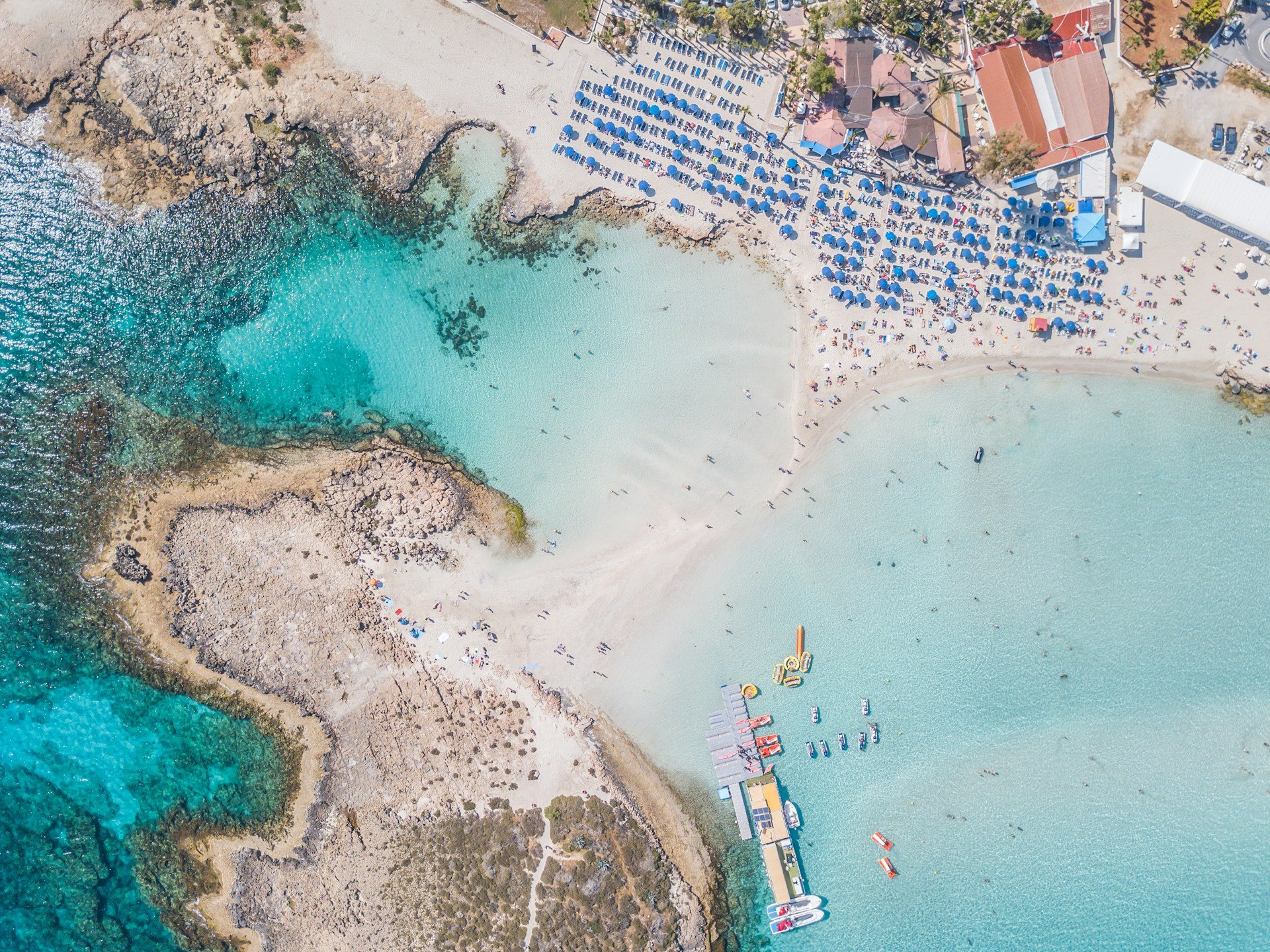
Ayia Napa is Cyprus's party resort and makes no apology for it — nightclubs, beach bars, water sports, and a summer crowd that peaks in July and August. The sea colour along this stretch is genuinely exceptional: shallow, warm, and an improbable shade of turquoise that justifies the reputation. Cape Greco, 5 km east, is a protected national forest park with sea caves, a natural sea bridge, and diving sites accessed by trail from the coast road. For visitors who want beaches without the nightclub soundtrack, the coast between Protaras and Cape Greco has the same water quality and more space.
Culture & Etiquette
Cyprus runs on Mediterranean time, which means things start later, last longer, and accommodate interruption more gracefully than Northern European visitors expect. The siesta — afternoon rest from roughly 1pm to 4pm — is still observed in smaller towns and villages, and many shops close during these hours. Planning to visit a village shop or government office at 2:30pm on a Tuesday will produce a locked door and a handwritten sign. This is not unusual.
Hospitality is genuine and specific: if you are invited into a Cypriot home, you will be fed regardless of whether you are hungry, and refusing food is mildly insulting. The coffee — Cypriot coffee, which is Greek coffee by method (thick, unfiltered, brewed in a small pot) — is offered to anyone who sits down long enough. The correct answer is "metrio" (medium sweet) unless you know your preference. Declining coffee is possible but requires more social navigation than simply accepting it.
The division is a subject that Cypriots engage with at different emotional registers depending on their personal history. Greek Cypriot families who lost property in the north, or who grew up in Nicosia hearing the buffer zone described in daily life, have a relationship with the subject that visitors should approach with care. Turkish Cypriots in the north have a different set of grievances and a different narrative about the same events. Both sets of feelings are entirely valid and coexist in a small island. Be curious, be respectful, and be prepared to listen more than speak on this topic.
Cyprus drives on the left, a British colonial legacy retained after independence. This catches visitors from continental Europe and the US completely off-guard at roundabouts. Rent a car with automatic transmission if you're not used to left-hand drive. The roads are fine; the instinct is the problem.
A Cypriot meze at a traditional taverna arrives in waves over two to three hours and is designed to slow you down. Do not fight it. Do not ask for the bill between courses. Order the meze, clear your afternoon, and let the meal happen to you. This is not service slowness — it is the intended experience.
Shoulders and knees covered in Orthodox churches and monasteries. Many have sarongs or shawls available at the entrance. The rule applies equally to men. Kykkos Monastery in the Troodos is particularly strict and the signs are explicit.
Cross at Ledra Street in Nicosia or one of the other checkpoints. Take your passport. The crossing is straightforward and both sides are professionally managed. The contrast between the two halves of Nicosia is worth the ten-minute process.
The local spirit — distilled from grape pomace after winemaking, similar to grappa — is offered at the end of every traditional meal and at many wineries. It ranges from about 45% to 65% ABV. Accept a small glass. It is the correct ending to a Cypriot dinner.
If you fly directly into Ercan Airport in Northern Cyprus (which operates only via Turkey), the Republic of Cyprus considers this an illegal entry and may deny you entry at any future point. Enter Northern Cyprus only through the Republic of Cyprus via a recognized crossing point. This rule is enforced.
Military areas, British Sovereign Base Areas (still present on the island at Akrotiri and Dhekelia), UN checkpoints, and the buffer zone require care. Photographing military personnel, installations, or checkpoints is officially restricted and can result in equipment confiscation or detention. Photograph the scenery; give uniforms a wide berth.
Cyprus's laws on cultural property are strict and actively enforced. Removing anything from an archaeological site — including surface sherds, tiles, or coins — is a criminal offense. Metal detecting without a permit is illegal. These laws exist because Cyprus has had significant problems with illegal antiquities trafficking.
The Troodos mountain roads become icy and occasionally snow-covered from December through February. Winter tyres are not standard on rental cars. Check conditions before driving into the mountains in winter and turn around if the road surface looks uncertain.
The Turkish Cypriot community has been on this island as long as the Greek Cypriot community. The north contains some of the island's most important history. Treating it as an illegitimate territory to be ignored is politically understandable but experientially impoverishing.
Orthodox Christianity
The Orthodox Church of Cyprus is one of the oldest autocephalous churches in the world, established by the Council of Ephesus in 431 CE and independent of Constantinople. It has been central to Cypriot Greek identity through Ottoman and British rule. The monasteries — Kykkos, Machairas, Stavrovouni — are active religious communities, not museums. Arriving at Kykkos at 6am for the morning liturgy is one of the more unexpected Cyprus experiences: the monastery active, the monks moving through the incense-thick air, the mountain forest quiet outside.
Traditional Crafts
Lefkara lace, Phini pottery (a village where traditional red-clay pottery has been made since the Bronze Age), woven basketry from the Paphos region, and wood carving from the Troodos villages represent a craft tradition that is still actively practiced and not merely performed for tourists. The Cyprus Handicraft Centre in Nicosia sells certified authentic work and also runs workshops. What you buy in the village from the maker costs less and means more.
Festivals & Calendar
Easter is the most important festival — Cyprus goes all-in on Holy Week, with midnight Saturday liturgies, fireworks, and the cracking of red-dyed eggs. The Limassol Carnival in February/March features ten days of increasingly elaborate processions. The Kataklysmos (Festival of the Flood) in June, celebrated only in Cyprus and marked by water-throwing and boat races on the waterfront, is Pentecost by another name and genuinely local. The Paphos Aphrodite Festival in September stages opera at the medieval castle against the sea.
Car Culture
Cyprus has effectively no public transport outside Nicosia and Limassol city buses. The country is built around the car in a way that makes rental non-optional for anything beyond a single coastal resort stay. Cypriots drive quickly on straight roads and more carefully on mountain roads than their reputation suggests. Roundabout priority rules are the same as UK — give way to traffic already on the roundabout. The instinct to look the wrong way will strike at every junction.
Food & Drink
Cypriot food is Greek in its foundations and distinctly its own in execution. The halloumi is not the rubbery block sold in supermarkets abroad — fresh halloumi, made from sheep and goat milk and eaten within days of production, has a squeaky resilience and a fresh, lactic brightness that no imported version achieves. The kleftiko — lamb slow-baked in a sealed clay pot overnight — falls from the bone in a way that requires planning only because it takes eight hours and needs ordering the day before at some traditional places. The meze is not a starter — it is the meal, and ordering it is committing to an afternoon.
The food in Northern Cyprus shares ingredients and tradition but with Turkish influence: börek, halva, Turkish coffee (identical to Cypriot coffee in method), and a cooking style that is slightly more vegetable-forward. Crossing into the north for lunch after a morning in Famagusta is not only convenient but culinarily worthwhile.
Halloumi
Cyprus's most famous product and a Protected Designation of Origin cheese since 2021. Made from a mix of sheep, goat, and (in some commercial versions) cow milk, it is grilled or fried and served at virtually every meal. The fresh version, available from village cheesemakers and good supermarkets (Alphamega, Sklavenitis), has a completely different quality from the exported product. Buy it the day it's made if you can. Eat it warm from the grill with fresh bread and halved tomato dressed in olive oil. This is the correct version.
Kleftiko & Souvla
Kleftiko — lamb marinaded in lemon, garlic, and herbs then sealed in a clay pot and baked overnight — is the great Cypriot slow-cooked dish, named for the "kleftes" (bandits) who allegedly cooked stolen livestock in sealed pits to hide the smoke. Souvla is the Sunday institution: enormous chunks of pork or lamb on a long spit over charcoal, turned slowly for three to four hours, eaten with bread and salad in someone's garden. If you are invited to a Cypriot family Sunday souvla, accept.
Meze
Between 20 and 35 dishes arriving in succession: hummus, taramosalata, tzatziki, olives, grilled halloumi, loukanika sausage, sheftalia (grilled sausage patties in caul fat), fried calamari, octopus, stuffed vine leaves, moussaka, stifado (wine-braised meat), grilled fish, roast potatoes, bread. Then dessert. Then coffee. Then zivania. Order the meze at a traditional taverna in a village. Budget €20–30 per person. Clear your afternoon. You will not regret the commitment.
Seafood
The fish tavernas of Latchi, Paphos harbour, and Kyrenia harbour serve catch that arrived that morning. Grilled sea bream (tsipoura), grilled sea bass (lavraki), octopus marinated in vinegar and then grilled on a charcoal brazier, squid (kalamari) fried in oil that is changed daily at the better places. The fish meze — a version of meze structured entirely around the sea — is the correct order at a harbourside taverna. It costs €28–35 per person and involves more seafood than you thought possible.
Commandaria & Cypriot Wine
Commandaria is the world's oldest named wine, produced in the Troodos foothills from dried Mavro and Xynisteri grapes since at least 800 BCE. Richard I served it at his Cyprus wedding in 1191 and reportedly called it the wine of kings. It is a sweet amber wine, intensely concentrated, best served slightly chilled with cheese or dessert. The Limassol Wine Route and the KEO winery in Limassol offer tastings. The local dry wines — Xynisteri white and Maratheftiko red — are increasingly interesting as younger winemakers work with indigenous varieties.
Cypriot Coffee & Loukoumades
Cypriot coffee is Greek coffee is Turkish coffee — thick, unfiltered, brewed in a small copper pot (briki), ordered by sweetness: sketo (unsweetened), metrio (medium, one teaspoon sugar), glyko (sweet, two teaspoons). Served in a small cup with a glass of water. Drunk slowly, sediment left at the bottom. Loukoumades — deep-fried dough balls soaked in honey and dusted with cinnamon — are the traditional companion at a kafeneion (traditional coffee house). Find a kafeneion, sit down, order a metrio and loukoumades, and stay for an hour. This is how it is done.
When to Go
April to June is the sweet spot: the wildflowers across the Troodos foothills are extraordinary in April and May, the coast is warm enough for swimming from late May, and the crowds haven't arrived. September to October offers the same mild conditions after the summer's main wave has cleared. July and August are hot (35–40°C on the coast), maximally crowded on the resort strip, and only really viable if you have access to a pool and plan minimal daytime outdoor activity. The Troodos mountains in summer are 10–15°C cooler than the coast and dramatically more pleasant.
Spring
Apr – JunWildflowers in the Akamas and Troodos. Warm enough for the sea from late May. Archaeological sites without the heat. Easter celebrations are elaborate and worth timing around. Hiking weather. Crowds manageable.
Autumn
Sep – NovSea still warm from summer. Ruins and mountains without the heat. Wine harvest in the Troodos foothills in September. October is genuinely beautiful: the sea deep blue, the air clear, the crowds gone. Some coastal facilities beginning to close in November.
Winter
Dec – FebCool and occasionally rainy on the coast but genuinely pleasant for sightseeing. The Troodos has occasional snow and a small ski resort (Mount Olympos) that functions for 6–8 weeks most years. Many coastal restaurants and hotels close November to March in tourist areas. Nicosia and Limassol stay active year-round.
Peak Summer
Jul – AugVery hot (35–40°C on the coast, occasionally 42°C). Crowded on the resort strip. Accommodation prices peak. Archaeological sites are difficult between 11am and 4pm. Only viable with a pool, air conditioning, and a plan to be indoors during midday. The mountains are the exception: 10–15°C cooler and genuinely good in summer.
Trip Planning
One week is enough to cover the main highlights of the Republic of Cyprus. Two weeks allows for the north and a slower pace in the mountains. A rental car is not optional — it is the only way to see the island beyond the coastal resort strip. Hire one at the airport on arrival (drive on the left; automatic transmission strongly recommended if you're not used to it). The island is small enough to drive across in 90 minutes, so no destination is logistically difficult — just make sure you have a plan for where you're staying each night, especially in the mountains where accommodation is limited.
Nicosia
Day one: Cyprus Museum, the walled city, the Leventis Museum. Evening walk along Ledra Street. Day two: cross into Northern Cyprus on foot. Selimiye Mosque (former Cathedral of St. Sofia), Büyük Han (the Great Inn, now an arts complex), coffee in the north, return to the south for dinner. The entire crossing and north Nicosia circuit takes 3–4 hours on foot.
Troodos Mountains
Drive up to the Troodos. Base in Kakopetria or Platres. Day three: Byzantine churches circuit — Asinou (finest frescoes, key from the priest's house next door), Agios Nikolaos tis Stegis (UNESCO), Panagia Podithou. Day four: hike the Atalanti Trail around Mount Olympos or drive up to the summit viewpoint, then down to Kykkos Monastery in the afternoon.
Paphos
Drive down from the mountains to Paphos (1.5h). Day five: Paphos Archaeological Park mosaics in the morning (arrive at 8am when the light is good and the tourists haven't arrived), Tombs of the Kings at sunset. Day six: drive to Petra tou Romiou for the morning, then the Akamas Peninsula. Boat trip to the Blue Lagoon from Latchi harbour, or drive the 4WD track if you have a suitable vehicle.
Limassol
Drive east to Limassol (1.5h). Morning at the Limassol Castle medieval museum. Lunch at a seafood taverna on the old port. Afternoon at the Kourion archaeological site, 15 km west — a Roman city with a theatre, a basilica, and views over the sea that are genuinely spectacular. Drive to the airport for the evening flight.
Nicosia & North
Three days in and around Nicosia. Day one: south Nicosia in depth. Day two: full day in Northern Cyprus — drive to Kyrenia (30 min from the crossing), the harbour, the shipwreck museum, St. Hilarion Castle on the ridge above. Day three: Famagusta by car from Nicosia (1.5h) — Lala Mustafa Pasha Mosque, the Venetian walls, ancient Salamis, and the Varosha fence line. Return to Nicosia.
Troodos
Three days in the mountains. A deeper circuit of the Byzantine churches than the 7-day version allows. One day for the Paphos Forest — the last cedar forest in Cyprus, accessible from the Troodos road. The village of Lefkara for lace. Kykkos Monastery at dawn. Dinner each night in the village taverna with the handwritten menu.
Paphos & Akamas
Four days in the Paphos region. The full Akamas Peninsula: Aphrodite Trail hike, Blue Lagoon by boat, sea turtle observation at Lara Beach (June–September evenings). The village of Polis to the north. The medieval Paphos fort at the harbour. One afternoon doing nothing but sitting at Coral Bay watching the sun set.
Limassol & East Coast
Limassol, Kourion, the wine villages of Koilani and Omodos. Day trip to the Choirokoitia Neolithic settlement (UNESCO, 9,000 years old, genuinely extraordinary, almost never crowded). Cape Greco and the east coast for the final beach days before the flight. Optional: the flamingo colony at Larnaka salt lake in winter and spring — a pink cloud descending on a salt flat behind the motorway that looks impossible but is real.
Nicosia & North in Depth
Four days. Nicosia south properly. Three days in Northern Cyprus: stay in Kyrenia (hotels here are significantly cheaper than the south). Kyrenia, St. Hilarion, Buffavento, and Kantara castles over two days. Famagusta and Salamis. The Karpaz Peninsula (the panhandle of the island) — wild donkeys on the road, sea turtle nesting beaches, the Apostolos Andreas monastery at the tip.
Troodos at Leisure
Four days in the mountains without rushing. One full day just walking the trails above Platres. One day visiting local producers: halloumi from a small farm, Commandaria from the Krasohoria wine villages, honey from Stavros tis Psokas. The Cedar Valley hiking trail in the Paphos Forest. Overnight at a traditional agrotourism guesthouse in Agros or Fikardou.
Paphos Region & Akamas
Five days. The full archaeological survey of Paphos. One day renting a mountain bike for the Akamas trails. An evening at the Paphos Aphrodite Festival if September. A day trip to the Pafos Aphrodite Hills for no reason other than that the golf course is built around a Bronze Age site, which is a very Cyprus kind of thing. Slow evenings at Latchi harbour eating the fish meze.
Limassol & Villages
Four days based in Limassol or nearby. Day trip to Larnaka (Church of St. Lazarus, the salt lake flamingos in season, the Hala Sultan Tekke mosque on the lake — one of Islam's most important shrines in Europe, quietly extraordinary). Kourion again at dawn before the site opens to tour groups. The wine route through the Commandaria villages.
East Coast & Slowing Down
Cape Greco. Protaras. Fig Tree Bay. Ayia Napa for the underwater sculpture park (a genuinely unusual diving destination — bronze sculptures placed on the seabed to create an artificial reef). Four days of beach and sea after three weeks of driving and archaeology. The island earns them.
Vaccinations
No mandatory vaccinations required to enter Cyprus. Routine vaccines recommended. No malaria risk. No significant tropical disease risk. Tick-borne diseases exist in rural areas — use insect repellent in the Troodos forests and check after walks in long grass between March and October.
Full vaccine info →Connectivity
EU roaming applies in the Republic of Cyprus. Northern Cyprus is not EU and EU roaming does not apply — your phone switches to Turkish mobile networks (Turkcell, KKTC Telsim) and international roaming rates apply. Buy a local SIM in the north if spending significant time there, or use a data eSIM with a generous data allowance. Coverage is good throughout the south; the north is well-covered in towns.
Get Europe eSIM →Power & Plugs
Cyprus uses the UK Type G plug (three rectangular pins) — the same British standard retained since colonial independence. European Type F (Schuko) adaptors do not work. Buy a UK adapter before traveling or pick one up at Larnaka or Paphos airport on arrival. Universal travel adaptors handle this.
Rental Car
Non-negotiable for any trip beyond the coastal resort strip. Hire at the airport. Automatic transmission strongly recommended if you're not used to left-hand driving — the instinct to steer toward the wrong side of the road will strike at roundabouts, especially when tired. A compact car handles all Troodos mountain roads except the very highest tracks (4WD territory).
Northern Cyprus Currency
The Republic of Cyprus uses the euro. Northern Cyprus uses the Turkish lira (TRY). The lira has been subject to significant inflation and exchange rate volatility — euros and British pounds are widely accepted in tourist areas of the north at broadly reasonable rates, but the lira gives you the best value at local restaurants and markets. Carry a mix.
Travel Insurance
EU citizens have EHIC coverage for emergency care in the Republic of Cyprus (EU). Coverage does not extend to Northern Cyprus. All visitors need travel insurance for comprehensive medical cover, particularly for any outdoor or water sports activities. Medical facilities in the south are good; the north has more limited hospital infrastructure.
Transport in Cyprus
The honest summary: Cyprus has almost no useful public transport. The intercity bus network (Intercity buses run by OSYPA) connects Nicosia, Limassol, Larnaka, and Paphos with reasonable frequency on the main route, but the buses run on schedules oriented toward commuters rather than tourists, don't serve the mountains at all, and make the Troodos and Akamas entirely inaccessible. For anything beyond the main coastal cities, a rental car is the only option. This is not an oversight in the guide — it is a genuine structural fact of the island's infrastructure.
Rental Car
€30–60/dayThe primary mode of transport for any trip beyond the main cities. Hire at Larnaka or Paphos airport. All major international chains plus local operators (Auto Europe, Cyprus Car Hire). Drive on the LEFT. International driving permit not required for EU/UK holders. Roads are in good condition on the main routes; mountain tracks require a compact car at minimum.
Intercity Buses (OSYPA)
€1.50–8/routeConnects Nicosia, Limassol, Larnaka, and Paphos on the main intercity routes. Tickets cheap. Service adequate on the main corridor. No connection to mountain areas, Akamas, or most archaeological sites. Not useful for a touring itinerary — useful as a one-way connection between cities if you've left a car at the other end.
Taxi
€1.50/km + baseAvailable in all cities and from the airports. Licensed taxis use meters. Service taxis (shared taxis between cities, fixed-price per person) exist on main intercity routes and are cheaper than private taxis. For airport transfers, negotiating a fixed price in advance is advisable.
City Buses
€1–1.50/tripNicosia and Limassol have functional city bus networks. Paphos city buses are limited. Larnaka has a basic system. Within the walled cities and beach areas, walking is generally more practical than waiting for buses. Google Maps covers Cyprus bus routes with some accuracy.
Boats & Sea Taxis
€15–35/tripThe most useful boat services are the Blue Lagoon excursions from Latchi harbour to the Akamas Peninsula coast, and the various glass-bottom boat tours from Paphos harbour. Seasonal ferry services between Cyprus and Israel/Greece exist but are infrequent — check current schedules as these change annually.
Scooter / Quad Rental
€20–40/dayAvailable in all coastal resort areas and in Paphos. Practical for short coastal explorations. Not recommended for mountain roads or the Akamas tracks. Helmet laws are enforced in the south. Road quality on minor roads varies significantly — flat tyres from potholes are common on rental quads.
Airports
From London ~€80Larnaka International (the main hub) and Paphos International. Both served by direct routes from the UK, Germany, Poland, Israel, Russia, and other European cities. No direct flights from North America — most connect via Athens, London, or other hubs. Note: Ercan Airport in Northern Cyprus operates only via Turkey — do not fly in there and attempt to cross to the south.
North Crossings
FreeSeven crossing points currently operate between the Republic and Northern Cyprus. Ledra Street (Nicosia, pedestrian), Agios Dometios (Nicosia, vehicles), Ledra Palace (Nicosia, vehicles), Pergamos, Strovilia, Kato Pyrgos, and Limnitis. Passport required. No visa needed for most Western nationalities. Car insurance from the south does not cover the north — buy supplementary insurance at the crossing (€10–15/day).
Accommodation in Cyprus
Cyprus's accommodation ranges from large resort complexes along the coast to traditional stone agrotourism guesthouses in the Troodos mountain villages. The resort infrastructure around Limassol marina and the Paphos hotel strip is well-developed and internationally familiar. The mountain villages — Kakopetria, Agros, Omodos, Platres — have small guesthouses and converted stone houses that offer a genuinely different experience from the coast and are significantly cheaper. Northern Cyprus has excellent value accommodation, particularly in Kyrenia, where hotels facing the harbour cost €60–100/night for what would be €200+ in comparable settings in the south.
Resort Hotels
€80–250/nightConcentrated around Limassol marina, the Paphos hotel strip, and Ayia Napa. Large properties with pools, beach access, and full-service amenities. Most have half-board or all-inclusive options that make economic sense given local restaurant prices. Book 2–3 months ahead for July and August.
Agrotourism (Mountain Guesthouses)
€40–90/nightThe Cyprus Agrotourism Company (agrotourism.com.cy) operates a network of restored traditional houses and village guesthouses across the Troodos region. Breakfast often included, dinner available on request. The experience of sleeping in a 200-year-old stone house in a mountain village is worth the marginal inconvenience of the distance from the coast.
Boutique Hotels
€80–180/nightNicosia and Limassol both have excellent boutique hotels in the old city. The Castelli Hotel in old Nicosia, the Curium Palace in Limassol, and several converted traditional townhouses in Paphos old town offer character that the large resort complexes don't. Good English spoken universally.
Northern Cyprus
€40–110/night (TRY/€)Northern Cyprus offers significantly better value than the south in accommodation. Kyrenia harbourfront hotels — The Dome, Nostalgia, Kyrenia Palace — are atmospheric and reasonably priced. The largely Turkish and Eastern European visitor base means some properties are less oriented toward Western tourists. Book in euros where possible for price clarity.
Budget Planning
Cyprus sits in the mid-range of EU countries for travel costs. It is cheaper than Greece's islands in peak season and more expensive than its Balkan neighbors. The coastal resort strip (Limassol marina, Paphos hotel zone, Ayia Napa) operates at significantly higher prices than the mountain villages and the inland towns. A restaurant that charges €18 for a main course on Limassol marina charges €10 for the same dish in a Troodos village. Travel inland and prices drop noticeably. Northern Cyprus is genuinely budget-friendly by European standards — a full meze in Kyrenia runs €10–15 per person.
- Guesthouse or simple hotel
- Lunch at a village taverna (€10–14)
- Self-catering dinner from supermarket
- Rental car shared between two people
- Free beaches, archaeological sites (~€4 each)
- 3-star hotel or boutique property
- Lunch and dinner at restaurants
- Rental car plus fuel
- Paid attractions and boat trips
- Winery tours and wine tastings
- 4-star resort or marina hotel
- Full restaurant dining and Cypriot wine
- Private boat excursions
- Guided archaeological tours
- Spa, watersports, and activities
Quick Reference Prices
Visa & Entry
Cyprus is an EU member but is not part of the Schengen Area — a fact that surprises many visitors and has practical implications. EU citizens enter the Republic of Cyprus with a national ID card or passport. Non-EU visitors (US, UK, Canada, Australia, New Zealand) can enter without a visa for up to 90 days. Because Cyprus is not Schengen, the standard ETIAS requirement does not apply to Cyprus — you do not need ETIAS to visit Cyprus even when ETIAS becomes mandatory for Schengen countries in 2025. Confirm this position with the Cyprus Department of Civil Registry before traveling, as policies can change.
Entry to Northern Cyprus: most Western passport holders can enter Northern Cyprus directly from the Republic of Cyprus via the crossing points without additional visa requirements. Entry directly from Turkey (via Ercan Airport) is technically possible for most nationalities but is strongly advised against if you intend to subsequently enter the Republic of Cyprus — the Republic considers Ercan entry an illegal entry and may deny you future admission.
Cyprus is EU but not Schengen. Visa-free entry for most Western passport holders for up to 90 days. ETIAS does NOT currently apply to Cyprus. Enter Northern Cyprus only through Republic of Cyprus crossing points, not directly from Turkey via Ercan Airport.
Family Travel & Pets
Cyprus is excellent for families. Children are genuinely welcome everywhere — at late taverna dinners, at outdoor cafes, in shops and museums. The beaches are among the safest in the Mediterranean: shallow, calm, warm, and consistently awarded EU Blue Flag status for water quality. The combination of beach, archaeology, and mountain scenery provides variety that works for children of multiple ages on the same trip. The heat in July and August requires planning (pools, air conditioning, early-morning activities) but the infrastructure to support it is well-developed.
Beaches
Fig Tree Bay at Protaras, Nissi Beach at Ayia Napa, Coral Bay near Paphos, and the beaches of the Akamas Peninsula are all consistently rated among Cyprus's best. The protected bay at Polis in the northwest has calm shallow water ideal for young children. Lara Beach in the Akamas — a sea turtle nesting site — is accessible by 4WD and wild enough to feel like a discovery.
Sea Turtles
Green and loggerhead sea turtles nest on Lara Beach (Akamas) and occasionally at other beaches from June to September. The Society for the Protection of Turtles (SPOT) runs evening guided visits to observe nesting females on Lara Beach. Children who have watched a loggerhead turtle haul herself up the beach in the dark and lay eggs in the sand do not forget it. Book via the SPOT website; places are limited.
Castles
Cyprus has more castles per square kilometer than almost anywhere in the Mediterranean. Kolossi Castle (Crusader, well-preserved), Saranta Kolones (Paphos, 7th century), St. Hilarion in the north (spectacular, three-tiered on a clifftop ridge, the model for the castle in Disney's Snow White according to local lore). Children respond to medieval ruins intuitively. Take them to the castles before the museums.
Water Parks
Waterworld Aquapark in Ayia Napa is the largest water park in the Mediterranean and is built around a Greek mythology theme that is simultaneously educational and completely irrelevant to the quality of the slides. Aphrodite Hills Water Park near Paphos and WaterMania in Limassol are the main alternatives. All require a full day. All are very hot in July and August — go early and leave by 2pm.
Archaeology for Children
The Paphos mosaics work well for children because the mythological stories depicted — Dionysus, Theseus and the Minotaur, the seasons — are visually engaging and can be narrated. The Choirokoitia Neolithic settlement has a reconstructed village section that children can walk through. The Kyrenia Shipwreck Museum in the north — a real 4th century BCE ship with its original cargo still in place — is one of the most genuinely fascinating small museums in the Mediterranean at any age.
Food for Families
Cypriot food is broadly child-friendly: grilled halloumi, souvlaki (small skewers of pork or chicken), lamb koftes, fresh bread, fried potatoes, fresh salad. The meze is usually a reliable family meal — there will be something in the procession that every family member eats. Cypriot ice cream shops (gelaterias) have spread across the island; the local loukoumades (honey doughnuts) work on every age. Allergies and dietary requirements are understood in most restaurants with some advance communication.
Traveling with Pets
Cyprus has specific and strictly enforced entry requirements for pets that differ from standard EU pet travel rules. Despite being an EU member, Cyprus is NOT part of the standard EU pet travel scheme for all nationalities. The rules are complex and depend on your country of origin. Dogs and cats require a microchip, valid rabies vaccination, a rabies antibody titre test (blood test) with results meeting Cyprus's minimum threshold, and a specific waiting period after the titre test results. The waiting period varies by nationality — for some countries it is 90 days, for others longer. Cyprus is classified as a rabies-free island and takes these protections seriously.
Start the process at least six months before travel. Contact the Cyprus Veterinary Services (moa.gov.cy) for the current requirements specific to your country of origin. Do not rely on a standard EU pet passport for entry — Cyprus may require additional documentation that the EU passport alone doesn't satisfy. Non-compliance results in mandatory quarantine at the owner's expense.
Within Cyprus: dogs are welcome in most outdoor spaces, on beaches (specific designated areas in some areas), and in many holiday villas and apartments. City hotels are less reliably pet-friendly. Most agrotourism properties have outdoor space suitable for dogs. Note that the summer heat is serious — dogs should not be walked in the middle of the day from May through October and should have constant access to water and shade.
Safety in Cyprus
Cyprus is very safe. Violent crime against tourists is extremely rare. The island consistently ranks among the safest EU member states. The political division does not create a danger situation for tourists — the buffer zone is UN-monitored, the crossing points are professionally managed, and Northern Cyprus is not a conflict zone. The main practical risks are heat-related in summer, road safety (driving on the left, mountain roads, and an accident rate that is higher than the EU average on rural roads), and water safety at unguarded beaches.
General Safety
Extremely safe by European standards. Petty crime in tourist areas is minimal. Nicosia, Paphos, Limassol, and all resort areas are safe to walk at night. Northern Cyprus is equally safe for tourists.
Solo Women
Cyprus is generally comfortable for solo female travelers. Street harassment exists at lower levels than in some Mediterranean countries. Resort areas in summer have the standard nightlife environment that requires standard precautions. Rural and mountain areas are very safe at all hours.
Road Safety
Cyprus's road fatality rate is above the EU average. Mountain roads require care. Driving on the left catches continental European drivers off-guard at roundabouts and junctions, particularly in the first day of driving. Drive defensively on rural roads. Pedestrians have theoretical but not practical priority at unmarked crossings.
Heat
July and August temperatures of 35–42°C are genuinely dangerous for extended outdoor activity, particularly for children and older adults. Carry water at all times. Avoid direct sun between 12pm and 4pm. Symptoms of heat exhaustion (heavy sweating, weakness, cold pale skin) should be taken seriously and treated immediately with shade, water, and cooling.
Sea Safety
Beach flag systems operate on all managed beaches (red = no swimming, yellow = caution, green = safe). Rip currents occur on exposed west-facing beaches in the Akamas region. Unguarded beaches require self-assessment of conditions. Sea urchins are present on rocky coastal sections — wear water shoes on rocky entries.
Buffer Zone
The UN buffer zone is not dangerous and is not a conflict area. Walking alongside it (along Ledra Street, for example) is normal. Do not cross it except through official checkpoints. Do not enter abandoned buildings in or near the buffer zone — this is legally restricted and physically risky in collapsed structures.
Emergency Information
Your Embassy in Cyprus
Most major embassies are in Nicosia. The UK and US also have offices in Limassol.
Book Your Cyprus Trip
Everything in one place. These are services worth actually using.
The Island That Contains Multitudes
What most visitors discover after a few days is that Cyprus resists the single-image summary. It is a beach destination but it is also a mountain destination with Byzantine frescoes in cedar forests. It is an EU member state whose capital is still bisected by a Cold War–era buffer zone. It is Greek and Turkish and Venetian and Ottoman and British and something that is none of these things and entirely itself. The halloumi you buy at the supermarket abroad is a pale approximation of the thing made fresh from the sheep on the hill above Kakopetria.
The Greeks have a word for this quality of bearing many things within a single form: polyphony — many voices. It describes Byzantine choral music, which is the appropriate soundtrack for the painted churches of the Troodos, where you stand in the half-dark beside 900-year-old frescoes while the key-holder waits outside and the cedar trees block the noon sun. The island contains all its voices simultaneously: the ancient and the modern, the sacred and the political, the warmth of hospitality and the weight of unresolved grief. The voices don't resolve. They harmonize. That is enough, and it is more than most places offer.