
What You're Actually Getting Into
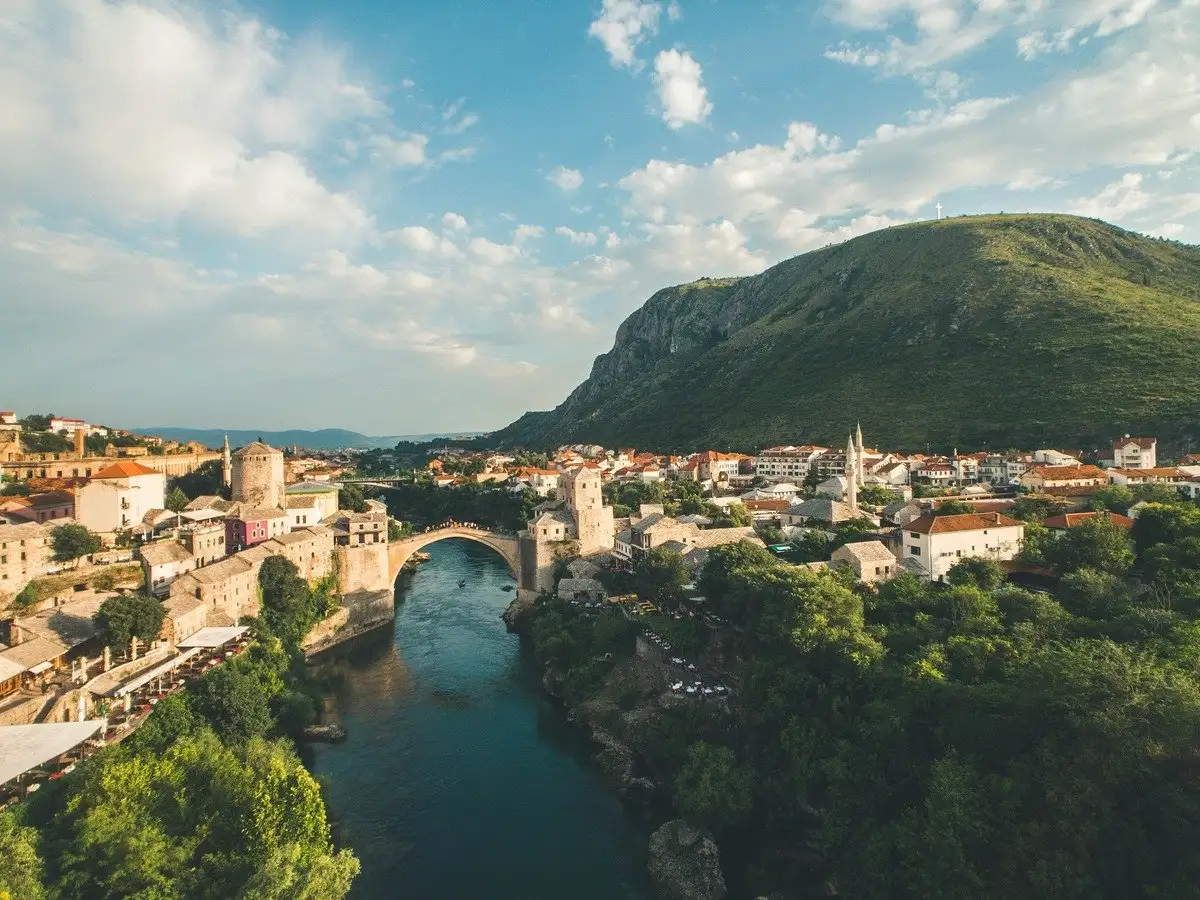
Bosnia and Herzegovina is the country most travelers to the Balkans discover by accident, usually via a Mostar day trip from the Croatian coast, and then quietly decide is the trip's real highlight. Sarajevo earned the nickname "Europe's Jerusalem" for a reason: mosques, Catholic and Orthodox churches, and a synagogue sit within a few blocks of each other in a city where Ottoman and Austro-Hungarian architecture meet at a literal painted line in the pavement. The country carries its history openly rather than hiding it. Bullet-pocked facades, a war tunnel you can still walk through, and a rebuilt 16th-century bridge sit alongside some of the cheapest good coffee and best mountain scenery left in Europe.
It is also still genuinely affordable. A full ćevapi lunch costs 8 to 10 convertible marks (about 4 to 5 euros), a private double room in Sarajevo's old town runs 50 to 80 KM (25 to 40 euros), and Kravice Falls, one of the best swimming spots in the Balkans, costs a few marks to enter. The country rewards travelers who came for one bridge and stay for the mountains they didn't know were there.
The honest complications
Bosnia and Herzegovina is not a fully settled country. The Dayton Agreement that ended the 1992-1995 war split it into two semi-autonomous entities, the Federation of Bosnia and Herzegovina and Republika Srpska, plus the self-governing Brčko District, an arrangement that keeps the peace but leaves politics fragmented and, periodically, tense. Land mines remain in rural and forested areas away from cities and marked trails, a real and specific risk that this guide addresses directly rather than glossing over. Road infrastructure outside the Sarajevo-Mostar corridor is variable, and English fluency drops off fast outside the two main tourist cities. None of this makes the country unsafe to visit as a tourist who sticks to cities, main roads and marked paths, but it is not a polished, frictionless destination, and it doesn't pretend to be.
A History Worth Knowing
Bosnia's position at the meeting point of the Ottoman and Austro-Hungarian empires, and later at the center of Yugoslavia's violent breakup, made it one of the 20th century's pivot points twice over: the 1914 assassination that triggered the First World War happened on a Sarajevo street corner, and the 1992-1995 war produced the longest siege of a capital city in modern history. Understanding both is close to essential for understanding what you're looking at in Sarajevo and Mostar today.
- 1461
Sarajevo founded. Ottoman governor Isa-beg Isaković establishes the settlement that becomes Sarajevo, building the mosque, bazaar and public baths around which Baščaršija still stands.
- 1878-1908
Austro-Hungarian rule. Administered from 1878 and formally annexed in 1908, bringing the grid streets, grand facades and coffeehouse culture that now sit directly against the Ottoman old town.
- 28 June 1914
The assassination. Gavrilo Princip shoots Archduke Franz Ferdinand and his wife Sophie at the Latin Bridge, the spark that ignites the First World War.
- 1984
Winter Olympics. Sarajevo hosts the Winter Games; the bobsled track on Mount Trebević is abandoned and repurposed less than a decade later.
- 1992-1996
The siege of Sarajevo. 1,425 days, the longest siege of a capital city in modern warfare, with the Sarajevo Tunnel the city's main lifeline for people and supplies.
- July 1995
Srebrenica. Over 8,000 Bosniak men and boys are killed by Bosnian Serb forces, recognized internationally as genocide.
- 14 Dec 1995
Dayton Agreement. Ends the war and splits the country into two entities, the Federation of Bosnia and Herzegovina and Republika Srpska, plus the Brčko District.
- Dec 2022-present
EU candidate. The European Council grants candidate status; accession negotiations have not yet formally opened.
Read the full history: empires, the siege and what Dayton actually built
Medieval Bosnia existed as an independent kingdom before Ottoman conquest absorbed the region in the 15th century. Ottoman rule, lasting roughly four centuries, is why Sarajevo's old town looks the way it does: the Gazi Husrev-beg Mosque, completed in 1531, the covered bazaar, and the Ottoman-era bridges over the Miljacka all date from this period, and a large share of the population converted to Islam, making Bosniaks today the country's largest ethnic and religious group.
The 1878 Congress of Berlin handed administration of Bosnia to Austria-Hungary, which formally annexed it in 1908, provoking Serbian nationalist anger that culminated in the 1914 assassination of Archduke Franz Ferdinand at the Latin Bridge, the immediate trigger for the First World War. The interwar and Yugoslav periods that followed brought Bosnia into a multi-ethnic socialist federation under Tito, culturally confident enough by 1984 to host the Winter Olympics in Sarajevo.
The war and the siege. Yugoslavia's violent breakup reached Bosnia in April 1992. Bosnian Serb forces encircled Sarajevo for 1,425 days, from 5 April 1992 to 29 February 1996, the longest siege of a capital city in modern warfare, three times longer than the siege of Stalingrad. Snipers and artillery on the surrounding hills, including the former Olympic bobsled course on Mount Trebević, targeted the city below; the 800-meter Sarajevo Tunnel dug under the airport runway became the main route for food, weapons and people in and out of the besieged city. In July 1995, Bosnian Serb forces killed more than 8,000 Bosniak men and boys at Srebrenica in what international courts have ruled was genocide, the worst atrocity on European soil since the Second World War.
Dayton and after. The Dayton Agreement, signed 14 December 1995, ended the fighting but built a famously complicated state: the Federation of Bosnia and Herzegovina (majority Bosniak and Croat, itself split into ten cantons), Republika Srpska (majority Serb), and the self-governing Brčko District, which belongs to both entities simultaneously. The arrangement has kept the peace for three decades but leaves national-level governance slow and, at times, gridlocked. The country received EU candidate status in December 2022, a milestone with real symbolic weight even though formal accession talks are still pending further reform.
Top Destinations
Bosnia and Herzegovina splits naturally into Sarajevo and the central mountains, the Herzegovina region around Mostar with its rivers and stone villages, and the wilder national parks toward the Croatian border. The country is compact, roughly the size of West Virginia, but mountain roads are slow, so plan by drive time, not straight-line distance. Five days covers Sarajevo and Mostar well; ten lets you add the national parks and the Herzegovina villages properly.
Sarajevo, where two empires meet at a painted line
Sarajevo is the reason most people extend their trip. Baščaršija, the Ottoman-era old town, runs directly into the Austro-Hungarian center at a spot marked in the pavement, mosque and cathedral bells audible from the same street corner. The Gazi Husrev-beg Mosque, the Sarajevo Tunnel Museum, and the Latin Bridge where the First World War's spark was lit cover the historical arc in a single walkable day; the Trebević cable car, rebuilt after wartime destruction, reaches the abandoned, graffiti-covered 1984 Olympic bobsled track for one of the best views and strangest sights in the Balkans. Our full Sarajevo city guide covers where to stay, eat and spend two or three days properly. Budget at least two full days.
Mostar, the bridge that survived twice
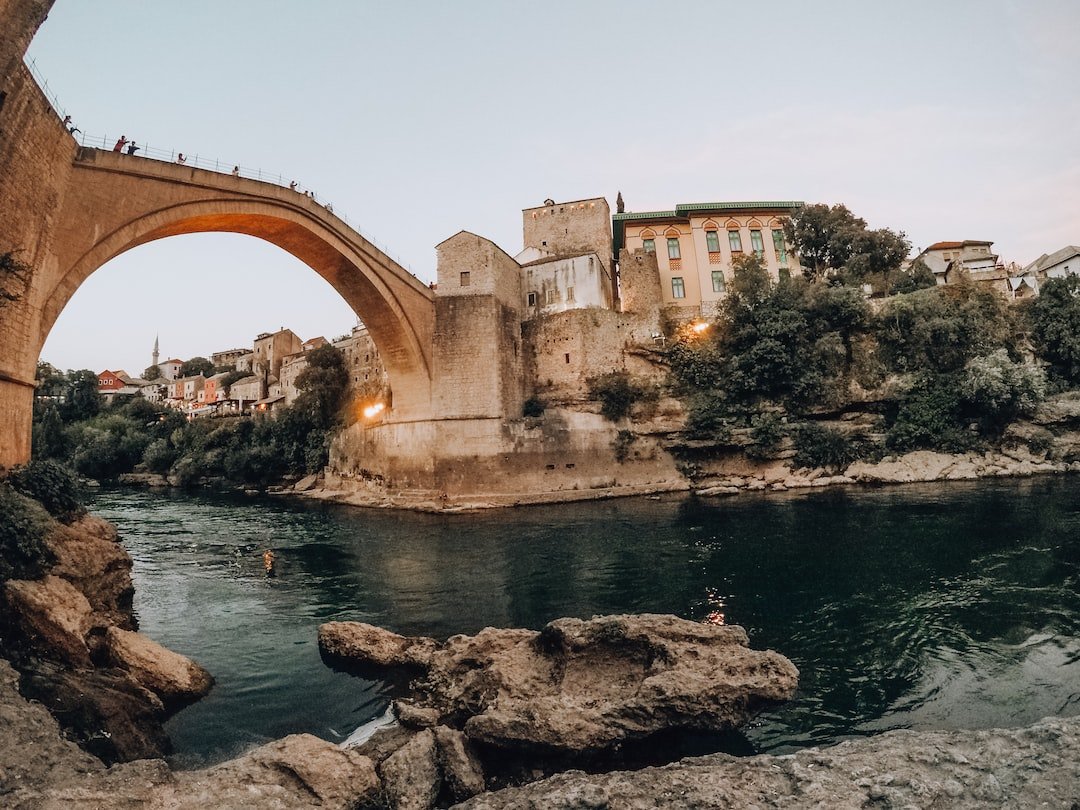
Stari Most, Mostar's Ottoman-era stone bridge, was built in 1566 by the architect Mimar Hajruddin, destroyed by shelling in November 1993, and rebuilt using original-technique stonework by 2004, now a UNESCO World Heritage Site. Local divers still leap the 24 meters into the Neretva for tips from the crowd, a tradition older than the current bridge itself. The Old Town's Kujundžiluk lane is dense with copper and jewelry stalls, and the mosque minarets along the river give the best photograph of the bridge from a small entry fee. Mostar is roughly 2.5 hours from Sarajevo by road; visit early morning or early evening to see the bridge without the day-tripper crowds from the coast.
Blagaj, Počitelj & Kravice Falls
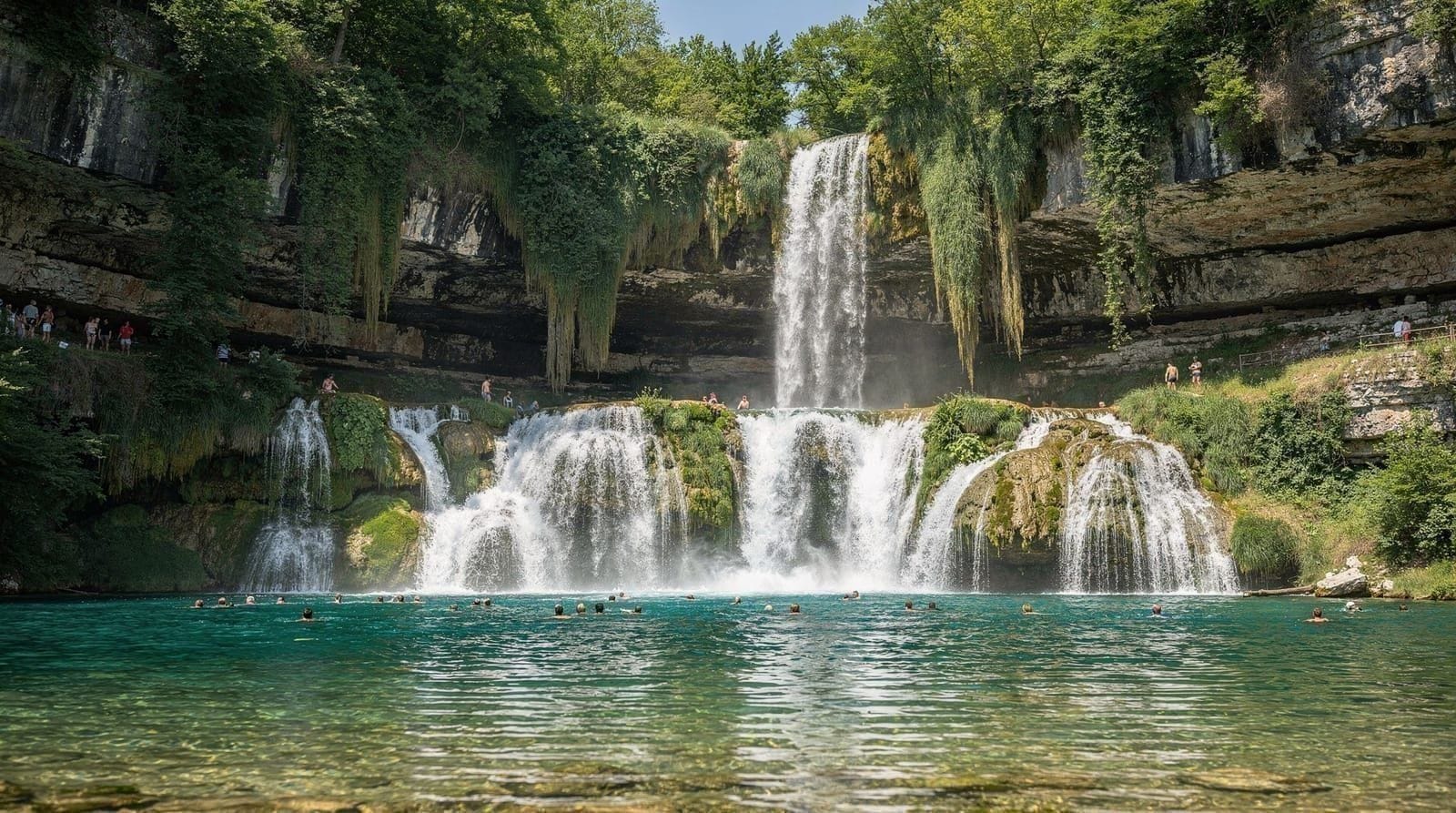
Herzegovina's stone villages make an easy loop from Mostar. Blagaj's Tekija, a 16th-century Dervish monastery, sits built directly into a cliff face over the Buna spring, one of Europe's largest karst springs and startlingly blue-green up close. Počitelj is a small fortified Ottoman-era village on the Neretva, its stone houses and minaret climbing a hillside, best visited slowly rather than as a five-minute photo stop. Kravice Falls, a horseshoe-shaped, roughly 25-meter cascade on the Trebižat River about 40 minutes from Mostar, is swimmable from late May through September and is one of the best natural swimming spots anywhere in the Balkans.
Sutjeska & Una National Parks
Sutjeska National Park, established in 1962 in eastern Bosnia, holds Maglić, the country's highest peak at 2,386 meters, and Perućica, one of Europe's last remaining primeval forests. The Tara River canyon nearby carves one of the deepest gorges in Europe, and whitewater rafting its rapids is a classic Balkans adventure booked through operators based in the park. Una National Park, in the northwest near Bihać, centers on the Una River's turquoise rapids and waterfalls, with rafting, kayaking and canyoning options for a full range of experience levels. Both parks require more driving time than Sarajevo or Mostar reward with rushed day trips; budget at least one overnight for either.
Jajce, the waterfall in the town center
Jajce, a former medieval Bosnian capital in the country's center-north, has a genuine oddity: a 17-meter waterfall where the Pliva River drops directly into the Vrbas, visible from the town's main street. The hilltop fortress above dates to the medieval Bosnian kingdom, and the AVNOJ museum marks where Yugoslavia's post-war federal state was formally declared in 1943. Quieter than Sarajevo or Mostar and rarely crowded, Jajce works best as a stop on a longer loop toward Una National Park rather than a dedicated day trip from the capital.
Hidden gems beyond the main circuit
The zones above cover a first trip well. With extra days, these reward the detour and rarely make the standard itineraries.
Trebinje
A sun-warmed town of plane-tree squares near the Montenegrin and Croatian borders, with the Hercegovačka Gračanica monastery overlooking the valley. Far fewer tourists than Mostar, and a natural stop en route to Dubrovnik.
Stećci medieval tombstones
Carved limestone grave markers from the 12th to 16th centuries, scattered at sites across the country and collectively UNESCO-listed in 2016. Understated and easy to miss, but a genuinely distinct piece of medieval European heritage.
Prokoško Lake
A glacial lake in the Vranica mountains reachable by 4x4 track or a half-day hike, ringed by wooden shepherd huts and grazing horses. Popular with Bosnian weekenders, still rare on foreign itineraries.
Bihać's town-center rapids
The Una River runs directly through Bihać itself, with a small island and old mills in the middle of the current: a preview of the national park a short drive away, with none of the entry fee.
Konjic's Tito bunker
A vast, still largely intact Cold War nuclear bunker built in total secrecy for Yugoslav leadership, now open for guided tours and periodically used as a contemporary art biennial venue.
Banja Luka
The de facto capital of Republika Srpska, with a riverside Ottoman-era fortress, a compact walkable center, and almost no foreign tourists, a genuinely different read on the country than Sarajevo or Mostar.
Culture & Etiquette
Bosnia and Herzegovina's defining cultural fact is its layered religious and ethnic diversity: Bosniak Muslims, Bosnian Serbs (mostly Orthodox), Bosnian Croats (mostly Catholic) and a small historic Jewish community have shared this land for centuries, and Sarajevo in particular wears that layering visibly, with mosque, cathedral, Orthodox church and synagogue all within a short walk in the old town. Coffee culture runs deep: Bosnian coffee, brewed unfiltered in a copper džezva and poured into a small fildžan cup with a cube of Turkish delight, is a slow ritual, not a to-go order, and rushing it reads as mildly rude.
Do
- Sit down for coffee. Bosnian coffee is meant to be drunk slowly over conversation, often for 30 minutes or more. Ordering it to go misses the point entirely.
- Dress modestly for mosques. Cover shoulders and knees; women should carry a scarf for the Gazi Husrev-beg Mosque and remove shoes before entering.
- Learn a few local words. Hvala (thank you), Dobar dan (good day), Da (yes), Ne (no). Bosnian, Croatian and Serbian are close enough that these work everywhere in the country.
- Carry cash (KM). Cards work in Sarajevo and Mostar hotels and restaurants, but markets, small kafanas and rural guesthouses are often cash only.
- Ask before photographing war memorials or cemeteries. Many Bosnians lost family members in the 1990s war; treat memorial sites and the people visiting them with the same care you would at any recent grave.
Don't
- Wander off marked paths or into abandoned buildings. This is the single most important safety rule in the country and it's cultural as much as physical: land mines are a real, documented hazard away from cities and marked trails.
- Raise the war as small talk. Most adult Bosnians lived through or lost family in the 1992-1995 war. Sites like the Tunnel Museum and War Childhood Museum exist precisely so visitors can engage with this history respectfully; unprompted personal questions to strangers do not.
- Assume "Bosnian," "Croatian" and "Serbian" are wildly different languages. They're mutually intelligible registers of one language with political and identity significance attached; treating the distinction as trivial can land badly.
- Skip the divers' tip jar in Mostar. The Stari Most bridge jumpers rely on visitor contributions; watching for free without contributing to the collection is a minor but real faux pas.
- Expect Uber. Ride-hailing apps are inconsistent outside Sarajevo; agree taxi fares upfront or use a hotel-booked driver in smaller towns.
Deeper culture: sevdalinka, the two entities, and Sarajevo's Haggadah
Sevdalinka. A traditional Bosnian folk music genre of melancholic love songs, typically accompanied by accordion, that dates back centuries and remains a living tradition performed in Sarajevo's old-town kafanas rather than only preserved as a museum piece.
Two entities, one country. The Federation of Bosnia and Herzegovina and Republika Srpska, created by the 1995 Dayton Agreement, function with separate governments under a shared national state. As a tourist this is mostly invisible day to day, but it explains why you'll see different flags, different license-plate conventions, and occasionally different official languages on signage depending on which entity you're in.
The Sarajevo Haggadah. A 14th-century illuminated Jewish manuscript, one of the oldest of its kind in the world, saved from destruction twice, once from the Nazis by a museum curator and once during the 1990s siege. It's held at the National Museum of Bosnia and Herzegovina and is a genuine point of civic pride across ethnic lines.
Food & Drink
Bosnian food carries a heavy Ottoman inheritance: grilled meats, filo pastry pies, and slow-brewed coffee, plus a genuine national obsession with ćevapi that produces fierce local opinions about which grill does it best. It is also very cheap: a full meal at a proper Baščaršija ćevabdžinica rarely tops 15 KM (about 7-8 euros) per person.
Ćevapi 9-12 KM
Small grilled minced-meat sausages served in somun, a soft flatbread, with raw onion and often kajmak, a clotted cream. Sarajevo-style comes without ketchup or mustard; ordering them here marks a first-timer.
Burek & Pita ~3-5 KM
Coiled filo pastry filled with meat (burek), cheese (sirnica), potato (krompiruša) or spinach (zeljanica), sold by weight at bakeries across the country and eaten with a spoon of yogurt.
Bosnian Coffee ~2-3 KM
Finely ground coffee brewed unfiltered in a copper džezva, poured into a small fildžan cup and served with a cube of rahat lokum (Turkish delight). Meant to be drunk slowly, grounds and all.
Dolma & Sarma
Vegetables (dolma) or cabbage leaves (sarma) stuffed with spiced minced meat and rice, slow-simmered and typically served with mashed potato: home cooking more than restaurant food, but on most traditional menus.
Ajvar
A roasted red pepper and eggplant relish, made in bulk every autumn across the region, spread on bread or served alongside grilled meats. Jars from a market stall make a genuinely good, packable souvenir.
Rakija ~3-5 KM
Fruit brandy, usually plum (šljivovica) or grape, offered as a welcome drink or a toast. Homemade versions from a guesthouse or village stop are typically stronger and better than what's sold commercially.
When to Go & Itineraries
May, June, September and October give the best balance: warm enough for Kravice Falls and Mostar's riverside cafes, cool enough for comfortable hiking in Sutjeska and Una, without July-August's heat and coach-tour crowds at the Old Bridge. Winter suits Sarajevo specifically, with functioning ski resorts on Bjelašnica and Jahorina less than an hour from the city, though mountain valleys elsewhere can be genuinely cold and some rural roads become difficult.
All four seasons compared, with temperatures
| Season | Verdict | Temps | Prices & crowds |
|---|---|---|---|
| May-Jun & Sep-Oct | Best | 18-27°C Sarajevo/Mostar | Mid prices, manageable crowds |
| Jul-Aug | Good (hot) | 28-36°C Mostar/Herzegovina | Peak crowds at the Old Bridge and Kravice; Sarajevo more bearable |
| Dec-Feb | Good for skiing | -2 to 6°C Sarajevo | Low tourist prices; Bjelašnica and Jahorina ski season |
| Mar-Apr | Good | 10-18°C | Low prices, few tourists; some mountain roads still difficult |
Year-round averages: Sarajevo 11°C, Mostar 16°C (regularly above 35°C in summer), Banja Luka 12°C, Bihać 11°C. Sutjeska's high valleys can hold snow into May.
Itineraries
Five days covers Sarajevo and a proper Mostar-Herzegovina loop. Ten days adds a national park and slows the pace enough to actually enjoy the villages instead of rushing them.
- Days 1-2
Sarajevo. Baščaršija, Gazi Husrev-beg Mosque, the Latin Bridge, the Tunnel Museum, and the Trebević cable car up to the bobsled track.
- Day 3
Travel to Mostar. About 2.5 hours by road; afternoon and evening at the Old Bridge once the day-tripper coaches have thinned out.
- Days 4-5
Herzegovina loop. Blagaj's Tekija, Počitelj, and Kravice Falls, then back to Sarajevo or onward to the Croatian coast.
- Days 1-3
Sarajevo, unhurried. The full old-town and war-history circuit, plus a day trip to Vrelo Bosne or a half-day up on Bjelašnica.
- Days 4-6
Mostar & Herzegovina. Two nights in Mostar, with a full day for Blagaj, Počitelj and Kravice at an unrushed pace.
- Days 7-8
Sutjeska National Park. Drive to the park, a day hiking toward Maglić or the Perućica primeval forest, optionally add Tara Canyon rafting.
- Days 9-10
Return via Jajce. Break the drive back with the waterfall town and its medieval fortress before returning to Sarajevo.
- Days 1-3
Sarajevo extended. Add a ski or hiking day on Jahorina depending on season, and the Konjic Tito bunker tour as a half-day trip.
- Days 4-7
Mostar & Herzegovina, slow. Three nights in Mostar covering Blagaj, Počitelj, Kravice and a detour south to Trebinje.
- Days 8-10
Sutjeska National Park. Multi-day hiking toward Maglić and the Perućica forest, plus Tara Canyon rafting.
- Days 11-12
Una National Park. Bihać's rapids, kayaking or canyoning on the Una River.
- Days 13-14
Jajce & return. The waterfall town, the AVNOJ museum, and the drive back to Sarajevo.
Getting there & around
Sarajevo International Airport (SJJ) is the main gateway, with connections from Vienna, Munich, Istanbul and several other European hubs; Mostar has a much smaller airport with limited seasonal service. A rental car (from about €25-35/day) is the most practical way to see Herzegovina and the national parks; the bus network covers Sarajevo-Mostar and other main routes well but makes the village loop and park access slow and roundabout. Roads are generally good on the main Sarajevo-Mostar corridor and noticeably slower and more mountainous elsewhere.
All transport options with prices: buses, trains, taxis
| Option | Price | Notes |
|---|---|---|
| Sarajevo-Mostar bus | ~20-25 KM | About 2.5-3 hours, several daily departures, tickets from the main bus station. |
| Sarajevo-Mostar train | ~10-15 KM | A scenic but slower alternative through the mountains; schedules are limited, check current timetables. |
| Taxis (Sarajevo) | ~5-15 KM | Metered taxis are reliable in the capital; agree the fare upfront in smaller towns where meters are less consistent. |
| Rental car | €25-35/day | The practical choice for Herzegovina villages and the national parks; a standard EU or international license is accepted. |
Practical prep: buy a Bosnian SIM at the airport or in central Sarajevo (around 20-30 KM for a data package), or get an eSIM before landing. Standard travel insurance works well for the country generally; if hiking in Sutjeska or Una, confirm the policy covers mountain rescue. Neither Uber nor Bolt is consistently reliable outside Sarajevo, so download offline maps and keep your accommodation's phone number handy for taxi bookings in smaller towns.
Where to stay
Sarajevo old-town guesthouses
Baščaršija's pansions and small hotels put you within walking distance of everything; our Sarajevo city guide covers specific picks across every budget.
Mostar Old Town stays
Small family-run guesthouses within sight or sound of the Old Bridge; booking one with a river-view terrace is worth the modest premium for the evening light on the bridge.
National park lodges
Sutjeska and Una both have simple lodges and camps geared toward hikers and rafters, useful bases if you're spending more than a rushed day trip in either park.
Sarajevo full-service hotels
Marijin Dvor and the streets around Ferhadija have the capital's international-brand and boutique options, a short walk or tram ride from Baščaršija.
Budget Planning
Bosnia and Herzegovina remains one of the cheapest countries in Europe to visit, noticeably less expensive than neighboring Croatia for comparable quality. The main cost spikes are Sarajevo Film Festival week in August and peak-season Mostar day-tour prices; outside those, prices stay flat and low year-round.
- Hostel dorm or basic pansion €10-20
- Ćevapi and bakery meals €3-6
- Intercity buses between cities
- Free old-town sights, mosque exteriors
- 3-star hotel or guesthouse double
- Restaurant dinners €10-20/person
- Rental car €25-35/day
- Guided Mostar-Herzegovina day tour
- Best available hotels in Sarajevo
- Private drivers and guided tours
- Fine dining and boutique stays in Mostar
- National park lodge with guided hikes
Quick reference prices: coffee, buses, entry fees
| Bosnian coffee | ~2-3 KM |
| Ćevapi (portion of 10) | 9-12 KM |
| Restaurant meal (mid) | 15-25 KM |
| Rakija (shot) | 3-5 KM |
| Sarajevo-Mostar bus | ~20-25 KM |
| Tunnel of Hope Museum entry | ~10-12 KM |
| Baščaršija guesthouse double | 50-80 KM/night |
| Sarajevo mid-range hotel | 120-200 KM/night |
| Kravice Falls entry | ~10 KM |
| Trebević cable car return | ~20 KM |
Prices reflect August 2026 research and drift over time, especially Sarajevo Film Festival week and peak Mostar season. Treat them as a planning baseline, not a quote.
Visa & Entry
Bosnia and Herzegovina has a permissive visa regime for most Western passports: US, EU, UK, Australian, Canadian and New Zealand citizens enter visa-free for up to 90 days within a 180-day period, by passport at land borders, Sarajevo International Airport, or Mostar Airport. Rules do change; the Bosnia and Herzegovina Ministry of Foreign Affairs is the authoritative source, not third-party paid "e-visa" sites that rank well in search but charge for something that's often free.
✓ Valid passport
At least 3 months validity from date of entry. Keep a photocopy separate from the original.
✓ Return/onward ticket
May be requested at immigration for air arrivals or if travel plans look one-way.
✓ Accommodation registration
Hotels and registered guesthouses handle this automatically; have your booking confirmation handy at the border.
✓ Not Schengen
Time in Bosnia and Herzegovina does not count toward your Schengen 90-day allowance, which matters for longer European trips.
| Bosnia and Herzegovina | Croatia | |
|---|---|---|
| Daily budget | €35-50 gets you far; one of Europe's cheapest | Noticeably pricier, especially the coast in summer |
| Coast | Almost none, just Neum's 20km strip | Long Adriatic coastline, the main draw |
| Old towns | Ottoman Sarajevo and Mostar, deep layered history | Venetian and Roman heritage along the coast |
| Crowds | Quiet outside Mostar's Old Bridge | Heavy cruise-ship and coastal crowds in summer |
| Schengen | No, doesn't touch your 90 days | Yes, joined Schengen and the euro on 1 Jan 2023 |
Safety, Land Mines, Solo Women & Family
Bosnia and Herzegovina is safe for tourists who stay in cities, on main roads and on marked trails. The US State Department rates the country Level 2, Exercise Increased Caution, citing crime, a general terrorism risk shared across the region, and land mines. The mine risk is real and specific rather than a background statistic: minefields remain from the 1992-1995 war, concentrated in rural, forested and formerly front-line areas away from cities, and they are the one hazard in this guide worth taking literally rather than skimming past.
Land mines
Never leave paved roads, marked trails or paths other visitors are visibly using. Hazardous areas are usually marked with red skull-and-crossbones signs; treat any unmarked overgrown field, forest edge or abandoned building outside a city with real caution.
Petty crime
Pickpocketing occurs in crowded Baščaršija lanes and at busy Mostar viewpoints at the level of a typical European tourist city. Keep phones and wallets secured in dense crowds.
Traffic & mountain roads
Mountain roads toward Sutjeska and Una are narrow with limited lighting and variable maintenance. Avoid unnecessary night driving outside the Sarajevo-Mostar corridor and drive defensively year-round.
Two more things worth knowing: leftover firearms and rural infrastructure
Firearms from the war era. The US State Department notes that violent crime involving firearms remaining from the war does occur, though it is not typically directed at tourists and is concentrated away from tourist areas. Normal urban awareness in Sarajevo and Mostar is sufficient for the overwhelming majority of visitors.
Rural infrastructure. Away from Sarajevo and Mostar, medical facilities, English-speaking staff and reliable mobile signal all become less consistent. Carry basic first aid on national park trips and confirm your accommodation's emergency contact details before heading into Sutjeska or Una.
The 3 scams to actually know about
Bosnia and Herzegovina is not a high-scam destination, and most Bosnians are protective of their tourism reputation given how recently the country's image was defined by war. But three patterns catch uninformed visitors. The full country list lives on our Bosnia travel alerts page.
Unofficial taxi overcharging
Unmetered drivers at Sarajevo Airport or Mostar's bus station sometimes quote inflated flat fares to tourists. Use metered taxis, agree the fare before getting in if no meter is visible, or book a fixed-price transfer in advance.
Aggressive tour and souvenir touts
Baščaršija and Mostar's Old Bridge approach have persistent tour and souvenir sellers, occasionally pushy about "helping" with directions before steering you to a shop. A firm "ne, hvala" (no, thank you) and continuing to walk works.
Poor currency exchange rates
Airport and some street exchange counters offer noticeably worse KM rates than bank ATMs. Withdraw from a bank machine where possible and always choose to pay in KM, not your home currency, at card terminals.
Solo women travelers
Bosnia and Herzegovina rates reasonably well for solo women, particularly in Sarajevo and Mostar, where street harassment is uncommon and the cafe culture makes solo evenings easy to navigate. The land mine rule matters more here than the usual solo-female safety statistics: it applies equally regardless of who you're traveling with, and it is the risk most likely to actually cause harm if ignored. Practically: dress modestly around mosques and rural villages, keep your accommodation's contact details handy in smaller towns where English is less common, and stick to marked trails on any hike. Full detail on our Solo Woman Explorer pages.
Emergency numbers
Embassies in Sarajevo and mountain emergency protocol
112 is the standard emergency number, though the local numbers (122 police, 123 fire, 124 ambulance) remain more consistently staffed by Bosnian/Croatian/Serbian-speaking operators outside the capital. In Sarajevo, most embassies cluster around the Marijin Dvor and Kovačići neighborhoods, a short walk or tram ride from Baščaršija.
- USA
- +387-33-704-000
- UK
- +387-33-282-200
- Germany
- +387-33-570-500
- France
- +387-33-668-149
- Italy
- +387-33-296-660
- Netherlands
- +387-33-562-600
- Australia
- via Vienna, +43-1-506-740
- Canada
- +387-33-222-033
If you suspect you're near a minefield: stop immediately, do not proceed, and retrace your exact steps back the way you came rather than continuing forward or trying to walk around. Call 122 (police) or 112 and note your location as precisely as possible.
Family travel & pets
Bosnia and Herzegovina works well for families with some planning around the heavier history. Baščaršija's pedestrian lanes, Vrelo Bosne's shaded, stroller-friendly paths, and Kravice Falls' swimmable pool all suit kids of most ages, and the low prices make family travel here noticeably easier on a budget than in Western Europe. The war-history sites, the Tunnel Museum and War Childhood Museum in particular, land better with children over roughly 10 who can process what they're seeing; younger kids may find them upsetting or simply confusing without context.
Which history sites suit which ages, and bringing pets
History sites by age: the Trebević cable car and abandoned bobsled track work as an adventure for almost any age, since the war context can be as light or heavy as parents choose to make it. The Tunnel Museum and War Childhood Museum are more emotionally direct and suit older children and teenagers better than young kids.
Pets: EU pet passport holders can enter with dogs, cats and ferrets given valid rabies vaccination and a microchip. Non-EU visitors need a veterinary health certificate issued shortly before travel, current rabies vaccination, and to check current import rules with Bosnia's Veterinary Office before traveling, since requirements can change. Well-behaved dogs are generally welcome at outdoor kafana seating in Baščaršija and Mostar's Old Town.
Bosnia and Herzegovina FAQ
Is Bosnia and Herzegovina safe to visit?
Yes, for the overwhelming majority of visitors who stick to cities, main roads and marked trails. The US State Department rates it Level 2 (Exercise Increased Caution) for crime, terrorism risk and land mines. Sarajevo and Mostar's tourist areas are safe to walk; the real rule is never step off a paved road or marked trail into overgrown or abandoned ground.
Are there still landmines in Bosnia and Herzegovina?
Yes. Minefields from the 1992-1995 war remain in rural and forested areas, mostly away from cities and marked hiking trails. Hazardous areas are usually marked with red skull-and-crossbones signs. Stay on paved roads, marked trails and paths other people are visibly using, and never enter abandoned buildings or wander into overgrown fields.
Do I need a visa for Bosnia and Herzegovina?
Citizens of the US, EU, UK, Australia, Canada and New Zealand can enter visa-free for up to 90 days within a 180-day period. Bosnia and Herzegovina is not in Schengen, so time there doesn't count against a Schengen 90-day allowance.
What currency does Bosnia and Herzegovina use?
The convertible mark (BAM, locally KM), fixed by currency board to the euro at 1.95583 KM per euro since 1997. Cards are widely accepted in Sarajevo and Mostar; smaller towns and older kafanas are more cash-reliant.
When is the best time to visit Bosnia and Herzegovina?
May, June, September and October: warm enough for Kravice Falls and Mostar's bridge jumps without July-August's heat and crowds, and mountain trails in Sutjeska and Una are fully open. Winter suits Sarajevo's ski slopes and museums but the coldest mountain valleys drop well below freezing.
How many days do you need in Bosnia and Herzegovina?
Five days covers Sarajevo and a Mostar-Kravice day trip comfortably. Ten days adds Una or Sutjeska National Park, Blagaj and Počitelj, and a slower pace through the Herzegovina villages.
Is Mostar a day trip from Sarajevo or worth staying overnight?
Both work. Mostar is roughly 2.5 hours from Sarajevo by road, doable as a long day trip, but the Old Bridge is calmer and better lit before the tour buses arrive and after they leave, so one night lets you see it at both ends of the day without the crowds.
Is Bosnia and Herzegovina in the European Union?
No. Bosnia and Herzegovina has held EU candidate status since December 2022, but accession negotiations have not formally opened and it isn't in the EU or the Schengen Area.
What language is spoken in Bosnia and Herzegovina?
Bosnian, Croatian and Serbian, three standardized registers of what is essentially one mutually intelligible language. English is common in Sarajevo and Mostar's tourist areas, less so in smaller towns.
Is Bosnia and Herzegovina safe for solo female travelers?
Generally yes, particularly in Sarajevo and Mostar, where street harassment is uncommon and the cafe culture makes solo evenings easy. Normal city precautions apply, and the same landmine-avoidance rule matters more than crime does outside urban areas.
Is Bosnia and Herzegovina good for families with kids?
Yes, with some planning. Baščaršija's pedestrian lanes, Vrelo Bosne's shaded paths and Kravice Falls' swimmable pool all work well for kids; the war history sites are more suited to children over about 10 who can process what they're seeing.
Is Bosnia and Herzegovina cheaper than Croatia?
Noticeably. Budget travelers manage on €35-50 a day in Bosnia and Herzegovina versus €60 or more for comparable quality in Croatia, and Bosnia's tourist sites are far less crowded outside Mostar's Old Bridge.
What Stays With You
Most visitors arrive for one bridge and leave having rearranged their sense of what a European capital looks like. Sarajevo doesn't ask you to forget the 1990s to enjoy it: the bullet holes are still there in the plaster, the tunnel is still walkable, and the guide leading you through Baščaršija may well have lived through the siege they're describing. None of it feels staged, and somehow the coffee still gets poured slowly and the hospitality is still unhurried and genuine.
Stand on the rebuilt Stari Most at dusk, watch a diver climb the railing for the crowd's donation, and understand why a country this recently defined by its worst year is, twenty-five years later, quietly becoming known for something else entirely.