
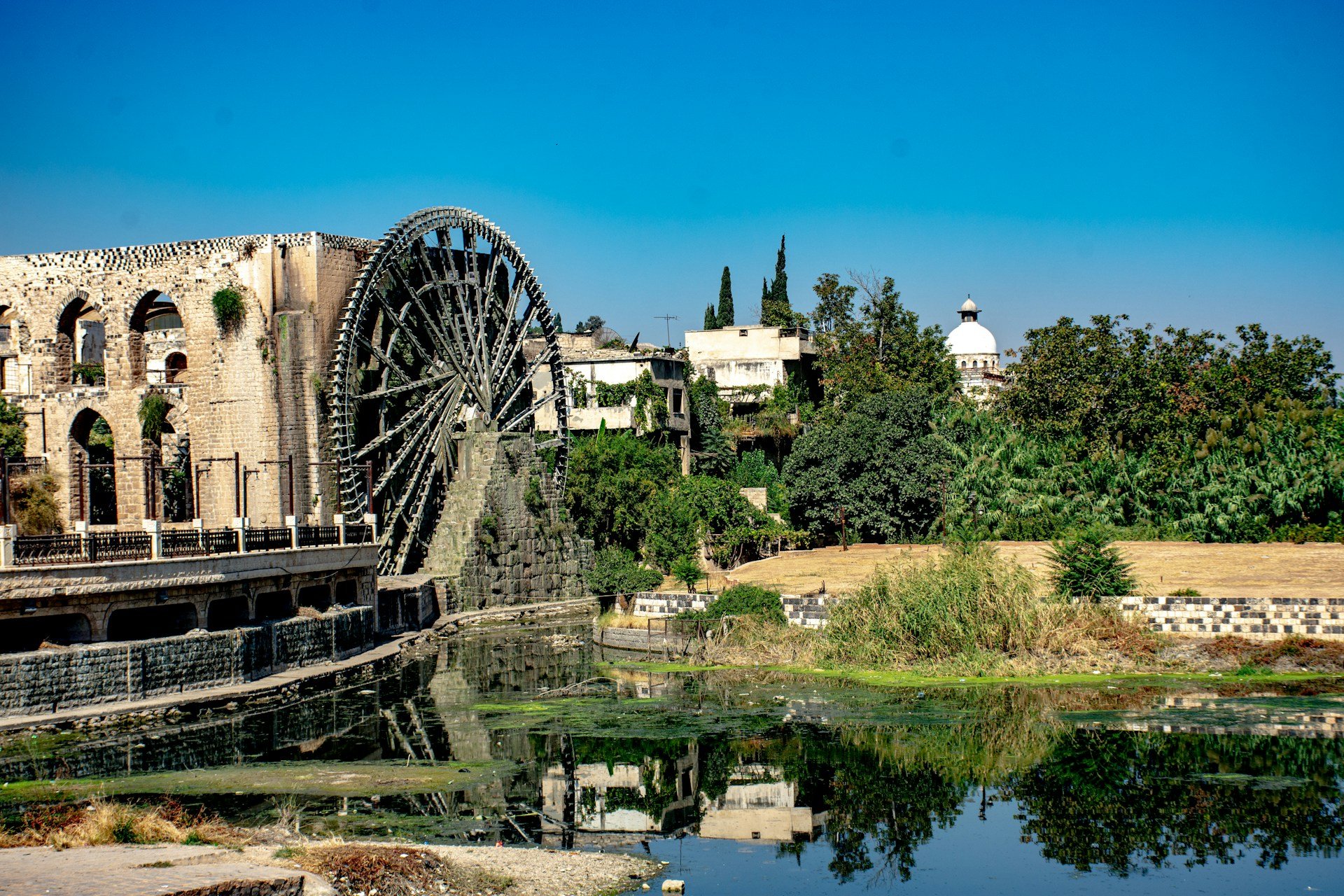
Syria
One of the oldest continuously inhabited landscapes on earth, with sites that rewrote what we know about the ancient world. The Assad regime fell in December 2024. What comes next — for the country and for those who visit it — is being written now, by people who have lived through extraordinary things and are still here.
What You're Actually Getting Into
Syria was, before the civil war that began in 2011, one of the most rewarding destinations in the Middle East. Damascus is among the oldest continuously inhabited cities on earth — people have lived on this site for at least 8,000 years, possibly longer. The old city's souqs, built and rebuilt over centuries, are still operating. The Umayyad Mosque, completed in 715 CE on a site that had been a temple to Hadad, then a Roman temple to Jupiter, then a Byzantine cathedral, is one of the great religious buildings of the world. Palmyra's Roman-era ruins, rising from the Syrian desert, were among the most atmospheric ancient sites in the Middle East. Krak des Chevaliers, the crusader castle in the mountains above Homs, was called by T.E. Lawrence "perhaps the best preserved and most wholly admirable castle in the world."
What happened to Syria between 2011 and 2024 was catastrophic. The civil war killed an estimated 500,000 people. It displaced half the country's pre-war population of 21 million — an estimated 6 million fled as refugees to neighboring countries and Europe, and another 6 million became internally displaced. Cities that had stood for millennia — Aleppo, Homs, Raqqa — were reduced to rubble across entire neighborhoods. Palmyra's ancient ruins were partially destroyed by ISIS. The economic collapse was total. A country that had been developing and opening — Syrian tourism was growing steadily before 2011 — was devastated across every dimension.
The fall of Bashar al-Assad in December 2024, after a rapid offensive by a coalition of rebel groups led by Hayat Tahrir al-Sham (HTS), ended 54 years of Assad family rule. What comes next is genuinely uncertain. Syria in 2026 is a country in transition: a new governing authority is establishing itself, some infrastructure is being restored, some borders are reopening, and some extraordinary sites that were closed or dangerous during the war are again accessible. This is also a country with a fractured political landscape, significant areas still controlled by different armed factions, an economy near collapse, and the fresh wounds of a 13-year civil war.
The travelers visiting Syria in 2026 are not typical tourists. They are journalists, researchers, humanitarian workers, members of the diaspora returning to see what remains, and a small number of adventurous independent travelers for whom witnessing a country at a historical inflection point is a considered reason to go. This guide is written for people in that last category who intend to go regardless — providing the most honest information available so they can make the best decisions possible once they arrive.
Syria at a Glance
Ratings reflect current 2026 conditions for independent travelers, not pre-war Syria. The country that existed before 2011 would score considerably higher across most categories.
The Current Situation on the Ground
Understanding Syria in 2026 requires understanding what changed in December 2024 and what hasn't. The Assad regime's fall was rapid — the offensive that began in late November 2024 reached Damascus in days. Assad fled to Russia. The transitional governance structure that emerged is led primarily by HTS (Hayat Tahrir al-Sham), formerly affiliated with al-Qaeda but which officially severed that connection in 2016 and has since evolved toward a more pragmatic governance approach. How that evolution continues and whether the new Syria is stable, pluralistic, and safe is being determined in real time.
The areas of Syria that are relatively stable and receiving some visitors in 2026 are Damascus and its old city, the coast (Latakia), and the areas around Aleppo's surviving old city. Palmyra, while partially destroyed, is accessible with a guide. Krak des Chevaliers is open. The areas that remain genuinely dangerous include the northeast (still complex due to Kurdish autonomous zone dynamics and Turkish military presence), parts of the south near the Jordanian border, and any area with unexploded ordnance — which includes significant parts of former frontline cities like Homs, Raqqa, and parts of Aleppo.
🟢 Relatively Stable
Damascus old city and central districts. Latakia coast. Tartus. Parts of Aleppo old city. Krak des Chevaliers region. Accessible to careful, prepared travelers.
🟡 Exercise Caution
Palmyra (UXO risk, limited services). Hama and surroundings. Daraa in the south. Rural areas between major cities. Route planning essential.
🔴 Avoid
Raqqa and eastern Deir ez-Zor. Former frontline areas of Homs. Eastern desert regions. Areas near active faction boundaries. UXO-dense zones.
⚫ Inaccessible / Complex
Northeast Syria (Rojava / Kurdish autonomous zone). Areas near Turkish military operations. Golan Heights (Israeli-controlled). Israeli air strike zones.
A History Worth Knowing
The territory of modern Syria is one of the cradles of human civilization. Tell Qaramel, north of Aleppo, has evidence of human habitation dating to around 10,000 BCE. Çatalhöyük in Turkey gets more attention in the popular imagination, but Syria's Neolithic settlements are equally significant. Ebla, discovered in 1964 southwest of Aleppo, was a major Bronze Age city-state that flourished around 2400–2300 BCE, with archives of over 17,000 cuneiform tablets that rewrote our understanding of the ancient Near East. The tablets recorded commercial transactions, diplomatic correspondence, and literary texts in one of the oldest known writing systems. Syria has been a place where things were written down for a very long time.
Damascus claims to be the world's oldest continuously inhabited city — a claim contested with Jericho and a few others, but supportable across a documented human presence of at least 8,000 years. It was capital of the Aramaean kingdom, then an Assyrian province, a Persian satrapy, a Hellenistic city (Alexandria under the Seleucids), a Roman city, the capital of the Umayyad Caliphate, and eventually a provincial capital under the Ottomans. Each layer of its past is still present in the fabric of the old city — the street plan follows the Roman grid, the Umayyad Mosque sits on the temple platform that held every previous version of the city's main religious space, and the Khan As'ad Pasha caravanserai built in 1752 still stands in the souq.
The Umayyad Caliphate, based in Damascus from 661 to 750 CE, was the first great Islamic empire — stretching from Spain and North Africa across the Middle East to Central Asia and the Indian subcontinent. The Umayyad Mosque, completed by Caliph al-Walid I in 715 CE, was built on the site of a Byzantine cathedral of St. John the Baptist, which was itself built on a Roman temple to Jupiter, which was itself built on an Aramaean temple to Hadad. The mosque still contains a shrine believed to hold the head of John the Baptist — a sacred site for Muslims, who revere him as the prophet Yahya, and for Christians. This compression of sacred history into a single place is characteristically Syrian.
The modern Syrian state was carved from the wreckage of the Ottoman Empire by the French Mandate of 1920–1946. Independence came in 1946. The subsequent decades brought coups, pan-Arab nationalism, and in 1970 the rise to power of Hafez al-Assad through a military takeover. His Ba'athist secular authoritarian state — allied with the Soviet Union and later Russia — ruled for 30 years before he died in 2000 and his son Bashar inherited power.
The 2011 Arab Spring protests that began in the southern city of Daraa were met with violent suppression. What followed was a progressive militarization that became a multi-sided civil war involving the Syrian government, multiple opposition armed groups, Kurdish forces, ISIS, al-Qaeda-affiliated groups, and the military interventions of Russia, the United States, Turkey, Iran, Israel, and others. The human cost was catastrophic: an estimated 500,000 dead, half the pre-war population displaced, and cities reduced to rubble. The Syrian economy contracted by over 60%. Infrastructure across the country was devastated.
The fall of Assad in December 2024 came faster than almost any analyst had predicted. A rebel offensive beginning from Idlib province rapidly captured Aleppo, then Hama, then Homs, reaching Damascus in a matter of days. Assad fled to Russia. Prisons were opened. Thirteen years of authoritarian rule ended — though what replaces it, and whether the various armed factions can build a stable government, remains the central question of Syrian life in 2026.
Among the world's earliest agricultural settlements. Tell Qaramel near Aleppo is one of the oldest known sites with monumental stone structures.
Major Bronze Age city-state west of Aleppo. The Ebla tablets — 17,000 cuneiform documents — transform our understanding of ancient Near Eastern civilization when discovered in 1964.
Damascus becomes the capital of the first great Islamic empire. The Umayyad Mosque is built. At its peak the caliphate spans from Spain to Central Asia.
European Crusader kingdoms hold parts of the Syrian coast and interior. Krak des Chevaliers is built and expanded. Saladin defeats the Crusaders at the Battle of Hattin in 1187.
Syria placed under French administration after WWI. Independence achieved in 1946. The modern borders of Syria are largely a product of this colonial period.
Military coup brings Hafez al-Assad to power. Thirty years of Ba'athist authoritarian rule begin. His son Bashar inherits power in 2000.
Arab Spring protests in Daraa met with violent suppression. The conflict escalates into a multi-sided war involving dozens of factions and multiple foreign powers.
A rapid HTS-led offensive captures Aleppo, Hama, Homs, and Damascus in days. Bashar al-Assad flees to Russia. 54 years of Assad family rule ends.
A new governing authority attempts to establish stability. International sanctions are partially lifted. Some borders reopen. The reconstruction of a devastated country begins.
What to See in Syria
Syria's extraordinary heritage — six UNESCO World Heritage sites, thousands of years of layered civilization, and landscapes that produced the civilizations that shaped the modern world — is the reason visitors have always come. What survives, what is accessible, and what is currently safe varies by location. The sites listed here were accessible to careful visitors as of early 2026, with notes on current conditions where known. Verify all before going.
Damascus — Old City
The heart of Damascus — the old walled city, a UNESCO World Heritage site — is one of the most layered urban spaces on earth. The Umayyad Mosque, built in 715 CE on a Roman temple platform that held a century of previous sacred buildings, is functioning and open to non-Muslim visitors with appropriate modesty of dress. The Hamidiyya Souq, its great covered market, is partially operating. The street called Straight — the Roman Decumanus Maximus, still straight after 2,000 years, still lined with workshops — is accessible. The Azem Palace, the finest Ottoman merchant house in Damascus, is partially restored. The old city survived the war with less physical damage than Aleppo, Homs, or Raqqa, making it the most intact part of Syria's urban heritage. What has changed: many buildings that were hotels, restaurants, and guesthouses are closed or repurposed. The tourism infrastructure that existed pre-war is rebuilding slowly.
Palmyra (Tadmur)
Palmyra was one of the most extraordinary Roman-era sites in the world: a desert caravan city that grew wealthy on the silk and spice trade, adorned itself with temples, colonnades, and a funerary complex to rival anything in the Roman world, and was briefly the center of a breakaway empire under Queen Zenobia in the 270s CE. ISIS controlled Palmyra from May 2015 to March 2016 and again briefly in 2016–17, destroying the Temple of Bel, the Temple of Baalshamin, and a significant number of the funerary towers. What remains is still remarkable. The Great Colonnade, partially surviving temples, the theatre, the funerary towers in the Valley of the Tombs, and the Arab castle (Qal'at ibn Ma'an) above the site are accessible. The town of Tadmur adjacent to the ruins was also heavily damaged. Travel to Palmyra requires a guide and current security verification — the road from Damascus is passable but the area requires local knowledge.
Krak des Chevaliers
In the mountains above Homs, the Knights Hospitaller's great castle — built and expanded between 1142 and 1271, held against repeated assaults, and finally surrendered to the Mamluk Sultan Baybars only through negotiation — is the best-preserved crusader castle in the world. T.E. Lawrence was correct. The concentric walls, the Great Hall, the Gothic-arched loggia, and the view across the Homs Gap to the coast are extraordinary. The castle was used as a military position during the civil war and sustained some damage, but it is accessible and structurally sound in its main sections. The road from Damascus or Homs requires current route verification.
Aleppo
Aleppo's old city — one of the world's great Islamic urban ensembles, a UNESCO World Heritage site — was heavily damaged during the siege and battle that lasted from 2012 to 2016. The Citadel (one of the oldest and largest castles in the world, its history spanning from the Bronze Age through the Mamluks and Ottomans) survived with damage. The ancient souqs were largely destroyed by fire and bombing. Reconstruction has begun but is partial. Visiting Aleppo in 2026 means witnessing a city at the very beginning of a long recovery — immensely affecting, but requiring honest preparation for what you will see. Some areas have unexploded ordnance. Stay on main roads and go with a local guide.
Latakia & the Coast
Syria's Mediterranean coast — Latakia and the mountains rising behind it — escaped much of the worst war damage, partly because the Assad regime concentrated resources to defend this area. The coastal strip has functioning hotels, restaurants, and infrastructure. The ruins at Ugarit (a Bronze Age port city where alphabetic writing was invented in the 14th century BCE) are accessible near Latakia. The Assassin fortresses in the Nusayriyah mountains above the coast are extraordinary and little-known. The coast is the most conventionally functional part of Syria for visitors in 2026.
Ebla (Tell Mardikh)
Southwest of Aleppo, Ebla is one of the most significant archaeological sites in the Near East — a Bronze Age city-state that reached its height around 2400 BCE, destroyed and rebuilt multiple times, and rediscovered by Italian archaeologists in 1964 when they found the archive of 17,000 cuneiform tablets that transformed our understanding of the ancient world. The site was not significantly damaged during the war. It receives almost no visitors even in normal times. Going there now requires genuine off-path effort — a guide from Aleppo or Idlib, route verification, and realistic expectations about infrastructure. The reward is a 4,400-year-old city almost entirely to yourself.
The Dead Cities of Northern Syria
Across the limestone plateau of northern Syria, the ruins of Byzantine-era towns — abandoned when the trade routes shifted and the agriculture that sustained them dried up, preserved for 1,500 years in the dry air — constitute a UNESCO World Heritage site unlike anything elsewhere. Hundreds of churches, villas, oil presses, and civic buildings in near-complete preservation, arranged in ghost towns across an empty landscape. The most accessible cluster is around Jebel Seman, near the pillar of Saint Simeon Stylites — the 5th-century ascetic who lived on a platform on top of a column for 37 years and attracted pilgrims from across the known world. The basilica built around his column is the most complete early Christian pilgrimage church surviving in the world.
Bosra
In southern Syria near the Jordanian border, Bosra was a major Roman city and the capital of the province of Arabia. Its Roman theatre — a 2nd-century structure capable of holding 15,000 spectators, remarkably complete because it was enclosed within a medieval Arab fortress that protected it for centuries — is one of the best preserved Roman theatres in the world. A black basalt city surrounds it. The area was affected by conflict in the south and access requires current security assessment, but Bosra is closer to the Jordanian border crossing at Nasib/Jaber than to Damascus, making entry from Jordan possible if that crossing is functioning.
Culture & Etiquette
Syria is an overwhelmingly Muslim-majority country (roughly 87% Muslim, predominantly Sunni with significant Shia and Alawi minorities), with a significant Christian minority (roughly 10%) whose presence in Syria predates Islam by six centuries. The pre-war Syrian social culture was notably cosmopolitan by regional standards — Damascene café culture, a relatively open arts scene, women driving and working in professional roles, and a social mixing between religious communities that was genuinely different from the Gulf states — though all of this operated within the constraints of an authoritarian political system that controlled public discourse strictly.
Post-war Syria's social norms are in flux. The transitional governance is led by groups with more conservative Islamic orientations than the Assad regime's secular Ba'athism. What this means in practical terms for visitors — dress codes, alcohol availability, social mixing — is evolving. The guidance here reflects the situation as of early 2026 but verify current norms locally on arrival.
For both men and women. Women should have loose clothing covering arms and legs, and a headscarf accessible for mosques. Men should avoid shorts in the old city and religious areas. The dress standards that applied in pre-war Syria (relatively relaxed by Gulf standards in the cities) have shifted somewhat toward more conservatism under the transitional governance. Err toward modest.
"Marhaba" (hello), "Shukran" (thank you), "Inshallah" (God willing), "Ahlan wa sahlan" (welcome). Syria's Arabic is the Levantine dialect, considered among the most musical and accessible in the Arabic-speaking world. The effort of attempting even a few words generates instant warmth from people who have had very few foreign visitors in recent years.
Syrian hospitality — pre-war, during the war, and after — is a cultural constant that has survived everything. Being invited for tea, coffee, or a meal is genuine and common. Accept. The person offering has likely been through experiences you cannot imagine and is making a deliberate choice to extend warmth to a foreign visitor. Honor it.
Syrians have extraordinary stories to tell and — depending on context and trust — are willing to tell them. People who have survived the war, lost family members, returned from refugee status, or lived through the transition want to be heard more than they want to be asked about politics. Let conversations develop at the pace the other person sets.
In a country with a long history of surveillance and suspicion of foreigners, being straightforwardly honest about your nationality, your purpose in visiting, and how you got there is the correct approach. Vagueness creates anxiety. Clarity creates the conditions for trust.
Photographing armed groups, checkpoints, military positions, or security personnel without explicit permission is dangerous anywhere in Syria. In a transitional environment with multiple armed actors and high tension, a camera pointed at a checkpoint can produce a very serious response very quickly. Ask before pointing anything at anyone in uniform.
Syrian society is deeply divided about the war, about the different factions, and about the transition. Assumptions that everyone is uniformly pro-revolution or uniformly pro-Assad or uniformly anything will almost always be wrong and frequently offensive. People's actual views are complex, personal, and earned through experience you haven't had. Listen before you interpret.
Independent solo exploration in areas outside the main urban centers is genuinely dangerous due to unexploded ordnance, unpredictable checkpoint situations, and the absence of any meaningful tourist support infrastructure. Go with a local guide. This is not a cultural suggestion — it is a practical safety requirement in current Syria.
Travel information about Syria from before 2011 — which is most of what exists online — is not reliable in 2026. Hotels, restaurants, roads, checkpoints, and entire areas have changed entirely. Pre-war Lonely Planet descriptions of specific guesthouses or routes should be treated as historical documents, not current guides.
Syria is a country of staggering loss. The destruction you will see in formerly inhabited neighborhoods, the absence of people, the rebuilt and unrebuilt ruins — this is not scenery. It is the recent lived experience of the people you will meet. Approaching it with appropriate gravity is the minimum. Treating war damage as a photographic backdrop is not acceptable here.
Levantine Social Culture
Syrian social life, particularly in Damascus and along the coast, was built around long, multi-dish meals eaten communally. A Syrian mezze table — dozens of small plates, a sequence of hot dishes, time, conversation — is one of the great social formats in the world. This culture survived the war and is returning in Damascus's functioning restaurants and in private homes. Being invited to a Syrian home for dinner is not a casual thing. It requires significant effort on the host's part under current economic conditions. Arrive with something — fruit, sweets, whatever is available — and stay as long as you are asked to stay.
Coffee Culture
Syrian coffee culture — the small cups of cardamom-spiced Arabic coffee that mark every meeting, the afternoon tea in a cafe, the long evenings over nargileh (water pipe) that defined Damascus café life before the war — is returning to the old city slowly. A number of cafes along the Street Called Straight and in the Hamidiyya area are operating. Sitting in one and spending an afternoon is one of the most direct ways to experience Damascus returning to its pre-war social rhythms.
Religious Sites
Syria has a particularly dense landscape of sacred sites spanning multiple religions and millennia. The Umayyad Mosque (Muslim and Christian resonance), the Sayyida Ruqayya Mosque (Shia pilgrimage site), the Chapel of Ananias where Saint Paul was baptized, the Syrian Orthodox cathedral of Mar Sarkis in Maaloula — a village where Western Aramaic, the language spoken by Jesus, is still used in liturgy — are all in or near Damascus and accessible with appropriate modesty and respect.
The Diaspora's Return
The fall of Assad prompted an extraordinary phenomenon: the return of Syrians from the diaspora to see what remains of their country. Refugees who had been in Germany, Sweden, Turkey, Lebanon, and across the world were returning within weeks. Visiting Damascus in 2026 means encountering this reunion — people seeing their family homes for the first time in years, neighborhoods compared to remembered versions, and the particular tenderness of return. This is not incidental context. It is the atmosphere of the city.
Food & Drink
Syrian food is one of the great Levantine cuisines — a tradition that predates the political boundaries of the modern states and that connects Damascus, Beirut, Jerusalem, and Amman through shared dishes, techniques, and produce. The kibbeh (bulgur wheat and minced lamb in dozens of preparations), the muhammara (walnut and red pepper paste from Aleppo), the kibbeh nayyeh (raw minced lamb with spices eaten the way Westerners eat steak tartare), the slow-cooked lamb shoulder with spiced rice, the mezze spread of hummus, baba ghanoush, fattoush, tabbouleh, and pickled vegetables — this is ancient food, made with ingredients from the same region's farms and orchards for centuries.
Alcohol is available in pre-war levels in Christian-owned restaurants and some hotels in Damascus and on the coast. The transitional governance has not imposed prohibition, though the social climate around alcohol has shifted somewhat in some neighborhoods. Syrian arak — anise-based, drunk with water and ice, turning cloud-white in the glass — is the traditional spirit of the Levant and is the correct accompaniment to a Syrian mezze table. Damascus has always had wine; the Bekaa Valley wines of neighboring Lebanon cross the border and the Syrian wine tradition from mountain areas is ancient, if diminished by the war.
Mezze
The Syrian mezze table is the form around which social eating is organized. A dozen or more small dishes — hummus drizzled with olive oil and paprika, baba ghanoush still warm from the grill, muhammara from Aleppo walnuts and red pepper, kibbeh in multiple forms, fattoush with its pomegranate molasses dressing, pickles, olives, fresh herbs — arrive gradually, eaten communally with flatbread. The full mezze is not a starter. It is the meal, extended over two or three hours. In Damascus's functioning restaurants, this experience is returning.
Kibbeh
Syria's most versatile dish — bulgur wheat and minced lamb combined in dozens of regional preparations. Kibbeh nayyeh is raw (comparable to steak tartare, eaten for freshness and trust in the quality of the meat). Kibbeh bil saniyeh is baked in layers like a casserole. Kibbeh maqli is deep-fried into hollow footballs. Each shape and method produces a different texture and experience. Aleppo has its own kibbeh tradition that was considered the finest before the war; Damascus has its own; every region argues. Find the local version wherever you are.
Aleppo Pepper
The dried, flaked, oily red pepper from the Aleppo region — milder than chili, fruity, with a slight salt and olive oil finish — is one of the world's great spices and is now sold in specialty food shops across Europe and America at prices that would astonish a Syrian farmer. In Syria itself, it appears on every table, in the muhammara, scattered over hummus, in the spice rub for grilled meats. The pepper was grown in the region around Aleppo for centuries. The war disrupted production significantly; it is slowly recovering.
Bread
Syrian flatbread — khubz — is baked in clay ovens and exists in multiple regional forms. The bread from the wood-fired bakeries in Damascus's old city, eaten warm and slightly charred at the edges, is the foundation of every meal. The street bread vendors who sell small sesame-covered rounds (ka'ak) in the souqs were a fixture of Syrian urban life before the war. Some have returned. The smell of bread baking is one of the first things visitors notice when a Syrian market is functioning: it means the supply chain, the fuel, the wheat, and the baker are all present. It means the neighborhood is alive.
Syrian Sweets
The sweet-making tradition of Damascus and Aleppo — baklava layered with pistachios and drenched in orange-flower water syrup, maamoul filled with dates or walnuts, halawat al-jibn (a warm cheese pastry rolled with cream and rose water) — was among the finest in the Arab world. Some of the old sweet shops in Damascus's old city have reopened. Bakdash ice cream on Straight Street, which has been making Syrian ice cream (stretchy, mastic-flavored, pounded on marble) since 1895, was operating as of early 2026. Going there is an act of historical continuity as much as a food purchase.
Syrian Olive Oil
The Orontes Valley and the mountains around Latakia produce olive oil of extraordinary quality from trees that in some cases are thousands of years old — not metaphorically, but literally, with DNA-confirmed Roman-era olive trees still producing fruit. Pre-war, Syrian olive oil was one of the world's undervalued artisanal products. Production was severely disrupted. Buying olive oil directly from a producer in the coastal mountains or the Jabal al-Zawiya area is one of the most direct economic contributions a visitor can make to a Syrian family.
When to Go
The Syrian climate is Mediterranean along the coast and semi-arid in the interior, with hot, dry summers and mild, occasionally rainy winters. Damascus sits at 690 meters altitude, which moderates the summer heat compared to the coast. The best weather for travel is spring (March to May) and autumn (September to November), when temperatures are comfortable across all regions. Summer in the interior can reach 40°C; Palmyra and the eastern desert are genuinely extreme from June to September. The coast is hot and humid in summer but has sea breezes that make it bearable.
The political situation is a more significant timing variable than the weather. Given the pace of change in Syria, what is accessible in one season may differ considerably from the next. Spring 2026 appears to be a window of relative openness as the transitional governance stabilizes and borders begin to function more normally. The situation could improve or could deteriorate — plan with flexibility built in from the start.
Spring
Mar – MayThe finest weather for Damascus, Aleppo, Palmyra, and the interior. Temperatures 15–28°C. Wildflowers across the limestone plateau of northern Syria. The Orontes valley and coastal mountains are green. Spring 2026 may also represent the earliest window when tourism infrastructure begins to reconstitute itself more meaningfully.
Autumn
Sep – NovThe other comfortable season. Damascus's stone buildings hold daytime warmth into pleasant evenings. The harvests are in — pomegranates, olives, late figs. The Syrian summer dust has settled. Autumn light on the old city and on the ruins at Palmyra and Bosra is warm and specific.
Winter
Dec – FebDamascus in winter is cool but comfortable — 5–15°C, occasionally lower. The old city is quieter. Snow sometimes falls in the Anti-Lebanon mountains above Damascus, which is extraordinary. The coast is mild. The interior (Palmyra, the eastern desert) is cold at night. The main consideration is rain, which comes episodically and can make unpaved paths at archaeological sites difficult.
Summer
Jun – AugInterior Syria in summer is very hot — Damascus 35–40°C, Palmyra and the desert regularly exceeding 45°C. Outdoor archaeological sites in this heat are exhausting and potentially dangerous without careful hydration management. The coast is hot but bearable. The weather has not historically been the primary barrier to visiting Syria; the political situation has always been the real variable.
Trip Planning
Planning a trip to Syria in 2026 requires accepting a level of uncertainty that doesn't apply to most destinations in this guide. Itineraries should be treated as frameworks rather than schedules. Borders may open or close. Routes may require rerouting based on checkpoint situations. Accommodation that exists on paper may not be functional on arrival. Building in flexibility — extra time, alternative plans, a local contact who can advise in real time — is not optional. It is the minimum viable approach to Syria right now.
The single most valuable planning resource is a trusted local contact in Damascus or wherever you're visiting. An NGO worker, a journalist's fixer, a Syrian with family in the country, a locally based tour guide — anyone with current ground-level knowledge who can tell you what the checkpoint situation is on the road you're planning to take tomorrow. No published guide, including this one, can substitute for that.
Damascus Old City
Arrive through Beirut (the most reliable current entry point) or through Jordan via the Nasib/Jaber crossing. Three full days in Damascus's old city: the Umayyad Mosque, the Hamidiyya Souq, the street called Straight, the Chapel of Ananias, the Azem Palace. Walking is the only sensible mode. The old city is compact and layered enough that three slow days barely skim it. Evening: whatever functioning restaurants are on Straight Street. The conversation you have over dinner is the best part.
Krak des Chevaliers + Return
Day trip or overnight from Damascus to Krak des Chevaliers, approximately 3 hours via Homs. Verify the route the day before through your local contact or guide. The castle. The view. Return to Damascus. Do not rush this. One more evening in the old city before departure.
Damascus
Four days in Damascus: the old city in depth, the national museum (check if open — collections were partially evacuated during the war), the Sayyida Ruqayya mosque (one of the most ornate Shia shrines in the world), and the Maaloula day trip if road conditions allow. Maaloula is the village where Western Aramaic — the language of Jesus — is still spoken in daily life and used in liturgy. It is 56 kilometers from Damascus and was affected by fighting; verify current access before going.
Krak des Chevaliers + Coast
Drive from Damascus through Homs to Krak des Chevaliers. Full afternoon at the castle. Continue to Latakia on the coast. The drive from the mountains to the Mediterranean takes you through a completely different Syria — green, forested, and relatively undamaged.
Latakia + Ugarit + Assassin Castles
Two days on the coast: the ruins at Ugarit (origin of the alphabet, 20 minutes from Latakia), the mountain villages above the coast, and the Ismaili Assassin fortresses (Masyaf, Qadmus, Kahf) in the Nusayriyah mountains — a remarkable series of medieval mountain fortresses almost entirely unknown to international visitors. The coast infrastructure is the most functional in Syria.
Palmyra (if conditions allow)
The drive from Damascus to Palmyra is approximately 3 hours through open desert. This route requires current security assessment — verify conditions with your guide and your local contact the day before. If the route is clear: a night at Palmyra, dawn and sunset at the ruins (the light makes the difference between good and transcendent), the Arab castle above the site, the Valley of the Tombs. Return to Damascus for departure.
Vaccinations
Recommended: Hepatitis A, Hepatitis B, Typhoid, and routine vaccines up to date. Syria experienced poliovirus reemergence during the war — ensure your polio vaccination is current. Cholera is present in some areas; the WHO has documented outbreaks in the Syrian water supply. Drink only bottled or treated water.
Full vaccine info →Connectivity
Syrian mobile networks (Syriatel, MTN Syria) are functioning in Damascus and most accessible areas. Coverage in rural and former frontline areas is patchy. Bring a local SIM if possible. International roaming from some carriers works partially. WhatsApp is the primary communication platform used by Syrians for everything from personal contact to logistics coordination. Internet speed is slow by regional standards.
Power & Plugs
Type C and L plugs at 220V. Power cuts are common — Syria's electricity grid was significantly damaged during the war and is not yet fully repaired. Carry a power bank. Generator backup exists at hotels but is not universal. In some areas, power runs for only 4–8 hours per day. Factor this into device charging and planning.
Cash & Currency
The Syrian Pound is the official currency but has been severely devalued. US dollars are widely accepted and often preferred for transactions. Carry significant cash in USD — ATMs in Syria are unreliable for international cards and banking infrastructure is severely disrupted. The money-changing market in Damascus provides informal exchange rates significantly better than any official rate. Do not rely on cards for anything.
Travel Insurance
Standard travel insurance will not cover Syria — virtually all policies have conflict zone exclusions. Specialist high-risk travel insurance (from providers like AXA XL, Battleface, or specialist brokers) is available but expensive. Medical evacuation coverage is essential given the state of Syria's healthcare system. This is non-negotiable for any visit.
Language
Arabic is the only practical language. English proficiency is limited and has declined further during the war as educated Syrians left in large numbers. French has some presence from the Mandate period. Having a local Arabic-speaking guide or contact is not a luxury in Syria — it is a fundamental requirement for navigating checkpoints, logistics, and any situation that requires communication with local authorities.
Transport in Syria
Syria's transport infrastructure was significantly damaged during the war. The rail network connecting major cities was largely non-functional for most of the conflict period and has not been restored. Buses between cities operate on some routes but schedules and availability are variable. The practical mode of intercity transport for visitors is private car hire with a driver — someone who knows the roads, the checkpoints, and the current situation in real time. This is not a luxury but a safety necessity.
Private Car with Driver
USD 100–200/dayThe only reliable intercity transport option for visitors in 2026. A driver with local knowledge of the current checkpoint situation, road conditions, and security landscape is genuinely necessary outside Damascus. Arrange through your local contact or guesthouse. Do not use anonymous taxi aggregators for routes outside the capital.
Intercity Buses (Limited)
USD 5–20Some bus services between Damascus, Latakia, and Aleppo are operating. Schedules and availability are inconsistent. Not recommended for foreign visitors on their first trip — the checkpoint situation and road conditions require local knowledge that a private driver provides and a bus cannot.
Taxis (Damascus)
USD 3–15 within cityYellow taxis operate within Damascus. Negotiate the fare before getting in. Most drivers accept USD. Service taxis (shared taxis on fixed routes) also operate in the city. Within the old city, walking is both more practical and more rewarding than any vehicle.
Damascus Airport
Varies by airlineDamascus International Airport has limited international service resuming since the transition. Direct flights from some regional destinations (Beirut, Istanbul, Cairo, Dubai) were reported as of early 2026 but schedules are irregular. Verify current service directly with airlines before depending on it. Beirut remains the most reliable entry hub for Syria.
Walking (Damascus Old City)
FreeThe Damascus old city is best explored entirely on foot. The street plan is ancient and a car creates more problems than it solves. The souqs, the mosque, the caravanserais, and the residential neighborhoods are all within a walkable area. Good shoes and a basic map are the only navigation tools needed within the walls.
Land Border Crossings
VariesThe Nasib/Jaber crossing with Jordan was operating as of early 2026. The crossing with Lebanon at Masnaa/Al-Masna'a was functioning. The Turkish border crossings in the northwest are complex due to the Turkish military presence. Verify the status of your intended crossing immediately before travel — border status can change rapidly.
The most reliable entry route for most visitors is via Beirut, Lebanon. Lebanese border infrastructure is functional and the Masnaa crossing is regularly used. From Beirut, Damascus is approximately 2 hours by shared or private taxi. The Jordan crossing at Nasib/Jaber is the second most reliable option and was regularly used by NGO workers and researchers as of early 2026. Damascus airport should be verified directly with airlines before booking — service is inconsistent. Do not enter Syria through Turkish-controlled border areas in the northwest without specialist advice.
Accommodation in Syria
Syria's pre-war accommodation sector included some extraordinary properties — boutique hotels in converted historic merchant houses in Damascus's old city, the Cham Palace chain in multiple cities, guesthouses in Palmyra overlooking the ruins. Much of this infrastructure was damaged, closed, or converted to other uses during the war. What is operating in 2026 is a subset of what existed before, with new properties that emerged from the transitional period alongside partially restored older ones.
Damascus Old City Guesthouses
USD 30–80/nightSeveral guesthouses in converted historic houses (called bayt arabi — Arab houses, with central courtyards, stone fountains, and painted ceilings) in the old city have reopened or newly opened since the transition. These are the most atmospheric accommodation option in Syria. Verify current operation directly by phone or through your local contact before depending on any specific property.
City Hotels (Damascus)
USD 40–150/nightSeveral Damascus hotels resumed operation after the transition, including some international-standard properties in the newer parts of the city. The Four Seasons Damascus (which hosted various delegations during the war years) was operating. Verify current availability and actual function (power, water, wifi) before booking through any platform.
Coastal Hotels (Latakia)
USD 30–100/nightLatakia and the coast have the most functional hotel infrastructure in Syria. The area escaped the worst war damage and several properties operated throughout the conflict. Mid-range coastal hotels are generally the most reliable accommodation outside Damascus for predictable standards.
Near Palmyra
USD 15–50/nightBasic accommodation in the town of Tadmur adjacent to the Palmyra ruins resumed in limited form. Expect very basic standards — the town was heavily damaged. The experience of watching sunrise and sunset at the ruins from a nearby guesthouse is worth the simplicity. Bring everything you might need in terms of food and supplies.
Budget Planning
Syria is extraordinarily cheap in USD terms because the Syrian Pound has collapsed — the exchange rate has made everything priced in local currency essentially free to someone carrying hard currency. A full mezze dinner in Damascus costs a few dollars at informal establishments. A night in a guesthouse is $20–30. The main cost variables are the private car hire (necessary and relatively expensive at $100–200/day) and specialist travel insurance (expensive and non-negotiable). Budget these separately from daily expenses.
- Basic guesthouse in old city
- Local restaurants and street food
- Shared taxis within Damascus
- Self-guided walking in the old city
- Excludes intercity car hire
- Decent guesthouse or mid-range hotel
- Mix of restaurants and local food
- Private car hire for intercity trips
- Local guide for archaeological sites
- Insurance cost amortized across trip
- Best available hotel or Damascus Four Seasons
- Restaurant dining and specialist meals
- Private vehicle with experienced driver-guide
- Journalist/specialist security assessment
- Full specialist insurance coverage
Quick Reference Prices (USD equivalent)
Visa & Entry
The visa situation for Syria in 2026 is in active transition and requires direct verification immediately before travel. Under the Assad regime, tourist visas were issued through Syrian embassies abroad on a case-by-case basis. The transitional authority is establishing new entry procedures that are not yet fully systematized.
As of early 2026, entry to Syria from Lebanon (via the Masnaa crossing) and from Jordan (via the Nasib/Jaber crossing) was functioning for foreign nationals in a relatively informal mode — some visitors were receiving entry stamps at the border without a pre-arranged visa; others were turned back. This is not a system that independent travelers should depend on without local guidance and current information. Contact the Syrian embassy in your country (if reopened), the embassies of Lebanon or Jordan for current crossing information, or NGO workers who have crossed recently for the most accurate current picture.
Safety in Syria
Syria is not a conventional tourist destination in 2026. The security situation is better than it was during the height of the civil war, but it remains significantly more complex and unpredictable than any other country covered in this guide series. The travelers who visit Syria now do so with specific purposes and specific preparations. This section is written for them.
Damascus Old City (Cautiously OK)
The Damascus old city was relatively stable for ordinary movement in early 2026. Walking the historic streets, visiting the major sites, and eating in local restaurants was functioning. Normal urban awareness applies. The transitional governance's security presence was visible. Crime levels were reported as low by regional standards — Syrians noted a reduction in the petty crime that characterized the late Assad period.
The Coast (Most Stable)
Latakia and the Syrian coast represent the most conventional travel environment in Syria currently. Hotel infrastructure functions, roads are passable, and the security situation is more settled than the interior. Several NGOs and journalists use Latakia as a base. This is the safest part of the country for visitors with limited Syria experience.
Intercity Routes
All intercity driving in Syria passes through checkpoints. The number, staffing, and behavior of checkpoints varies by route and changes frequently. Going with a local driver who knows the current situation is not optional. Routes that were passable last week may have new complications this week. Real-time local knowledge is the only reliable navigation tool.
Unexploded Ordnance (UXO)
Large areas of Syria — particularly former frontline zones around Homs, Aleppo, Raqqa, and Deir ez-Zor — contain unexploded ordnance that kills civilians regularly. Stay on established paths and roads in any area that saw fighting. Do not enter abandoned buildings. Do not pick up or approach any suspicious objects. The UXO risk is not a minor concern — it is one of the most serious ongoing dangers in post-conflict Syria.
Remaining Conflict Areas
Parts of northeastern Syria, areas near the Turkish military presence in the northwest, and some contested areas in the south remain genuinely dangerous and should not be visited by independent travelers under any circumstances. The Islamic State (ISIS) retains a residual presence in some eastern desert areas. Do not travel to these regions regardless of your experience level.
All Travelers: Be Prepared for Detention
The risk of arbitrary detention — by any of the various armed groups and authorities operating in Syria — is real and cannot be fully mitigated by behavior or documentation. If detained: identify yourself clearly and calmly, immediately request consular access, do not sign anything, contact your embassy through whatever means are available. This risk is lower in Damascus and the stable areas but it exists. Your government's registration of your travel is your best protection.
Emergency Information
Your Embassy — Most Relocated During the War
Many Western embassies closed in Damascus during the civil war. Some are reopening with the transition but not all. Verify which embassies are currently operational in Damascus or whether consular services are being provided from Beirut or Amman.
A Country at the Beginning of Something
The Syrians who stayed through the war, who hid in basements during bombardments, who kept their shops open through checkpoints and power cuts and the collapse of the economy, who buried their dead and then went back to work the next day — these people have a relationship with their country that no visitor can fully comprehend. But they are present, and they are generous, and when they look at a foreign visitor who has chosen to come to Syria in 2026, of all years, they see something. They see the acknowledgment that Syria is worth coming to. That it is still there. That what it was and what it can become are not destroyed, only interrupted.
The Arabic word sumud — steadfastness, the insistence on remaining — is used across the Arab world for the condition of people who refuse to be erased. In Syria it has been tested in ways that would make its pre-war use seem theoretical. The Umayyad Mosque is still standing. The street called Straight is still straight. The falafel at Abu Shaker is still available at dawn. These are not small things. They are the thread that connects 8,000 years of continuous habitation to whatever comes next. A country that has survived this long is not finished. It is, as it has always been, in the middle of its story.