
Sri Lanka
An island the size of Ireland containing eight UNESCO sites, the world's densest leopard population, a train journey through cloud-covered tea estates that people name as a life highlight, and a food culture that most of the world has entirely missed. The Sinhalese call it the Teardrop of India. Once you've seen it, you'll understand why.
What You're Actually Getting Into
Sri Lanka is the kind of country that generates a specific type of traveler behavior: people who came for two weeks, extended to three, and are currently planning their third visit. It is not large — you can drive from the northernmost point to the southernmost in about eight hours — but the density of extraordinary things packed into that space is genuinely unusual. Ancient fortress cities, cloud-forest train journeys, leopard territories, Buddhist temples with 2,000-year-old relics, surfing breaks, whale watching, and a food culture that belongs in the conversation with the finest cuisines in Asia. All within a day's travel of each other.
The context that shapes a visit in 2026: Sri Lanka went through a severe economic crisis in 2022 that included fuel shortages, electricity blackouts, soaring inflation, and a popular uprising that forced the president to flee the country. The economy has substantially stabilized since then — tourism is functioning, fuel is available, hotels and transport are operating normally — but the crisis left real marks. Some businesses that closed haven't reopened. Prices have risen significantly in the post-crisis normalization. The country's political situation has improved considerably under new leadership, but the institutional fragility that produced the crisis hasn't fully resolved.
Understanding the dual monsoon system is the single most important planning decision for Sri Lanka. The island has two distinct monsoon seasons that affect opposite coasts. The southwest monsoon (May to October) soaks the west coast, south coast, and Hill Country while leaving the east coast dry and beautiful. The northeast monsoon (November to January) does the reverse. This means that if you're visiting the south coast beaches in June, you'll be in rain; if you want the south coast in December, you'll be in sunshine. Planning around this isn't complicated once you understand the geography, but ignoring it produces genuinely wet holidays.
The biggest planning mistake people make: trying to see the whole island in ten days. Sri Lanka rewards slowness. The tuk-tuk ride through the Hill Country at dawn, the early-morning elephant gathering at Minneriya, the conversation with the family at the guesthouse that turns into a home-cooked dinner — these are the things people remember. Book fewer places. Stay longer. The island will fill the time.
Sri Lanka at a Glance
A History Worth Knowing
Sri Lanka's recorded history stretches back over 2,500 years, making it one of the longest continuously documented civilizations in Asia. The Mahavamsa — the ancient Pali chronicle that records the island's history from its legendary founding — was composed in the 5th century CE and chronicles a royal and religious lineage reaching back to 543 BCE, when Prince Vijaya is said to have arrived from northern India and founded the Sinhalese kingdom. Whether or not the founding legend is literal history, the Sinhalese civilization that followed was genuine and extraordinary.
The ancient hydraulic civilization of the Dry Zone in the north-central plains — centered on successive capitals at Anuradhapura and then Polonnaruwa — built an irrigation network of reservoirs (called wewas or tanks) that supported a population of millions in what is otherwise semi-arid terrain. At its peak, the Anuradhapura kingdom was one of the most sophisticated urban civilizations in Asia. The ruins of both cities — enormous dagobas (dome-shaped reliquary monuments), palace complexes, bathing pools, and the sacred Sri Maha Bodhi tree (grown from a cutting of the original Bodhi tree under which the Buddha attained enlightenment, planted in the 3rd century BCE and still living today) — are UNESCO World Heritage sites of the first order.
Buddhism arrived in Sri Lanka in the 3rd century BCE, brought by Mahinda, the son of Emperor Ashoka of India. It took root with extraordinary depth and has been the dominant religion and cultural force of the Sinhalese people for 2,300 years. The Tooth Relic of the Buddha, housed in the Temple of the Tooth in Kandy, is the most sacred object in Theravada Buddhism. The annual Esala Perahera festival in Kandy — a ten-day procession of decorated elephants, dancers, and drummers that has been held continuously for over a millennium — is one of the great religious spectacles in Asia.
The Tamil people of Sri Lanka, predominantly Hindu, have been present in the north and east of the island for at least a millennium. Their relationship with the Sinhalese Buddhist majority has been complex and periodically violent. Colonial powers — the Portuguese (1505–1658), Dutch (1658–1796), and British (1815–1948) — administered the island in ways that deepened ethnic tensions, particularly through British preferential treatment of Tamils in civil service and professional roles that generated Sinhalese resentment after independence.
Sri Lanka gained independence from Britain in 1948. The ethnic tensions that followed — rooted in language policy, political representation, and economic competition — escalated into a devastating civil war between the Sri Lankan government and the Liberation Tigers of Tamil Eelam (LTTE), also known as the Tamil Tigers, from 1983 to 2009. The war cost an estimated 80,000–100,000 lives and displaced hundreds of thousands. It ended in May 2009 with the military defeat of the LTTE, in a final campaign whose conduct — including large-scale civilian casualties in the final weeks — remains the subject of international human rights investigations and continues to affect the country's international relationships.
The post-war period brought economic growth, tourism recovery, and the gradual reopening of the north and east. The 2019 Easter Sunday bombings — coordinated attacks on churches and hotels that killed 269 people — devastated tourism and shook the country's multi-ethnic fabric. Recovery was underway when the 2022 economic crisis struck: a combination of policy failures, pandemic losses, and mismanagement of foreign reserves produced fuel shortages, power cuts, and a popular uprising. The president fled. The economy has since stabilized, but the experience left a generation of Sri Lankans with a sharper understanding of institutional vulnerability.
Emperor Ashoka's son Mahinda brings Theravada Buddhism to Sri Lanka. The religion takes root permanently. The Sri Maha Bodhi tree is planted — it is still alive today.
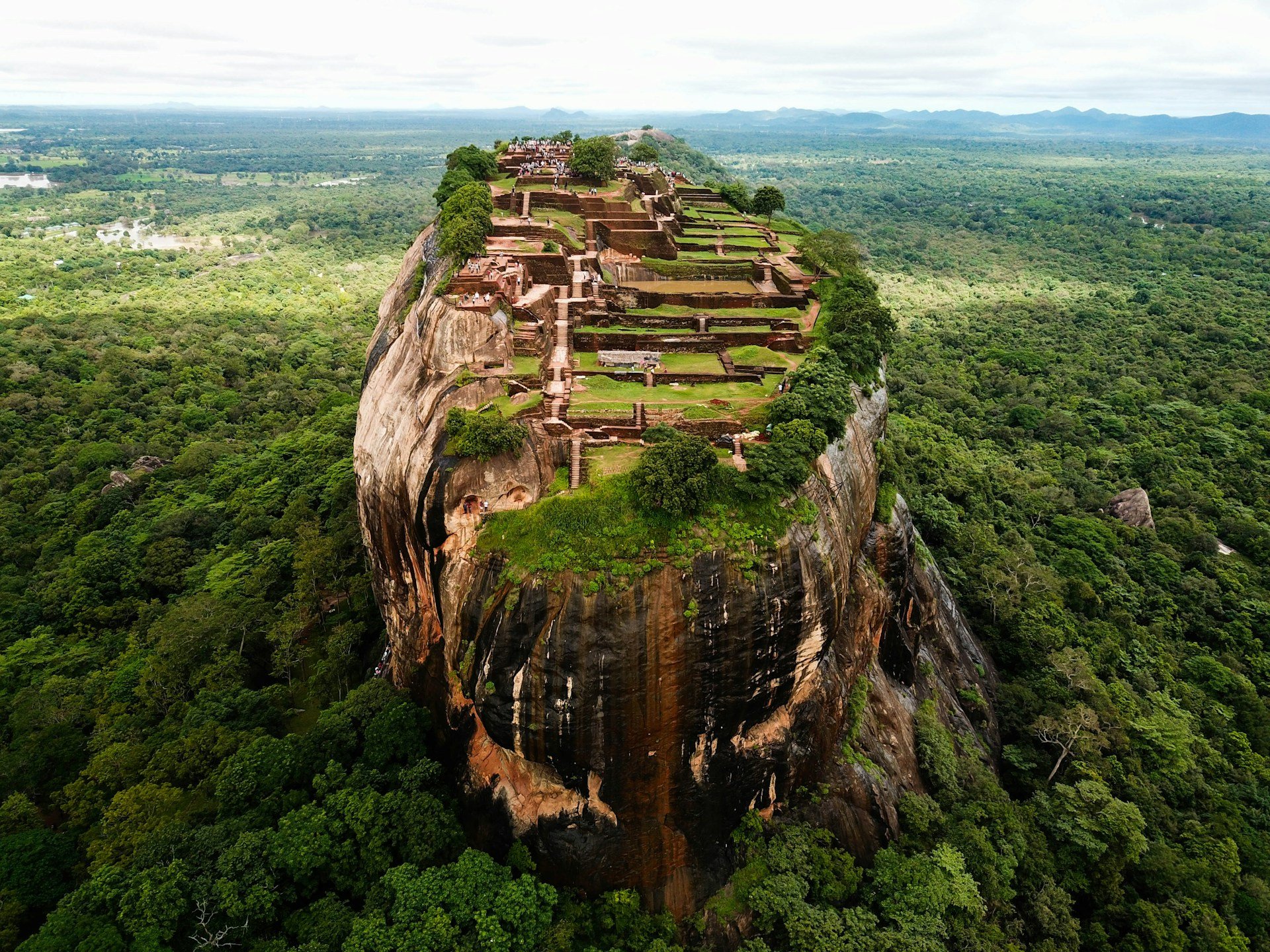
King Kashyapa builds his palace on top of a 200-meter granite rock, surrounded by sophisticated water gardens. One of the great architectural feats of the ancient world.
First European colonial power. 150 years of Portuguese presence introduces Catholicism to coastal communities and disrupts the existing political order.
The entire island comes under British rule for the first time. Tea cultivation transforms the Hill Country economy. Hundreds of thousands of Tamil laborers brought from India to work the estates.
Ceylon gains independence as a dominion within the British Commonwealth. Post-independence language and representation policies sharpen Sinhalese-Tamil tensions.
26-year conflict between the government and the Tamil Tigers. Estimated 80,000–100,000 deaths. Ends in military defeat of the LTTE in May 2009.
Coordinated attacks on churches and hotels kill 269 people. Tourism collapses. The country slowly rebuilds.
Fuel shortages, power cuts, and soaring inflation produce the country's worst economic crisis since independence. The president flees. Recovery is underway.
Top Destinations
Sri Lanka divides into natural travel circuits: the Cultural Triangle in the north-center (Sigiriya, Anuradhapura, Polonnaruwa, Dambulla), the Hill Country in the center (Kandy, Nuwara Eliya, Ella), the south coast (Galle, Mirissa, Tangalle), the east coast (Arugam Bay, Trincomalee), and the north (Jaffna). Most visitors combine the Cultural Triangle with the Hill Country train journey and the south coast. Jaffna and the east coast require more time and are visited by travelers doing a fuller circuit or a second trip.
Sigiriya
A 200-meter granite monolith rising vertically from the surrounding jungle, with the ruins of a 5th-century palace complex on its summit and a set of water gardens at its base that are among the most sophisticated hydraulic landscapes of the ancient world. King Kashyapa built his citadel here around 477 CE, constructing pools, fountains, and stepped gardens that still partially function after 1,500 years. The climb — 1,200 steps, through a lion-paw gateway halfway up — takes 90 minutes each way and is genuinely demanding. Go at dawn, before tour groups arrive and before the heat becomes a factor. The view from the summit of flat jungle extending to distant mountains in every direction is one of the finest in Asia.
Kandy to Ella — The Tea Train
The railway from Kandy through Nuwara Eliya to Ella climbs from 500 to over 1,800 meters through tea estates, cloud forest, waterfalls, and tunnel-cut hillsides in a journey that takes about 7 hours and which people name as a life highlight. The observation car has open windows, a rear viewing platform, and the kind of scenery that makes the train's slowness feel like generosity rather than inconvenience. Book first-class observation car tickets weeks ahead through the Sri Lanka Railways website — they sell out. Alternatively, ride in second class standing at the open doors, which is how locals do it and is equally spectacular. At Ella: the Nine Arch Bridge, Ella Rock, and the best hotel-to-landscape ratio in Sri Lanka.
Yala National Park
Yala has the world's highest density of wild leopards — estimates suggest one per square kilometer in the reserve's most wildlife-rich blocks. A morning safari here has a genuinely high probability of a sighting, which is not something you can say of most leopard habitats anywhere. Beyond leopards: elephants, sloth bears, crocodiles, peacocks, and over 200 bird species. The southeast coast location means best access during the west-monsoon season (April to November). Book your jeep and accommodation well ahead for December to March when the park is at its busiest.
Galle
The Dutch Fort at Galle — a UNESCO World Heritage site still largely intact — is the best-preserved European colonial fort in Asia. The bastions overlook the Indian Ocean, the streets inside are lined with Dutch-period buildings now housing boutique hotels, galleries, and restaurants, and the lighthouse at the fort's tip is one of the most photographed structures in Sri Lanka. Galle has become the most design-conscious town on the island, with a concentration of good restaurants and guesthouses that make it an excellent base for the south coast. Best in the December to March dry season.
Minneriya & Kaudulla
In the dry season (July to October), the gathering of wild elephants at Minneriya and Kaudulla tanks is one of the most extraordinary wildlife spectacles in Asia — hundreds of elephants converging on the receding reservoir for water and grass. The "Gathering" at Minneriya is one of the largest concentrations of wild Asian elephants on earth, with numbers sometimes exceeding 300 animals in a single view. Afternoon safaris are the standard approach. The setting — a vast ancient irrigation reservoir surrounded by forest — frames the scene in a way that makes it genuinely different from any other elephant experience.
Arugam Bay
On the east coast, Arugam Bay has been Asia's most consistent surf destination for decades — a long right-hand point break that works from May to October, precisely when the south and west coast beaches are in monsoon rain. The town that has grown around the break is exactly the right kind of laid-back: good cheap restaurants, a few excellent guesthouses, and almost no pretense. Day trips from Arugam Bay to Kudumbigala monastery (ancient rock caves in the jungle) and the elephant-inhabited Lahugala National Park are possible and worthwhile. Not a beginner break.
Anuradhapura & Polonnaruwa
The Cultural Triangle's two ancient capitals are among the most significant archaeological sites in South Asia. Anuradhapura — capital of the Sinhalese kingdom for over a millennium — contains enormous dagobas (stupa-style monuments), the living Sri Maha Bodhi tree (planted 288 BCE and still venerated today), and ruins of palace complexes and bathing pools spread across a city-sized archaeological zone. Polonnaruwa, the 11th to 13th century capital, is more compact and arguably easier to absorb: the Gal Vihara, a collection of enormous Buddha figures carved from a single granite face, is the most affecting Buddhist sculpture in Sri Lanka. Hire a bicycle at both sites — the scale requires it.
Jaffna
Jaffna — the cultural capital of Tamil Sri Lanka, closed to tourists throughout most of the civil war and still in active recovery — is unlike anywhere else in the country. The food is different (more South Indian in character, heavier on fresh seafood, with a different spice palette from the Sinhalese south). The temples are different (Hindu kovils rather than Buddhist viharas). The streets have the energy of a community rebuilding consciously and with pride. The Jaffna Peninsula and the nearby islands off the coast — accessible by ferry — have a landscape of saltpans, palmyra palms, and colonial-era Dutch fortifications that is entirely distinct from the rest of Sri Lanka. Go. It is worth the journey from Colombo (6 hours) or the short domestic flight.
Culture & Etiquette
Sri Lanka is predominantly Buddhist (about 70% of the population) with significant Hindu (13%), Muslim (10%), and Christian (7%) minorities, reflecting both its ancient history and its colonial and trade connections. The religious diversity shapes the cultural calendar — Buddhist full moon days (Poya) are public holidays when alcohol sales are restricted; Hindu festivals like Diwali and Thaipongal are celebrated in the Tamil north; the Muslim community observes Ramadan and Eid; the Christian community observes Easter, which has complex resonance given the 2019 bombings.
The Sinhalese "yes" — a side-to-side head wobble that looks exactly like a Western "no" — confuses almost every first-time visitor. It is genuinely affirmative. When a Sri Lankan driver wobbles his head in response to "Is this the right road?", he means yes. This single piece of non-verbal context prevents considerable confusion.
Remove shoes before entering any temple, dagoba, or mosque. Cover shoulders and knees. At Buddhist sites, white is the color of worship — locals wear it; tourists don't need to, but keeping modest respectful clothing in your bag at all times saves the frustration of being turned away or renting sarongs at the gate. The rules are genuine and enforced politely but firmly.
When being photographed near a Buddha image or statue, face toward it rather than turning your back. Posing with your back to a sacred image is considered deeply disrespectful and has caused genuine incidents with tourist visitors. This applies at all religious sites.
Sri Lankan hospitality is centered on food. Being offered tea, fruit, or a meal by a guesthouse host or a family you've encountered is a genuine invitation. Accept graciously. Refusing is not impolite exactly, but accepting deepens every relationship here.
At markets and with tuk-tuk drivers, negotiation is expected and normal. Do it with good humor and a sense of proportion — the difference between the tourist price and the fair price is usually modest, and aggressive haggling over small amounts creates bad feeling that isn't worth the savings.
The traditional Sinhalese greeting — hands pressed together, slight bow, said as "eye-oo-BO-wan," meaning "may you live long" — is received with genuine warmth from a foreign visitor. In Tamil areas, "Vanakkam" is the equivalent. Both words are small keys that open significant doors.
Photographing yourself in front of or touching a Buddha statue for tourist photos is illegal in Sri Lanka and has resulted in deportations of foreign visitors. The law specifically prohibits posing with your back to a Buddha image. This is not a cultural suggestion — it is enforced law with real consequences.
Bikinis, board shorts, and beachwear belong at the beach. Wandering into a town, temple, or local market in swimwear is considered disrespectful and is genuinely jarring to local sensibilities. Keep a sarong or light trousers easily accessible for the walk from beach to town.
Children near tourist sites sometimes approach visitors asking for sweets or money, sometimes encouraged by adults. Giving reinforces the practice and keeps children out of school. If you want to contribute to communities, give to local organizations or buy directly from adult artisans and vendors.
The head is considered sacred in Buddhist culture. Don't touch, pat, or ruffle anyone's head, including children. The gesture that means "cute kid" in Western culture registers as a serious breach of respect here.
The 26-year civil war and its consequences are still present in living memory for most Sri Lankans. Both Sinhalese and Tamil communities carry grief, grievance, and complicated feelings about what happened. Approaching the subject with ignorance or casual curiosity is different from approaching it with genuine interest and respect. The latter is welcome. The former causes pain.
Esala Perahera
The annual Kandy Esala Perahera — held over ten nights in July or August, culminating on the full moon — is one of the great religious spectacles in the world. Dozens of decorated elephants process through the streets of Kandy carrying a replica of the Tooth Relic, accompanied by thousands of drummers, fire dancers, whip crackers, and flag bearers. The tradition has been observed continuously for over a millennium. Accommodation in Kandy books out months in advance for peak festival nights. Worth planning an entire trip around.
Poya Days
Every full moon day is a public holiday in Sri Lanka — a Buddhist observance day when alcohol is officially banned from sale (some tourist restaurants ignore this, but it's the law), abattoirs are closed, and many businesses run reduced hours. The dates shift monthly. A Poya day in a town near a significant temple is a genuinely special experience — the streets fill with white-clad devotees, the temples are lit and full, and the atmosphere is unlike any other day of the month. Check the lunar calendar when planning your trip.
Kandyan Arts
The Kandyan cultural tradition — the arts that developed around the court of the Kandyan kingdom before British annexation in 1815 — includes the distinctive Kandyan dance (highly physical, with elaborate costuming and percussive music), lacquerwork, traditional weaving, and the craft of making the temple accessories used in Buddhist ritual. Kandy has several cultural performance venues where you can see condensed versions of these traditions. The full experience is in the Perahera, but an evening cultural show gives a workable introduction.
Tea Culture
Ceylon tea — produced in the Hill Country estates above 1,200 meters — is not background scenery. It is a specific, terroir-driven product that tasting guides around the world pay significant attention to. High-grown (above 1,200m), medium-grown, and low-grown teas have genuinely distinct flavor profiles. Visiting a tea factory in Nuwara Eliya or around Ella and tasting the day's production fresh off the drying machines — before it's blended, graded, or shipped — is one of the most specific sensory experiences Sri Lanka offers. It costs almost nothing and takes 45 minutes.
Food & Drink
Sri Lankan food is one of the most underrated cuisines in the world — consistently overlooked in the global food conversation because Sri Lanka is small and its diaspora thin, while neighboring India's food culture dominates the regional narrative. This is a genuine oversight. Sri Lankan cooking has its own logic: coconut milk is the primary enriching agent (not ghee or yogurt as in India); the spice palette is deeper and more complex, with roasted curry powder producing a distinctive smokiness; and the balance of a full rice and curry spread — the sweet pumpkin curry, the bitter murunga (drumstick) leaves, the sour tamarind-based gravy, the fiery green chili sambol — is a complete flavor education.
Alcohol is available throughout Sri Lanka at licensed restaurants, hotels, and government-issue wine stores. Lion Lager is the national beer — cold, light, and widely available for around 300–500 LKR at a decent restaurant. Arrack — distilled from coconut flower toddy — is the national spirit, drunk neat, with water, or mixed with Elephant House Ginger Beer in a combination called "Sprite" that Sri Lankans defend passionately. Ceylon tea, drunk with condensed milk and the smallest possible amount of sugar, is the daily beverage of the entire country from before dawn to after dark.
Rice & Curry
The foundational meal: a mound of red or white rice surrounded by four to eight small bowls of curries — dal, a vegetable in coconut milk, a dry-fried leaf curry, a fish or meat curry, a pickle, a sambol. The best version is at a local kade at noon, assembled fresh, where the coconut milk in the curries is still warm and the rice is still steaming. The tourist restaurant version, plated for aesthetics, is always inferior. Find the local version. The upgrade is entirely in the address.
Hoppers
Bowl-shaped fermented rice flour pancakes, crispy at the edges and soft in the center, eaten for breakfast with a cracked egg in the middle (egg hopper), with coconut milk and jaggery (sweet hopper), or plain with a constellation of chutneys and sambol. String hoppers — steamed noodle discs pressed through a mold, eaten with coconut milk gravy and pol sambol (grated coconut, red chili, and lime) — are the other morning staple. A hopper breakfast at a small roadside spot at 7am, eating on a plastic chair with a glass of tea, is one of Sri Lanka's essential experiences.
Jaffna Crab Curry
The north's signature dish and one of the great curries in South Asia. Whole crab — fresh from the Jaffna Lagoon — simmered in a dark, roasted-spice-based coconut curry that is fierier and more aromatic than the Sinhalese south's milder coconut-milk tradition. Eaten with your hands, on newspaper, at a restaurant in Jaffna where the menu is often just "crab" and the price is around 1,500–2,000 LKR. The preamble to eating it: shell cracking tools, a finger bowl, and the acceptance that you will make a mess. This is the correct way.
Pol Sambol
Freshly grated coconut mixed with dried chili flakes, red onion, lime juice, and Maldive fish (dried, fermented tuna). Served at every meal from breakfast to dinner alongside rice, hoppers, and bread. Pol sambol is not a condiment — it is a fundamental element of the Sri Lankan table. The version in a tourist restaurant is watery and mild. The version in a private kitchen is a different food entirely: intensely fragrant, properly spicy, and freshly made that morning. Ask for it extra spicy. Trust the coconut.
Street Food
Kottu roti — chopped flatbread stir-fried with vegetables, egg, and meat on a flat griddle, made with an extraordinary rhythmic chopping sound that you hear before you see the stall — is the signature Sri Lankan street food and the best thing to eat at 10pm anywhere in the country. Isso wade (prawn fritters), ulundu wade (lentil doughnuts), and the extraordinary variety of Sri Lankan sweets made from jaggery, coconut, and rice flour fill market stalls from morning. The Colombo Pettah market is the most concentrated street food zone in the country.
Ceylon Tea
The highest-grown Ceylon teas — produced at 1,500–2,200 meters in the Nuwara Eliya area — are among the finest in the world: bright copper-colored, with a floral character and light astringency that is completely different from the blended tea bag you know from home. Drink it in the Hill Country at a tea factory, freshly made with condensed milk in the way Sri Lankans drink it, sitting on the estate's viewing terrace with the estate rows terraced below you. Buy two extra boxes to take home. They never taste quite the same once you've left, but they come close.
When to Go
Sri Lanka's two monsoon seasons are the most important thing to understand before booking. Most visitors make the mistake of treating Sri Lanka as a single weather zone. It isn't. The southwest monsoon (May to October) brings rain to the west coast, south coast, and Hill Country while the east coast has sunshine. The northeast monsoon (November to January) brings rain to the east and north while the west and south coast are beautiful. The Hill Country and Cultural Triangle receive some rain year-round but are generally accessible in any month.
Dry Season
Dec – MarPeak season for the south coast, Galle, and Colombo. December to March is when Galle, Mirissa, Tangalle, and the western beaches are at their most reliable. Whale watching in Mirissa (blue whales and sperm whales) peaks in January and February. Yala National Park is busy but accessible. This is the most crowded and most expensive window.
East Coast Season
May – SepArugam Bay surf season is May to October. Trincomalee's beaches are at their best from May to September. The Minneriya elephant gathering peaks in August and September. While the west coast is in monsoon, the east is gloriously sunny. This is the most undiscovered window for experienced travelers.
Shoulder
Apr & Oct–NovThe transition months between monsoon systems. April sees heat and intermittent rain across most of the island. October and November are the inter-monsoon period with variable conditions. The Hill Country and Cultural Triangle are always accessible. Prices are lower and crowds are thinner at the major sites.
SW Monsoon
May – Oct (west/south)The southwest monsoon brings sustained rain, rough seas, and beach closures to the west and south coasts from May to October. It is not constant rain — it comes in waves — but beach holidays on the south coast in June are genuinely miserable. The Hill Country stays operational but receives more mist and rain. The east coast is the correct answer during this period.
Trip Planning
Two weeks is the ideal length for a first Sri Lanka trip. Ten days is survivable but rushed. Three weeks lets you add the east coast or Jaffna properly without sprinting. The standard first-visit circuit — Colombo arrival, Cultural Triangle, Hill Country (Kandy and the train to Ella), south coast (Galle and Mirissa), and Colombo departure — works well in two weeks if you don't waste days. The train from Kandy to Ella should be booked before you leave home.
Cultural Triangle — Sigiriya & Dambulla
Land in Colombo and drive 4 hours to Sigiriya. Climb the rock at dawn on day two — the 5:30am start gets you at the summit before the tour buses arrive at 9am and before the heat. Afternoon at the Dambulla cave temples, where five chambers of painted Buddhas have been sealed into a granite overhang since the 1st century BCE. The colours are extraordinary. No shoes allowed inside; the stone floor is cool.
Kandy & the Train
Drive to Kandy (2 hours). Temple of the Tooth in late afternoon when the light through the lake reflects off the gold roof. Evening cultural show. Next morning: board the Kandy-to-Ella observation car train. Seven hours through tea estates and cloud forest to Ella. Nine Arch Bridge walk at sunset.
Galle & South Coast
Tuk-tuk or bus from Ella to the south coast via Yala (if budget allows, one morning Yala safari). Galle Fort arrival: afternoon walk on the ramparts, dinner in the fort. Day six: Mirissa for whale watching at 6am if timing is right (December to March). Beach afternoon. Drive back to Colombo for departure on day seven.
Colombo
Don't skip Colombo as most guides suggest. The Pettah market area, the Fort district with its colonial-era architecture, the Gangaramaya Temple, and the Galle Face Green sunset are each worth half a day. Kottu roti at Pillawoos at 10pm. The city is chaotic and interesting and you'll appreciate it more with two days than a rushed morning transit.
Cultural Triangle
Three days: Sigiriya (dawn climb), Polonnaruwa (full day on bicycle), Dambulla caves. Stay near Sigiriya — several extraordinary eco-lodges overlook the rock and are worth the price of the view alone. Add the elephant gathering at Minneriya if July to September.
Hill Country
Drive to Kandy (2 hours). One full day in Kandy — the Temple of the Tooth, the botanical gardens at Peradeniya (one of Asia's finest), and the evening cultural show. Train to Nuwara Eliya, then the continuation to Ella the next morning. Two nights in Ella: Ella Rock hike, Nine Arch Bridge at golden hour, tea factory visit.
South Coast
Bus or tuk-tuk down to the coast via Yala (one morning safari — non-negotiable if you have the time). Galle Fort for two nights. Mirissa for whales and beach. Tangalle for the most quiet and beautiful of the south coast beaches. Return to Colombo for departure.
Colombo + Negombo
Land in Colombo. Two days in the city — properly, not as a transit point. Day trip or overnight to Negombo (30 minutes north), a fishing town that was the center of the 2019 Easter Sunday attacks and has rebuilt with quiet dignity around its cathedral and beach. The Dutch canal and morning fish market are extraordinary.
Cultural Triangle + Anuradhapura
Four days: Sigiriya, Polonnaruwa, Dambulla — plus a day at Anuradhapura, which requires a full day on bicycle to see properly. The Sri Maha Bodhi tree, the Ruwanwelisaya dagoba (a 2,000-year-old white hemisphere 103 meters tall), and the Abhayagiri complex are the highlights. The town at dawn, when white-clad devotees arrive for morning puja, is one of the most atmospheric things in Sri Lanka.
Hill Country — slowly
Kandy (2 nights) then the train to Nuwara Eliya (stop here for a day — the colonial hill station with its horse racing and strawberry farms and improbably cold mornings is absurd and wonderful), then Ella. Stay two nights. Hike Ella Rock at dawn. Have a meal at the restaurant that has a train going through it. Take the short bus to Lipton's Seat — the peak above the Dambetenna estate where tea planter Thomas Lipton used to survey his entire operation — for the finest view in the Hill Country.
East Coast — Arugam Bay + Trincomalee
Bus or train from Ella to the east coast (best May to October). Arugam Bay for three days: surf or watch the surfers, eat at the beach shacks, do the day trip to Kudumbigala monastery. Drive north to Trincomalee: the Koneswaram temple on a headland, Nilaveli beach (one of Sri Lanka's best and least known), and whale shark snorkeling offshore.
Jaffna
Fly or take the train from Trincomalee to Jaffna. Four days: Jaffna Fort, the rebuilt library, Nainativu Island (a Hindu pilgrimage island accessible by motorboat, with a temple that has operated continuously for centuries), and the extraordinary Casuarina Beach. Eat at local restaurants. The food here — Jaffna crab, mutton curry, murunga sambol — is different enough from the south that it feels like a separate country.
Vaccinations
Recommended: Hepatitis A, Typhoid, and routine vaccines up to date. Japanese Encephalitis for longer rural stays. Rabies pre-exposure for travelers working with animals or going on extended rural trips — stray dogs and monkeys are present at many sites. Dengue fever is present year-round; mosquito repellent from dusk is essential.
Full vaccine info →Connectivity
Dialog, Mobitel, and Hutch offer tourist SIMs at the airport and in cities. Dialog has the best coverage including in remote areas. 4G works well across most of the country including Ella and Sigiriya. Jaffna has solid coverage. The Hill Country above 1,500 meters can have patchy signal between towns. Buy a SIM at the airport before leaving arrivals.
Get Sri Lanka eSIM →Power & Plugs
Sri Lanka uses Type D (round 3-pin) and Type G (UK square 3-pin) plugs at 230V. Bring a multi-adapter. Power cuts are less common now than during the 2022 crisis but can still occur in rural areas. Budget guesthouses in remote areas sometimes run on generators that shut off at 10pm. Carry a power bank for day trips.
Language
English is widely spoken throughout Sri Lanka's tourism industry, in cities, and in the educated middle class — a legacy of British colonial education that makes independent travel here significantly easier than in many South Asian countries. In rural areas and among older generations, English is less common. Google Translate works well for Sinhala script.
Travel Insurance
Strongly recommended. Ensure it covers water sports (if surfing Arugam Bay), wildlife safaris, and medical evacuation. Sri Lanka's major hospitals in Colombo are good; facilities in remote areas are limited. Any serious injury or illness in the Hill Country or north requires transfer to Colombo. Medical costs without insurance add up quickly.
Health
Drink bottled water everywhere outside Colombo's top hotels. Tap water is not safe for travelers. Mosquito repellent for dengue and malaria risk (malaria is present in some northern jungle areas). The food at local kades is safe if freshly cooked and busy — avoid anything that looks like it's been sitting out. Sunscreen and hydration are non-negotiable at Sigiriya and cultural sites in summer heat.
Transport in Sri Lanka
Sri Lanka's most distinctive transport is its train network — genuinely scenic, surprisingly reliable for the Hill Country routes, and cheap enough that first-class observation car tickets (the premium option) cost a fraction of what the equivalent experience anywhere else in the world would charge. The road network is adequate but subject to significant congestion between Colombo and the Cultural Triangle, and travel times are often longer than Google Maps suggests. Tuk-tuks are the universal last-mile solution everywhere outside major cities.
Trains
LKR 200–1,500The Hill Country line (Kandy–Ella) is world-class. The coastal line (Colombo–Galle–Matara) hugs the shore and is beautiful. The cultural triangle line (Colombo–Anuradhapura) is reliable and cheap. Book observation car tickets at seatreservation.railway.gov.lk or through your guesthouse for popular routes.
Tuk-Tuks
LKR 50–500The standard transport for everything under 20 kilometers. Metered in Colombo (use the meter). Negotiated elsewhere — agree on a price before you get in. PickMe (like Uber for tuk-tuks) works in Colombo and some larger towns and eliminates negotiation entirely. Having the app before you leave Colombo is useful.
Public Buses
LKR 30–300Cheap and comprehensive. CTB (green) buses are government-run; private buses are often faster and more frequent. The Colombo–Galle expressway bus takes 2 hours for under 200 LKR. Local buses are crowded but authentic and cheap. Not always air-conditioned outside intercity routes.
Driver Hire
LKR 6,000–12,000/dayHiring a private car with a driver for multi-day touring is extremely common and genuinely practical. A good driver knows the roads, the timing at each site, and often becomes a genuine source of local insight. Ask your first guesthouse to recommend one or book through a reputable agency. Rates are reasonable for what you get.
Motorbike Rental
LKR 1,500–3,000/dayAvailable in Ella, Arugam Bay, and some coastal towns. Good for independent exploring in small areas. Sri Lankan road conditions are variable and traffic in towns is chaotic. Semi-automatic scooters are easier than manual bikes on the Hill Country gradient roads. Wear a helmet — provided and essential.
Domestic Flights
LKR 8,000–25,000FitsAir and Cinnamon Air operate domestic routes including Colombo–Jaffna (40 minutes versus 6 hours by train), Colombo–Trincomalee, and Colombo–Batticaloa. Useful for the north if time is short. Small aircraft, scenic routes, variable pricing depending on booking window.
The observation car on the Kandy–Ella train (the 1st class carriage with large windows and a rear viewing platform) has around 40 seats and sells out weeks ahead during peak season (December to March). Book at seatreservation.railway.gov.lk — the official Sri Lanka Railways online system — at least 2–4 weeks before travel. Depart from Kandy station. The full journey to Ella runs through Hatton, Nuwara Eliya Road, and Bandarawela, arriving in Ella in approximately 7 hours. Bring food and water. The restaurant car serves tea and snacks but the view from the rear platform requires being out of your seat, which is the whole point.
Accommodation in Sri Lanka
Sri Lanka's accommodation sector spans the full range from village guesthouses where you eat breakfast with the family and pay $15 a night to extraordinary colonial tea estate bungalows that have been running as boutique hotels since the British era. The mid-range sweet spot — a well-run guesthouse with its own kitchen, good wifi, and hosts who can arrange transport and tours — is available at almost every destination for $30–60 per night and is often the most rewarding option at any price point. The best views in Sri Lanka — an infinity pool overlooking a tea valley in Ella, a treehouse in a jungle near Sigiriya — are often at mid-range properties, not the luxury ones.
Family Guesthouses
LKR 3,000–8,000/nightThe dominant and often the best accommodation category in Sri Lanka outside major cities. Family-run, with breakfast typically included, and hosts who cook dinner on request (always take them up on this). The best ones in the Hill Country have views that justify the entire trip. Book through Booking.com but follow up with a direct message to confirm dinner arrangements.
Boutique Hotels & Villas
LKR 15,000–50,000/nightGalle Fort has the finest concentration of boutique hotels in the country — colonial merchant houses converted into intimate properties with courtyard gardens. The tea estate bungalows (Ulapane, Bogawantalawa, Pussellawa areas) are extraordinary: colonial-era planter's residences with wraparound verandas overlooking the estate. Book well ahead for peak season.
Eco-Lodges
LKR 8,000–20,000/nightAround Sigiriya, near Yala, and in the Hill Country, genuine eco-lodges in forest settings are excellent. Vil Uyana near Sigiriya is one of the best: a series of lake-facing villas in a constructed wetland ecosystem that has attracted extraordinary birdlife since it was built. Worth the price for the wildlife experience alone, separate from the accommodation quality.
Beach Stays
LKR 5,000–25,000/nightThe south coast from Galle to Tangalle has excellent beach accommodation at all price points. Mirissa has a compact beach strip with good options from hostel dorms to boutique properties. Tangalle, further east, is quieter and has some extraordinary beachfront guesthouses at genuinely low prices. Arugam Bay on the east coast has a surf camp culture with hostels and simple guesthouses from $15–25 a night.
Budget Planning
Sri Lanka has become noticeably more expensive since the 2022 economic crisis. The rupee depreciated substantially, causing imported goods and fuel to become expensive in local currency terms. As the economy has partially stabilized, a new price level has emerged that is higher than pre-crisis Sri Lanka but still affordable by Western standards. The main cost variables are accommodation (wide range), the entry fees to major sites (Sigiriya costs $30 for foreigners — the most expensive site entry in South Asia), and safari jeeps at Yala. Local food, public transport, and local-market shopping remain genuinely cheap.
- Guesthouse dorm or basic private room
- Local kades and street food
- Buses and trains (standard class)
- Self-guided site visits
- Lion Lager at local prices
- Good guesthouse with breakfast included
- Mix of restaurants and local food
- First-class train tickets, some tuk-tuks
- Yala safari (shared jeep)
- Major site entry fees
- Boutique hotel or tea estate villa
- Restaurant dining with wine or arrack
- Private driver for touring
- Private jeep safari at Yala
- Whale watching and diving trips
Quick Reference Prices
Visa & Entry
Most nationalities require an Electronic Travel Authorization (ETA) before arriving in Sri Lanka. The ETA is obtained online at eta.gov.lk and costs $35–50 USD depending on nationality. It is valid for 30 days from arrival and allows double entry. Extensions to 90 days total are available at the Department of Immigration in Colombo or at the Kandy office. Apply at least 48 hours before travel — the system is usually faster, but the stated processing time is 48 hours and airline check-in staff may ask to see approval before boarding.
Citizens of the Maldives, Singapore, and a few other countries receive free ETAs. Nationals of some countries require a visa instead of an ETA — check the Sri Lanka Immigration website for the current country-specific list. The ETA process is straightforward and rarely causes problems for Western passport holders.
Apply online at eta.gov.lk before departure. Cost: $35–50 USD. Valid 30 days from arrival, extendable to 90 days at the Department of Immigration. Double-entry ETA available.
Family Travel & Pets
Sri Lanka is one of the best family travel destinations in South Asia — genuinely so, not as a marketing formula. Children are received with warmth that is immediate and sincere across the entire country. The island is compact enough that the variety of experiences — wildlife, ruins, beaches, train journeys, food — fits a family itinerary without requiring the kind of logistics that exhausts everyone. The main practical challenges are the heat, the occasional temple climb that doesn't suit very young children, and the road quality in rural areas where long journeys can be bumpy.
Wildlife for Kids
The elephant gathering at Minneriya (July to October) is one of the most impactful wildlife experiences for children anywhere — hundreds of elephants in a single view. Yala's leopard safaris are equally compelling for older children. The golden rule: book morning safaris, not afternoon ones, and choose a guide who knows when to stay still and when to move.
The Tea Train
Children find the observation car train journey through the tea estates genuinely magical — the scale of the landscape, the open windows, the waterfalls, the mist. Book seats rather than assuming standing room. The seven-hour journey requires snacks, drinks, and a device backup for the inevitable child hour in the middle. The opening and closing thirds are the most dramatic.
South Coast Beaches
The south coast beaches (Unawatuna, Mirissa, Tangalle) have calm sections suitable for children when the sea conditions allow. Avoid beaches with strong waves for young swimmers — the sea can be rough between the monsoon systems. Unawatuna Bay's sheltered position makes it consistently the most protected and child-friendly of the main south coast beaches.
Food for Children
Rice and curry can be very spicy; guesthouses will prepare mild versions for children without complaint. Hoppers are universally liked by children who encounter them. Tropical fruit — mangoes, pineapple, rambutan, wood apple — is widely available and good. Coconut water from a fresh coconut is the perfect hydration for the heat. Rotty (flatbread) with banana and honey is a reliable child breakfast at any guesthouse.
Sigiriya for Families
The Sigiriya climb is suitable for children above about 7–8 years old who are reasonably comfortable with heights — some sections require climbing steel staircases on the cliff face. For younger children, the water gardens at the base are extensive and interesting, and the view of the rock from below is already spectacular. Dawn timing keeps the heat manageable for the ascent.
Turtle Watching
Several south coast beaches near Rekawa and Kosgoda are nesting sites for sea turtles from November to April. Guided night walks to watch turtles lay eggs are available through reputable conservation organizations. The Kosgoda Sea Turtle Conservation Project allows visitors to observe hatchlings being released into the sea. One of the more genuinely memorable experiences for children in Sri Lanka.
Traveling with Pets
Bringing pets to Sri Lanka involves strict biosecurity requirements. Dogs and cats require a rabies vaccination certificate (administered at least 30 days before arrival), an ISO-compliant microchip, a health certificate from an accredited veterinarian not more than 10 days before departure, and import permits from the Sri Lanka Department of Animal Production and Health. Sri Lanka is rabies-endemic, so import requirements are strictly enforced. Processing takes time — begin at least 3–4 months before travel.
Practically: most guesthouses do not accept pets, the transport infrastructure is challenging for animals, and the combination of tropical heat, stray dog population, and limited veterinary care outside Colombo makes this a difficult destination for pets. Most travelers leave animals at home for Sri Lanka trips.
Safety in Sri Lanka
Sri Lanka is generally safe for tourists in its main destinations. Crime against visitors is relatively rare. The country has recovered substantially from the 2022 economic crisis and the 2019 Easter Sunday bombings. Normal travel awareness applies in cities; in rural areas the primary risks are traffic and heat rather than crime.
Main Tourist Areas
The Cultural Triangle, Hill Country, Galle, south coast, and Colombo are all safe for tourists. Crime against visitors is low. Petty theft in crowded areas (Colombo Pettah, tourist sites) requires normal vigilance — keep valuables secure. Violent crime against tourists is rare.
Solo Women
Sri Lanka is more comfortable for solo female travelers than many South Asian destinations. Harassment exists, particularly at beach resorts, but is generally less aggressive than in India or parts of Southeast Asia. Modest dress outside beach areas reduces unwanted attention. The tourism industry has a relatively high awareness of respectful conduct. Normal urban caution applies after dark.
Jaffna & the North
Jaffna is open and safe for tourists. The city and peninsula have rebuilt significantly since the end of the civil war in 2009 and are welcoming to visitors. Former conflict areas between the north and east may have unexploded ordnance (UXO) in off-path rural areas — stay on marked paths and roads. Do not walk through abandoned buildings in former battle areas.
Wildlife Safety
Wild elephants at Minneriya and in the forest corridors around the Cultural Triangle can be dangerous if surprised at close range. Never approach elephants on foot. At Yala, follow your guide's instructions without exception — leopards and sloth bears can be aggressive if cornered. Monkeys at temple sites steal food and bags with intent and speed. Hold your belongings.
Water Safety
Rip currents affect several Sri Lankan beaches. The south and west coasts can have dangerous surf during the southwest monsoon (May to October). Check local conditions before swimming anywhere outside protected bays. Lifeguard coverage is minimal outside major resort beaches. Drowning is the leading cause of tourist death in Sri Lanka.
Scams
The main tourist area scam: tuk-tuk drivers who offer to take you to a "free" textile shop, gem market, or family business where you are pressured to buy. The shop pays the driver a commission. Politely decline or agree to a direct fare with a clear destination. Gem scams (being convinced to buy gems to resell at profit abroad) are a Sri Lankan specialty with decades of practice. No gem deal is what it claims to be.
Emergency Information
Your Embassy in Colombo
Most foreign embassies are in the Colombo 3 and Colombo 7 areas.
Book Your Trip
Everything in one place. These are services worth actually using.
You'll Want to Come Back
The pattern with Sri Lanka is consistent: people arrive expecting beaches and leave having had their understanding of what travel can be quietly expanded. The train through the tea estates does something to your sense of scale. The leopard that sits in the grass at Yala watching you watch it does something to your sense of significance. The family at the guesthouse who insists on cooking you dinner, and then sits with you while you eat it, and then asks questions about your life with genuine interest — this does something to your sense of what hospitality means.
The Sinhalese greeting is Ayubowan: may you live long. You say it with your hands pressed together, a slight bow. The person you say it to responds in kind. It is the oldest greeting on the island and it is still the first and last thing said at every significant meeting. The brevity of any visit is built into it — the wish for long life is the acknowledgment that time is short and the invitation is real. Come back. The island will still be here, adding layers, recovering, building forward. It has been doing this for 2,500 years and shows no sign of stopping.