
Morocco
A country where the Atlantic meets the Sahara, where ancient medinas have been navigated by foot for a thousand years, and where the smell of cumin and rose water follows you through alleys so narrow two people can't pass side by side. Africa and Arabia and Andalusia, all at once.
What You're Actually Getting Into
Morocco begins before you land. The descent into Marrakech or Casablanca gives you terracotta rooftops and the first suggestion of dust, and by the time you've walked ten minutes into a medina you've understood something that no photograph communicates properly: these cities have been continuous for over a thousand years. The alley you're lost in has been used by the same kinds of traders for longer than most European capitals have existed. The tanneries in Fes have been operating in the same spot, using the same methods, since the 11th century.
Morocco is the closest approximation of another world that you can reach from Europe in three hours. That's part of its appeal and part of its friction. The country is genuinely foreign in ways that take adjustment — the intensity of the medinas, the persistence of touts and commission-seeking guides in tourist areas, the heat, the sensory overload of souks where every sense is working simultaneously. First-time visitors sometimes find it overwhelming. Second-time visitors know what they're walking into and love it.
The country has remarkable geographic variety for its size: Atlantic and Mediterranean coastlines, the peaks of the High Atlas mountains, the Sahara Desert stretching south and east, fertile valleys between, and the Rif mountains in the north producing cannabis that is one of the open secrets of Moroccan agriculture. You can be standing in a Sahara camp watching the Milky Way and be in Marrakech for dinner the next night — though why you'd want to leave the desert that fast is its own question.
What separates Morocco from other "intense medina" destinations is the warmth that runs underneath the commercial noise. Get past the tourist circuit — eat at the restaurant the guesthouse owner recommends, walk the residential neighborhoods in the early morning before the souks open, accept an invitation for tea — and you find a hospitality culture so deeply rooted that it changes how you understand the word. Moroccan hospitality is not performance. It is obligation, in the best sense of the word.
Morocco at a Glance
A History Worth Knowing
Morocco's history is the history of a crossroads. Positioned at the point where Africa and Europe nearly touch, where the Atlantic meets the Mediterranean, the country has been a meeting point of civilizations for millennia. The Phoenicians established trading posts on its coast. Carthaginian merchants operated there before Rome absorbed the region as the province of Mauretania Tingitana. Roman ruins at Volubilis, still remarkably preserved outside Meknes, mark the western edge of what was once empire.
The Arab conquest of the 7th and 8th centuries transformed Morocco's identity permanently. Islam arrived with the armies of Uqba ibn Nafi and took root rapidly, merging with the existing Berber population to create a distinct Moroccan-Islamic identity. The Berbers — or Amazigh, as they call themselves — were not passive recipients of this change; they shaped it, contested it, and ultimately produced from it one of the medieval world's most powerful dynasties. The Almoravids, a Berber confederation from the western Sahara, emerged in the 11th century to build an empire spanning Morocco, Algeria, and Muslim Spain. Their successors, the Almohads, went further — controlling territory from Lisbon to Tripoli at their peak in the 12th century and making Marrakech one of the most sophisticated cities in the world.
The city of Fes deserves particular attention. Founded in the 9th century by Idris II, it became the spiritual and intellectual capital of the Maghreb. The University of al-Qarawiyyin, founded in 859 CE, is considered by many scholars to be the world's oldest continuously operating university. Students came from across the Islamic world and from Christian Europe to study here. The medina of Fes el-Bali, still largely intact today, is a living document of medieval Islamic urbanism — the tanneries, the foundouks, the Koranic schools, the mosques, all operating in essentially the same physical space they occupied a thousand years ago.
Morocco's relationship with European colonial power was more ambiguous than most of its neighbors. The Portuguese seized several Atlantic coastal towns in the 15th century. Spain established footholds at Ceuta and Melilla (which it still holds today). But Morocco resisted full colonial control far longer than the rest of North Africa — the French and Spanish didn't formally divide it as a protectorate until 1912, and even then, resistance continued. Sultan Mohammed V became a symbol of independence, was exiled by the French in 1953, and returned in triumph in 1955. Morocco achieved full independence on March 2, 1956.
The monarchy has been the defining institution of modern Morocco. King Mohammed VI, who has ruled since 1999, has pursued cautious modernization — improving literacy, women's rights, and economic development — while maintaining strong central authority. The country has largely avoided the political instability that affected neighbors during the Arab Spring, positioning itself as a stable regional hub and a significant diplomatic actor between Africa, Europe, and the Arab world. It hosted the 2030 FIFA World Cup jointly with Spain and Portugal — a symbolic moment for a country that has long defined itself as a bridge between civilizations.
Carthaginian and Phoenician merchants establish coastal settlements. Morocco enters recorded history as a trading crossroads.
Mauretania Tingitana. Volubilis becomes a regional capital whose ruins remain remarkably preserved today.
Islam arrives and permanently reshapes Moroccan identity. Berber culture and Arab Islam merge into something distinctly Moroccan.
Founded in Fes — the oldest continuously operating university in the world. Scholars travel from across the medieval world to study here.
Berber dynasties build empires spanning Morocco to Muslim Spain. Marrakech becomes one of the world's great cities.
Morocco divided between France and Spain. Resistance continues throughout the colonial period.
Morocco regains full independence. Sultan Mohammed V returns from French exile as a national hero.
King Mohammed VI rules a stable, modernizing kingdom. Co-host of the 2030 FIFA World Cup with Spain and Portugal.
Top Destinations
Morocco rewards depth over breadth. Trying to see everything in one trip produces a blur of medinas and a lot of time on overnight buses. Pick a focus — the imperial cities circuit, the south and Sahara, the coast and mountains — and give each place two or three days rather than racing through on a checklist. The country's distances are longer than they look on a map and the roads in the south require time.
Marrakech
The city most visitors picture when they picture Morocco: terracotta walls, the din of Jemaa el-Fna square at dusk, snake charmers competing with Gnawa musicians competing with food stalls that materialize every evening from nowhere. The medina here is genuinely intense — touts are persistent, the streets are disorienting, and the tourist economy is inescapable around the main square. Push past it. The residential neighborhoods of the Mellah and the Mouassine quarter are calm, beautiful, and largely undiscovered at street level. The Saadian Tombs, the Bahia Palace, and the Madrasa Ben Youssef are all extraordinary. Budget three days minimum, four to breathe.
Fes
Fes el-Bali is the best-preserved medieval Islamic city in the world. The medina has 9,000 alleys, 800 years of continuous human activity, and no cars — everything moves by foot, donkey, or bicycle. The Chouara Tanneries, where leather has been cured using the same method since the 11th century, are visible from rooftop terraces of surrounding shops (which will try to sell you leather — you don't have to buy). The Bou Inania Madrasa, the Medersa Attarine, and the al-Qarawiyyin mosque complex are among the most beautiful Islamic architecture in North Africa. Get a guide for the first day — not because you'll get lost (you will regardless) but because context transforms what you're looking at.
Chefchaouen
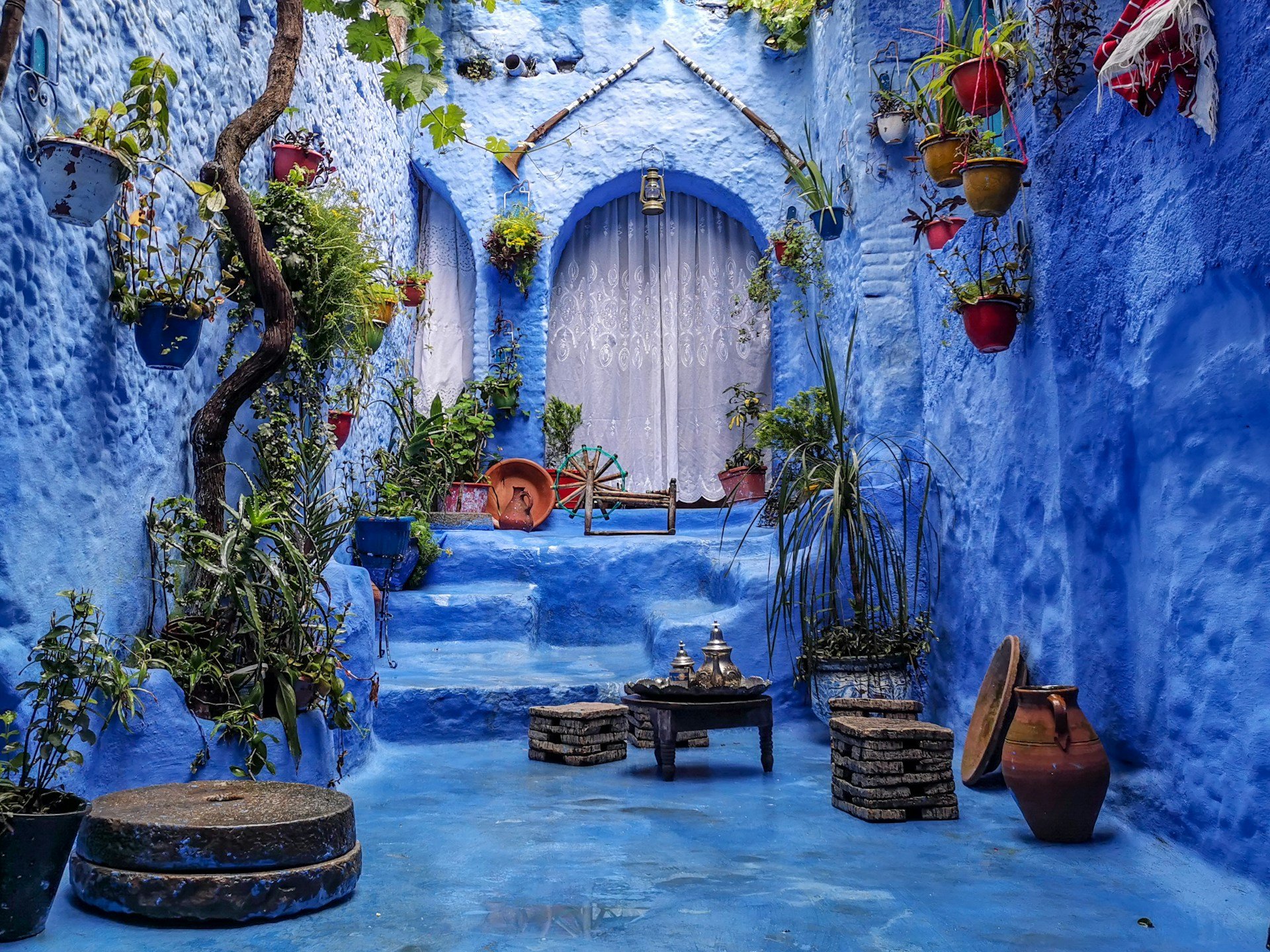
A mountain town in the Rif where every alley is painted in shades of blue and white. The story of why is genuinely interesting — some say Jewish refugees painted it blue in the 1930s, others attribute it to the 1970s tourist promotion. Whatever the origin, the effect is extraordinary. Go in early morning before tour groups from Fes arrive. The Plaza Uta el-Hammam in the center is pleasant at any hour. Hike up to the Spanish mosque at sunset for the full view over the town and the valley.
Merzouga & Erg Chebbi
The dunes of Erg Chebbi near Merzouga rise to 150 metres and shift colour from pale gold to deep orange depending on the hour. A camel trek into the dunes to a desert camp at sunset, followed by a night sleeping on a mat watching the Milky Way without any light pollution, is one of the more memorable things available on earth. Take the long route from Marrakech through the Draa Valley — the road through Ouarzazate, the kasbah road, and the Todra Gorge adds two days and is as beautiful as the destination.
Essaouira
A whitewashed walled city on the Atlantic coast that feels entirely unlike the inland medinas — open, breezy, relaxed in a way that Marrakech is not. The fortified Skala de la Ville battlements look directly over the Atlantic. The medina is easy to navigate and low-pressure. Argan oil, woodcraft, and thuya wood furniture are what the artisans sell here. Wind makes it a world-class destination for kitesurfing. Jimi Hendrix famously stayed here in 1969; the café that claims to have hosted him is, of course, excellent for mint tea.
Rabat
Morocco's capital is quieter, cooler, and more navigable than Marrakech or Fes — which is why most travelers skip it and are wrong to do so. The Kasbah of the Udayas overlooks the Atlantic from a clifftop of blue-and-white streets. The Hassan Tower and the Mausoleum of Mohammed V are genuinely moving monuments. The old medina is small enough to explore without a guide and free of the intense tourist pressure that characterises the imperial cities. Rabat is what happens when a city has a government rather than a souk as its centre of gravity.
High Atlas & Toubkal
Mount Toubkal at 4,167 metres is the highest peak in North Africa and accessible without technical climbing equipment on a two-day guided hike from the village of Imlil. The Ourika Valley south of Marrakech has Berber villages and waterfalls reachable as a day trip. The Aït Benhaddou kasbah, a UNESCO World Heritage site and the most photographed building in Morocco, is an ancient clay fortress that has been used as a film set for Game of Thrones, Gladiator, and Lawrence of Arabia.
Meknes & Volubilis
Meknes is the least-visited of Morocco's four imperial cities and the better for it. Sultan Moulay Ismail built it in the 17th century on a grandiose scale: 25 kilometres of walls, enormous granaries and stables, and the Bab Mansour gate, which is probably the most impressive monumental gate in the country. Thirty minutes away, the Roman ruins of Volubilis are the best-preserved in North Africa — intact mosaics, a triumphal arch, and the outline of an entire Roman city, mostly free of tourists.
Culture & Etiquette
Morocco is a Muslim country with deep roots in Arab, Berber, and Andalusian cultures. The etiquette expectations are different from East Asia or Europe — less about formal hierarchy and more about religious observance, family respect, and genuine hospitality that can feel overwhelming if you're not prepared for it. The hospitality is real. The invitation for tea at a shop is often also real — and also commercial. Both things can be true simultaneously.
Ramadan, if your trip overlaps with it, changes the country completely. Restaurants close during daylight, the streets empty during prayer times, and iftar (the evening meal breaking the fast) turns every square into a communal feast. Traveling during Ramadan requires adjustment but rewards the traveler who engages with it rather than resents it.
In medinas and traditional towns, both men and women should cover shoulders and knees. Women receive significantly less unwanted attention in conservative dress. This is practical advice, not a moral judgment. Light linen trousers and loose long-sleeved shirts work in the heat.
Mint tea offered at a riad, a shop, or a home is a genuine gesture of hospitality. Refusing it reads as rude. You can accept tea without committing to any purchase. The social ritual of tea — the pouring from height, the three glasses, the conversation — is worth experiencing many times.
"Shukran" (thank you) and "La shukran" (no thank you) in Darija (Moroccan Arabic) go a long way. French is widely spoken in cities and a basic phrase in French is often more effective than English in non-tourist areas.
Negotiating price in a souk is expected and not impolite — it's part of the social contract of the market. Start at roughly half the asking price and expect to meet somewhere in the middle. Walking away is a legitimate negotiating tactic and often results in the seller calling you back.
Particularly in medinas and markets. Some people are happy to be photographed; others object strongly. A smile and a gestured question is the right approach. In Jemaa el-Fna, performers will expect a small payment for photographs.
Most mosques in Morocco are closed to non-Muslims, including the Koutoubia in Marrakech and the Kairaouine in Fes. The Hassan II Mosque in Casablanca and a small number of others allow guided tours. Don't attempt to enter others — the signs are clear and the expectation is firm.
Doing so is disrespectful and technically illegal. Tourist-facing restaurants may have screened-off areas for non-fasting visitors, but in public spaces and medinas, observe the fast even if you're not participating in it.
The men who approach you near transport hubs offering to take you to your riad are almost always working on commission from guesthouses or shops. Politely decline. Have your riad's address written down and use Google Maps or ask your accommodation to arrange pickup.
Public displays of affection between couples are frowned upon, particularly in more conservative medinas and rural areas. Same-sex affection is legally and socially sensitive. Discretion is advisable throughout the country.
The left hand is considered unclean in Islamic etiquette. Use your right hand when eating communal food, shaking hands, and passing items to others.
The Ritual of Mint Tea
Moroccan mint tea (atay) is not just a drink — it's a social institution. Poured from height to create foam, served three times (the first mild, the second strong, the third sweet — "the first is gentle as life, the second is strong as love, the third is sweet as death"), it marks the opening of any serious conversation. Being invited for tea is being invited into someone's world.
The Hammam
The public bathhouse is a central institution of Moroccan social life. Traditional hammams charge a few dirhams for a hot room, a cold room, and the use of black soap (savon beldi) and a kessa exfoliating mitt. Tourist hammams offer full scrub treatments. Both are worth doing. The traditional neighbourhood hammam, if you can find one a local recommends, is the real experience.
Craft Culture
Moroccan craft is genuinely extraordinary — zellige tilework, leatherwork, carved plasterwork, woodcraft in thuya and cedar, hand-knotted Berber carpets with centuries-old geometric designs. The souks of Fes and Marrakech are where you buy these things. The first price is never the real price. Buying directly from the workshop, when you can find it, cuts out the middlemen and is more interesting anyway.
Friday & Prayer Times
Friday is the holy day in Islam. Many shops in traditional areas close for Friday midday prayers. The call to prayer (adhan) sounds five times daily from minarets across the country — experiencing it in the medina of Fes or Marrakech at dusk, when multiple minarets answer each other across the rooftops, is one of the more resonant travel experiences Morocco offers.
Food & Drink
Moroccan cuisine is one of the great underappreciated food cultures of the world. It doesn't have the global footprint of French or Japanese cooking, but it has a depth and complexity — built on centuries of Berber, Arab, Andalusian, and sub-Saharan influences — that rewards serious attention. The spice blends alone: ras el hanout (30 spices in some recipes), cumin, coriander, cinnamon in savory dishes, preserved lemon, argan oil. The combination of sweet and savory that runs through bastilla and tagine is one of the most sophisticated flavor principles in any cuisine.
One important note: the restaurants around Jemaa el-Fna in Marrakech are the worst value in the country and not where Moroccans eat. The tourist restaurants are expensive, heavily marketed to passing visitors, and frequently mediocre. Walk five minutes from any main square into the residential streets and find somewhere that doesn't have a laminated menu with photographs. That's where the food is.
Tagine
Slow-cooked stew in a conical clay pot that functions as both cooking vessel and serving dish. Chicken with preserved lemon and olives. Lamb with prunes and almonds. Kefta (spiced meatball) with eggs. The slow cook concentrates flavors in a way that fast cooking can't replicate. Eat it with Moroccan bread for the sauce. Don't eat it at the restaurant aimed at tourists — find somewhere where the tagine takes 45 minutes to arrive because it's actually being cooked.
Bastilla (Pastilla)
Shredded pigeon (or chicken) with almonds, eggs, and spices, wrapped in layers of paper-thin warqa pastry and dusted with powdered sugar and cinnamon. The combination of savory meat, sweet sugar, and flaky pastry is one of the most distinctive flavor experiences in Moroccan cooking. Traditionally served at weddings and celebrations; now available at the better restaurants in Fes and Marrakech. Order it when you see it.
Street Bread & Bissara
Moroccan bread (khobz) baked in communal ovens and carried home on wooden boards through the medina alleys. Bissara is a thick purée of dried fava beans served in a bowl with olive oil, cumin, and paprika — the working breakfast of Morocco, eaten at street stalls for a few dirhams. Msemen is a flaky griddle flatbread eaten with honey and argan oil for breakfast. These are the foods that most visitors never find and that Moroccans eat every day.
Mechoui & Couscous
Mechoui is a whole lamb slow-roasted in a clay oven until the meat falls from the bone and the skin is crisp. Eaten by hand. It appears at celebrations and, in Marrakech's Jemaa el-Fna square, from whole-animal vendors who serve it by the gram. Couscous is the Friday dish — steamed semolina with a whole vegetable and meat stew poured over it. In a Moroccan home on Friday, couscous is lunch. In a restaurant, order it and don't expect speed.
Harira & Soup
Harira is the soup that breaks the Ramadan fast — a thick, deeply spiced broth of tomatoes, lentils, chickpeas, and lamb, finished with lemon and coriander. During Ramadan you can buy it from street vendors for almost nothing. Outside Ramadan it's a starter at any traditional restaurant. Served with dates and chebakia (honey-sesame cookies) for the full traditional pairing.
Drinks — What to Know
Morocco is a Muslim country and alcohol is not freely available everywhere. Beer and wine are served in tourist restaurants, riads, and hotel bars in major cities, but not universally and not in traditional medina establishments. Soft drinks, fresh-squeezed orange juice (Marrakech has the best in the world, from stalls in Jemaa el-Fna at 4 dirhams a glass), and mint tea are what most Moroccans drink. Tap water is not safe to drink — bottled water or filtered water from your riad.
When to Go
Morocco's geography means there is no single "best time" — the optimal season depends entirely on where you're going. The Sahara is best in spring and autumn. The coast is year-round. The mountains are snow-covered in winter (excellent for skiing) and cool in summer. Marrakech in August is hot enough to make sightseeing genuinely unpleasant. The Atlantic coast in January is mild and quiet and entirely pleasant.
Spring
Mar – MayThe ideal time for most of Morocco. Temperatures are pleasant across the country (18–28°C in Marrakech), wildflowers bloom in the Atlas valleys, the Sahara is hot but manageable, and the Rose Festival in the Dades Valley in May is extraordinary. Book accommodation ahead — Easter week is busy.
Autumn
Sep – NovEqually good to spring. Summer heat dissipates in September, the Sahara becomes accessible again, and the light in late October is exceptional for photography. Fewer tourists than spring in most destinations. The Atlantic coast is at its warmest in September.
Winter
Dec – FebMarrakech and the coast are mild and uncrowded. The High Atlas mountains are snow-covered and accessible for skiing at Oukaimeden. The Sahara can be cold at night (below zero in December) but the days are warm and the light is dramatic. January and February are the quietest months — fewer tourists, lower prices.
Summer
Jun – AugInland cities are extremely hot. Marrakech regularly exceeds 40°C in July and August. The Sahara is inaccessible except to heat enthusiasts. Chefchaouen and the coast are the only summer options that make sense. If you must travel in summer, base yourself on the Atlantic coast.
Trip Planning
Ten days is the minimum for Morocco to make sense. Less than that and you're rushing through medinas and spending most of your time on transport. Two weeks allows the imperial cities circuit (Marrakech, Essaouira, Casablanca, Rabat, Meknes, Fes) with a Sahara extension. Three weeks lets you add the south properly — Draa Valley, Todra Gorge, Merzouga — without feeling like you're on a race.
Morocco's distances are deceptive on a map. Fes to Merzouga is 8–9 hours by CTM bus or 5 hours by car. Marrakech to Chefchaouen requires either two bus changes or a full day on the road. Plan for travel days and don't try to do everything in one go. The country rewards people who stop.
Marrakech
Land at Menara Airport. Get a taxi to your riad (agree the price before getting in — around 100–150 MAD). Day one: Jemaa el-Fna at sunset, dinner at a restaurant in the medina off the main square. Day two: Madrasa Ben Youssef, Bahia Palace, Saadian Tombs. Get lost in the souks in the afternoon and accept that you will walk in circles. Day three: Majorelle Garden (book online), afternoon in the Mellah (the Jewish quarter), hammam in the evening.
Essaouira
3-hour CTM bus from Marrakech. Whitewashed medina, Atlantic walls, argan oil and woodcraft. Walk the ramparts at sunset. Grilled sardines at the harbor. No touts, no pressure, the Atlantic breeze. A day and a half is enough. Essaouira is for decompressing after Marrakech.
Back to Marrakech
Return to Marrakech for the final two days. Day trip to Aït Benhaddou (2.5 hours, rent a car or join a tour). The kasbah at dawn with no one else there is genuinely extraordinary. Final evening at Jemaa el-Fna for fresh orange juice, watching the entertainers, and accepting that this place requires more time than seven days.
Marrakech
Three full days. Medina, souks, palaces, hammam. Hire a guide for half a day to navigate the souks and understand what you're looking at. Evening walks in the residential quarters away from the main square. Eat where there are no photographs on the menu.
Sahara Road: Ouarzazate & Aït Benhaddou
Drive or take a shared taxi south through the Tizi n'Tichka mountain pass. Aït Benhaddou kasbah. Night in Ouarzazate. The road itself is one of the more beautiful drives in North Africa — the shift from green Atlas to red desert geology happens within a few kilometres.
Draa Valley & Merzouga
Continue east through the Draa Valley's palmeries and kasbahs to Merzouga. Two nights in a desert camp. Camel trek at sunset. Sleep under the Milky Way. Wake for sunrise on the dunes. This is the part of Morocco that people talk about for the rest of their lives.
Fes
Fly from Errachidia (nearest airport to Merzouga) or take the long CTM bus. Two nights in the medina, staying in a riad inside Fes el-Bali. Guided morning in the tanneries and medina. Solo afternoon getting genuinely lost. Best food of the trip.
Chefchaouen
3-hour bus from Fes. Two nights in the Blue City. Early morning alley walks before tour groups arrive. Hike to the Spanish mosque at sunset. Buy what you've been meaning to buy all trip. CTM bus to Casablanca or Tangier for departure.
Marrakech in Depth
Slow down. Hire a guide for the souks. Take a cooking class in a riad kitchen. Hammam day. Day trip to Ourika Valley waterfalls. Wander the Mellah and the Mouassine quarter at 7am before the city wakes up. Four days in Marrakech is enough to get past the surface.
Essaouira
Atlantic coast decompression. Medina, ramparts, grilled fish, argan oil tasting, a long walk on the beach. Two nights.
High Atlas & Sahara Route
Tizi n'Tichka pass, Aït Benhaddou, Ouarzazate, Skoura palmerie, Todra Gorge (dramatic limestone canyon, walk the floor of it). Drive or bus east to Merzouga.
Merzouga & Sahara
Two nights in the desert. Camel trek, desert camp, sandboarding on the dunes. One full day at leisure in Merzouga — visit the local Gnawa musicians, drive to the black volcanic Erg Znigui dunes 40 minutes north.
Fes
Fly from Errachidia or take the night bus. Three nights in the medina. Guided morning, solo afternoons, evening meals in the residential quarter. Volubilis and Meknes day trip.
Rabat
Two nights in the capital. Kasbah of the Udayas, Hassan Tower, the small and excellent medina. Vastly calmer than Fes or Marrakech. Good seafood restaurants on the waterfront. A city that rewards people who give it time.
Chefchaouen
Final destination: the Blue City. Morning walks at dawn. Hike up to the Spanish mosque. Buy your last souvenirs. Bus to Casablanca or Tangier for departure.
Vaccinations
No mandatory vaccinations for most nationalities. Recommended: Hepatitis A and B, Typhoid (especially if eating street food), and routine vaccines up to date. Rabies if you'll be spending time in rural areas. Malaria is not a risk in most of Morocco.
Full vaccine info →Connectivity
Get a Moroccan SIM on arrival at the airport — Maroc Telecom (IAM), Inwi, or Orange all offer good coverage in cities. Rural and Sahara coverage is patchy. A Moroccan eSIM through Airalo is an alternative if you prefer not to swap cards.
Get Morocco eSIM →Power & Plugs
220V, Type C and E plugs. Most European appliances and chargers work without an adapter. North Americans and British visitors need a Type C adapter. Older riads sometimes have limited sockets — pack a small multi-adapter.
Language
Moroccan Arabic (Darija), Berber/Tamazight, and French are the working languages. French is the most useful second language for visitors — more effective than English in most non-tourist contexts. A few phrases of Darija ("shukran," "la shukran," "bshal hadshi" for "how much is this") make a significant difference.
Water & Health
Do not drink tap water. Bottled water from shops is cheap and widely available. Your riad should provide filtered water. Stomach issues from street food are common — start cautiously and build up. Carry oral rehydration salts. The sun in the south is stronger than it looks.
Travel Insurance
Strongly recommended. Private hospital care in Casablanca and Marrakech is good but expensive without insurance. In rural areas, the nearest proper hospital may be several hours away. Emergency evacuation coverage is worth having if you're going to the mountains or Sahara.
Transport in Morocco
Morocco has decent transport infrastructure between major cities and challenging transport everywhere else. The CTM bus company is the most reliable option for intercity travel — comfortable, punctual, and reasonably priced. The ONCF train covers the main Atlantic corridor from Tangier to Marrakech via Rabat, Casablanca, and Fes. The Sahara and south require either a rental car, a shared grand taxi, or a organized tour — public transport coverage thins out significantly once you leave the main cities.
Taxis come in two flavors: petit taxis (small, metered, within cities) and grand taxis (larger, shared or chartered, for longer distances). Grand taxis leave when they're full — typically six passengers — or you can pay for the remaining seats to leave immediately. Always agree the price before getting in a taxi. Meters in medina taxis are frequently "broken."
ONCF Train
50–350 MAD/routeCovers Tangier to Marrakech via Rabat, Casablanca, and Fes. Clean, air-conditioned, and reliable. The Al Boraq high-speed line connects Tangier to Casablanca in 2h10m. Book through the ONCF app or website. Recommended over buses for the main city corridor.
CTM Bus
80–250 MAD/routeThe best bus option for routes not covered by the train. Comfortable, punctual, and covers destinations like Merzouga, Chefchaouen, and Ouarzazate. Book in advance at ctm.ma. The cheaper Supratours buses (ONCF-affiliated) are a good second option.
Petit Taxi
10–40 MAD/tripSmall colour-coded taxis within cities (red in Marrakech, blue in Rabat, etc). Metered for local trips — insist on the meter or agree a price before departure. Cheap and plentiful in cities. Available at taxi ranks near the main square in most medinas.
Grand Taxi
VariesShared Mercedes or Peugeot taxis for intercity routes, typically six passengers. Cheaper than buses for some routes but depart when full. Charter the whole vehicle for private travel or if you don't want to wait. Useful for day trips and routes not served by CTM.
Car Rental
200–500 MAD/dayThe most flexible option for the south and Sahara. Roads in the main tourist circuit are tarmac and well-maintained. Piste (dirt track) roads to remote areas require a 4x4. International Driving Permit recommended. Book in advance in peak season — supply is limited at smaller airports.
Domestic Flights
200–700 MADRoyal Air Maroc connects Casablanca to Marrakech, Fes, Agadir, and Ouarzazate. Useful for covering the long Marrakech to Fes distance quickly. Check prices versus buses — they can be competitive especially on advance booking.
Camel Trek
200–400 MAD/hourFor the Sahara. Camel treks to desert camps are the correct way to arrive at the dunes for sunset. Your riad or hotel in Merzouga will arrange — book directly rather than through a tour operator in Marrakech where the markup is significant.
Walking in Medinas
FreeThe only way to actually see a Moroccan medina. Cars can't enter most of Fes el-Bali. Wear comfortable shoes with grip. A downloaded offline map is useful but will frequently fail in the narrowest alleys — consider getting lost a feature, not a bug.
Accommodation in Morocco
Staying in a riad is the Moroccan accommodation experience. A riad is a traditional townhouse built around a central courtyard — from the street it looks like a blank wall and a wooden door; inside it opens into tiled courtyards, fountain sounds, and rooms with hand-carved plasterwork. In Marrakech and Fes, riads range from budget guesthouses to extraordinary boutique hotels. The medina address matters — staying inside the old city, even if harder to navigate to, transforms how you experience the place.
For Rabat specifically, we recommend a property we've stayed in personally and can vouch for.
Riad Dar Jabador — Rabat
We stayed here and it's one of those places you find yourself recommending unprompted months later. Riad Dar Jabador is a proper riad in the traditional sense, with a tiled courtyard and the quiet that comes with a thick-walled house that has been here a long time. What makes it genuinely exceptional are the hosts: they're warm and welcoming in a way that goes well beyond hospitality as a service. They give you real information about the city — where to eat, what to see, which neighborhoods to walk at what time of day, the kind of local knowledge that no review site replaces. If you're spending time in Rabat, this is where to stay.
Check Availability →Riad (Medina)
300–2,000+ MAD/nightThe definitive Moroccan accommodation. A traditional townhouse with a central courtyard, often with a rooftop terrace. Inside the medina. Ranges from simple guesthouses to extraordinary boutique hotels with plunge pools and private hammams. Book directly with the riad when possible — they'll usually give you a better rate and can arrange airport pickup.
Modern Hotel
400–1,500 MAD/nightOutside the medinas in the ville nouvelle (new town), where international chains and Moroccan hotel groups operate. More predictable than riads, with better transport access and usually a pool. Less atmospheric. Good option if you're traveling with children or need accessibility features that older riads may not provide.
Sahara Desert Camp
600–2,000 MAD/nightLuxury and basic desert camps operate throughout the dune fields near Merzouga. The better camps have proper beds and private bathrooms in their tents, a communal firepit, and musicians in the evening. Basic camps are mattresses on the ground and a shared drop toilet — still extraordinary under the stars. Book in advance in spring and autumn.
Hostel / Budget Guesthouse
80–200 MAD/nightMorocco has a solid hostel circuit in the main medinas. Fes and Marrakech have the best options — small riad-style guesthouses with shared facilities that give you the medina location without the boutique hotel price. Cleanliness varies. Read recent reviews carefully and look at photos of bathrooms before booking.
Budget Planning
Morocco is excellent value for money. Eating like a local costs almost nothing — a bowl of bissara for breakfast, a tagine for lunch at a local restaurant, street food in the evening. The tourist tax adds up in Marrakech specifically, where cafes with medina views charge European prices, but the moment you walk away from the main squares, the cost drops dramatically. The dirham is not pegged to the euro and the exchange rate has been favorable for European and American visitors for several years.
- Basic riad guesthouse or hostel
- Street food, local restaurants, bissara
- CTM buses between cities
- Petit taxis for city movement
- Self-navigated medina exploration
- Comfortable riad in the medina
- Mix of local and tourist restaurants
- Licensed guide for half a day in Fes
- Hammam session
- Desert camp for one night
- Boutique riad with private hammam
- Good restaurants, bastilla and mechoui
- Private driver for Sahara route
- Cooking class, private tours
- Luxury desert camp with private tent
Quick Reference Prices
Visa & Entry
Morocco offers visa-free entry to citizens of over 60 countries for stays of up to 90 days. This includes the US, UK, all EU countries, Australia, Canada, New Zealand, Japan, South Korea, and most Latin American countries. No online application or pre-authorization is required — you receive an entry stamp on arrival at the airport or land border. Requirements are straightforward.
US, UK, EU, Australia, Canada, New Zealand and 60+ nationalities. Entry stamp on arrival. No advance application required for most Western passport holders.
Family Travel & Pets
Morocco with children is rewarding but requires more planning than countries with simpler tourist infrastructure. Moroccans love children openly and warmly — a child in a medina is a social asset; shopkeepers will offer sweets, strangers will stop to admire. But the medinas themselves are hard to navigate with strollers, the heat in summer is serious, and the food hygiene cautions (bottled water, cooked food only from clean-looking establishments) require vigilance with young children.
For families with older children and teenagers, Morocco is excellent. The camel trek to a Sahara camp, the maze-like medinas, the Atlas mountain villages, the Roman ruins at Volubilis — all of these are genuinely exciting at any age. The coast at Essaouira and Agadir is the easiest family option: beaches, lower pressure, better food safety standards at the more established restaurants.
Sahara Camel Trek
The camel trek into the Erg Chebbi dunes at Merzouga is genuinely transformative for children of almost any age. An hour on a camel to a desert camp, watching sunset over 150-metre dunes, sleeping under more stars than you've seen before. The logistics from Merzouga are straightforward and the camps range from basic to luxurious.
Souk Craft Watching
The working craftsmen of the medinas — tilemakers, leather workers, metal engravers, carpet weavers — are fascinating for children. A guide who can explain what's being made and why transforms the souks from a commercial labyrinth into a living industrial museum. Request a craftsman-focused tour when you arrange a medina guide.
Coastal Essaouira
The most family-friendly of Morocco's major destinations. The medina is compact and low-pressure, the Atlantic beach is enormous, and the steady wind that makes it a kite-surfing hub also keeps the temperature bearable in summer. Safer for young children than the intense inland medinas.
Volubilis Roman Ruins
The most complete Roman ruins in North Africa, 30 minutes from Meknes. Children can walk on the ruins, see intact mosaics of mythological scenes, and stand on the steps of the triumphal arch. Combine with a stop at the holy town of Moulay Idriss on the hill above. A full day from Fes.
Atlas Mountains
The Ourika Valley, 40 minutes from Marrakech, has waterfalls and Berber villages accessible as a half-day trip. The village of Imlil, base for Toubkal treks, is a gentle and beautiful introduction to mountain Berber culture. Mule rides through mountain villages work well for children who don't want to walk.
Cooking Together
Moroccan cooking classes in riad kitchens are excellent family activities. Learning to make tagine, bastilla, and Moroccan salads — buying ingredients at the souk first — gives children a structured way to engage with the culture and something tangible to take home. Available in Marrakech, Fes, and Essaouira.
Traveling with Pets
Morocco permits entry of dogs and cats with proper documentation. Requirements include a microchip meeting ISO standard, a valid rabies vaccination administered at least 21 days before travel, a health certificate issued by an accredited vet within 10 days of departure, and an official export health certificate endorsed by your national authority. Dogs additionally require a tapeworm treatment documented within 5 days of entry.
Bringing pets to Morocco requires advance planning. Contact the Moroccan embassy or consulate in your country for current documentation requirements, as they update periodically. There is no quarantine for animals entering with correct documentation.
Once in Morocco: attitudes towards dogs vary. Morocco is a Muslim-majority country where dogs are considered unclean in traditional Islamic jurisprudence, and you will encounter less pet-friendliness than in Western Europe. Cats are treated far better — they are considered clean in Islamic tradition and are fed and tolerated throughout the medinas. Pet-friendly accommodation exists in the villa and riad sector but must be confirmed explicitly at booking.
Safety in Morocco
Morocco is broadly safe for tourists. Violent crime against foreigners is rare. The main safety issues are the persistent touts, commission-seeking guides, and overcharging that characterise the major tourist medinas — these are annoying and can be stressful but are not dangerous. Walking in the medina at night is generally fine in well-traveled areas. Pickpocketing occurs in crowded areas. Solo women require more awareness than in East Asia or Europe but Morocco is manageable with appropriate preparation.
General Safety
Low violent crime rate against tourists. Morocco's security services actively protect the tourist industry. Terrorism threat exists at a general level (as in most countries) but direct incidents targeting tourists are very rare.
Solo Women
Street harassment in medinas and tourist areas is common and persistent. Walking confidently, dressing modestly, wearing sunglasses, and responding with firm dismissal ("La shukran") is more effective than engaging. Many women travel Morocco solo successfully with appropriate preparation and realistic expectations.
Touts & Scams
The "unofficial guide" scam, the "closed for festival" misdirection, the carpet shop commission loop — all well-documented and still common in Marrakech and Fes tourist areas. Know the common scams before you arrive, stay confident in declining, and never follow someone who approaches you near a major sight or transport hub.
Road Safety
Driving standards outside cities are poor. Highways are generally good; mountain roads require care. Night driving in rural areas is risky due to unmarked livestock and unlit vehicles. If renting a car, drive defensively and don't drive after dark if avoidable in rural areas.
Heat & Sun
The summer sun in the Sahara and south can be genuinely dangerous. Sunstroke is a real risk if you underestimate it. Cover up, carry more water than you think you need, and don't be in the Sahara dunes between noon and 3pm in summer without shade and hydration.
Healthcare
Private clinics in Marrakech and Casablanca are adequate for most issues. Serious emergencies may require medical evacuation. In rural areas, the nearest hospital can be several hours away. Travel insurance with emergency evacuation is strongly recommended if you're going off the main tourist circuit.
Emergency Information
Your Embassy in Rabat
Most foreign embassies are located in Rabat, Morocco's capital. Consulates also operate in Casablanca for some countries.
Book Your Morocco Trip
Everything in one place. These are services worth actually using.
You'll Need More Time
Most people who visit Morocco feel they didn't give it enough time. Not because they missed things — they probably saw everything on their list — but because the country has a depth that doesn't reveal itself on a tight schedule. The moments worth having here are the unscheduled ones: the conversation with a weaver in a Fes workshop that takes an hour, the tea with strangers who won't let you pay for anything, the morning you wake up before the city and walk through the empty alleys of the medina with no one selling anything.
Morocco requires a certain kind of patience. Give it that patience and it gives back something that's difficult to explain to people who haven't been. Come back with more time. You will want to.