
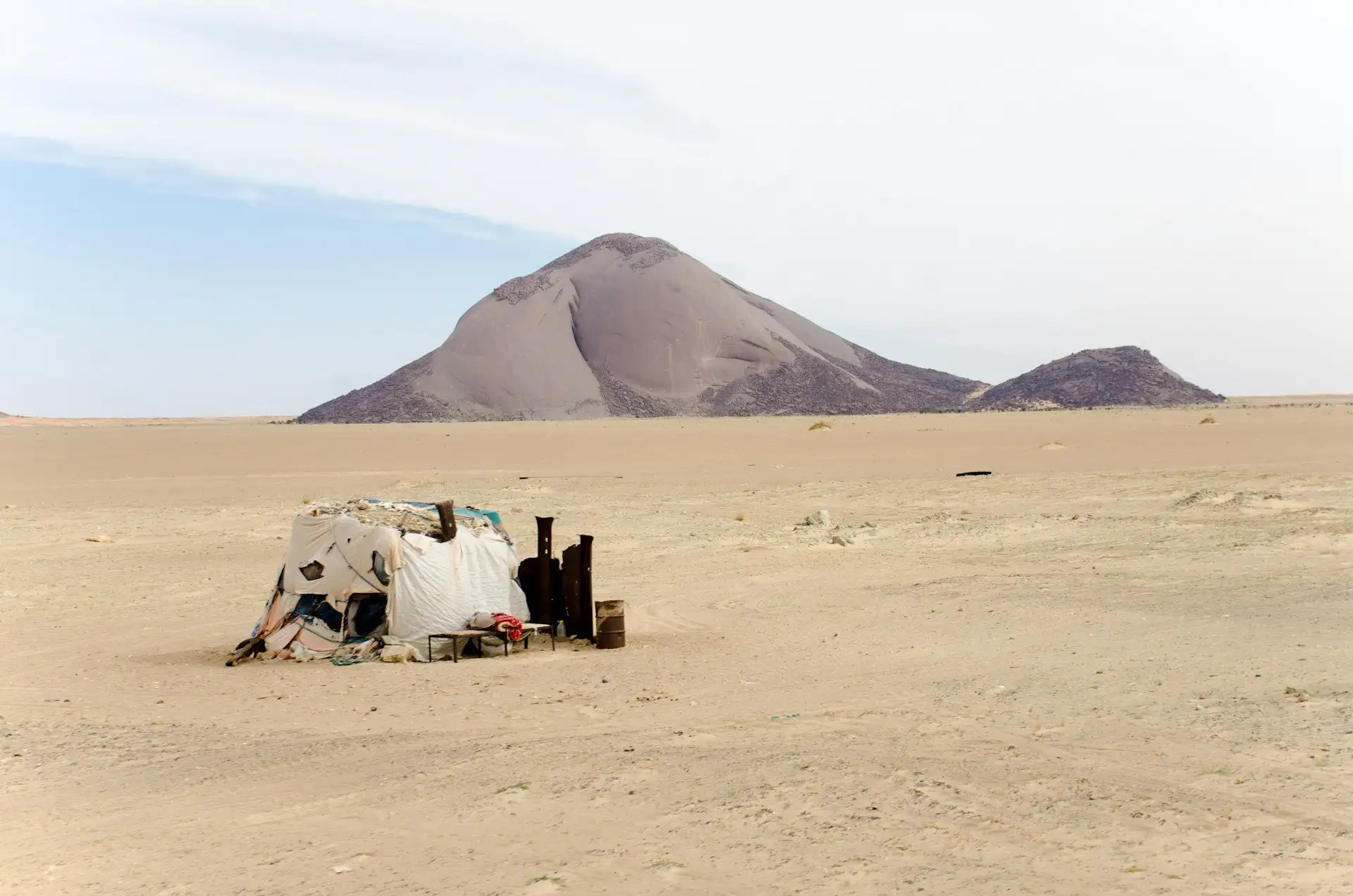
Mauritania
One of the world's longest trains runs 700 kilometers across the Sahara at night — and you can ride on top of it. Medieval cities hold manuscripts nobody reads. A geological dome the size of a city is visible from space. Mauritania is not for everyone. For the right person, it's unforgettable.
What You're Actually Getting Into
Mauritania is the country that gets skipped. Between Morocco's obvious draw to the north and Senegal's beaches to the south, this vast expanse of sand and wind — bigger than Egypt, with less than five million people — goes largely unnoticed by the tourist mainstream. That is precisely its appeal. The roads are nearly empty. The ancient cities of the Adrar region receive a trickle of visitors, mostly French (their former colonizer, and still their primary tourist source). The iron ore train crosses 700 kilometers of Sahara every single day and passengers from outside the country are sufficiently rare that locals will photograph you sitting on top of the wagon.
The country is predominantly desert — the Sahara covers about 90% of the territory — and what is not desert is Sahel scrubland along the Senegal River in the south. The Atlantic coast, where Nouakchott sits, gives the capital a wind that makes the heat survivable for much of the year. The city itself is oddly compelling: the French called their colonial territory here le Grand Vide — the great void — and Nouakchott, built almost from scratch as an administrative capital after independence in 1960, still has the feeling of a city that grew up uncertain of itself. Sand dunes appear at the edge of residential neighborhoods. The camel market on the outskirts is one of the largest in West Africa.
Before you go, there is one thing about Mauritania that belongs in the overview rather than buried in a history section: the country is consistently identified by international human rights organizations as having the highest rates of contemporary slavery in the world. Mauritania was the last country on earth to officially criminalize slavery — in 2007, not 1807. The Haratine people, who form around 40% of the population, continue to face hereditary servitude in significant numbers, enforced by a social hierarchy that the government acknowledges poorly and enforces against almost never. This is not a distant historical fact. You will be in a country where this is an ongoing reality. Travel here with that knowledge and spend accordingly — supporting local operators and communities that are working toward something different.
Mauritania at a Glance
A History Worth Knowing
The territory that is now Mauritania was a crossroads long before the French arrived to name it. Berber peoples — the ancestors of today's Moors — inhabited the western Sahara for millennia. By the 11th century, the Almoravid movement — a puritanical Islamic reform movement born in the desert of what is now southern Mauritania — swept north to conquer Morocco, cross into Spain, and reshape the religious landscape of the western Mediterranean. The great mosque at Marrakesh was an Almoravid project. Mauritanian desert preachers helped build an empire that stretched from the Sahara to the Pyrenees.
The trans-Saharan trade routes defined the next several centuries. Gold and salt, the great commodities of medieval West Africa, moved through the desert towns that still stand in the Adrar region today. Chinguetti — now a UNESCO site being slowly consumed by sand — was the seventh holiest city of Islam, a gathering point for Saharan pilgrims assembling their caravans for the hajj to Mecca. Its libraries accumulated manuscripts across centuries: theology, mathematics, astronomy, medicine, poetry. Some of those manuscripts, up to 1,400 years old, are still in family libraries in the town. The librarians will show them to you.
The Portuguese arrived on the Atlantic coast in the mid-15th century, establishing a trading post at Arguin Island — now the heart of the Banc d'Arguin National Park — and began trading in gum arabic, gold, and slaves. French colonial interest arrived in the 19th century. The "pacification" of Mauritania, as the French styled their military conquest, was not completed until 1934. Their nickname for the territory — le Grand Vide, the great void — captured their attitude toward a landscape they never much valued. France invested little. When Mauritania became independent in 1960, it had almost no infrastructure.
Since independence, Mauritania has been through a series of coups and military governments, alternating with periods of nominal democracy. The first peaceful transfer of power between two elected leaders happened only in 2019 — a milestone that the country greeted with genuine relief. President Mohamed Ould Ghazouani, who succeeded his former ally Mohamed Ould Abdel Aziz (subsequently arrested for corruption), has maintained a degree of stability. The country's iron ore and copper wealth finances the state; its fishing grounds are among the richest in the Atlantic.
The slavery question runs through all of this. The social hierarchy established by the arrival of Hassaniya Arab tribes in the 17th century — with Moors (Bidhan) at the top, Haratine in hereditary servitude below — has never been fully dismantled. Mauritania was the last country in the world to outlaw slavery (1981 by decree, 2007 by criminal law). Human rights organizations consistently report tens of thousands still living in conditions of servitude. The abolitionist movement — led by figures like Biram Dah Abeid, who has been repeatedly imprisoned for his activism — continues to push against a government that officially denies the problem. This is the honest context of the country you are visiting.
Born in the Mauritanian desert, this Islamic reform movement sweeps north to conquer Morocco, cross into Spain, and reshape the Mediterranean world.
Chinguetti, Ouadane, Tichitt, and Oualata thrive as caravan cities linking sub-Saharan gold and salt to North Africa and beyond. Libraries accumulate.
First European trading post in West Africa. The trans-Saharan trade routes begin their long decline as Atlantic sea routes open.
The War of Bubba establishes the Bidhan-Haratine social hierarchy. The caste structure that defines contemporary Mauritania is set.
"Le Grand Vide." France invests little in a territory it considers nearly worthless. Independence in 1960 begins with almost no infrastructure.
The 700km railway from Zouérat to Nouadhibou begins operating, shipping iron ore to the Atlantic. One of the world's longest trains from the start.
The last country on earth to make slavery a criminal offense. Enforcement remains minimal. The Haratine abolitionist movement continues.
President Ghazouani succeeds Abdel Aziz — the first time in Mauritanian history that one elected leader hands power to another without a coup.
Top Destinations
The classic Mauritania circuit — done by most visitors in 7–10 days — runs from Nouakchott northeast into the Adrar region: Terjit oasis, Chinguetti, Ouadane, back through Atar, then west to board the iron ore train at Choum for the overnight ride to Nouadhibou. Everything is accessible with a 4x4 and a local guide. Everything requires planning, patience with schedules that don't exist, and a tolerance for magnificent discomfort.
Chinguetti
Once considered the seventh holiest city of Islam. A UNESCO World Heritage Site. A gathering point for centuries of Saharan pilgrims assembling caravans to Mecca. Today a small desert town being slowly buried by encroaching sand dunes — there are entire buildings that have disappeared up to their rooflines. Its family libraries still hold manuscripts up to 1,400 years old, in Arabic and Ajami script, covering theology, mathematics, astronomy, and literature. The librarian families will show you. The old mosque's minaret rises above mud-brick walls. Climbing the dunes above the town for sunset is the most visually striking moment of most people's Mauritania trip. The town is about 500km northeast of Nouakchott, accessible by 4x4.
Richat Structure (Eye of the Sahara)
Near Ouadane, a geological formation so distinctive it was used by early astronauts as a landmark for orientation from orbit. The Richat Structure is a deeply eroded geological dome roughly 50 kilometers in diameter — a series of concentric circular ridges visible from space as a perfect eye or target. From the ground it's a dramatic landscape of ancient rock layers exposed by erosion, shimmering in the heat. It looks nothing like the desert around it and everything like a landscape from another planet. Requires a 4x4 and a guide. The drive across it is worth the morning of slow, spectacular off-road travel.
Ouadane
Another UNESCO World Heritage ancient ksour (fortified city), sitting on a rocky promontory overlooking the Sahara plains. Founded in 1147, it was once a prosperous stopover on the trans-Saharan gold trade routes. The old city is a labyrinth of ruined stone buildings, lanes barely wide enough for two people, and the occasional intact house still occupied. Ouadane is quieter and less visited than Chinguetti — even fewer tourists, and the sense of time suspended that comes with genuine historical remoteness. Base here for the Richat Structure drive.
Terjit
A palm-fringed spring in a narrow canyon of red rock, about 45 kilometers southwest of Atar. For centuries, trans-Saharan caravans stopped here to rest in the shade and refill their water. Today it is a genuinely beautiful oasis with a cold spring pool, palm trees creating improbable shade, and a quality of silence that makes the heat outside the canyon walls feel unreal. Most tours stop here on the way north to Chinguetti. Allow two to three hours — enough to eat lunch in the shade, wade in the pool, and let the scale of the surrounding desert become real.
Banc d'Arguin National Park
A UNESCO World Heritage site on the Atlantic coast, midway between Nouakchott and Nouadhibou. The park covers 12,000 square kilometers of Atlantic shallows, sandbanks, and islands — the most important migratory bird staging area in the world for species traveling between Eurasia and sub-Saharan Africa. Up to three million birds winter here: flamingos, pelicans, herons, terns, and dozens of wading species. Bottlenose dolphins patrol the inshore waters. Humpback whales pass offshore. The Imraguen people, who have fished these waters for generations using traditional methods unchanged for centuries, are the park's human face. Accessible by 4x4 from the coastal road.
Nouakchott
A city that barely existed at independence in 1960, built almost from scratch on a coastal sand flat with no natural advantages and no colonial investment. Today it holds a third of the country's population, with sand dunes appearing at the edge of residential neighborhoods and a constant Atlantic wind that makes the heat manageable. The camel market on the outskirts is one of the largest in West Africa — thousands of animals traded by nomadic herders who have walked days to get here. The Port de Pêche (fishing port) is a kaleidoscope of hand-painted wooden boats, fish auctions, and chaotic harbor commerce. The National Museum is worth two hours for context before heading inland.
Atar & the Adrar Region
The capital of the Adrar region and the base for all desert exploration. Atar has a small airport (with seasonal charter flights from France), a lively market, a historic mosque from 1674, and the infrastructure — such as it is — for arranging guides, 4x4 vehicles, and permits for the national park. It is a functional rather than beautiful town, but it has the quiet energy of a place that was once on important trade routes and knows it. The Adrar plateau around it — a landscape of sandstone mesas, wadis, and scattered palms — is worth at least a morning of slow driving.
Nouadhibou
The train's destination on the Atlantic coast — Mauritania's second city, a fishing and mining port on the Cap Blanc peninsula. The primary reason most visitors end up here is the iron ore train's arrival. The city has a ship graveyard in the bay (rusting hulks of vessels from around the world, abandoned over decades) and a lively fish market. It's not beautiful but it is alive. Flying back to Nouakchott from here saves two days of road travel. The Mauritania–Morocco border crossing is accessible from Nouadhibou for overland travelers continuing north.
The Iron Ore Train
The Mauritania Railway — officially the Train du Désert — has been running since 1963 and is, by some measures, the longest and heaviest train in the world on a regular service. Every day it makes the 700-kilometer journey from the iron ore mines at Zouérat to the port at Nouadhibou on the Atlantic. The consist is up to 200 wagons, pulled by three or four diesel locomotives, stretching up to 2.5 kilometers. It carries roughly 17,000 tonnes of iron ore per trip. For most of the journey it crosses terrain with no roads, no settlements, no phone signal, and no one.
There is a passenger wagon. It is crowded, airless, and essentially camping gear with a roof. Most travelers choose to ride on top of the ore wagons instead — climbing up at the departure point and sitting or lying on the iron ore for the 10-to-14-hour journey. It is cold at night (desert cold, which is genuinely cold), dusty beyond anything you can prepare for, occasionally loud when the wagons slam into each other, and completely extraordinary. Travelers consistently describe it as one of the most memorable experiences of their lives. They also consistently describe arriving at Nouadhibou covered in red iron ore dust from head to foot and immediately needing a shower and several hours of recovery.
The train departs from Choum (the most practical boarding point, 14 hours to Nouadhibou rather than the 20 from Zouérat) at any time between 2am and 5am — it runs on iron ore schedule, not tourist schedule. You camp at Choum and wait. Pack: warm layers (the desert night is cold and the wind moving at train speed makes it colder), goggles to protect your eyes from ore dust, a face covering, snacks and water for the entire journey, a headlamp, a sleeping bag or blanket, and the psychological acceptance that this is an adventure rather than transportation.
Board at Choum
Choum is the standard departure point, reducing the journey from 20 hours (Zouérat) to 10–14 hours. Camp near the tracks. The train arrives at some point between 2am and 5am — don't sleep heavily. When you hear it coming, you have minutes to organize yourself and climb on.
Climb a Wagon
The ore wagons have metal rungs welded to the sides. Climb up and find a position in the ore — people hollow out a small seat and settle in. Some bring cardboard or sleeping pads to sit on. Get as far from the locomotives as possible to reduce diesel fume exposure.
Survive the Night
Layer up. Goggles on immediately. The ore dust is fine and gets into everything — wrap a shemagh or buff around your face. The train moves at 60–70km/h, which generates serious wind chill in the desert night. Temps can drop below 10°C even in winter. This is the cold-and-dusty part that makes the experience memorable.
Watch the Sunrise
Somewhere around hour six or seven, the sun comes up over an empty Sahara horizon. The light on the dunes through the ore dust is one of those views that photographers try and fail to capture. This is the moment people describe when they talk about the train years later.
Arrive at Nouadhibou
The train stops at the port. You are covered in red iron ore dust from head to foot. You will need to shake out every piece of clothing and equipment separately. Your lungs will be fine — the dust is not particularly toxic — but the shower at the hotel in Nouadhibou is a genuinely emotional experience.
Recover
Budget a full rest day in Nouadhibou or fly back to Nouakchott. The train is physically demanding — not dangerous, but tiring. Most organized tours build in the recovery time. Don't schedule a tight onward connection the same day you arrive.
Culture & Etiquette
Mauritania is 99.9% Muslim, operates under Sharia law, and takes religious practice seriously in ways that are visible from the moment you arrive. The call to prayer structures the day. Dress expectations are strict and apply to everyone, men and women both. Alcohol is illegal throughout the country. Atheism is theoretically punishable by death, though this has not been carried out in modern times and tourists are not questioned on their personal beliefs. Homosexuality is illegal and dangerous — same-sex couples should exercise extreme discretion.
The nomadic Moorish tradition of hospitality runs equally deep. Accepting tea when it is offered is not optional — refusing it is a significant social failure. The tea ceremony itself (three small glasses of sweet green tea, poured from height, repeated over 30 to 40 minutes) is both a practical hospitality ritual and a social bond-forming exercise. Take your time with all three glasses.
Long trousers or skirts, covered shoulders, for everyone. Women should carry a headscarf — it is expected in mosques, villages, and most public spaces. The relaxation at beach resorts elsewhere does not apply in Mauritania.
The tea ceremony is hospitality ritualized. Three rounds, each glass poured from height to create a froth: the first bitter as life, the second sweet as love, the third light as death. Accepting all three is the social contract. Take your time.
At each of the many security checkpoints, you must present a copy of your passport and visa. Bring 20–30 photocopies. Running out and having to write your information down by hand at every checkpoint adds significant time to every journey.
"As-salamu alaykum" opens every door in Mauritania. Launching into a question or request without the greeting is rude in a way that Mauritanians notice and remember.
Standard across the Arab world and most of West Africa. The left hand is considered unclean. Use your right hand to receive objects, eat communally, and gesture when speaking.
Enforced strictly. Cameras or phones pointed at checkpoints, soldiers, or government infrastructure will be confiscated and may result in detention. This rule is applied more consistently than most visitors expect.
Alcohol is illegal throughout Mauritania, full stop. There is no tourist exception, no licensed establishment, no winking accommodation. If you need alcohol to enjoy a trip, choose a different destination.
Ramadan falls in February 2026. During daylight hours, eating, drinking, or smoking in public is both illegal and deeply offensive. Respect the fast.
Not in cities, not in villages, not even in the desert. The expectation is modest dress in all contexts. Shorts and sleeveless tops will draw stares and diminish your interactions with Mauritanians.
Homosexuality is illegal and carries serious penalties. Same-sex travelers should maintain complete discretion in all contexts. This is not a nuance — it is a safety matter.
The Griot Tradition (Iggawen)
Like in Mali to the east, the Moorish world has its own hereditary storyteller-musician caste — the iggawen. Historically they served the warrior and religious lineages as praise singers, historians, and mediators. The music they produce — using the ardine (a women's harp) and the tidinit (a lute) — is distinctly Moorish in character, melismatic and modal, unlike anything easily compared to Western music. You may encounter it at weddings or ceremonies if you spend time in Nouakchott.
Silverwork & Leatherwork
Mauritanian craftspeople — particularly women, working in leather, and silversmiths working in the Berber tradition — produce some of the finest traditional metalwork and leather goods in the Sahel. Silver pendants, bracelets, and the distinctive cross of Agadez appear in the markets of Nouakchott and Atar. Leather cushions, saddlebags, and pouches are practical and beautiful. Buy directly from artisans when possible.
Nomadic Culture
Mauritania remains one of the world's more genuinely nomadic societies. Large numbers of Mauritanians — particularly from the Moorish and Tuareg communities — follow seasonal patterns of movement with their herds of camels, goats, and cattle across vast desert territories. The dark tent (khaima) pitched in the desert at sunset, with a small fire and three glasses of tea, is not a tourist recreation. It is how many Mauritanians still live.
The Slavery Reality
Mauritania has the highest rates of contemporary slavery of any country by most estimates. The Haratine (Black Moors), who make up 40% of the population, face hereditary servitude enforced by social hierarchy and inadequately addressed by law. Activists like Biram Dah Abeid have been imprisoned for their advocacy. As a visitor, you cannot fix this. You can be aware of it, support the abolitionist organizations directly, and choose local operators who employ Haratine guides and staff equitably.
Food & Drink
Mauritanian food is simple, abundant in protein, and deeply connected to the desert and ocean around it. Camel meat, goat, and fresh Atlantic fish are the protein pillars. Rice and couscous are the staple bases. Everything is flavored with spices that reflect the trans-Saharan trade that defined this region for centuries. There is no restaurant culture to speak of outside Nouakchott — in the desert you eat what your guide's cook prepares, communally, on a mat in the sand. This is one of the pleasures of the desert circuit, not an inconvenience.
Thiéboudienne
Borrowed and adapted from Senegal — rice cooked in a tomato and fish broth with vegetables, the fish nested in the center of the pot. The Mauritanian version tends to be drier and more spiced than the Dakar original. Found in Nouakchott restaurants and as a standard meal option in the desert. The rice absorbs everything the fish has given it and turns a deep orange-red. Eat it with your right hand from a communal bowl.
Mechoui
Whole roasted lamb or goat, slow-cooked over coals until the meat falls from the bone. The celebration dish for special occasions — weddings, eid, welcoming important guests. In the desert, a guide who likes you may arrange a mechoui over a fire in the sand dunes. There is no special occasion. The fire and the desert night are occasion enough.
Camel Milk
Fresh camel milk is the Saharan staple — thin, slightly salty, slightly tangy, completely different from the milk of any other animal. Nomads survive on it for extended periods. In the desert circuit you will encounter it offered by nomadic families from a bowl. Drink it. It is good and it is a genuine act of hospitality. Zrig, camel milk diluted with water and sometimes slightly soured, is a refreshing version available at roadside stops.
Bread from the Sand
Desert bread — millet or wheat dough buried in the hot sand beneath a fire, then dug up, brushed clean (mostly), and torn apart. It is dense, slightly ashy, slightly smoky, and one of those foods that taste exactly like their context. Eaten with a camel milk stew in the desert at dawn before the train, it is the breakfast you remember for years.
Atlantic Seafood
Mauritania's Atlantic coast is one of the richest fishing grounds in the world. In Nouakchott and Nouadhibou, fresh fish — grouper, sea bream, octopus, and whatever the boats brought that morning — is grilled at the port and sold at the fish market for almost nothing. The Port de Pêche in Nouakchott in the late afternoon, when the boats come in, is both a meal and a spectacle. This is where the cheapest and best food in Mauritania is found.
Mint Tea
Three glasses. Always three. Chinese green tea with fresh mint and enough sugar to stand a spoon in, poured from height between two glasses to create a froth. First glass bitter as life, second sweet as love, third light as death. The ritual takes 30 to 40 minutes and is the social technology of the desert — you cannot rush it and you should not try. Refusing any of the three glasses is a social failure. Accept all three and take your time.
When to Go
This is not a destination where you choose your season based on whether you prefer the crowds to be smaller in spring or the flowers to be better in autumn. Mauritania in summer will kill you. The Sahara desert in June, July, August reaches 45–50°C — temperatures that are not merely uncomfortable but genuinely dangerous without exceptional preparation and acclimatization. Come between November and March. December and January are the sweet spot.
Dec – Feb
Peak Desert SeasonDaytime temperatures in the Adrar region of 20–28°C. Cold nights — down to 5°C or below — which makes the train experience genuinely cold but survivable. Perfect for the desert circuit. Banc d'Arguin is at maximum bird numbers. Peak season for organized tours.
Nov & Mar
Shoulder SeasonSlightly warmer at either end. November is excellent — post-rainy season landscape is at its greenest (which in the Sahara means occasional green patches), fewer visitors, same experience. March is the last comfortable month before the heat builds. Good value, excellent conditions.
Apr – Oct
Desert SummerDo not come. The Sahara in summer reaches 45–50°C. The iron ore train becomes a metal oven. Chinguetti's sand dunes radiate heat that closes off outdoor movement. Many lodges close. This is not a risk calculation — it is a physical reality that no tourist preparation adequately addresses.
Trip Planning
Seven to ten days is the standard circuit and covers the main highlights well. Less than a week means you're rushing through destinations that deserve patience. More than two weeks is for people who want to go beyond the main circuit into the southern Sahel, the Tagant region, or the remote UNESCO site of Oualata.
Nouakchott
Arrive, settle, walk the Port de Pêche in the late afternoon when the boats come in. Camel market in the morning if you arrive early enough. National Museum for context. Good dinner at one of the few decent restaurants in the capital before heading into the desert.
Azouega Dunes
Drive northeast from Nouakchott (about 6 hours). Stop at Akjoujt (former copper mining town) for lunch. Arrive at Azouega in late afternoon, camp beside the highest dune in Mauritania. Sunset from the dune top. Dinner by fire. Sleeping bag essential.
Terjit Oasis + Chinguetti
Early morning dune climb before the heat. Drive to Terjit oasis — lunch in the shade of the palms, wade in the spring. Continue to Chinguetti in the late afternoon. Arrive, check in, walk the old city before it gets dark. Sunset from the dunes above — don't miss it.
Chinguetti + Ouadane
Morning: visit one or two of Chinguetti's family manuscript libraries — the librarians will show you manuscripts they are personally custodians of. Walk the old mosque. Drive to Ouadane (90 minutes through desert). Afternoon: explore the ruined old city. Drive to the Richat Structure viewpoint for sunset.
Richat Structure + Atar
Morning drive through the Richat Structure — a half-day off-road circuit through the concentric ridges. Return to Atar in the afternoon. Early evening: walk the market and the 1674 mosque. Camp or guesthouse near Atar. This is the last comfortable night before the train.
Drive to Choum + Iron Ore Train
Afternoon drive from Atar to Choum (3 hours). Set up camp near the tracks. Wait for the train — it arrives between 2am and 5am. Board the ore wagons. 10–14 hours across the Sahara, arriving at Nouadhibou by early afternoon. Shower. Sleep.
Nouadhibou + Departure
Rest day in Nouadhibou. Walk the ship graveyard bay. Fish market. Fly back to Nouakchott for international departure, or continue north toward Morocco by road through the Western Sahara.
Nouakchott
Two days in the capital: Port de Pêche, camel market, National Museum, the sand dune neighborhoods, and enough time to find a good Mauritanian meal and orient yourself before the desert. The coast at sunset is worth the last evening.
Banc d'Arguin + Azouega
Day three: drive north along the coast and into Banc d'Arguin National Park — a half-day with a guide among the bird colonies. Continue to Azouega for the dune camp. Day four: sunrise dune climb, then drive east into the Adrar.
Terjit + Chinguetti
Terjit oasis stop. Two nights in Chinguetti — enough time to walk the old city at different hours, visit multiple manuscript libraries, do a camel ride into the dunes, and sit through the sunset twice.
Ouadane + Richat Structure
Drive to Ouadane, explore the ruined ksour. Full day on the Richat Structure — not just the viewpoint, but the 4x4 circuit through the interior of the dome. Overnight near the structure.
Atar + Iron Ore Train
Afternoon in Atar. Drive to Choum. Camp. Train arrives at 2–5am. Arrive Nouadhibou by midday on day nine. Rest.
Nouadhibou + Departure
Full recovery day. Ship graveyard bay and fish market in the morning. Fly back to Nouakchott for international departure, or overland north.
Fiche Copies
Print 20–30 copies of your passport photo page and visa before you go. Every security checkpoint — and there are many — requires one. Running out and having to write everything manually adds serious time to every drive. This is the most practically important thing in this entire planning section.
Train Kit
For the iron ore train: goggles (dust is fine and gets everywhere), face covering (shemagh or buff), warm layers and a sleeping bag (cold nights), snacks and water for 12+ hours, a headlamp, and something waterproof to sit on. The ore dust destroys clothing — wear things you don't care about.
Vaccinations
Yellow fever certificate is required. Also strongly recommended: Hepatitis A, Typhoid, Meningitis (Sahel is a high-risk belt), Rabies for desert and rural travel, and malaria prophylaxis for southern Mauritania. Medical facilities outside Nouakchott essentially don't exist.
Full vaccine info →Cash Only
Credit cards not accepted outside a few Nouakchott hotels. ATMs in Nouakchott exist but are unreliable. Bring euros or US dollars for your entire trip — the e-visa fee itself ($60/€55) must be paid in exact cash on arrival. The Ouguiya (MRO) is the local currency; exchange at banks in Nouakchott.
Sun & Heat
Even in December, the Saharan midday sun is serious. High-SPF sunscreen, a hat that covers your neck, UV-blocking sunglasses, and light loose long-sleeved shirts are essential protective equipment, not optional comfort items. At 40°C, sunburn accelerates to burn in minutes on exposed skin.
Connectivity
Mauritel is the main carrier. Signal in Nouakchott and Atar is workable. In the desert, especially near Chinguetti and Ouadane, signal is intermittent or absent. Download offline maps (Maps.me covers Mauritania reasonably well). Your guide will be your navigation and communication system in the deep desert.
Transport in Mauritania
Outside the main paved road linking Nouakchott to Nouadhibou (and a secondary road toward Atar), Mauritania is navigated by 4x4. The desert circuit requires a 4x4 with a driver who knows the tracks — GPS helps but does not replace local knowledge of which sand to avoid and which wadis flood. The train is the other transport option of substance.
International Flights
Via Casablanca or DakarOumtounsy International Airport serves Nouakchott. Royal Air Maroc (via Casablanca), Air France (via Paris), and Turkish Airlines are the main carriers. Seasonal charter flights from France serve Atar directly — the easiest access for the desert circuit without going through Nouakchott.
Iron Ore Train
Free (ore wagons) / small fee (passenger car)The daily service from Zouérat/Choum to Nouadhibou. 700km, 10–14 hours from Choum. Ore wagons are free to ride — you just climb on. The passenger carriage charges a small fee but is essentially irrelevant to most visitors who come specifically to ride on top. Schedule is determined by the mine, not a timetable.
4x4 with Driver
$80–150/dayThe only practical transport for the desert circuit. Your guide will arrange this — either they drive or they know the driver. Do not rent a 4x4 and self-drive in the desert. The tracks are unmarked, the sand conditions change, and getting stuck requires local knowledge to solve.
Shared Taxis & Bush Taxis
$5–30/routeAvailable between Nouakchott and major towns like Atar. The 500km journey to Atar takes 8–10 hours in a shared taxi (usually an old Mercedes) that leaves when full. Rough but functional. Not recommended for the desert interior.
Domestic Flights
$80–150 one-wayMauritania Airlines serves Nouakchott–Nouadhibou regularly, saving the two-day drive. Seasonal charters from Europe serve Atar. Schedules are unreliable — confirm repeatedly and build buffer time around domestic connections.
Camel
$20–40/half dayFor excursions around Chinguetti into the dunes, a camel ride is the appropriate and atmospheric transport. Not for covering distances — for experiencing the desert at camel pace for a morning or afternoon. Every guide in Chinguetti can arrange this.
Accommodation in Mauritania
Accommodation in Mauritania is functional rather than polished. In Nouakchott there are several international-standard hotels and a growing number of decent mid-range options. In the desert circuit towns — Atar, Chinguetti, Ouadane — accommodation is guesthouses, auberges, and tented camps, all basic but clean enough. Electricity and running water may be intermittent. The best accommodation experience is camping in the desert itself — which is not roughing it but the correct way to experience the landscape.
Hotels (Nouakchott)
$50–150/nightMonotel, Halcyon, and several others offer international-standard rooms in the Tevragh Zeina neighborhood. These are the best options for arrival and departure nights. The city also has budget guesthouses for backpackers.
Auberges (Adrar Region)
$20–50/nightGuesthouses in Chinguetti and Ouadane are simple but functional. L'Eden in Chinguetti has been operating since 2005 and is consistently recommended. Beds, cold (or no) water showers, communal meals cooked by the owner's family. Clean and entirely adequate.
Desert Camping
$15–30/nightThe correct accommodation for at least two nights of any desert circuit. Camp beside Azouega dunes, or near the Richat Structure, or at Choum waiting for the train. Your guide's cook prepares dinner over a fire. Sleeping bag essential. The sky at night in the Sahara, away from any light source, is one of the great celestial experiences available to travelers.
Nouadhibou
$30–80/nightAfter the train, you need a shower and a bed. Nouadhibou's hotels are functional and no more. The city is a port town, not a resort. Book the closest reasonable hotel to where the train drops you and plan to spend 24 hours recovering.
Budget Planning
Mauritania is not particularly cheap once you factor in the 4x4 hire and guide — the essential costs of the desert circuit — but it is significantly less expensive than comparable adventure destinations in Morocco or Namibia. The iron ore train is essentially free. The ancient cities charge minimal entry. The auberges are cheap. The main cost is the private transport and guide, which typically runs $100–150 per day for a 4x4 with driver-guide and a cook.
- Shared taxis between towns
- Budget auberges and camping
- Local meals from the cook
- Iron ore train (free)
- Self-organized with local contacts
- Private 4x4 with driver-guide
- Cook for desert camps
- Guesthouse/auberge accommodation
- All meals on circuit included
- 2 nights desert camping
- Reputable tour operator organizing everything
- English-speaking guide
- Best available accommodation in each location
- All meals, transport, permits
- Iron ore train logistics managed
Quick Reference Prices
Visa & Entry
Mauritania requires an e-visa for most nationalities, applied for online before departure. The system has been in place since 2025 and generally works — processing takes about 24 hours. The fee is paid in cash on arrival, not online, so bring the exact amount in euros or US dollars. Change is not given. The process at the airport is relatively quick once you have your confirmation printed.
Apply at evisa.gov.mr before departure. €55 or $60 paid in cash on arrival — bring exact change. Processing approximately 24 hours. Print your confirmation.
Safety in Mauritania
Mauritania is rated Level 3 "Reconsider Travel" by the US — not the Level 4 "Do Not Travel" of Mali or Libya. The distinction matters. Organized tours to the main circuit have run safely for years. The last terrorist attack on tourists in Mauritania was in 2009. The army maintains extensive checkpoints throughout the country that experienced travelers generally credit with keeping the main routes stable. The areas near the Malian and Algerian borders — the eastern and southeastern regions — are genuinely dangerous due to spillover from the Sahel conflict. The classic tourist circuit (Nouakchott, Adrar, train) does not approach these areas.
Terrorism Risk
Al-Qaeda-linked groups remain active in the Sahel and there is a theoretical risk of terrorism in Mauritania. No attacks have targeted tourists on the main circuit since 2009. The army checkpoint system and intelligence apparatus are credited by experienced travelers with maintaining stability in the tourist zones. Stay on established routes and with experienced guides.
Border Zones
Areas near the Malian border (east and southeast), the Algerian border (northeast), and the Hodh regions are designated "No Movement Zones" by the Mauritanian military. Do not go there. These areas are explicitly off-limits and the risk of kidnapping or attack is high. The classic tourist circuit does not approach them.
Crime in Nouakchott
The US advisory specifically cites crime outside the Tevragh Zeina neighborhood of Nouakchott — mugging, armed robbery, and assault. Within Tevragh Zeina, the risk is more normal. Don't walk alone at night in unfamiliar areas. The Port de Pêche has active pickpockets — watch your belongings in the crowd.
The Checkpoint System
You will pass many military and gendarmerie checkpoints throughout any overland journey. This is the practical security architecture of Mauritania. Cooperate completely, have your fiche copies ready, and follow your guide's lead. These checkpoints are also why the tourist circuit has remained relatively safe — they prevent free movement of armed groups.
Heat
In December and January the desert is perfectly manageable. In summer it is not — it is dangerous. If you find yourself in the Adrar in April or later without appropriate water, shelter, and heat experience, the landscape will kill you faster than any security threat. Never underestimate desert heat.
LGBTQ+ Travelers
Homosexuality is illegal in Mauritania and penalties are severe — death penalty is on the books for men, though not carried out in recent years. Same-sex couples must exercise complete discretion in all contexts. This is a safety issue, not a cultural sensitivity note.
Emergency Information
Key Contacts in Nouakchott
Most Western missions are in the Tevragh Zeina district of Nouakchott.
Book Your Mauritania Trip
Mauritania is primarily planned through local guides and operators. These platforms help with flights, accommodation, and the logistics around the trip.
Three Glasses
The Mauritanian tea ceremony has three rounds and you cannot rush any of them. The first glass is bitter — the tea brewed strong and dark and poured slowly between the pot and the glass, from height, the way you pour it to create the froth that indicates care. The second glass is sweet — more sugar, the same tea, a different character. The third is lighter still, almost delicate. The nomads say: first bitter as life, second sweet as love, third light as death.
You are somewhere in the Adrar. The fire is down to coals. The dunes are invisible in the dark, present only as the absence of stars along the horizon. Your guide is doing something with his hands you cannot quite see — the same thing his father did, and his father's father, maintaining the small flame under the teapot while conversation happens around it. The train is tomorrow, and after the train is a shower and a flight home and everything else. But right now there is no tomorrow. There is the fire, and the glass in your hand, and the sand cooling around you, and the entire Sahara extending in every direction to the edge of what you can comprehend.
This is what Mauritania offers. Not comfort. Not ease. Not the carefully managed experience. Three glasses of tea in the dark, and the largest desert on earth, and enough silence to hear yourself think.