
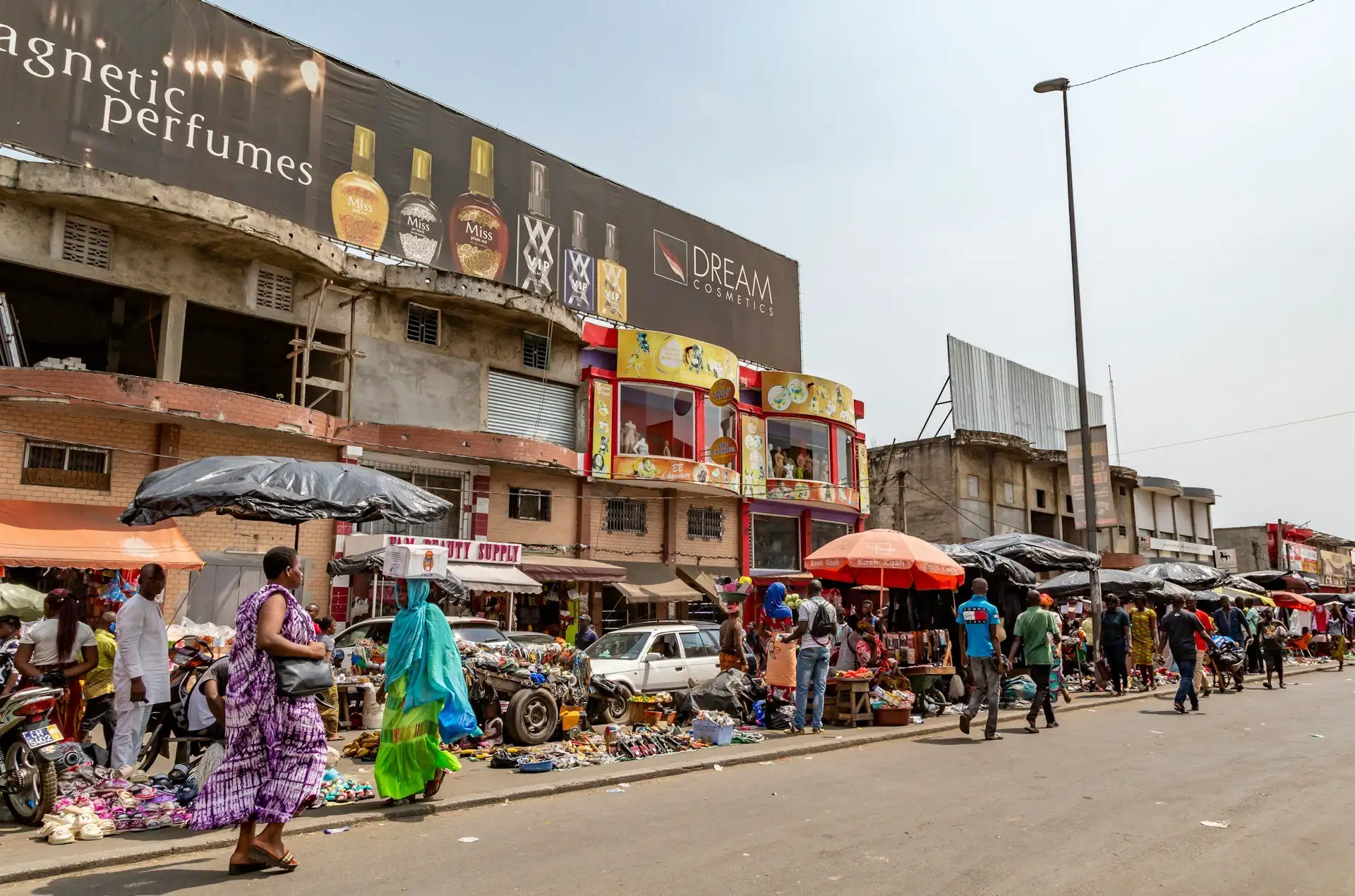
Ivory Coast
The world's cocoa capital with a skyline that surprises everyone. Grilled fish at open-air maquis, mask dances in Senoufo country, and a basilica in the middle of nowhere that's bigger than St. Peter's. West Africa's economic engine, served with attiéké.
What You're Actually Getting Into
Most people who haven't been to Abidjan picture something small and dusty. What they get instead is a city of six million built across a lagoon, with a skyline of glass towers in the Plateau district that genuinely startles first-time visitors, a live music scene that runs seven nights a week, and a food culture centered on open-air restaurants called maquis that serve some of the best grilled fish on the African continent. The Economist called Ivory Coast's economic success "Africa's best-kept secret" in 2025, and the description is accurate. Growth rates above 6% annually for over a decade. Chinese-funded infrastructure projects transforming the roads. A new metro system under construction in Abidjan. This is not the war-torn country of the 2000s headlines. It's something more complicated and more interesting than that.
Cote d'Ivoire produces nearly 40% of the world's cocoa. That single statistic explains much of the country's modern history: the wealth it generated, the migration it attracted, the political tensions over who deserves to benefit from it. The cocoa economy built Houphouet-Boigny's "Ivorian miracle" in the 1970s, fueled two civil wars in the 2000s, and funds the current construction boom. You'll taste it in the chocolate, see it in the plantations along the southern roads, and understand it better once you've been to Yamoussoukro, the political capital, where the country's founding president built a basilica larger than St. Peter's in Rome in the middle of a town that feels like it has about 50,000 people.
The tourism infrastructure is developing but still young. Abidjan has international-standard hotels and restaurants. Grand-Bassam, the colonial-era beach town 40 kilometers east, has a UNESCO listing and genuine charm. Beyond these, you're into territory where French is essential, roads get rougher, and the reward is cultural experiences that haven't been packaged for tourists: Senoufo mask dances in Korhogo, primary rainforest in Tai National Park, cocoa villages where your guide will crack open a pod and hand you the sweet white pulp that eventually becomes the chocolate you know.
The country sits at a crossroads. Economically booming, politically uncertain, culturally electric. If you're interested in Africa beyond the safari circuit, Ivory Coast is one of the most rewarding destinations on the continent right now.
Ivory Coast at a Glance
A History Worth Knowing
Before the French arrived, this territory wasn't a single country. It was home to dozens of distinct societies: the Senoufo in the north, the Baoulé in the center, the Bété in the west, the Agni near Ghana, the Dioula traders along the trade routes connecting forest and savanna. The name "Ivory Coast" came from European merchants who arrived in the 15th century looking for elephant tusks. They got what they came for. The elephants did not benefit from the arrangement.
France colonized the territory in the late 19th century, and in 1960, independence arrived under Felix Houphouet-Boigny. What followed was one of the most remarkable post-colonial experiments in Africa. Houphouet-Boigny, a former French cabinet minister, combined shrewd ethnic balancing with aggressive economic investment. He encouraged immigration from neighboring countries to work cocoa plantations. He built infrastructure. He maintained close ties with France. The economy grew at 10% annually through the 1970s. Ivory Coast became the poster child for African development, earning the nickname "the Cocoa Republic."
Then Houphouet-Boigny did what long-serving leaders often do: he built a basilica. In his hometown of Yamoussoukro, he constructed the Basilica of Our Lady of Peace, modeled on St. Peter's in Rome but slightly taller. It seats 18,000. It cost an estimated $300 million. He also moved the political capital there from Abidjan. Most government functions remained in Abidjan anyway. The basilica stands today as one of the strangest and most impressive structures on the continent.
When Houphouet-Boigny died in 1993, the ethnic balance he'd maintained collapsed. His successor, Henri Konan Bedie, introduced the concept of "Ivoirité," a policy designed to exclude people of northern or immigrant origin from political participation. The primary target was Alassane Ouattara, a northern politician whose Ivorian nationality was challenged. This toxic identity politics fueled a military coup in 1999, a civil war that split the country in half from 2002 to 2007, and a second crisis in 2010-2011 when incumbent Laurent Gbagbo refused to accept electoral defeat to Ouattara. Over 3,000 people died before Gbagbo was arrested with French and UN military support.
Ouattara has led the country since 2011, overseeing impressive economic growth and infrastructure development. But he won a contested third term in 2020 and a fourth in October 2025, with key opposition figures excluded from the ballot. The country's democratic trajectory remains an open question. France withdrew its last military base in late 2024, part of a broader trend across West Africa. The economy is booming. The politics are fragile. Both things are true at the same time.
Portuguese and French traders arrive. The ivory trade gives the coast its name.
France formalizes colonial control. Cocoa, coffee, and timber extraction begins in earnest.
Houphouet-Boigny becomes president. Three decades of stability and economic growth follow.
Our Lady of Peace opens in Yamoussoukro. The world's largest church, in a country that's majority Muslim.
The country splits: rebel-held north, government-controlled south. Identity politics at the root.
Gbagbo refuses to concede election. Over 3,000 die before Ouattara takes power with French/UN support.
6%+ annual growth. Massive infrastructure investment. Political tensions persist beneath the surface.
Top Destinations
Ivory Coast stretches from rainforest coast to northern savanna, with the Ebrie lagoon system running 350 kilometers along the southern shore. Most travelers concentrate on Abidjan, Grand-Bassam, and Yamoussoukro. Push further and you reach Senoufo country in the north and primary forest in the west. The country is roughly the size of Germany, and getting around takes longer than the map suggests.
Abidjan
Six million people sprawled across a lagoon, divided into neighborhoods that function almost as separate cities. Plateau is the business district, all glass towers and French-Ivorian bistros. Treichville is the heartbeat: markets, maquis, nightclubs, and the best garba in the country. Cocody is where the money lives, with the Marché de Cocody for crafts and the Musée des Civilisations for context. Yopougon is the largest commune and arguably the most Ivorian, where the maquis culture reaches its peak expression. Banco National Park sits inside the city limits and offers genuine primary forest within 20 minutes of downtown. Stay three to four days. One is not enough to even begin understanding this city.
Grand-Bassam
Forty kilometers east of Abidjan, Grand-Bassam was the first capital of French colonial Ivory Coast. The colonial quarter, a UNESCO World Heritage Site since 2012, is a grid of crumbling French buildings being slowly swallowed by tropical vegetation. The National Costume Museum shows traditional dress from across the country's ethnic groups and is more interesting than it sounds. The beach runs long and golden, with maquis set up under palm thatch shelters where you eat poisson braisé with your feet in the sand. It's the closest thing Ivory Coast has to a beach resort scene, but it's low-key and local rather than international. A half day from Abidjan. A full day with lunch and the museum.
Yamoussoukro
Houphouet-Boigny's hometown and the official capital since 1983, though in practice Abidjan runs everything. The Basilica of Our Lady of Peace dominates the skyline and your sense of proportion. The Presidential Palace is surrounded by a moat stocked with crocodiles that are fed live chickens at feeding time. The town itself is quiet, spacious, and slightly surreal. Three hours from Abidjan by road. Doable as a long day trip, but staying overnight lets you visit the basilica in morning light.
Korhogo
The main city of the north and the center of Senoufo culture. The Senoufo are known for their mask traditions, painted textiles, and sacred architecture. The panther dance (Boloy) in surrounding villages is one of the most extraordinary living cultural performances in West Africa. Korhogo's craft workshops produce the painted Korhogo cloths that have become symbols of Ivorian art. The town is near the northern border zone, so check security advisories before traveling. When conditions allow, it's deeply rewarding.
Assinie
The resort coast, 80 kilometers east of Abidjan. Cleaner beaches than Grand-Bassam, better infrastructure, and the closest thing to a weekend getaway that Abidjan's professional class has. The lagoon side is calm and good for swimming. The ocean side has stronger currents. Several mid-range to upscale resorts dot the coast. This is where Abidjan goes when it needs a break, and it's a good base for water sports and coastal relaxation.
Tai National Park
One of the last significant areas of primary tropical forest in West Africa and a UNESCO World Heritage Site. Home to chimpanzees, pygmy hippos, and over 1,400 plant species. Getting there requires a 4x4 and genuine effort. The park is in the far southwest, near the Liberian border. Guided treks with the park's eco-tourism program are the only way in. Facilities are basic. The forest is extraordinary. Two to three days minimum if you make the trip.
San Pedro & Sassandra
San Pedro is Ivory Coast's second port and a gateway to the western coastline. Sassandra, further along, is a small fishing town with colonial ruins, an estuary, and a pace that makes Grand-Bassam look frantic. Surfers are starting to discover the west coast's consistent swells. Both towns feel genuinely off the tourist track and offer a different mood from the Abidjan corridor. Access is by road (5-6 hours from Abidjan) or infrequent flights.
Culture & Etiquette
Ivory Coast has over 60 ethnic groups and a large immigrant population, particularly from Burkina Faso and Mali. The resulting cultural mix is one of the country's defining features and one of its persistent tensions. Islam (roughly 43%) and Christianity (roughly 34%) coexist alongside traditional animist beliefs. In practice, many Ivorians blend all three. You'll see a mosque and a church on the same block and a shrine to local spirits around the corner.
The country's cultural identity also carries deep French influence. Baguettes are everywhere and they're excellent. Cafe culture is real. The legal system, education, and business culture all follow French models. But underneath the French veneer is something distinctly Ivorian: the maquis, the Zouglou music born in Abidjan's universities, the Coupe-Decale dance style that went global, the textile traditions of the Senoufo and Baoulé. This isn't a place trying to be France. It's a place that absorbed French influence and turned it into something entirely its own.
A handshake, eye contact, and a genuine "Bonjour, ca va?" opens every interaction. In the north, greetings in Dioula ("I ni sogoma" for good morning) earn immediate warmth. Take time with greetings. Rushing them is rude.
For eating, giving, and receiving. This is universal across West Africa and observed strictly. If eating from a communal bowl, use your right hand only.
Ivorians take appearance seriously. Abidjan is one of the most fashion-conscious cities in Africa. You don't need designer labels, but showing up to dinner or a meeting in dirty or torn clothing communicates disrespect.
Accepting food when offered is important socially. Even if you're not hungry, eat a small amount. Refusing outright in a social setting is considered cold. The food is good. You'll want to eat it anyway.
In markets and taxis, bargaining is expected and normal. The first price quoted to a foreigner is typically double or triple the real price. Negotiate firmly but with humor. Getting angry is counterproductive.
This is taken very seriously. Photographing police, soldiers, military installations, government buildings, or the presidential palace can result in detention and confiscation of your equipment. Ask before photographing any official-looking building.
The question of who is "truly Ivorian" has fueled two civil wars. This remains a deeply sensitive topic. Don't bring it up casually. If Ivorians raise it with you, listen more than you talk.
You need an exit permit from the National Museum to take art objects out of the country. This includes masks, statues, and traditional crafts. Customs checks this. Getting caught without a permit is a serious problem.
The Atlantic currents along the Ivorian coast are dangerous. Rip tides kill people every year. There are no lifeguards. Always ask locals about safe swimming spots. The lagoon side is generally calmer than the ocean side.
Abidjan has significant income inequality. Displaying expensive electronics, jewelry, or cash openly invites unwanted attention. Be sensible, especially after dark in crowded areas.
Music & Dance
Ivory Coast has been one of Africa's most influential music exporters for decades. Zouglou emerged from Abidjan's universities in the 1990s. Coupe-Decale followed in the 2000s, a high-energy dance style that went global. DJ Arafat, who died in 2019, was the genre's biggest star and his influence is everywhere. Live music venues in Abidjan's Zone 4 (Marcory) neighborhood run most nights. Check local listings or just follow the sound.
Mask Traditions
The Senoufo in the north, the Dan and Guéré in the west, and the Baoulé in the center all maintain living mask traditions. These aren't museum pieces. They're active spiritual practices tied to initiation, agriculture, funerals, and community governance. If you're invited to witness a ceremony, behave with the seriousness it deserves. Ask permission before photographing. Some ceremonies prohibit photography entirely.
Cocoa Culture
Cocoa shapes everything here. The beans grow in the humid south and west. Harvest season runs from October to March. If you visit a cocoa village, you'll see the process from pod to fermented bean. The fresh white pulp inside the pod is sweet and tangy and tastes nothing like chocolate. The transformation from that to what you know requires fermentation, drying, roasting, and processing that mostly happens abroad. Ivorians are increasingly aware that the value chain leaves the country. This is a live conversation worth paying attention to.
Fashion & Fabric
Abidjan is one of West Africa's fashion capitals. Wax-print fabric (pagne) is everyday wear and comes in patterns with names and social meanings. Tailors can turn any fabric into custom clothing within 24 hours. The CAVA handicraft center in Cocody sells high-quality locally made goods. Korhogo cloth, hand-painted by Senoufo artisans with natural dyes, makes a distinctive and authentic purchase.
Food & Drink
Ivorian food culture revolves around the maquis: open-air restaurants, usually with plastic chairs, a charcoal grill, and a sound system playing Coupe-Decale at a volume that makes conversation optional. This is where Ivorians eat, socialize, argue about football, and stay out until the early hours. The food is built around grilled protein and starchy sides. The protein is almost always excellent because it's cooked fresh, over charcoal, by someone who has been doing it the same way for decades. The maquis is not a restaurant concept. It's the center of Ivorian social life.
The other food institution is the garbadrome, a street stall or cluster of stalls specializing in garba: attiéké topped with fried tuna, chopped onions, tomatoes, and chili. Garba was invented by a Nigerian man named Garba who started selling attiéké with tuna at a university in Abidjan in the 1990s. It became so popular that his name became the dish. A full plate costs around 300-500 CFA (50-90 cents). It is filling, delicious, and possibly the best cheap lunch in West Africa.
Poisson Braisé
Whole fish (usually capitaine, tilapia, or barracuda) marinated in garlic, lemon, ginger, and pepper, then slow-grilled over charcoal. Served with sautéed onions and tomatoes on top, and a side of attiéké or alloco. This is the maquis signature dish. You get the whole fish, you eat it with your hands, and it's better than anything you'd pay five times more for in a proper restaurant.
Attiéké
Fermented cassava granules with a texture similar to couscous and a slightly sour taste. The base of Ivorian cuisine. Served with almost everything. Eating it with your hands by pressing it into small balls is the local way. The fermented smell puts some newcomers off. Push past it. Once you start eating attiéké with grilled fish and sauce claire, you'll be ordering it for every meal.
Alloco
Ripe plantain sliced and deep-fried in palm oil until golden and crispy, served with a fiery chili-onion sauce and often a hard-boiled egg on the side. Street food perfection. Sold everywhere, at all hours. There are designated alloco stalls (allocodromes) in many neighborhoods. An alloco plate at 10pm with a cold beer is one of Abidjan's essential experiences.
Kedjenou
The closest thing Ivory Coast has to a national stew. Chicken sealed in a clay pot with vegetables, chili, and no added water, then slow-cooked until everything steams in its own juices. The result is intensely flavored and tender. Similar in concept to a Moroccan tagine but with West African spicing. Served with attiéké or rice. Ask for it at any maquis worth its charcoal.
Garba
Attiéké topped with fried tuna, raw onions, tomatoes, and chili oil. Named after the Nigerian who invented it. Sold at garbadromes across every city and town. At 300-500 CFA it's one of the cheapest full meals in West Africa and one of the most satisfying. The version at Garba 50 in Treichville has a near-religious following among Abidjan's students and taxi drivers.
Drinks
Flag and Ivoire are the local beers and they're cold and good. Bangui (palm wine) is tapped fresh and fermented, sweet when new and sour within a day. Bissap (hibiscus tea) is served cold and everywhere. Fresh juice stands sell pineapple, baobab, and ginger juice that'll wake up your entire body. The French influence means proper coffee and espresso are widely available. Abidjan's cafe scene is genuinely good.
When to Go
The dry season from November to March is the clear winner. Temperatures are warm (25-32°C in Abidjan), rain is rare, and roads are at their best. December and January bring Harmattan winds from the Sahara that can reduce visibility with haze but also cool things down slightly. The long rainy season runs from May to July, the short one from October to November. Abidjan gets hammered with rain in June, with roads flooding and traffic becoming even more creative than usual.
Dry Season
Nov - MarOptimal conditions. Warm and dry. Best for road travel, beach time, and northern excursions. December is peak season and prices rise for hotels in Abidjan and Assinie. Book ahead during the holiday period.
Short Dry
Aug - SepA brief respite between the two rainy seasons. Lower prices, fewer visitors, and reasonable weather for travel. Roads can still be muddy from the preceding rains but conditions are manageable.
Long Rains
May - JulAbidjan can receive 500mm+ in June alone. Streets flood. Some rural roads become impassable. It's still possible to travel in the south, but expect delays, detours, and wet everything. The north is drier during this period.
Trip Planning
A week to ten days covers the core circuit: Abidjan, Grand-Bassam, Yamoussoukro, and either Assinie or Korhogo depending on your interests. Two weeks lets you add Tai National Park or the western coast. Budget travelers can get by on the bus network and maquis meals. Comfort seekers will want private transport for anything beyond Abidjan.
Abidjan
Day one: arrive, settle in, walk the Plateau district and end with your first maquis dinner in Treichville. Day two: Banco National Park in the morning, Musée des Civilisations, Cocody market in the afternoon. Day three: deeper into neighborhoods. Yopougon or Adjamé for markets, Zone 4 for evening music.
Grand-Bassam & Assinie
Drive east to Grand-Bassam for the colonial quarter, Costume Museum, and beach lunch. Continue to Assinie for an overnight at a lagoon-side resort. Swim, relax, eat grilled fish. Return to Abidjan late on day five.
Yamoussoukro
Three hours north. Visit the Basilica (morning light is best), the Presidential Palace and its crocodiles, and the Foundation Houphouet-Boigny. Return to Abidjan on day seven or fly out from Yamoussoukro if continuing elsewhere.
Abidjan & Surroundings
Full exploration of Abidjan's neighborhoods, markets, and nightlife. Day trip to Grand-Bassam. One night in Assinie for the beach. Cocoa plantation visit possible within 2 hours of the city.
Yamoussoukro
Basilica, Presidential Palace, and an overnight to experience the town's strange quiet after the energy of Abidjan. Visit nearby Baoulé villages if time allows.
Korhogo & the North
If security conditions permit, continue north to Korhogo. Senoufo craft workshops, traditional mask dances in surrounding villages, and Mont Korhogo for sunset views. This is the cultural highlight of any Ivory Coast trip.
Bouaké & Return
Stop in Bouaké, the second-largest city, on the return south. Explore the central market and the city's cathedral. Final days back in Abidjan for last meals, shopping, and departure.
Abidjan, Grand-Bassam & Coast
Full Abidjan immersion. Grand-Bassam day trip. Assinie overnight. Possible surfing in Assinie or further east along the coast.
Yamoussoukro & Baoulé Country
Basilica, Presidential Palace. Visit traditional Baoulé gold-working villages near Bouaké. Stay in Bouaké for a night to experience the central heartland.
Korhogo & Senoufo Country
Deep dive into Senoufo culture. Multiple village visits for mask dances and craft workshops. Possible extension to Boundiali and the Comoe National Park area (check access conditions).
Western Circuit
Man region for stilt dancers and mountain scenery. South through the forest zone to San Pedro and Tai National Park for chimpanzee tracking. Return to Abidjan via Sassandra and the coastal road. Fly home from Abidjan.
Vaccinations
Yellow fever is mandatory and checked on arrival. Also recommended: Hepatitis A and B, Typhoid, Meningitis, Rabies, and Polio booster. Malaria prophylaxis is essential for the entire country year-round.
Full vaccine info →Connectivity
Orange is the biggest network with the best coverage. Buy a SIM at the airport or any Orange shop. 4G coverage is good in Abidjan and along major routes. Rural coverage is patchy. Download offline maps.
Power & Plugs
220V with Type C and Type E plugs (European two-pin, similar to France). Power is generally reliable in Abidjan. Outside the capital, outages happen. A portable power bank is worth carrying.
Language
French is essential. English is very rare outside international business hotels. Learn basic French before you go. In markets, Dioula is the trade language of the north; Baoulé and Bété are common elsewhere. Google Translate's French offline mode works well.
Travel Insurance
Strongly recommended. Medical facilities in Abidjan are adequate but expensive. Outside the capital, options are limited. Medical evacuation to Europe costs tens of thousands. World Nomads and AXA cover Ivory Coast.
Medication
Bring all prescription medication from home. Pharmacies in Abidjan exist but stock can be unreliable and counterfeits are a concern. Pack antimalarials, rehydration salts, basic first aid, and sunscreen.
Transport in Ivory Coast
Abidjan's traffic is legendary. Two million vehicles competing for road space designed for maybe a quarter of that. The city is investing in a metro system and bus rapid transit, but for now, you're looking at taxis, ride-hailing apps (Yango works here), and communal minibuses called gbakas. Inter-city travel relies on buses, bush taxis, and the occasional domestic flight. The road network has improved dramatically under recent infrastructure investment, with new highways connecting Abidjan to Yamoussoukro and onward. But secondary roads, especially in the north and west, remain challenging.
Taxis
1,000-10,000 CFA/tripOrange taxis in Abidjan run on shared routes or can be hired privately ("depot"). Negotiate the price before getting in. A shared taxi across town costs 500-2,000 CFA. A depot from Plateau to Cocody is around 3,000-5,000 CFA. After dark, prices increase.
Yango / Ride Apps
1,500-8,000 CFA/tripYango (the Yandex-backed ride-hailing app) works well in Abidjan. Fixed pricing, GPS tracking, and air-conditioned cars. More expensive than street taxis but less hassle, especially at night or when you're new to the city.
Inter-City Bus
5,000-15,000 CFAUTB is the main intercity bus company. Air-conditioned coaches run on major routes (Abidjan-Yamoussoukro, Abidjan-Bouaké, Abidjan-Korhogo). Reasonably comfortable, reasonably reliable. Book at gare routière stations.
Bush Taxi / Gbaka
500-8,000 CFAMinibuses (gbakas) serve urban routes in Abidjan. Bush taxis (larger shared vehicles) cover intercity routes. Both leave when full. Both are an experience. Gbakas are the cheapest way around Abidjan but crowded, loud, and not for the claustrophobic.
Domestic Flights
50,000-150,000 CFAAir Cote d'Ivoire operates limited domestic routes from Abidjan to Bouaké, Korhogo, Man, and San Pedro. Schedules are thin and cancellations happen. Useful for reaching the north or west quickly if flights are available.
Car Rental
30,000-80,000 CFA/dayAvailable in Abidjan through international agencies (Europcar, Avis) and local companies. Hiring with a driver is strongly recommended unless you're comfortable with aggressive driving, unmarked roads, and frequent police checkpoints. International driving permit required.
Accommodation in Ivory Coast
Abidjan's hotel market serves business travelers and diplomats, which means decent options at every price point but with a premium attached. Cocody and Plateau are the main hotel districts for visitors. The Sofitel Ivoire in Cocody has a pool that could host water polo and rooms from around $250/night. Mid-range options like Ibis Plateau run $80-120. Budget options exist but inspect the room first. Outside Abidjan, hotel quality drops but prices drop faster. Grand-Bassam has charming beachfront stays. Yamoussoukro has the Hotel President. Beyond the main circuit, you're looking at basic guesthouses.
International Hotels
$120-300/nightSofitel Ivoire, Radisson Blu, Pullman, and Novotel all have Abidjan properties. International standards, reliable power and water, pools, restaurants. Cocody and Plateau locations. Book through Booking.com for best rates.
Mid-Range Hotels
$50-120/nightIbis, local business hotels, and a growing number of boutique properties in Cocody and Marcory. Air conditioning, private bathrooms, breakfast included at most. Quality varies. Read recent reviews before booking.
Beach Resorts
$60-200/nightAssinie and Grand-Bassam have beachfront and lagoon-side resorts ranging from basic to comfortable. The Assoyam in Grand-Bassam and Palm Beach Hotel in Assinie are reliable mid-range options. Book ahead for weekends when Abidjan residents flood the coast.
Budget / Guesthouses
$20-50/nightSimple rooms with fans or basic AC. Available in all major towns. Abidjan has some budget options in Treichville and Adjamé. Outside Abidjan, this is the main option. Basic but functional. Always check the mattress and water situation before paying.
Budget Planning
Ivory Coast uses the West African CFA Franc (XOF), pegged to the euro at a fixed rate of roughly 656 CFA to 1 EUR. This makes budgeting straightforward once you know the rate. The CFA is shared across eight West African countries, so if you're traveling regionally, leftover currency works next door. Food is remarkably cheap at the street and maquis level. Hotels in Abidjan are the main budget concern. ATMs are available in Abidjan and major towns (Orange Money mobile payment is increasingly common) but carry cash for smaller towns and rural areas.
- Basic guesthouse or budget hotel
- Maquis and street food meals
- Shared taxis and gbakas
- Free sights: markets, beaches, neighborhoods
- Local SIM for data
- Mid-range hotel in Abidjan
- Mix of restaurants and maquis
- Yango / private taxis
- Guided day trips and museum entries
- Occasional domestic flight
- International hotel or beach resort
- Private car with driver
- Restaurant and maquis dining
- Full guided cultural tours
- Domestic flights for longer routes
Quick Reference Prices
Visa & Entry
Most nationalities need an e-visa to enter Ivory Coast, applied for online before departure. The process takes about 48 hours and costs approximately $100. The e-visa is valid for 90 days with a 30-day stay allowed per entry. ECOWAS nationals are exempt. The e-visa must be collected on arrival at Abidjan's Port Bouet Airport. There are no visas on arrival for most nationalities, so do not arrive without your e-visa confirmed.
A yellow fever vaccination certificate is mandatory for all travelers and is checked on arrival. There is a vaccination center at the airport for those without one, but getting vaccinated in an airport arrivals hall in the middle of the night is not the ideal introduction to your trip.
Apply online before departure. Processing takes approximately 48 hours. Cost approximately $100. Valid 90 days, 30-day stay.
Family Travel & Pets
Ivory Coast is more family-accessible than most West African countries, at least in and around Abidjan. The city has international-standard hotels with pools, a growing number of restaurants with menus that work for children, and beach resorts in Assinie and Grand-Bassam that cater to families. Medical facilities in Abidjan are adequate for routine issues. That said, this is not a plug-and-play family destination. The heat, traffic, and general intensity of Abidjan can exhaust young children quickly. Plan slow days. Keep hydration constant.
Beach Days
Assinie's lagoon side is the safest swimming option for children. The ocean side has dangerous currents. Grand-Bassam's beach is popular on weekends. Always supervise children closely in the water. There are no lifeguards anywhere.
Banco National Park
A rainforest inside city limits. Well-maintained paths, monkeys in the canopy, and a genuine sense of escape from the urban chaos. Manageable for children over about 5. Bring water and mosquito repellent.
Food for Kids
Alloco (fried plantain) is universally popular with children. Grilled chicken and rice are safe bets. Fresh baguettes are excellent and cheap. Fruit (pineapple, papaya, mango) is available everywhere. French-style bakeries in Abidjan have pastries and sandwiches.
Healthcare
Abidjan has private clinics that handle routine pediatric care. Outside the capital, options are very limited. Travel with a comprehensive medical kit. Ensure all vaccinations are current and malaria prophylaxis is started before departure.
Traveling with Pets
Bringing pets to Ivory Coast requires a veterinary health certificate, proof of rabies vaccination, and an import permit. The process is bureaucratic and pet-friendly accommodation outside international hotels in Abidjan is essentially nonexistent. For tourism, bringing a pet is not practical.
Safety in Ivory Coast
The US, UK, Canada, and Australia all rate Ivory Coast at Level 2: Exercise Increased Caution. This is a step below most West African destinations and reflects the country's relative stability compared to its recent past. Abidjan and the southern coastal areas are generally safe for tourists exercising normal urban caution. The north, particularly the border region with Burkina Faso and Mali, carries a genuine terrorism risk from JNIM (a Sahel-based group linked to al-Qaeda). Most governments advise against all travel within 50km of these borders.
Abidjan & South
Generally safe for tourists. Normal urban precautions apply. The main risk is petty crime: bag snatching, pickpocketing in crowded markets, and taxi scams. Don't walk alone late at night in unfamiliar neighborhoods. Cocody, Plateau, and Marcory Zone 4 are well-trafficked and relatively secure.
Grand-Bassam & Assinie
Low crime, relaxed atmosphere. A March 2016 terrorist attack on Grand-Bassam's beach killed 19 people. Security has been significantly increased since. The risk is now assessed as low but not zero.
Political Unrest
Protests around elections and political events can turn violent. The October 2025 election was relatively calm but underlying tensions remain. Avoid all demonstrations and large political gatherings. Follow local news.
Northern Border Zone
JNIM and AQIM have conducted attacks on security forces in the Savanes and Zanzan districts near the Burkina Faso and Mali borders. Most governments advise against all travel within 50km of these borders. Korhogo (further south) is generally considered accessible but check current advisories.
Road Safety
Traffic accidents are a leading risk for visitors. Driving is aggressive, roads are shared with pedestrians and livestock, and night driving is dangerous. Use a driver if possible. Always wear a seatbelt.
Ocean Safety
Strong currents and rip tides along the Atlantic coast kill multiple people every year. There are no lifeguards or lifeboat services. Swim only where locals swim and always ask about conditions before entering the water.
Emergency Information
Embassies & Consulates in Abidjan
Most embassies are in the Cocody district of Abidjan.
Book Your Ivory Coast Trip
Everything in one place. These are services worth actually using.
The Maquis Never Closes
Ivory Coast is a country that makes more sense at night, around a table. The grilled fish arrives whole on a metal plate. Someone orders another round of Flag beers. A Coupe-Decale track comes on and someone starts dancing without getting up from their chair. The conversation is loud, the sauce is hot, and nobody is in a hurry to go anywhere. This is the maquis. It's been the center of Ivorian social life for decades, and it's the thing you'll miss most when you leave.
The Ivorian national anthem begins with the words "Salut, o terre d'esperance, pays de l'hospitalite" -- "Greetings, land of hope, country of hospitality." It was written in 1960 and it's still accurate. The hospitality is real. The hope is complicated. Both are worth your time.