
What You're Actually Getting Into
Ghana is, for a great many independent travelers, the country that eases them into West Africa rather than throwing them in. English is the official language, used on every sign and by every official. The country has run as a stable multiparty democracy since 1992, after a rougher post-independence stretch of coups. Ride-hailing apps with fixed, upfront prices work reliably in Accra and Kumasi. None of this makes Ghana a theme park, it is a real, complicated, fast-growing country of 34 million people, but the friction that can make a first West Africa trip exhausting is lower here than almost anywhere else in the region.
What makes Ghana specifically worth the trip is the weight of its history. The coast is lined with more than 40 European-built forts and castles, several of them central to the transatlantic slave trade, and two, Cape Coast and Elmina, are UNESCO World Heritage Sites that confront that history directly rather than glossing over it. Inland, the Ashanti Empire never fully disappeared: the Asantehene still reigns from Kumasi's Manhyia Palace, kente cloth is still hand-woven in villages outside the city, and the Akwasidae festival still draws crowds in full traditional dress. Since the government's 2019 Year of Return campaign, that history has also become a homecoming: hundreds of thousands of African-American and Caribbean visitors have come to trace ancestry, and several have taken Ghanaian citizenship.
The honest complications
Accra's traffic is genuinely bad at rush hour, and a short cross-town trip can eat an hour you didn't budget. Outside the south, road quality drops off, and reaching Mole National Park in the far north is a full-day commitment by road (there are short domestic flights, but schedules are limited). Ghana is not visa-free for most Western travelers, unlike several East African countries, so the paperwork needs sorting weeks in advance, and a yellow fever certificate is checked, not just recommended. Malaria prophylaxis is a genuine consideration nationwide, not a formality. And visiting Cape Coast or Elmina castle is heavy: the dungeons are not sanitized for tourism, and most visitors find the tour affecting in a way that's worth preparing for mentally rather than treating as one more stop on a checklist.
A History Worth Knowing
Before European contact, the region that is now Ghana held a number of powerful kingdoms, the Ashanti Empire foremost among them, built on gold and later cocoa. Portuguese traders arrived in 1471 and named the coast the Gold Coast; the trade in gold curdled over the following two centuries into a trade in people, run from more than 40 fortified castles along the coastline. Britain took formal colonial control in 1874, and on 6 March 1957, the Gold Coast became Ghana, the first sub-Saharan African colony to win independence, under Kwame Nkrumah. The short version of how the country you're visiting got here.
- 1482
Elmina Castle built. The Portuguese construct the oldest European building in sub-Saharan Africa, first as a gold trading post, later a hub of the transatlantic slave trade.
- 17th-19th century
The Ashanti Empire. Centered on Kumasi, the Ashanti build one of West Africa's most powerful states on the gold and kola nut trade, resisting British colonization through a series of Anglo-Ashanti wars.
- 1874
British Gold Coast. Britain declares the coastal region a Crown Colony; the Ashanti interior is not fully absorbed until 1902.
- 6 March 1957
Independence. Led by Kwame Nkrumah, the Gold Coast becomes Ghana, the first sub-Saharan African country to gain independence from colonial rule.
- 1966-1981
Coup era. A series of military coups, including two led by Jerry Rawlings, disrupts the young republic.
- 1992-present
The Fourth Republic. Multiparty democracy is restored; Ghana becomes one of Africa's most consistently stable democracies, with several peaceful transfers of power.
- 2019
Year of Return. Marking 400 years since the first enslaved Africans arrived in Virginia, Ghana invites the global diaspora home; the resulting heritage-tourism wave continues today.
Read the full history: gold, forts, the Ashanti and Nkrumah's Pan-Africanism
The name Ghana itself is borrowed from the medieval Ghana Empire, which lay hundreds of kilometers to the northwest in modern Mali and Mauritania and had no direct territorial link to the country. Nkrumah chose it deliberately at independence, to root the new nation in a deeper, pre-colonial African past rather than its colonial name, the Gold Coast.
The forts and the slave trade. More than 40 European-built forts and castles line Ghana's roughly 550-kilometer coastline, more than anywhere else in Africa, built first by the Portuguese, then contested by the Dutch, Swedish, Danish and British for control of the gold trade. From the late 17th century, that infrastructure was repurposed for the transatlantic slave trade: an estimated hundreds of thousands of enslaved people passed through Cape Coast and Elmina castles alone before being shipped across the Atlantic, mostly to the Caribbean and the Americas. The Door of No Return, the final exit point from the dungeons to the waiting ships, exists at both castles and is one of the most visited, and heaviest, sites in West African tourism.
The Ashanti Empire. Rising in the late 17th century under Osei Tutu I, the Ashanti built a centralized state on trade in gold and kola nuts, symbolized by the Golden Stool, believed to hold the soul of the Ashanti nation. The Ashanti fought the British to a standstill across four Anglo-Ashanti wars between 1823 and 1900 before the kingdom was absorbed into the British Gold Coast; the Ashanti monarchy itself was never abolished and continues today, with the Asantehene still holding genuine cultural and ceremonial authority from Kumasi's Manhyia Palace.
Nkrumah and independence. Kwame Nkrumah, educated in the US and UK, returned to lead the independence movement through the Convention People's Party, becoming prime minister in 1952 and Ghana's first president in 1957. He was also a founding voice of Pan-Africanism, pushing for African unity through the Organisation of African Unity, founded in Addis Ababa in 1963. He was overthrown in a 1966 coup while abroad and died in exile in 1972; his mausoleum at Kwame Nkrumah Memorial Park in Accra is now a major site of pilgrimage.
Coups to stability. Ghana cycled through several military governments between 1966 and 1981, most notably under flight lieutenant Jerry Rawlings, who seized power twice before overseeing the transition to the Fourth Republic's multiparty constitution in 1992. Since then, Ghana has held regular elections with peaceful transfers of power between parties, a record that stands out sharply in the region and underpins its reputation as a stable, comparatively easy country to visit.
Top Destinations
Ghana divides into four zones a first or second trip should know: the capital region, the Heritage Coast west of Accra, the Ashanti heartland around Kumasi, and the north around Mole National Park. The south is well connected by road; the far north is a genuine expedition. A two-week trip covers the first three zones comfortably; three weeks adds the north.
Accra, the capital
Ghana's sprawling, fast-growing capital is the country's economic engine and its main international gateway, and it rewards two or three days before heading for the coast or the interior. Jamestown's fishing harbor and colonial-era lighthouse, Kwame Nkrumah Memorial Park's mausoleum, the W.E.B. Du Bois Memorial Centre, and the market chaos of Makola all sit within the same compact historic core. Osu's Oxford Street is the city's restaurant and nightlife spine. Our full Accra city guide covers neighborhoods, where to stay, and a day-by-day plan.
Cape Coast & Elmina, the slave castles
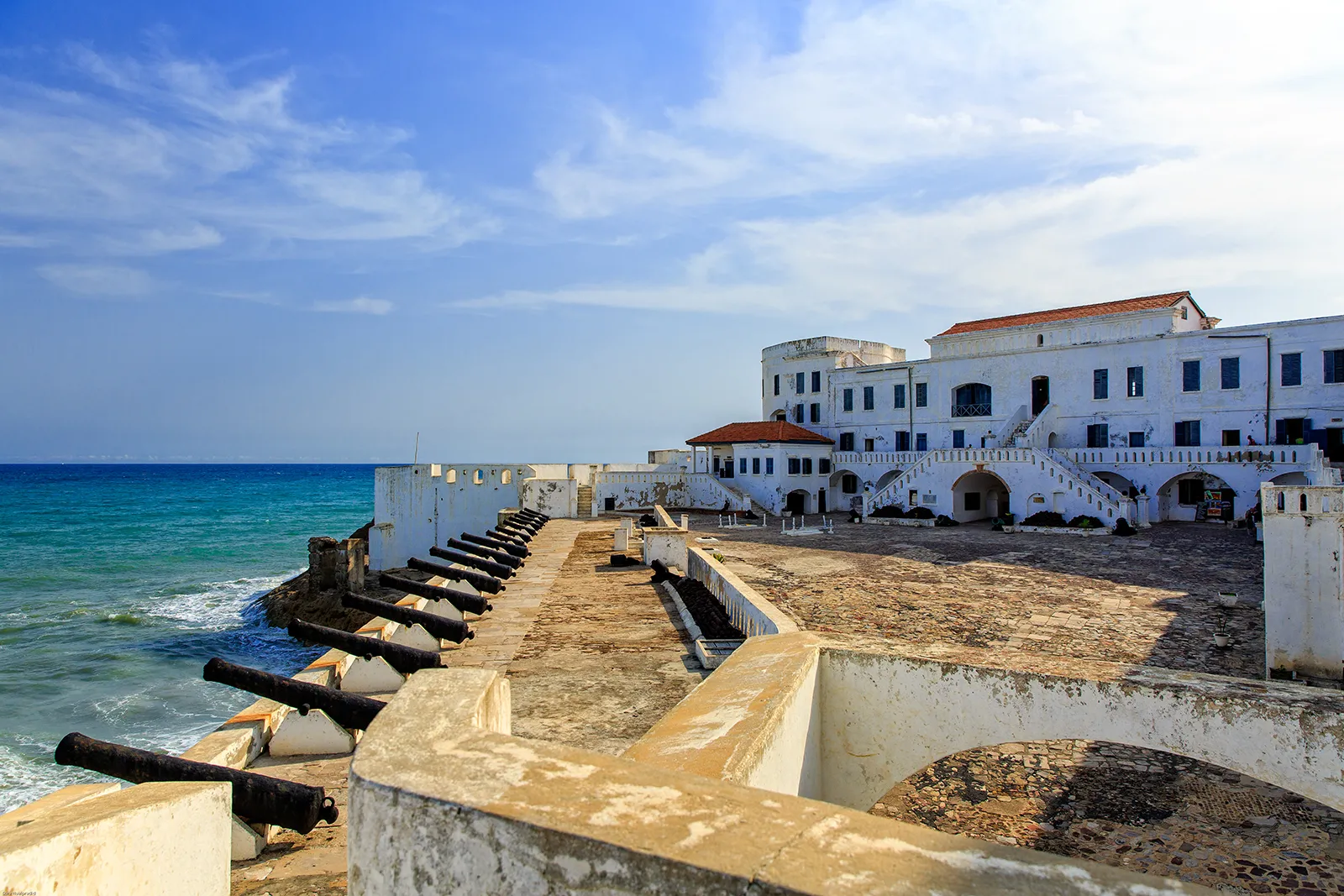
Roughly three hours west of Accra, Cape Coast and Elmina hold two of West Africa's most significant historical sites. Elmina Castle, built by the Portuguese in 1482, is the oldest European building in sub-Saharan Africa and was later a major hub of the slave trade under Dutch control; Cape Coast Castle, built in 1653 and expanded by the British, served the same purpose. Both are UNESCO World Heritage Sites with guided tours through the dungeons and the Door of No Return, the final exit point to the waiting ships (Cape Coast Castle: around $7 for foreign adults, guided tour included). These are not casual visits: budget genuine time and emotional space for both.
Kakum National Park, the canopy walk
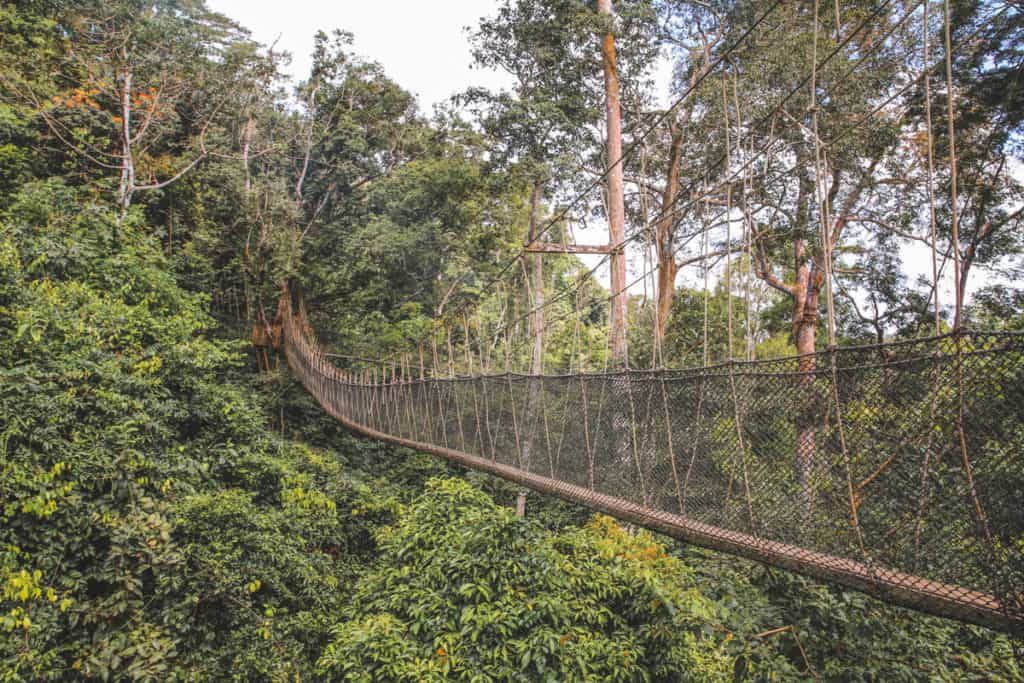
A 30-minute drive inland from Cape Coast, Kakum protects one of Ghana's last major tracts of tropical rainforest, and its main draw is a suspended canopy walkway strung between seven platforms up to 40 meters above the forest floor, one of the few of its kind in Africa (foreign adult entry around 130 Gh¢ for the canopy walk plus a park gate fee; go at sunrise for both cooler temperatures and better wildlife activity). The walkway sways more than it looks like it should; it is entirely safe, but not for anyone with real vertigo.
Kumasi, the Ashanti capital
Roughly four to five hours by road from Accra, Kumasi is the cultural heart of the Ashanti people and the seat of the Asantehene, the Ashanti king, who still reigns from Manhyia Palace. The palace's museum tells the story of the Ashanti Empire through royal regalia and artifacts, including replicas of the Golden Stool, believed to hold the nation's soul (the original is never displayed). Kejetia Market, the largest single-roof market in West Africa with an estimated 10,000-plus stalls, is worth an hour of purposeful wandering rather than a destination in itself.
Bonwire, the kente-weaving village
About 30 minutes from Kumasi, Bonwire is the traditional home of kente cloth weaving: narrow, hand-woven strips in bold geometric patterns, each color and pattern carrying specific symbolic meaning, worn at weddings, festivals and state occasions. Small workshops around the village let you watch weavers at the loom and buy directly rather than through a Kumasi souvenir shop.
Mole National Park
Ghana's largest wildlife reserve, in the far north near Larabanga, is the one place in the country for a proper safari, and its guided walking safaris, rather than the jeep-only format of most African parks, let you approach elephants, antelope and baboons on foot with an armed ranger. Getting there is the real commitment: it's a full day's drive from Kumasi or a short domestic flight to Tamale followed by a two-hour transfer. Best paired with the historic Larabanga Mosque, a Sudanese-style mud-and-timber mosque dating to the 15th or 16th century, a short drive from the park gate.
Hidden gems beyond the main circuit
The zones above cover a first or second trip well. With extra days, these are the spots that rarely make the standard itinerary but reward the detour.
Wli Waterfalls
West Africa's tallest waterfall, reached by an easy 45-minute forest walk to the lower falls, or a steeper climb to the upper falls for the more adventurous. Bring swimwear; the pool at the base is genuinely swimmable.
Bojo Beach & Kokrobite
Bojo is a clean, calm strip of sand split by the Densu River, with a small entrance fee covering a boat transfer and loungers. Kokrobite, further on, is Accra's laid-back backpacker and reggae-drumming beach town.
Boti Falls & Lake Volta
A twin waterfall near Koforidua, paired easily with a stop at the Akosombo Dam, which created Lake Volta, one of the largest man-made lakes in the world by surface area.
Culture & Etiquette
Akwaaba, welcome, is not just a word Ghanaians print on airport signage, it is a genuine cultural value. Greetings matter enormously and are rarely rushed; skipping straight to business without a proper hello reads as brusque. Ghana is religiously diverse and largely tolerant, roughly 71% Christian and 18% Muslim by most estimates, with traditional beliefs woven through both, and the country's ethnic makeup, Akan, Ewe, Ga, Dagomba and dozens more groups, means customs vary meaningfully by region even within one country.
Do
- Greet properly before getting to business. A handshake and a genuine "how are you" or its local equivalent, and greeting the eldest or most senior person first in a group, goes a long way.
- Use your right hand, or both hands, for giving and receiving. The left hand is traditionally considered unclean; use it for eating, shaking hands or handing over money and it will be noticed.
- Learn a greeting in the local language. Akwaaba (welcome) and Medaase (thank you) in Twi go further than English alone, especially outside Accra.
- Dress modestly outside beach resorts and nightlife areas. Shoulders and knees covered is a safe default for towns, markets and any religious site.
- Bargain respectfully in markets, with good humor rather than aggression; a fixed opening price from a taxi or market stall is rarely the final one.
Don't
- Treat a slave castle visit casually. Cape Coast and Elmina are sombre historical sites; loud conversation, casual photos in the dungeons, or rushing the tour reads as disrespectful.
- Assume Ghana is culturally uniform. What's customary among the Akan south may not apply in the Ewe-majority Volta Region or the largely Muslim north; ask rather than assume.
- Photograph people, especially in markets or villages, without asking first. A friendly request is almost always granted; skipping it is not well received.
- Rush the Ashanti court or chieftaincy customs. If you're fortunate enough to witness a durbar or festival procession, follow the lead of those around you rather than pushing for a better view.
- Underestimate the Harmattan season's dust and dry heat (roughly December-February): it's comfortable compared to the humid rainy months, but hazy skies and dry skin are real, not exaggerated.
Deeper culture: the Golden Stool, kente symbolism, Adinkra and Ghanaian funerals
The Golden Stool. Central to Ashanti identity, the Golden Stool is believed, according to Ashanti tradition, to have descended from the sky to Osei Tutu I in the late 17th century and to hold the soul of the Ashanti nation. It is never sat upon, even by the Asantehene, and is rarely displayed publicly.
Kente cloth. Traditionally woven by Ashanti and Ewe weavers in narrow strips on horizontal looms, then sewn together, kente's colors and geometric patterns each carry specific meaning: gold for status and wealth, green for growth, black for spiritual maturity, among many others. Originally reserved for royalty and special occasions, it's now worn at graduations, weddings and worldwide as a broader symbol of African heritage.
Adinkra symbols. A system of visual symbols originating with the Akan, each representing a proverb or concept, Gye Nyame (except for God), Sankofa (return and get it, often shown as a bird looking backward), and dozens more. They appear on cloth, pottery, architecture and increasingly in international design.
Funerals. Ghanaian, particularly Akan, funerals are major, often elaborate social events rather than solely mournful occasions, sometimes involving specially designed fantasy coffins shaped like objects meaningful to the deceased's life or trade. If your visit coincides with one nearby, observe respectfully from a distance unless invited to participate.
Food & Drink
Ghanaian food centers on starches, rice, cassava, plantain and maize, paired with heavily spiced stews, soups and grilled fish or meat, almost always with a fiery pepper sauce called shito on the side. The best introduction to it isn't a hotel restaurant but a chop bar, the informal, often open-air local eateries where a full, filling meal costs a few dollars.
Jollof Rice
Rice slow-cooked in a tomato and pepper base with onion, garlic and thyme, Ghana's most internationally recognized dish and the subject of an enduring, mostly good-natured rivalry with Nigeria over whose version is better.
Waakye ~20 GH¢
Rice and beans cooked together with dried millet leaves for its distinctive reddish-brown color, served with a build-your-own spread of fish, egg, gari, spaghetti, avocado and shito. A breakfast and lunch staple sold from street stalls across the country.
Banku & Grilled Tilapia
Fermented corn and cassava dough, smooth and slightly sour, paired with whole grilled tilapia and a hot pepper sauce, especially popular in coastal towns. Eaten by hand, pinched off and dipped.
Fufu & Soup
Pounded cassava and plantain worked into a smooth, stretchy dough, traditionally served in a bowl of light soup or groundnut (peanut) soup with meat or fish, swallowed rather than chewed.
Kelewele ~10-15 GH¢
Ripe plantain cubes fried with ginger, chili and warm spices, sold from roadside stalls as a snack or side, one of the most reliably excellent street foods in the country.
Red Red
Black-eyed peas stewed in palm oil and tomato, named for the reddish color of the beans and the accompanying fried ripe plantain, a popular vegetarian-friendly option.
When to Go & Itineraries
November through March, Ghana's dry season, is the easiest time to visit: minimal rain, more reliable roads, and the best wildlife viewing at Mole National Park. The Harmattan wind, typically strongest from December into February, brings a dry, dusty haze blown down from the Sahara; it dims the sun and can irritate eyes and skin, but the low humidity is a welcome break from the rest of the year. April through October is the rainy season, heaviest from April to June, with a lighter secondary wet spell around September-October.
All seasons compared, with temperatures
| Season | Verdict | Temps | Notes |
|---|---|---|---|
| Nov-Mar | Best | 24-33°C coast, hotter north | Dry season; Harmattan haze Dec-Feb; best for Mole |
| Apr-Jun | Rainy | 25-32°C | Heaviest rain of the year, especially inland |
| Jul-Aug | Cooler, drier interlude | 23-29°C | A short relative lull between the two rainy peaks |
| Sep-Oct | Rainy again | 24-31°C | Lighter secondary rains; roads can be muddy inland |
Accra stays humid and coastal year-round, typically 24-33°C. The north around Mole runs hotter and drier overall, with the harmattan season bringing daytime heat but cooler, hazier nights.
Itineraries
Seven days covers Ghana's essential circuit: the capital and the Heritage Coast. Two weeks adds the Ashanti heartland and the Volta Region's waterfalls. Three weeks makes room for the long haul north to Mole.
- Days 1-2
Accra. Jamestown, Kwame Nkrumah Memorial Park, the W.E.B. Du Bois Centre, Makola Market, dinner in Osu.
- Days 3-5
Cape Coast & Elmina. Drive west (3 hrs). Kakum's canopy walk at sunrise, Cape Coast Castle, Elmina Castle and the fishing harbor.
- Days 6-7
Return to Accra. A beach day at Bojo or Kokrobite on the way back, final evening in Osu.
- Days 1-2
Accra. The full-day circuit above, plus a slower second day.
- Days 3-5
Cape Coast & Elmina. Kakum canopy walk, both castles, a night in Cape Coast town.
- Days 6-9
Kumasi & the Ashanti. Manhyia Palace Museum, Kejetia Market, a half-day in Bonwire for kente weaving.
- Days 10-12
Volta Region. Wli Waterfalls, Lake Volta and the Akosombo Dam en route back toward Accra.
- Days 13-14
Back to Accra. A beach day and a final Osu dinner before departure.
- Days 1-3
Accra extended. The full capital circuit at an easy pace, plus a Bojo Beach day.
- Days 4-7
Heritage Coast. Kakum, Cape Coast Castle, Elmina Castle, and time to properly absorb both, not just tour them.
- Days 8-11
Kumasi & Ashanti heartland. Manhyia Palace, Kejetia Market, Bonwire, timed around an Akwasidae festival date if one falls in range.
- Days 12-14
Volta Region. Wli Waterfalls, Boti Falls, Lake Volta.
- Days 15-19
Mole National Park & the north. Fly or drive to Tamale, walking safaris at Mole, the Larabanga mosque.
- Days 20-21
Return to Accra. Fly back south, final day for anything missed and departure.
Getting there & around
Kotoka International Airport (ACC) in Accra is Ghana's main gateway, with direct flights from Atlanta (Delta, around 13 hours), London (British Airways, from Gatwick and Heathrow), Amsterdam (KLM) and Brussels (Brussels Airlines); there are no direct flights from Canada or Asia, so most non-European, non-US arrivals connect through Europe or the Middle East. A new Airport Infrastructure Development Charge, added to international tickets from April 2026, adds roughly $50 one-way or $100 return to fares, a real line item worth budgeting for. ECOWAS citizens can also cross by land from Togo, Burkina Faso or Côte d'Ivoire.
All transport options with prices: domestic flights, buses, tro-tros, ride-hailing
| Option | Price | Notes |
|---|---|---|
| Uber/Bolt (Accra, Kumasi) | GHS 30-90/ride | Fixed price shown before you accept; the easiest way to move around either city. |
| Tro-tros | GHS 2-10/route | Shared minibuses on fixed routes; cheapest option but route logic takes a day or two to learn. |
| Intercity buses (STC, VIP) | GHS 60-150 | Accra-Kumasi around 4-5 hrs; Accra-Cape Coast around 3 hrs. Book ahead for STC on popular routes. |
| Domestic flights (Africa World, PassionAir) | $80-150 | Accra-Tamale (for Mole) or Accra-Kumasi in under an hour; the practical way to reach the north without a full day's drive. |
| Official airport taxi | GHS 120-220 | Negotiated fare, no meter; confirm the price before getting in. Ride-hailing apps are usually cheaper and simpler. |
Practical prep: buy a Ghanaian SIM at the airport or arrange an eSIM before landing for maps and ride-hailing from the moment you land. A yellow fever certificate is checked at arrival, not just recommended, and malaria prophylaxis is worth discussing with a travel clinic regardless of season. GetTransfer offers fixed-price airport pickups from Kotoka.
Where to stay
Budget guesthouses & hostels
Concentrated in Accra's Osu and East Legon and in Cape Coast town, close enough to walk to the castle and the beach. Basic but clean, and the easiest way to meet other travelers heading the same direction.
Mid-range hotels
Osu, Labone and the Airport Residential Area in Accra have the widest selection; Cape Coast and Kumasi both have serviceable mid-range options within easy reach of the main sights.
Accra boutique & luxury
Villa Monticello in the Airport Residential Area and the Kempinski Hotel Gold Coast City downtown are Accra's best-regarded high-end options, both close to Kotoka Airport.
Mole National Park lodges
Accommodation options near Mole are limited; the park's own motel has the advantage of overlooking a waterhole where elephants regularly appear. Book well in advance for the November-March high season.
Budget Planning
Ghana is good value for the infrastructure on offer, especially outside Accra's more international-facing hotels and restaurants. The two real cost spikes are getting there, direct flights are limited and the new airport charge adds to the ticket price, and any private transport to the far north.
- Hostel or budget guesthouse $15-30
- Chop bar meals, waakye and jollof $2-6
- Tro-tros and shared transport
- Free beaches, castle entry ~$7
- Mid-range hotel $40-90
- Restaurant meals $10-20/person
- Uber/Bolt and intercity buses
- Kakum canopy walk, guided tours
- Accra boutique or luxury hotels
- Domestic flights over long road transfers
- Private drivers and guides
- Mole lodge with waterhole view
Quick reference prices: street food, transport, entry fees
| Waakye from a street stall | ~20 GH¢ ($1.50) |
| Kelewele (street snack) | 10-15 GH¢ |
| Local beer (Star/Club) | 15-25 GH¢ |
| Uber/Bolt short ride, Accra | GHS 20-40 |
| Accra-Kumasi bus (STC/VIP) | GHS 80-150 |
| Cape Coast Castle entry | ~$7 (foreign adult) |
| Kakum canopy walk | ~130 GH¢ (foreign adult) |
| Budget guesthouse | $15-30/night |
| Mid-range Accra hotel | $40-90/night |
| International airport charge (2026) | $50 one-way / $100 return |
Prices reflect July 2026 research and drift over time. The airport infrastructure charge and cedi exchange rate in particular are worth reconfirming close to travel; treat these figures as a planning baseline, not a quote.
Visa & Entry
Ghana is not visa-free for most Western passport holders. US, UK, EU, Canadian and Australian citizens need to apply in advance through Ghana's eVisa portal, launched in a major upgrade in May 2026, rather than getting a visa on arrival. ECOWAS citizens enter visa-free, and as of May 2026 other African passport holders can apply for a free electronic travel authorization instead of a paid visa, a significant recent change. The official Ghana Immigration Service eVisa portal is the only authoritative source; apply at least three weeks before travel.
✓ Valid passport
At least 6 months validity from your date of arrival. Keep a photocopy separate from the original.
✓ Yellow fever certificate
Mandatory, not optional. Carry the physical International Certificate of Vaccination (the yellow card); it is checked on arrival.
✓ eVisa approval
Apply online in advance through the official Ghana Immigration Service portal; single-entry visas typically run roughly $80-150 depending on validity and processing speed.
✓ ECOWAS exemption
Citizens of ECOWAS member states (Nigeria, Côte d'Ivoire, Senegal, Togo and others) enter visa-free.
| Ghana | Senegal | |
|---|---|---|
| Language | English, official and widely spoken | French, official; less English outside Dakar |
| Slave-trade heritage | Cape Coast & Elmina castles, over 40 forts on the coast | Gorée Island's House of Slaves, a single concentrated site |
| Visa | Required in advance via eVisa for most Western passports | Visa-free for many Western nationalities for stays under 90 days |
| Diaspora tourism | Year of Return since 2019, strong African-American & Caribbean pull | Growing heritage tourism, smaller scale so far |
| Wildlife | Mole National Park, walking safaris, a long trip north | Niokolo-Koba, less developed for tourism |
Safety, Solo Women & Family
Ghana is one of West Africa's safer countries to visit. The US State Department rates most of the country Level 1, exercise normal precautions, its safest rating, the same level assigned to much of Western Europe. The exception is a Level 2 advisory for the far northern border area, the Upper East, Upper West and Northeast Regions and parts of the Savannah Region near Burkina Faso, due to crime and regional instability spilling across the border; this sits well outside any standard tourist route, including the road to Mole National Park.
Petty crime
Pickpocketing, bag snatching and phone theft occur in crowded markets like Makola and Kejetia, and around bus and tro-tro stations. Keep valuables secured and be extra alert during festivals and rush hour.
Violent crime
Carjacking, mugging and assault do occur, disproportionately at night and in remote or poorly lit areas. Use ride-hailing apps after dark rather than walking or hailing unmarked taxis.
Health precautions
Yellow fever vaccination is mandatory; malaria prophylaxis is a genuine year-round consideration, discuss options with a travel clinic before departure. Tap water is not reliably safe to drink; stick to bottled or filtered.
The far north, and visiting the slave castles responsibly
The northern border regions. The US Level 2 advisory covers the Upper East, Upper West and Northeast Regions and parts of the Savannah Region near the Burkina Faso border, reflecting crime and instability that has spilled south from the wider Sahel crisis. Mole National Park itself sits south of this zone and is not included in the advisory, but check current guidance before planning any route that crosses close to the Burkina Faso border.
Visiting the castles. Cape Coast and Elmina are physically safe tourist sites with regulated entry and guided tours, but they are emotionally heavy. Photography is restricted in some dungeon areas out of respect; follow your guide's direction rather than pushing for a shot.
The 3 scams to actually know about
Ghana is not a high-scam destination relative to its region, but three patterns catch uninformed visitors repeatedly, concentrated in Accra's markets, transport hubs and the Cape Coast heritage sites.
Unofficial "guides"
Self-appointed guides approach at Kotoka Airport, Makola Market and the castles, offering unsolicited help and then demanding payment or steering you to overpriced shops. Use official guides at ticketed sites and politely decline unsolicited offers elsewhere.
Currency exchange tricks
Street money changers offering better-than-bank rates sometimes pass counterfeit or shortchanged notes. Exchange at a bank or licensed forex bureau, and count change on the spot.
Distraction theft
A stranger offers unsolicited help at a bus station or market while an accomplice works your bag or pockets. Politely decline unsolicited "assistance" and keep bags zipped and in front of you in crowds.
Solo women travelers
Ghana rates reasonably well for solo women overall, particularly in Accra, Cape Coast and Kumasi, where Ghanaian hospitality is genuine and overt street harassment is less common than in many destinations. Dressing modestly outside beach resorts and nightlife areas reduces unwanted attention, and using Uber or Bolt rather than unmarked taxis, especially at night, is the single most useful habit to build. Full detail on our Solo Woman Explorer pages.
Emergency numbers
Embassies in Accra and practical notes
112 reaches a central command center that routes calls to police, fire or ambulance services and works toll-free on all Ghanaian mobile networks. Most foreign embassies are concentrated in Accra's Ridge and Cantonments neighborhoods. For serious medical situations, private hospitals in Accra (such as those in the Airport Residential Area and Cantonments) generally offer more reliable care and English-speaking staff than public facilities; confirm your travel insurance covers medical evacuation, which may be necessary for serious incidents outside Accra.
Family travel & pets
Ghana works well for families with some planning around the heat and health precautions. Kakum's canopy walk and Mole's walking safaris both land well with older kids; the slave castles are heavier material best suited to children old enough to engage with the history meaningfully rather than young children. Malaria prophylaxis and yellow fever vaccination requirements apply to children too, discuss options with a pediatric travel clinic well ahead of departure.
Pets and traveling with animals
Bringing pets into Ghana requires an import permit from the Veterinary Services Directorate, a valid rabies vaccination certificate, and a health certificate issued shortly before travel; requirements and processing times vary, so start well in advance through Ghana's veterinary authorities or a specialist pet relocation service rather than assuming standard EU or US pet-passport rules apply.
Ghana FAQ
Is Ghana safe to visit?
Yes, for the vast majority of a typical visit. The US State Department rates most of Ghana Level 1, exercise normal precautions, the same as much of Western Europe. The exception is the far northern border area near Burkina Faso, rated Level 2, which sits outside any standard tourist route.
Do I need a visa for Ghana?
Yes, most Western passport holders, including the US, UK, EU, Canada and Australia, need a visa arranged before arrival through Ghana's eVisa portal. ECOWAS citizens enter visa-free, and since May 2026 other African passport holders can apply for a free electronic travel authorization instead of a paid visa.
How much does Ghana cost per day?
Budget travelers manage on $30-50 a day covering hostels, chop bar meals and tro-tros. Mid-range runs $70-120 a day for boutique hotels, restaurant meals and private transport.
When is the best time to visit Ghana?
November through March, the dry season, is best: minimal rain, easier road travel, and good wildlife viewing at Mole National Park. The Harmattan wind (December-February) brings hazy skies but comfortable, low-humidity heat.
Do I need a yellow fever vaccine for Ghana?
Yes, it is mandatory, not optional. All travelers must carry the physical International Certificate of Vaccination (the yellow card) and it is checked on arrival, regardless of which country you are flying in from.
What is Cape Coast Castle?
A former slave-trading fort on Ghana's coast, along with neighboring Elmina Castle one of the most significant historical sites of the transatlantic slave trade, now a UNESCO World Heritage Site open for guided tours, including the dungeons and the Door of No Return.
How many days do you need in Ghana?
Seven days covers the core route well: Accra, the Cape Coast heritage sites and Kakum National Park. Two weeks adds the Ashanti heartland around Kumasi and the Volta Region's waterfalls.
Is English spoken in Ghana?
Yes, English is the official language, used in government, business, signage and education, which makes Ghana one of the more straightforward first stops in West Africa for English-speaking travelers. Twi, Ga, Ewe and other local languages are widely spoken alongside it.
What is the Year of Return?
A 2019 Ghanaian government initiative marking 400 years since the first enslaved Africans arrived in Virginia, inviting the African diaspora to visit, trace ancestry and reconnect with Ghana. It sparked a lasting wave of heritage tourism that continues well beyond the anniversary year.
Is Ghana good for solo female travelers?
Generally yes, especially in Accra, Cape Coast and Kumasi, where Ghanaian hospitality is genuine and street harassment is less common than in many destinations. Normal precautions apply: dress modestly outside beach resorts, use Uber or Bolt, and stay alert in crowded markets.
Is Ghana expensive?
No, it is one of West Africa's better value destinations for the infrastructure on offer. Budget travelers spend $30-50 a day; the main cost spikes are international flights and the new $50-100 airport infrastructure charge added to tickets in 2026.
What should I know before visiting a slave castle in Ghana?
Cape Coast and Elmina castles are sombre historical sites, not casual attractions. Guided tours through the dungeons are emotionally heavy, photography is restricted in some areas out of respect, and most visitors find it worth reading some background beforehand rather than arriving cold.
What Stays With You
Most travelers leave Ghana talking about the warmth of a greeting from a total stranger, the jollof-versus-waakye arguments they never quite settled, or the sway of the canopy walkway at Kakum. But what actually stays is the door. Standing in the Door of No Return at Cape Coast or Elmina, looking out at the same Atlantic that carried hundreds of thousands of people away from everything they knew, does something that no amount of reading about the slave trade beforehand fully prepares you for.
Ghana calls the diaspora's return a homecoming, and treats it as one, genuinely, not as marketing. Whatever brought you here, that's the country that will still be with you on the flight home.