
Ethiopia
The only African country that was never colonized. The place where coffee was invented and still taken with more ceremony than anywhere else on earth. A civilization so old it has its own calendar, its own alphabet, and churches carved from rock 800 years ago that are still in daily use. Ethiopia is not a trip. It is an encounter with deep time.
What You're Actually Getting Into
Ethiopia operates by a different calendar. Literally: the Ethiopian calendar has 13 months and runs seven or eight years behind the Gregorian one. The country uses its own system of time as well, starting the clock at dawn rather than midnight, meaning that 6am by your watch is 12 o'clock by Ethiopian reckoning. These are not trivial details — they reflect something fundamental about how Ethiopia relates to the world. It has its own ancient alphabet, its own cuisine that no neighboring country shares, its own ancient Christian tradition that developed in relative isolation from Rome, and its own history of never having been conquered. Ethiopia is not African in the way that the safari circuit is African. It is something older and stranger and more self-contained.
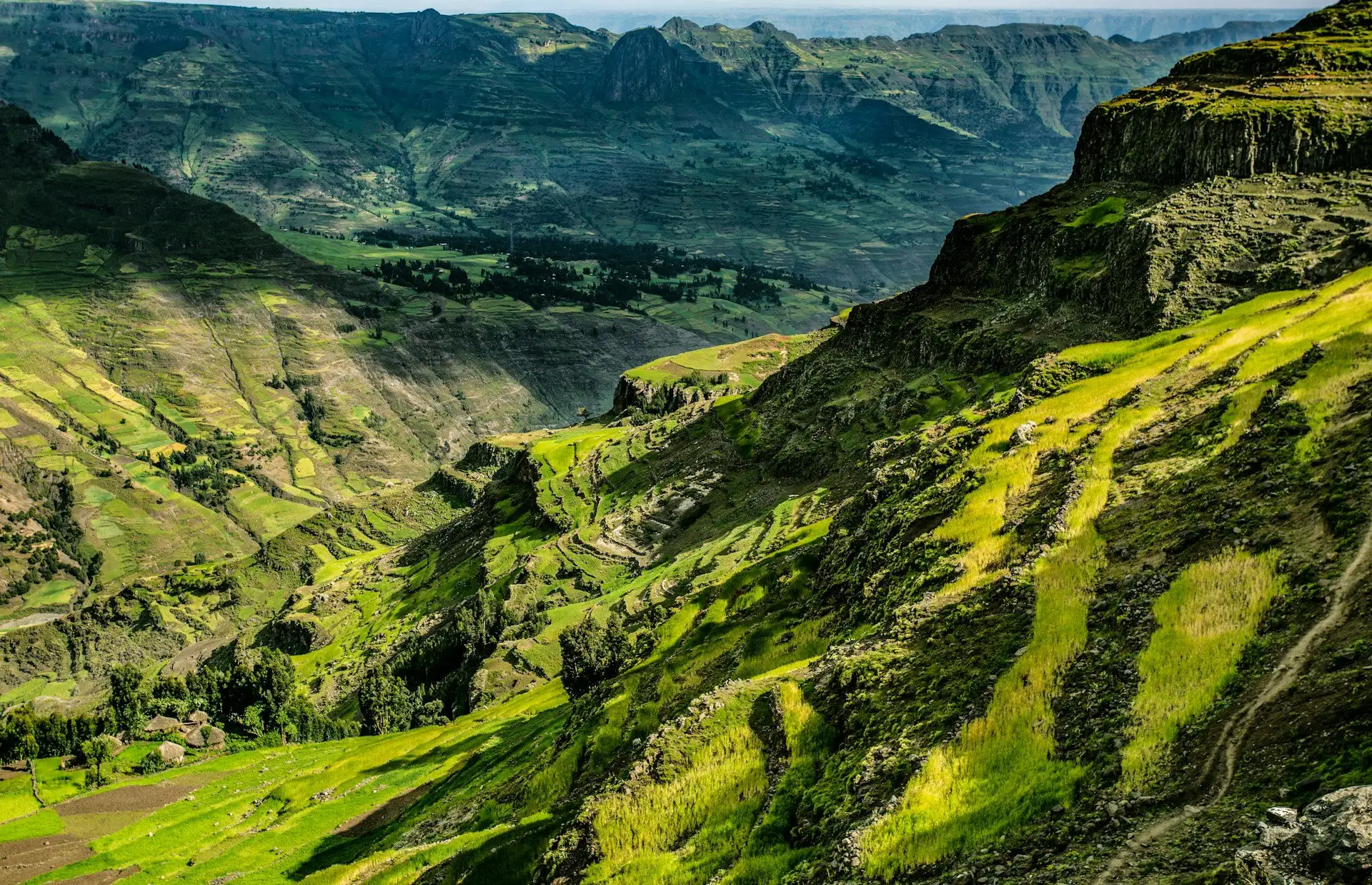
The landmarks are extraordinary in ways that photography has not fully communicated. Lalibela's 11 rock-hewn churches — carved top-down from solid volcanic rock in the 12th century, still in active daily use — represent an architectural achievement that has no real parallel anywhere in the world. The Danakil Depression, a geological hotspot sitting 120 metres below sea level in the northeastern corner of the country, is one of the most extreme environments on earth: neon-colored acid pools, active lava lakes, salt flats where Afar camel caravans still operate, and surface temperatures that regularly exceed 50°C. Axum has obelisks from a civilization that was trading with Rome when the Roman Empire was at its height. The Simien Mountains present a landscape of 4,000-metre escarpments and gelada baboons found nowhere else on earth.
The honest part: Ethiopia also requires more preparation and tolerance for difficulty than most other destinations in this guide. Infrastructure outside Addis Ababa and the main tourist towns is limited. Roads in some regions are poor or non-existent. The Tigray region, which includes Axum and Lalibela's closest airport, experienced a devastating civil war from 2020 to 2022 that ended with a ceasefire in November 2022 — the security situation has been improving but requires checking current advisories before including Tigray in an itinerary. The country's political situation can shift. The rewards for those who go well-prepared are experiences that exist nowhere else on earth.
One more thing that needs saying: the coffee. Ethiopia is the birthplace of coffee, the country where Coffea arabica originated, and Ethiopians conduct the coffee ceremony — beans roasted over charcoal, ground by hand, brewed three times in a clay pot, served in small cups with incense burning — as a social ritual of extraordinary warmth. You will be invited to participate in a coffee ceremony within hours of arriving in most Ethiopian households and guesthouses. Accept every single time.
Ethiopia at a Glance
A History Worth Knowing
Ethiopia's recorded history stretches back over 3,000 years, making it one of the world's oldest continuous civilizations. But the deeper story begins much earlier: the Afar region's geological formation of the Rift Valley has produced some of the most significant early hominin fossils ever found. Lucy — Australopithecus afarensis, discovered in 1974 near Hadar by Donald Johanson's team — is 3.2 million years old and was, at time of discovery, the oldest known human ancestor. She is displayed at the National Museum in Addis Ababa, and seeing the actual fossil (not a cast) puts an entirely different kind of time in your hands than standing next to the Pyramids.
The Kingdom of Axum, which reached its peak between the 1st and 7th centuries CE, was one of the most powerful empires of the ancient world. Trading gold, ivory, and enslaved people with Rome, Persia, India, and China via the Red Sea port of Adulis, Axum produced obelisks — carved granite stelae up to 33 metres tall — that are among the largest monolithic structures ever erected. The tallest standing obelisk today (24 metres) remains in Axum; a second was looted by Mussolini in 1937 and only returned by Italy in 2008 after decades of diplomatic effort. King Ezana of Axum converted to Christianity in approximately 330 CE — making Ethiopia one of the first countries in the world to adopt Christianity as the state religion, predating the Roman Empire's conversion by several decades.
The subsequent centuries saw the rise of the Ethiopian Orthodox Tewahedo Church as the central institution of Ethiopian identity. When Islam swept across North Africa and the Middle East in the 7th century, Ethiopia was isolated — cut off from the wider Christian world — but maintained its own distinct Christian tradition with a canon of scripture that includes texts not recognized by any other church, a liturgical language (Ge'ez) still used in services today, a tradition of illuminated manuscripts of extraordinary beauty, and a theology that has developed in magnificent isolation for over 1,500 years. The rock churches of Lalibela, built by King Lalibela in the late 12th and early 13th centuries, are the physical expression of this tradition at its most extraordinary.
Medieval Ethiopia developed the Solomonic dynasty, which claimed descent from the biblical union of King Solomon and the Queen of Sheba — a lineage maintained unbroken (with a brief interruption) all the way to Emperor Haile Selassie, who ruled from 1930 to 1974. The claim to Solomonic descent was not just dynastic mythology; it was the theological basis of imperial authority, recorded in the Kebra Nagast (Glory of Kings), a 14th-century text that also establishes Ethiopia's claim to hold the Ark of the Covenant in Axum — a claim maintained to this day by the Ethiopian Orthodox Church and impossible to verify since the supposed Ark is guarded by a single monk and no outsider is permitted to see it.
The Battle of Adwa on March 1, 1896, is one of the most significant events in African history and one of the least known outside the continent. Italy, which had colonized neighboring Eritrea and Somalia, attempted to colonize Ethiopia through the fraudulent Treaty of Wuchale — claiming rights over Ethiopia in the Italian text that the Amharic text did not grant. Emperor Menelik II mobilized 100,000 soldiers and decisively defeated a 17,000-strong Italian force. It was the first major defeat of a European colonial army by an African force and permanently preserved Ethiopian independence. The reverberations were felt across Africa and the African diaspora, where Adwa became a symbol of the possibility of resistance. Mussolini's 1935 invasion — seeking revenge for Adwa — used mustard gas and aerial bombing against a civilian population in a campaign that drew international condemnation but insufficient international action. Italy occupied Ethiopia from 1936 to 1941 before British forces and Ethiopian resistance drove them out.
The 20th century's second half is equally complex. The 1974 revolution that overthrew Haile Selassie brought to power the Derg — a Marxist military junta whose rule was characterized by political killings (the Red Terror), famine exacerbated by ideological rigidity, and devastating wars with Somalia and Eritrea. The 1983–1985 famine, which killed an estimated one million people and generated the Live Aid concert response in 1985, occurred partly as a consequence of Derg policy. The Derg was overthrown in 1991 by a coalition of resistance movements led by the TPLF (Tigray People's Liberation Front), which established a federal state organized along ethnic lines. This federal structure — and the TPLF's dominant political position — set the stage for the Tigray conflict that erupted in November 2020 between the federal government under Prime Minister Abiy Ahmed (Nobel Peace Prize 2019) and the TPLF. The two-year civil war killed an estimated 300,000–500,000 people in one of the world's most underreported humanitarian catastrophes and left enormous destruction in Tigray. A ceasefire was signed in November 2022 and reconstruction has begun.
Australopithecus afarensis fossil found in the Afar region. At time of discovery, the oldest known human ancestor. Now at the National Museum, Addis Ababa.
One of the ancient world's great powers. Trades with Rome, India, China. Erects giant granite obelisks. Adopts Christianity ~330 CE — among the first nations on earth.
King Lalibela commissions 11 churches carved from solid rock. Still in active daily use. UNESCO World Heritage site.
The dynasty claiming descent from Solomon and the Queen of Sheba rules, with one brief break, until Haile Selassie's overthrow in 1974.
Ethiopia defeats Italy. The first major defeat of a European colonial army by an African force. Ethiopia remains the only African country never colonized.
Mussolini's revenge for Adwa. Mustard gas and aerial bombing. International condemnation, minimal intervention. British and Ethiopian forces liberate the country in 1941.
Marxist military junta. Red Terror political killings. 1983–85 famine kills ~1 million. War with Somalia and Eritrea. Overthrown 1991.
Civil war between federal government and TPLF. Estimated 300,000–500,000 dead. Ceasefire November 2022. Reconstruction ongoing. One of the 21st century's most underreported conflicts.
Top Destinations
Ethiopia's main tourist circuit is known as the Historic Route — a circuit through the highlands connecting Addis Ababa, Bahir Dar (Lake Tana monasteries), Gondar (the Camelot of Africa), the Simien Mountains, Lalibela, and Axum. Most visitors cover this circuit over 10–14 days. The Danakil Depression in the northeast requires a separate excursion from Mekele or Addis. The Omo Valley in the southwest is a different journey entirely. Addis Ababa, often dismissed as a transit hub, deserves at least two full days.
Lalibela
There is no adequate preparation for Lalibela. You descend steps cut into the rock and find yourself standing in a sunken courtyard with a free-standing church rising above you — not built on the rock but hewn from it, top-down, over decades by King Lalibela's workers in the late 12th and early 13th centuries. Eleven churches total, connected by tunnels and trenches, each used for daily Orthodox services by white-robed priests and deacons. On major feast days — particularly Ethiopian Christmas (Genna, January 7) and Timkat (Epiphany, January 19–20) — tens of thousands of pilgrims gather and the churches operate as the living center of a living faith. Come at dawn when the light falls into the trenches and the priests are chanting. Come again at dusk. Budget two full days minimum. Three is better.
Danakil Depression
The Danakil Depression sits 120 metres below sea level in the Afar Triangle where three tectonic plates are slowly pulling apart. The geological consequence is a landscape of active volcanoes, lava lakes, sulphurous hydrothermal fields in neon yellow and green and orange, and salt flats that extend for kilometers in every direction. Erta Ale — the "gateway to hell," a shield volcano with a persistent lava lake in its summit caldera — requires a night trek of 2–3 hours to reach the rim. You arrive at midnight, watch molten lava in a lake below you, and hike out before dawn. The Dallol hydrothermal field has no equivalent anywhere on the surface of the earth. This is the active geology of planetary formation, accessible on foot, in a place where surface temperatures exceed 50°C. A licensed guide and armed escort are mandatory. 3–4 day tours from Mekele or Addis.
Simien Mountains
A UNESCO World Heritage site of dramatic escarpments, deep valleys, and high plateau terrain rising over 4,500 metres at Ras Dashen — Africa's fourth-highest peak. The Simiens are home to the gelada baboon, found nowhere else on earth, grazing in large herds on the high meadows. The Ethiopian wolf — the world's rarest wild dog, with fewer than 500 remaining — lives in the upper zones. Multi-day trekking with armed scout and guide covers the main escarpment trail. Even a single day from the Debark entry point to Sankaber camp gives you the plateau view and geladas. The dramatic sunrise and sunset light on the canyon walls is among the best landscape photography in Africa.
Axum
The ancient capital of the Axumite Empire — which at its peak controlled territory from Sudan to Yemen — still has extraordinary physical remnants of its power. The stelae field contains obelisks carved from single pieces of granite up to 33 metres tall, weighing hundreds of tonnes, erected without modern machinery. The Church of Our Lady Mary of Zion claims to hold the Ark of the Covenant in an adjacent chapel, guarded by a single monk. King Ezana's inscription park has bilingual inscriptions (Greek, Ge'ez, and South Arabian script) recording the king's Christian conversion in the 4th century. A day or two in Axum anchors the Abstract enormity of Ethiopian history in specific stone.
Gondar
The Royal Enclosure (Fasil Ghebbi) in Gondar — a UNESCO World Heritage site — contains the remains of six castles and several palaces built by Ethiopian emperors in the 17th and 18th centuries. The architecture is a remarkable synthesis of Portuguese, Indian, and Axumite influences, producing something entirely unlike anything else in Africa. Debre Berhan Selassie Church, painted floor-to-ceiling with elaborate frescoes including the famous ceiling of winged angel faces, is one of the most visually extraordinary interiors in Ethiopian religious art. Gondar is also the closest major city to the Simien Mountains trailhead.
Bahir Dar & Lake Tana
Lake Tana, Ethiopia's largest lake and the source of the Blue Nile, is dotted with peninsula monasteries and island churches dating back to the 14th century. Some hold extraordinary collections of illuminated manuscripts, ceremonial crosses, and royal mummies — including those of Ethiopian emperors — locked in treasury rooms. The Blue Nile Falls (Tis Abay), 30km from Bahir Dar, were once one of Africa's most impressive waterfalls; a hydroelectric dam has reduced the flow significantly. Bahir Dar itself is a pleasant lakeside city that serves as the gateway to the northern historic route.
Addis Ababa
At 2,355 metres altitude, Addis Ababa is the third-highest capital city in the world and the diplomatic capital of Africa (the African Union headquarters are here). The National Museum with Lucy. The Ethiopian National Museum's ethnographic collection. The Red Terror Martyrs Memorial Museum — an essential and harrowing record of the Derg's political killings. The Merkato, one of Africa's largest open markets. The Piazza district's Italian-era architecture. And the coffee houses that demonstrate why Ethiopia invented the substance. Budget two full days rather than treating Addis purely as a transit stop.
Omo Valley
The lower Omo Valley in southwestern Ethiopia is home to 16 distinct ethnic groups — Mursi (lip plates), Hamar (bull jumping initiation rites), Karo (body painting), Dassanech, Banna — who have maintained traditional practices in varying degrees of isolation. Visiting is ethically complex: the communities are aware of their tourist value and have developed specific relationships with tour operators that can veer between genuine cultural exchange and staged performance. Going with a licensed operator who has established community relationships, paying photography fees with transparency, and spending genuine time rather than racing through is the minimum standard. The physical landscape — the Omo River through semi-arid terrain — is beautiful in its own right.
Culture & Etiquette
Ethiopian culture is deeply shaped by two traditions operating simultaneously: Ethiopian Orthodox Christianity, which has been the dominant religion of the highlands for 1,700 years and shapes everything from the calendar to the food culture to the architecture to the social ethics; and a tradition of hospitality so deeply embedded in the national character that it functions almost as a moral law. Being invited into an Ethiopian home is an honor that comes with specific expectations — on both sides. The host provides the best they have. The guest eats it.
Ethiopia has over 80 ethnic groups and the cultural norms vary significantly between them. The Amhara and Tigrinya highlands have one set of expectations; the Oromo another; the Afar another entirely; the Omo Valley communities something else altogether. What is consistent is the warmth and the directness of hospitality, and the expectation that visitors engage with it genuinely rather than treating it as a photo opportunity.
The Ethiopian coffee ceremony (buna) — green beans roasted on a pan over charcoal, ground by hand in a wooden mortar, brewed three times in a clay jebena pot — takes 45 minutes and is an act of genuine hospitality. Refusing it is considered rude. Three small cups are customary (the third, abol, is the most important). The incense burning alongside it completes the ritual.
At all Ethiopian Orthodox churches and Islamic mosques, shoes are removed at the entrance. Keep socks on (the stone floors are cold and sometimes rough). Women should cover their heads at churches — a scarf is sufficient. This is non-negotiable at active holy sites.
Ethiopian meals are communal — dishes served on a shared injera. Use the right hand for tearing injera and scooping stews. Gursha — placing a piece of food in your companion's mouth — is a gesture of affection and friendship. When someone offers you gursha, accept it.
"Ameseginalehu" (thank you), "Selam" (hello), "Isshi" (okay), "Buna tifelligallehu" (I want coffee). Any attempt at Amharic is received with disproportionate warmth. The language uses the Ge'ez script which predates Arabic and is one of the world's oldest alphabets still in use.
At Lalibela, Axum, and other historic sites, licensed guides provide context that transforms what you're looking at. The Amharic inscriptions on churches, the iconographic programs of the frescoes, the architectural logic of the rock-cutting process — none of this is legible without explanation. The best guides studied Ethiopian history and theology and their knowledge is extraordinary.
Ethiopian Orthodox services are long (often 3–4 hours), conducted in Ge'ez, and not designed for tourist observation. Walking through an active service is intrusive. At Lalibela, the guides know when photography is appropriate and when to wait outside. Follow their guidance specifically.
Photography in the Omo Valley communities requires specific negotiation and payment. Most communities have established rates — typically $1–2 per person photographed. Don't attempt to photograph without this agreement; it is disrespectful and has contributed to a culture of transaction that has already changed how these communities relate to visitors.
Ethiopian Orthodox Christians fast (abstain from animal products) for over 200 days per year — every Wednesday and Friday plus additional fasting seasons. During these days, most restaurants in highland towns serve only fasting food (vegetarian). If you're a meat eater, it helps to know which days require flexibility in your food plans.
The 2020–2022 civil war killed hundreds of thousands of people and left deep trauma across both Tigray and the broader Ethiopian population. Opinions on the conflict are complex, regional, and deeply felt. This is not a topic for casual traveler conversation with people you've just met — and where it comes up naturally, listen more than you speak.
As in much of East Africa and the Arab world, the left hand is considered unclean for eating, passing items, and formal greetings. Use the right hand consistently for all social interactions, particularly in highland communities and the Omo Valley.
The Coffee Ceremony
Coffee originated in Ethiopia — specifically in the Kaffa region, whose name is the likely etymology of the word "coffee." The ceremony in which it is prepared and served is the central social ritual of Ethiopian highland culture: green beans washed and roasted over charcoal in the room, the smoke and smell filling the space, ground by hand, brewed in a clay jebena pot, poured into small cups, served three times (abol, tona, bereka — the third considered a blessing). It takes 45 minutes and is an act of genuine connection. Never refuse it.
The Ethiopian Calendar
Ethiopia uses the Coptic calendar — 13 months of 30 days each plus a short 13th month of 5 or 6 days. The year runs 7–8 years behind the Gregorian calendar. Ethiopia celebrated the millennium in 2007. The day is counted from 6am (Ethiopian midnight), so when an Ethiopian says "meet me at 3 o'clock," they may mean 9am your time. Confirming whether a time is "Ethiopian time" or "European time" before any appointment is essential and standard practice.
Ethiopian Orthodox Christianity
The Ethiopian Orthodox Tewahedo Church is one of the oldest Christian institutions in the world, predating Western Christianity's organizational forms by centuries. Its liturgy is in Ge'ez, an ancient Semitic language no longer spoken conversationally. Its canon includes the Book of Enoch and the Book of Jubilees, not recognized by any other Christian church. Its priests and deacons serve in distinct visual traditions — the white robes, the elaborate crosses, the illuminated texts. Engaging with this tradition is not background noise to the heritage sites. It is the main event.
Music & Timkat
Timkat — Ethiopian Epiphany, celebrated on January 19–20 (January 20–21 in Gregorian leap years) — is the most spectacular public religious festival in Ethiopia. Tabots (replicas of the Ark of the Covenant) are carried from churches to water in processions of priests, deacons, and thousands of white-robed faithful. The celebration at Lalibela and at Gondar's swimming pool (built for the purpose by Emperor Fasilidas in the 17th century) are the most famous. If your timing allows, plan your Ethiopia trip around Timkat.
Food & Drink
Ethiopian cuisine is one of the world's most distinctive and is essentially absent from the culinary conversation it deserves. The food culture is ancient, deeply tied to the religious fasting calendar, and built around injera — a large, spongy sourdough flatbread made from teff grain that functions simultaneously as plate, utensil, and starch. Teff is a grain native to Ethiopia and the Eritrean highlands, gluten-free, iron-rich, and responsible for the particular sour-fermented flavor that underlies every Ethiopian meal. The food is eaten communally from a shared plate, using the right hand to tear injera and scoop the various stews (wats and alicha) placed on top.
The fasting food culture (over 200 fast days per year in the Orthodox tradition) has produced one of the world's richest vegetarian cuisines — not by accident or ideology but by centuries of necessity. A fasting spread (yetsom beyaynetu) of seven or eight different vegetable, lentil, and legume dishes on a single injera is one of the great meals in East African cooking and costs almost nothing.
Injera
The foundation of everything. A 50cm sourdough crepe made from fermented teff batter, cooked on a clay mitad griddle, slightly spongy with a distinctive sour flavor that the wats poured on top both complement and rely on. Fresh injera is distinctly better than day-old; the best injera in the country is in Lalibela, where the local teff produces a lighter and more sour result. Eating injera with your hand from a shared plate with people you've just met is one of the more intimate forms of hospitality available in travel.
Doro Wat
The national dish of Ethiopia: a deep, dark red chicken stew slow-cooked with berbere spice blend (a complex mixture of chili, fenugreek, coriander, and other spices), clarified butter (niter kibbeh), onions, and a hard-boiled egg per serving. It is eaten on significant occasions and feast days and is the dish every Ethiopian cook is judged by. The berbere determines everything — each household has its own blend, made in large batches once a year, ground by hand. The commercial version and the home version are not the same dish.
Tibs & Kitfo
Tibs is sautéed meat — beef, lamb, or goat — cooked with butter, onion, and sometimes rosemary, served on injera. The quality ranges from chewy fast-food approximations to extraordinarily good at a proper tibs restaurant. Kitfo is Ethiopian beef tartare: very finely minced raw (or lightly cooked) beef mixed with mitmita spice and niter kibbeh. It is an acquired taste that many visitors become devoted to after the first encounter. Order it "leb leb" (slightly cooked) rather than raw on a first attempt.
Fasting Food (Beyaynetu)
The fasting spread: seven or more small dishes of different vegetable and legume preparations arranged on a single large injera. Misir (red lentils in berbere), shiro (ground chickpea stew — the everyday staple), gomen (collard greens with garlic and ginger), fossolia (green beans in tomato), tikil gomen (cabbage and potato). Each dish is distinct. The combination, eaten together from the shared plate, is more than the sum of its parts. Available every Wednesday and Friday throughout the country. Available more widely during Orthodox fasting seasons.
Coffee (Buna)
Ethiopia is the origin of Coffea arabica — the Kaffa region in the south is the most likely geographic origin. The traditional ceremony aside, Ethiopian filter coffee brewed in small establishments across the country is excellent: single-origin, fresh-roasted, prepared with serious attention. Addis Ababa's specialty coffee scene has grown dramatically in the last decade. Ethiopian coffee for export is one of the world's premium commodities; Ethiopian coffee drunk in Ethiopia is something else again.
Tej & Local Drinks
Tej is Ethiopian honey wine — mead fermented with gesho (a hop-like bitter plant), served in a traditional birille flask in tej houses (tej bet). It ranges from light and sweet to strong and slightly medicinal depending on the fermentation time. Tella is a mildly alcoholic grain beer brewed domestically that you find in local tej houses. Both are cheap, local, and deeply embedded in highland social culture. The tej houses in Gondar, Bahir Dar, and Lalibela are excellent places to drink and talk.
When to Go
Ethiopia's main dry season runs from October to May, making this the best overall window for most of the country. The Simien Mountains trekking is best in the dry season (October to April) when trails are clear and views are unobstructed. The Danakil is year-round but best avoided in the hottest months (June and July). Lalibela is extraordinary year-round but the major festivals — Genna (Ethiopian Christmas, January 7) and Timkat (Epiphany, January 19–20) — are when tens of thousands of pilgrims arrive and the religious dimension is at its most powerful.
Dry Season
Oct – FebOptimal weather across the highland circuit. Clear skies for Simien Mountain views. Trekking trails accessible. October–November sees lush green landscapes after the rains. January is peak festival time — Genna and Timkat. The best time for photography at Lalibela is the golden-hour light of December and January.
Late Dry Season
Mar – MayExcellent weather continuing. Landscapes drier but comfortable temperatures. Fewer tourists than January. Easter (Fasika) — usually April — is a major festival at Lalibela. Good time for the Danakil (April mornings are cooler than peak summer). The Omo Valley is accessible year-round but best in this window.
Post-Rains
Sep – OctThe long rains end in September. Landscapes are green and lush — the Ethiopian highlands in October look like Ireland at altitude. Wildflowers on the Simien escarpment. Slightly fewer tourists. The waterfalls (Blue Nile Falls) are at their most dramatic immediately after the rains in September–October.
Long Rains
Jun – AugHeavy rains make some roads impassable, particularly to Lalibela and in the Simien Mountains. The Danakil in July–August is at its most lethally hot. Trekking conditions are poor. However, prices drop, tourists almost disappear, and the highland landscape is extraordinarily beautiful. For Addis Ababa and Bahir Dar specifically, the rainy season is manageable.
Trip Planning
Twelve to fourteen days is the minimum for the historic route circuit (Addis, Bahir Dar, Gondar, Simien Mountains, Lalibela, and Axum). Adding the Danakil requires another 3–4 days from Mekele or Addis. The Omo Valley is a separate 5–7 day commitment in the southwest. A genuinely comprehensive Ethiopia trip — historic route plus Danakil plus Omo Valley — takes 3–4 weeks and should not be rushed.
Ethiopia requires a licensed guide for most major sites and for the Danakil and Omo Valley specifically. This is not optional bureaucracy. The Danakil requires an armed escort and organized logistics that independent travel cannot handle. The Omo Valley requires community relationships that only established operators have. For the historic route, a guide transforms the experience from looking at old buildings to understanding one of the world's oldest and most sophisticated civilizations.
Addis Ababa
Day one: arrive Bole International, acclimatize at 2,355m altitude (mild headache is normal for the first 12 hours, drink water, don't overexert). National Museum in the afternoon — Lucy's fossil. Evening coffee ceremony at the hotel. Day two: Red Terror Martyrs Memorial Museum in the morning (give it three full hours — do not rush this). Merkato market in the afternoon. Ethiopian dinner in the Piazza district. Fly to Lalibela tomorrow morning.
Lalibela
Three nights. Day three: northern church group in the morning with a licensed guide — arrive at dawn before tourist groups, the light is better and the priests are already in morning service. Bete Medhane Alem and Bete Maryam. Afternoon: Bete Giyorgis, the cross-shaped church in its own pit that is Lalibela's most photographed. Day four: southern church group and the connecting tunnel network. Day five: early morning return to the northern group at first light — the experience is different from day three and worth repeating. Fly to Gondar in the afternoon.
Gondar
Day six: Royal Enclosure — the six castles, afternoon Debre Berhan Selassie Church with its angel-face ceiling. Good tej house in the evening. Day seven: half-day Simien Mountains viewpoint drive from Gondar (the escarpment and gelada baboons visible even on a one-day visit), return to Gondar for the afternoon. Fly back to Addis for departure.
Danakil Depression
Join a 3-day organized tour from Addis Ababa or fly to Mekele for a slightly shorter overland. Day eight: overland to Erta Ale base camp. Day nine: sunrise at Erta Ale lava lake summit, return to base, drive to Dallol. Day ten: Dallol hydrothermal fields in the early morning (before 8am is essential for bearable temperature), drive back to Mekele or Addis. Return flight.
Addis Ababa
Two full days: National Museum, Red Terror Memorial, Ethnological Museum at Haile Selassie's former palace (Trinity University campus), Merkato, and one evening in a proper tej house. Try both the meat and fasting menus. Fly to Bahir Dar on day three morning.
Bahir Dar & Lake Tana
Two days at Lake Tana. Morning boat tour to two or three of the island monasteries — Ura Kidane Mihret has the best frescoes and manuscript collection. Blue Nile Falls afternoon (hire a local guide). Sunset on the Bahir Dar lakeside. Day four: Tana morning boat trip to a different set of monasteries. Fly to Gondar in the afternoon.
Gondar & Simien Mountains
Day five: Gondar castle complex and Debre Berhan Selassie. Day six: Full Simien Mountains day — drive to Sankaber, walk the escarpment trail to see geladas, view toward Ras Dashen. Return to Gondar. Day seven: fly to Axum via Lalibela airport (check current Tigray route status — alternative via Addis). Two nights in Axum.
Axum
The obelisk field, the Church of Our Lady Mary of Zion, King Ezana's inscription park, the tombs of Kaleb and Gebre Meskel, the bath of the Queen of Sheba (unlikely attribution but historically interesting site), the archaeological museum. Two full days if you engage seriously with the context. Most people do it in one, which is too fast.
Lalibela
Fly from Axum. Three days with the churches. Go slow. The licensed guides here are excellent — invest in the best and give them full time. On one evening, ask your guesthouse to arrange a coffee ceremony with a local family. Wander the market town above the churches for local life context.
Danakil Extension
Fly from Lalibela to Addis, continue to Mekele for a 2-day Danakil option — Dallol only (not Erta Ale) if pressed for time. Or return to Addis for final shopping, a proper Ethiopian restaurant meal, and departure from Bole.
Addis Ababa
Three full days for the capital. All museums. A full day at the Ethnological Museum and the university gardens. One day in the Bole area for the contemporary art galleries and the best specialty coffee shops. One evening at a cultural show (traditional music and dance from Ethiopia's many regions). The best doro wat in the country is at Yod Abyssinia Cultural Restaurant — go once.
Bahir Dar & Lake Tana
Island monasteries over two days — the full circuit has about 20 accessible monasteries, though visiting four to five is sufficient. Hire the same boat and guide for both days for continuity. The manuscripts in the treasury rooms of Ura Kidane Mihret and Kebran Gabriel deserve time and good light.
Gondar & Simien Mountains Trek
Day six in Gondar. Days seven to nine: three-day Simien Mountains trek staying at mountain huts — Sankaber, Geech (where the largest gelada herds are), Chenek. Walking 12–18km per day at altitude (3,200–4,200m). This requires a fitness level above casual hiking. The views and wildlife are extraordinary at this depth of immersion.
Axum
Two full days. The sites plus a visit to the workshop where replica ceremonial crosses are still hand-carved using ancient designs. Ask your guide about the Ark of the Covenant story — the theological and historical layers of this claim are genuinely interesting regardless of your view of its truth.
Lalibela
Three days as above. If visiting during Genna (January 7) or Timkat (January 19–20), plan to be here for the full festival period — the pilgrimage context transforms the already extraordinary churches into something that operates at a completely different register.
Danakil Depression
Full 3-day organized Danakil tour: Erta Ale lava lake night trek, Dallol hydrothermal fields at dawn, salt caravan flats, Afar village visit. Return to Addis or fly from Mekele.
Omo Valley
Fly from Addis to Jinka or Arba Minch. Four days with a licensed guide visiting Mursi, Hamar, and Karo communities. The Hamar bull-jumping ceremony (if timed right) is the most significant cultural event available in the Omo Valley and requires being in the right place at the right season (usually September–December). Return to Addis for departure.
Vaccinations & Health
Yellow fever vaccine required if arriving from an endemic country; strongly recommended regardless. Malaria is present in lowland areas including the Omo Valley, the Danakil, and the Blue Nile corridor — antimalarial prophylaxis recommended for these regions. Highlands (Addis, Lalibela, Gondar) are generally low-risk for malaria. Hepatitis A, Typhoid, and routine vaccines current. Consult a travel health clinic 6–8 weeks before departure.
Full vaccine info →Altitude in Addis
Addis Ababa sits at 2,355 metres. Most visitors experience mild altitude adjustment — headache, fatigue, slightly breathlessness on exertion — in the first 24–48 hours. Drink extra water, avoid alcohol on arrival day, don't plan strenuous activities for day one. The Simien Mountains go to 4,500m+ — proper acclimatization protocol applies for trekkers targeting Ras Dashen.
Connectivity
Ethio Telecom is the sole mobile provider (the market was monopoly until recently). Data coverage is reasonable in Addis and main tourist towns. Remote areas (Danakil, Omo Valley) have very limited coverage. An eSIM through Airalo provides a reliable alternative for the towns. Download offline maps and guides before entering remote areas. WiFi in hotels is variable — reliable in Addis, unpredictable elsewhere.
Get Ethiopia eSIM →Currency & Cash
Ethiopia is largely a cash economy outside Addis Ababa. Change USD to Ethiopian Birr at the airport or bank on arrival — the official rate is the rate to use. ATMs in Addis work reliably; outside Addis, ATM availability is inconsistent. Carry enough ETB for the entire historic route — don't assume ATMs will function in Lalibela or Axum when you need them. USD cash is accepted at some lodges and tour operators.
Travel Insurance
Essential. Must cover medical evacuation — Addis Ababa has reasonable private hospitals (Korean Hospital, Kadisco General Hospital) but remote areas require evacuation. If trekking the Simien Mountains, ensure your policy covers high-altitude trekking. For the Danakil, ensure it covers extreme environment activities. Check whether your policy covers the current security situation in Tigray if that region is part of your itinerary.
Power & Plugs
Ethiopia uses Type C, F, and L plugs at 220V. European appliances generally work. North Americans and British visitors need adapters. Power cuts (load shedding) occur throughout the country, including in Addis. Most hotels have generators but they may not cover room sockets during outages. A battery pack for charging phones and cameras is essential on the historic route where reliable power is not guaranteed.
Transport in Ethiopia
Ethiopian Airlines is one of Africa's best airlines and operates an extensive domestic network connecting Addis Ababa to Lalibela, Axum, Gondar, Bahir Dar, Mekele, Jinka, and other historic route destinations. Flying between cities is strongly recommended — the alternative is long road journeys on roads that range from good to extremely poor. The drive from Addis to Lalibela, for instance, is 8–12 hours depending on road conditions. The flight is 55 minutes. This is not a difficult calculation.
For the Danakil Depression and the Omo Valley, organized tours with 4x4 vehicles are the only practical option — these are not places with regular transport infrastructure. Addis Ababa itself is navigated by blue-and-white minibuses (unsafe for visitors), Uber (available in Addis), or negotiated taxis from your hotel.
Ethiopian Airlines Domestic
$80–200/routeThe dominant domestic carrier and one of Africa's best airlines overall. Connects Addis to all historic route cities. Flights are generally reliable and on time. Book through ethiopianairlines.com or your tour operator. The multi-destination historic route circuit is ideally done by flying between each city rather than driving.
Ride Apps & Taxis (Addis)
App-based or negotiatedRide, ZayRide, and inDrive (with occasional Uber availability) operate in Addis Ababa. The blue-and-white city minibuses (taksi) are used by locals and are technically functional but difficult for visitors without Amharic. Most hotels can arrange a driver for the day at a negotiated rate for Addis sightseeing — ETB 800–1,500 per day.
Organized Tour 4x4
Included with tourLand Cruisers with driver-guides for the Danakil, Omo Valley, and any off-road touring. Most historic route operators also provide a vehicle and driver as part of the tour package. For the Danakil, the 4x4 is not optional — the terrain and logistics require it. Book through reputable operators in Addis or online before departure.
Intercity Bus
ETB 200–800Selam Bus and SKY Bus are the most reliable intercity bus operators. Used by budget travelers for routes like Addis to Bahir Dar (10–12 hours) or Addis to Gondar (12–14 hours). Air-conditioned and reasonably comfortable. Times are long and the roads variable. Not recommended for the historic route if time is limited — the flight differential is too large.
Lake Tana Boat
$30–80/dayMotor boats hired from Bahir Dar waterfront for the Lake Tana monastery tours. Half-day or full-day circuits depending on which monasteries you want to visit. The traditional paper reed boats (tankwa) are no longer used for transport but occasionally seen on the lake. Hire through your hotel or directly at the dock — negotiate ahead of boarding.
Lalibela On Foot
FreeThe Lalibela church complex is compact and navigated entirely on foot through the trenches, tunnels, and carved pathways connecting the 11 churches. The town above the complex is also walkable. Hiring a mule for the approach to the more remote outlying churches is available and optional. Wear shoes with grip — the carved rock floors can be slippery when wet.
Simien Mountains Trek
Guide + scout feeAll Simien Mountains trekking requires a licensed guide and an armed scout (mandatory for security reasons). Mules are available for gear carry on multi-day treks. The main trailhead is at Sankaber, reachable from Debark (30 minutes from Gondar). Day trips are possible; the multi-day route between Sankaber and Chenek (3–4 days) covers the best scenery and wildlife.
Addis–Dire Dawa Train
$15–25The Ethio-Djibouti Railway (Chinese-built, opened 2017) connects Addis Ababa to Dire Dawa in eastern Ethiopia in 7–8 hours. A scenic alternative to flying for those wanting to see the eastern lowlands. The train is comfortable and the journey passes through dramatic landscape changes from highland to semi-arid terrain. Useful for those routing via Djibouti or wanting to explore the Harar region (a UNESCO-listed walled Islamic city 50km from Dire Dawa).
Accommodation in Ethiopia
Ethiopia's accommodation ranges from genuinely excellent boutique hotels in Addis Ababa to basic guesthouses in Lalibela and the historic route towns that are clean, functional, and nothing more. The gap between Addis Ababa's best hotels and the provincial options is considerable. Lalibela in particular has limited mid-range options — a few lodges perched on the hillside with views over the valley, and small guesthouses in the town. The options are improving but remain limited by international standards. This is not a country where accommodation is part of the headline experience — the sites are the headline. Sleep comfortably and be at the churches at dawn.
Addis Ababa Hotel
$80–400/nightAddis has genuinely good hotels. The Sheraton Addis is one of Africa's best luxury properties. Hyatt Regency and Radisson Blu are reliable international standards. Boutique options in Bole and Kazanchis include The Residence and Nexus, both excellent. For a budget option with good location, the Jupiter and Ghion hotels serve the mid-market well. The airport is far from the city center (8km but 20–45 minutes in traffic) — stay in Bole for the first night if arriving late.
Lalibela Lodge
$80–300/nightLalibela has several lodges perched above the church complex with views over the valley. Maribela Hotel and Mountain View Hotel are the best mid-range options. Ben Abeba — a striking circular design building on the hill above town — is the most architecturally interesting. All are basic by international standards but the location and views compensate. Book ahead for January (Genna and Timkat) when the town fills completely.
Gondar & Historic Route
$40–150/nightGondar has better accommodation than most historic route towns: Goha Hotel on the hill has castle views and a pool; Fasil Guesthouse is the best mid-range. Bahir Dar: Kuriftu Resort on Lake Tana is the best option (mid-range, good restaurant). Axum: Remhai Hotel is the standard choice. None of these compare to Addis in quality, but all are functional and clean.
Danakil & Remote Camps
Included in tourThe Danakil tour includes camping on the Erta Ale base camp (shared tents or sleeping bags under the stars on volcanic rock — bring a sleeping bag liner) and basic accommodation in the Dallol area. These are not comfortable by any standard and are entirely part of the experience. The Omo Valley has basic eco-lodges and guesthouses in Turmi, Jinka, and Arbore that are functional. Go with appropriate expectations.
Budget Planning
Ethiopia offers remarkable value compared to Kenya, Tanzania, or Morocco. The Ethiopian Birr has weakened significantly and local food, accommodation outside Addis, and domestic transport are all very affordable in dollar or euro terms. The main cost drivers are domestic flights (essential on the historic route), organized tour costs for the Danakil and Omo Valley, and the Lalibela church entrance fee ($50 per person, valid for multiple days) which is significant but appropriate for what you're seeing. Budget travelers can do Ethiopia surprisingly cheaply; mid-range is genuinely reasonable; there is no significant luxury tier outside Addis Ababa.
- Guesthouse accommodation
- Local restaurants — injera and wat
- Bus between some cities
- Self-guided site visits where possible
- Tej house evenings
- Good guesthouse or lodge
- Licensed guide at major sites
- Domestic flights between cities
- Organized Danakil tour
- Restaurant meals + tej houses
- Best available hotels in each city
- Private vehicle and guide throughout
- All domestic flights
- Private Danakil and Omo tours
- Sheraton Addis for arrival and departure
Quick Reference Prices
Visa & Entry
Most visitors to Ethiopia need a visa. The e-Visa system at evisa.gov.et is the most straightforward option — apply online, pay by card, receive approval by email within 3–5 business days. Tourist e-Visas cost $82 USD for 30-day single entry or $112 for 90-day single entry. Visa on arrival is also available at Bole International Airport for most nationalities at the same price. Applying online in advance is recommended to avoid the queue at immigration on arrival.
Citizens of some countries (currently Seychelles and a few others) can enter without a visa. African Union passport holders also have facilitated entry arrangements. Check the Ethiopian e-Visa portal for your specific nationality's requirements before traveling.
Apply at evisa.gov.et at least one week before departure. Visa on arrival also available at Bole International Airport. Both cost the same. The e-Visa is faster at immigration.
Family Travel & Pets
Ethiopia with children requires honest assessment. The country is logistically more demanding than Kenya or Tanzania — roads, food hygiene, accommodation quality, and healthcare outside Addis are all factors that need more management with young children. For teenagers with genuine curiosity about history, culture, and extreme geography, Ethiopia is extraordinary. The Lalibela churches, the Danakil (for older teenagers — the heat and conditions are demanding), the Simien Mountains, and the coffee ceremony are all experiences that reward engaged young minds.
Ethiopians are openly warm toward children and families — visitors with children receive a level of welcome and assistance that solo travelers don't always experience. Practical limitations are the main constraint, not cultural ones.
Lalibela for Older Children
Children old enough to engage with the scale of what was built here — and the fact that it is still in use, still alive, not a museum — find Lalibela extraordinary. The tunnels connecting the churches, the underground rivers the builders encountered, the logistics of carving these structures from the top down — these are problems that children can think about productively. Budget two days and let the guide explain the process in detail.
Simien Mountains Geladas
Gelada baboons — large, ground-dwelling primates with striking red chest patches — live in herds of hundreds on the Simien plateau and are completely unafraid of humans. Children can approach to within a few metres and watch them grazing. A one-day trip from Gondar to Sankaber is achievable for children who can manage 3–4 hours of walking on relatively flat terrain.
Coffee Ceremony
The coffee ceremony is both a cultural education and a ritual performance that engages all the senses — the smell of the roasting beans, the grinding, the repeated brewing, the incense. Children who don't drink coffee can participate in the ceremony without drinking it; the hosts understand. The ceremony takes 45 minutes and moves at a pace that rewards attention.
Lucy at the National Museum
The actual 3.2-million-year-old fossil bones of the human ancestor named Lucy — not a cast, the original — are displayed in a case on the second floor of the National Museum in Addis. For children who have been taught about human evolution in school, seeing Lucy's actual bones in a glass case is one of those experiences that connects the abstract to the concrete in a way that doesn't leave. Budget two hours and hire the museum guide.
Lake Tana Monasteries
A boat trip across Lake Tana to the island monasteries works well for children who can manage a 2–3 hour boat journey. The monasteries themselves — painted with vivid frescoes, holding treasury rooms of ancient manuscripts and crosses — are accessible to children with a guide providing explanation. The boat journey across the lake, with herons and hippos visible from the boat, is pleasant for any age.
Gondar Castle Complex
The six castles of Gondar's Royal Enclosure are accessible, photogenic, and imaginatively engaging for children who respond to medieval fortress architecture. The castles are climbable in parts, the different architectural styles across six buildings built by different emperors gives a sense of dynasty over time, and the adjacent Debre Berhan Selassie Church ceiling — covered in dozens of cherub faces — has an immediate visual impact at any age.
Traveling with Pets
Ethiopia permits the import of pets with proper documentation, including an import permit from the Ethiopian Veterinary Drug and Feed Administration and Control Authority, an ISO microchip, valid rabies vaccination, a health certificate from an accredited vet within 10 days of travel, and blood test results for certain parasites. The permit process takes several weeks and requires advance application through the Ethiopian embassy or consulate in your country.
Practically: bringing a pet to Ethiopia for a tourist visit is not advisable and serves no one well. The country's infrastructure for pet care outside Addis is minimal. Rabies is present throughout the country. The historical sites require walking through crowds, on rough terrain, in conditions that are not pet-friendly. No tour of the Danakil, the Simien Mountains, or Lalibela is compatible with having a pet in tow. Ethiopia is a trip for people.
Safety in Ethiopia
Ethiopia's safety situation is more regionally complex than the other African countries in this guide. The main tourist circuit — Addis Ababa, Bahir Dar, Gondar, Lalibela, and the Danakil Depression (with a licensed operator) — is generally manageable. The Tigray region, which includes Axum, has been recovering from a devastating civil war that ended with a ceasefire in November 2022; the situation is improving but requires checking current government travel advisories before visiting. The Somali, Oromia, and some border regions carry higher risk and should be avoided without specific local knowledge and current guidance.
Addis Ababa
Generally safe for tourists. Petty theft in markets and crowded areas. Use ride apps rather than walking with valuables visible after dark. The neighborhoods of Bole, Kazanchis, and CMC are the safest for visitors. The Merkato area requires normal urban awareness.
Historic Route (Bahir Dar, Gondar, Lalibela)
These destinations are well-traveled and relatively safe. Standard precautions apply. Touts and unofficial guides around Lalibela can be persistent but are not dangerous. Political demonstrations occasionally occur in these cities — if you encounter one, move away from it.
Tigray Region
The Tigray region (including Axum) has been reopening cautiously since the November 2022 ceasefire. Some operators are running tours again. Check current FCO, US State Department, and your own government's advisories specifically for Tigray before including it in an itinerary. The situation is evolving.
Danakil Depression
The Danakil requires an organized tour with armed escort — this is not negotiable or bureaucratic. The Afar region has historically had security incidents involving tour groups, and the armed escort requirement exists for a real reason. Use only reputable, established operators who have current relationships with local Afar communities.
Border Regions
Areas near the Eritrean, Somali, and South Sudanese borders carry elevated risk. The Somali region (Ogaden) and parts of the Oromia region have experienced ongoing insecurity. Avoid these areas without specific guidance from a well-informed, current-intelligence source.
Medical Facilities
Addis Ababa has reasonable private hospitals: Korean Hospital (+251-11-663-3104) and Kadisco General Hospital (+251-11-629-5999) are most used by visitors. Outside Addis, medical facilities are limited. Emergency evacuation is necessary for serious cases from remote areas. AMREF Flying Doctors covers Ethiopia — their membership is worth having.
Emergency Information
Your Embassy in Addis Ababa
Most foreign embassies are in the Kazanchis and Bole areas of Addis Ababa.
Book Your Ethiopia Trip
Everything in one place. These are services worth actually using.
An Encounter with Deep Time
You stand in the Bete Giyorgis church — the cross-shaped one, cut into its own rock pit — and understand that this was made by hand, 800 years ago, top-down from the surface, by a king who wanted his Jerusalem in the Ethiopian highlands. The priest inside is chanting in Ge'ez, a language used continuously for over 2,000 years. The tourists around you are photographing. The priest is ignoring them with complete serenity. He was here before you arrived and will be here after you leave, which is also true of the building and the tradition it represents.
Ethiopia operates on a different time scale from most places. The calendar is seven years behind. The day starts at dawn. The civilization began before yours. And when you hold the photograph of Lucy's bones — the actual 3.2-million-year-old bones on the second floor of a Addis Ababa museum — and understand that you are looking at the skeleton of someone who walked upright on the same African plateau you're standing on, the word "ancient" stops meaning what it usually means. Ethiopia is not a travel destination. It is a reckoning with time. Come prepared for it.