
Chad
A country the size of France, Germany, and Spain combined, with a lake that once rivalled the Caspian Sea and is now mostly gone, elephants that nearly vanished and are coming back, and desert landscapes that require a word the English language doesn't have.
What You're Actually Getting Into
Chad is one of the world's least visited and most misunderstood countries. At 1.28 million square kilometers it is Africa's fifth largest country, stretching from equatorial savanna in the south to Saharan desert in the north. It contains Lake Chad, which once covered 25,000 square kilometers and has since shrunk by 90 percent — one of the world's most documented climate and water management disasters. It contains the Tibesti Mountains, a volcanic massif rising to 3,445 meters in the Sahara whose high passes have been used by trans-Saharan caravans for millennia. It contains Zakouma National Park, one of Africa's most significant conservation recovery stories. It contains the Ennedi Plateau, a UNESCO-listed sandstone landscape of extraordinary natural arches, hidden oases, and prehistoric rock art that rivals anything in the Sahara for sheer visual impact.
It also contains serious and active security threats across significant portions of its territory. Boko Haram and ISWAP operate near the Lake Chad basin. Armed groups cross the borders with Sudan, Libya, and the Central African Republic. The country has been governed by authoritarian leaders for all but brief periods since independence, is currently under a transitional military government following the death of President Idriss Déby in 2021 and his replacement by his son, and sits at the center of the Sahel's cascading instability. These are not background conditions — they directly affect which parts of Chad are accessible and how you navigate them.
For the visitor who approaches Chad correctly — with a specialist operator, proper preparation, and an itinerary focused on the areas that are genuinely accessible — it offers experiences unavailable anywhere else in Africa: Zakouma's elephant herds against the savanna, the Ennedi's stone arches turning pink at sunset in total silence, the Saharan caravan culture around Fada, the sense of scale that comes from traveling through a country where you can drive for ten hours without seeing another vehicle and be in genuine wilderness the entire time.
This guide covers both realities: the extraordinary and the dangerous. It does not recommend Chad as a casual destination. It provides everything someone who has committed to the Zakouma or Ennedi experience needs to know.
Chad at a Glance
⚠️ Wildlife rating applies to Zakouma specifically. Overall country conditions require specialist preparation. Not a general tourist destination.
The Security Situation by Region
Chad's security picture is complex, regional, and changes faster than most travel guides can track. The country shares borders with six countries, several of which are themselves in states of conflict or instability: Libya, Sudan, Central African Republic, Cameroon, Nigeria, Niger. Conflict dynamics from all of these bleed across Chad's borders. Understanding the geography of risk allows visitors to identify the genuine windows of accessibility while avoiding genuinely dangerous areas.
The transitional government of Mahamat Idriss Déby — who succeeded his father after the elder Déby's death during a rebel offensive in April 2021 — has maintained an uneasy stability in the capital and the south. A constitutional referendum in 2023 and elections in 2024 have provided a veneer of democratic transition while the Déby family and the military establishment remain the functional decision-makers. This political context shapes how checkpoints operate, how the security services interact with foreigners, and what subjects are sensitive in conversation.
Lake Chad Basin (West)
Boko Haram and ISWAP (Islamic State West Africa Province) actively operate near the Lake Chad shores and in Lac Province. Attacks on civilians, military, and humanitarian workers documented. Do not travel to the Lake Chad basin or Lac Province under any circumstances. The humanitarian crisis here is severe.
North and Tibesti (Libya Border)
The Tibesti Mountains and all areas near the Libyan border carry serious risk from armed groups, smuggling networks, and cross-border conflict dynamics. Libya's southern border is one of the most poorly controlled and dangerous frontiers in Africa. Tibesti, once visited by the most adventurous Saharan travelers, is not accessible to tourists in 2026.
East (Sudan Border)
The border region with Sudan is highly dangerous due to the Sudan civil war spillover and cross-border armed group activity. Do not approach any areas near the Sudanese border. Hundreds of thousands of Sudanese refugees have crossed into Chad's east since the Sudan conflict intensified in 2023.
N'Djamena
The capital has experienced periodic security incidents including armed attacks and political demonstrations that have turned violent. Criminal activity is elevated. Security services operate with broad and sometimes arbitrary authority. Use only operator-vetted transport and accommodation. Do not attend any political demonstrations or gatherings.
Southeast (Zakouma Area)
The most accessible region for international visitors. African Parks manages Zakouma with effective anti-poaching security and is experienced in operating in the Chadian context. The drive route from N'Djamena requires security assessment; most visitors fly. Current security should be confirmed with African Parks and your operator before travel.
Northeast (Ennedi)
Accessible with specialist Saharan desert operators who know the routes, the local communities, and the current armed group activity patterns in northeastern Chad. The Ennedi itself has been relatively stable, but the routes through Fada and toward Koro Toro require current intelligence. Never attempt the Ennedi independently.
A History Worth Knowing
The territory that is now Chad has been populated continuously for at least 7,000 years, a fact written in the rock art of the Ennedi and Tibesti — paintings and engravings that show cattle, giraffes, elephants, and human figures in a Sahara that was once green and well-watered. The Green Sahara was real: between roughly 10,000 and 5,000 years ago, when monsoon patterns extended further north, the Sahara supported herds, lakes, and populations that subsequent desiccation erased. What the Ennedi's art preserves is the memory of a different world, left by the last people who watched it disappear.
The Kanem-Bornu Empire, which emerged around Lake Chad in the 8th century CE and in various forms lasted until the 19th century, was one of the longest-lived states in African history. At its height it controlled trans-Saharan trade routes from North Africa to the forest zone and produced a sophisticated political culture, Islamic scholarship, and administrative system. The Bornu sultanate, the empire's later incarnation near Lake Chad, survived into the colonial period. Its legacy is still present in the Kanuri-speaking communities around the lake and in the deep historical memory of what this region once was.
French colonial conquest in the 1890s to 1900s was accompanied by extreme violence. The Voulet-Chanoine expedition of 1899 to 1900, which crossed the Sahel massacring thousands of civilians on its way to the Lake Chad basin, became one of colonial France's more documented atrocities — documented because the French officers involved went so far in their violence that they were eventually ordered arrested by Paris, and the trail of burned villages and mass killings they left behind was too visible to ignore. France ran Chad as part of French Equatorial Africa, treating it primarily as a labor reserve for the more productive southern colonies and investing almost nothing in development.
Independence came August 11, 1960. What followed was a fifty-year cycle of coups, armed rebellions, and civil conflicts that kept the country in near-constant instability. France intervened militarily multiple times to protect whatever government it considered strategically useful, most notably in 1987 when French air support helped Chad defeat Libyan forces in the "Toyota War" — a conflict fought across the northern desert in pick-up trucks that became a textbook case in unconventional warfare. Idriss Déby came to power in 1990 by overthrowing Hissène Habré (himself a brutal dictator who used French support) and governed until 2021 — 31 years of nominally elected but effectively autocratic rule, in which Chad served as a key French counterterrorism partner in the Sahel and Déby survived multiple coup attempts through a combination of military effectiveness and geopolitical utility. He died in April 2021 during a military operation against rebels, and his son Mahamat was placed in power by the military council the same day. The dynastic succession was dressed in transitional language but represented the continuation of the same elite's control. It is the context in which Chad operates today.
Rock art in the Ennedi and Tibesti depicts cattle, hippos, and elephants in a well-watered Sahara. The first record of human habitation in the region.
The Kanem-Bornu state emerges around Lake Chad. At its height controls trans-Saharan trade routes across 1,000 years of intermittent supremacy.
French colonial conquest accompanied by massacre of thousands of civilians. One of French colonialism's most documented atrocities.
August 11, 1960. Chad becomes independent with minimal infrastructure and trained administrators. Instability begins almost immediately.
Chad defeats Libyan forces occupying the Aouzou Strip in a mobile desert war fought in 4x4 pick-ups. A military innovation studied worldwide.
Idriss Déby overthrows Hissène Habré. Governs for 31 years as a French counterterrorism partner and nominal democrat.
African Parks begins management of Zakouma National Park. Elephant population begins recovery from under 500 to over 1,000 by the mid-2020s.
Idriss Déby killed during a rebel offensive. Son Mahamat Déby placed in power by military council the same day. A dynastic succession dressed as a transition.
Chad's Destinations
Chad has two realistic visitor destinations in 2026: Zakouma in the southeast and the Ennedi Plateau in the northeast. They appeal to entirely different visitors — Zakouma to wildlife travelers, Ennedi to desert and landscape enthusiasts — and are not normally combined in a single trip because the logistics and security requirements are different. What they share is the quality of experience that comes from genuinely remote, virtually untouristed wilderness.
Zakouma National Park
Zakouma is one of the most important wildlife conservation stories in contemporary Africa. Between 2000 and 2010, the park lost 75 percent of its elephant population to poaching — herds that numbered around 4,000 were reduced to fewer than 500 survivors, typically found huddled in a single dense group at the center of the park for protection. When African Parks took management in 2010, they rebuilt the ranger force, established aerial surveillance, worked with surrounding communities on economic alternatives to poaching, and created the conditions in which the elephant population could recover. By the mid-2020s, the herd is over 1,000 and growing. The recovery is not just a conservation number — it is visible in the landscape: elephants moving through the savanna in family groups, calves at the water's edge, the particular quality of a park that has been given back to its wildlife and is responding. Zakouma also has lion, leopard, African wild dog (one of the highest densities in West/Central Africa), buffalo, giraffe, roan antelope, red-fronted gazelle, and an extraordinary bird list of over 370 species. The camp at Tinga, built on a forested hill above the river, is the base for all activities: morning game drives, afternoon drives, and night drives that reveal what the savanna is doing while most visitors are asleep.
Ennedi Plateau (UNESCO)
In the northeastern Sahara, the Ennedi Massif rises from the desert floor as a sandstone plateau that wind and water have carved over millions of years into an architecture that belongs to no human tradition. Natural arches — some among the largest on earth — span deep gorges. Stone towers stand in formations that look deliberate until you understand the geology. Guelta d'Archei, the most dramatic of the Ennedi's desert oases, is a canyon pool fed by a permanent spring where the last wild population of West African crocodiles lives in the Sahara, 1,000 kilometers from the nearest river, descendants of animals stranded when the Green Sahara dried out 5,000 years ago. The rock art — thousands of images painted and engraved on sheltered cliff faces — shows the same cattle, elephants, and human figures that appear across the Green Sahara, alongside more recent images showing horses, camels, and the gradual transformation of the landscape from savanna to desert. UNESCO inscribed the Ennedi as a World Heritage Site in 2016. The access town is Fada; the routes require desert-experienced 4x4 teams and proper water and fuel logistics. There are no facilities, no roads in the conventional sense, and almost no other visitors. The silence is the kind that takes a day to adjust to.
Lake Chad
The Lake Chad of 2026 is a fraction of the lake that sustained the Kanem-Bornu Empire and gave the country its name. What remains is a shallow, shifting mosaic of open water, papyrus marshes, and sandy islands that moves with the seasons and the rivers. It is still beautiful, still ecologically significant, still supporting the fishing and farming communities that depend on it. It is also one of the world's most visible climate casualties — satellite images comparing 1963 with 2023 are among the most frequently used visuals in climate communication. Visiting Lake Chad in the current security environment is not straightforward: the lake's shores are in Lac Province, which has experienced Boko Haram activity. Visits require current security assessment and should only be made through operators with specific knowledge of the current situation near the lake.
N'Djamena
The capital sits on the Chari River across from Cameroon. It is a functional rather than spectacular city, made more interesting by its position as the frontier between sub-Saharan and Sahelian cultures, where the Chari-Nile riverine communities, the Saharan nomadic peoples, and the French colonial overlay exist in uneasy proximity. The Grande Marché is genuinely worth an hour — the full range of Chadian material culture laid out in a chaotic but navigable grid. The National Museum of Chad, when functioning, documents the country's archaeological and ethnographic history. Most visitors spend 24 to 48 hours here as necessary transit. The security situation in the city requires your operator's current guidance on where to go.
Tibesti Mountains
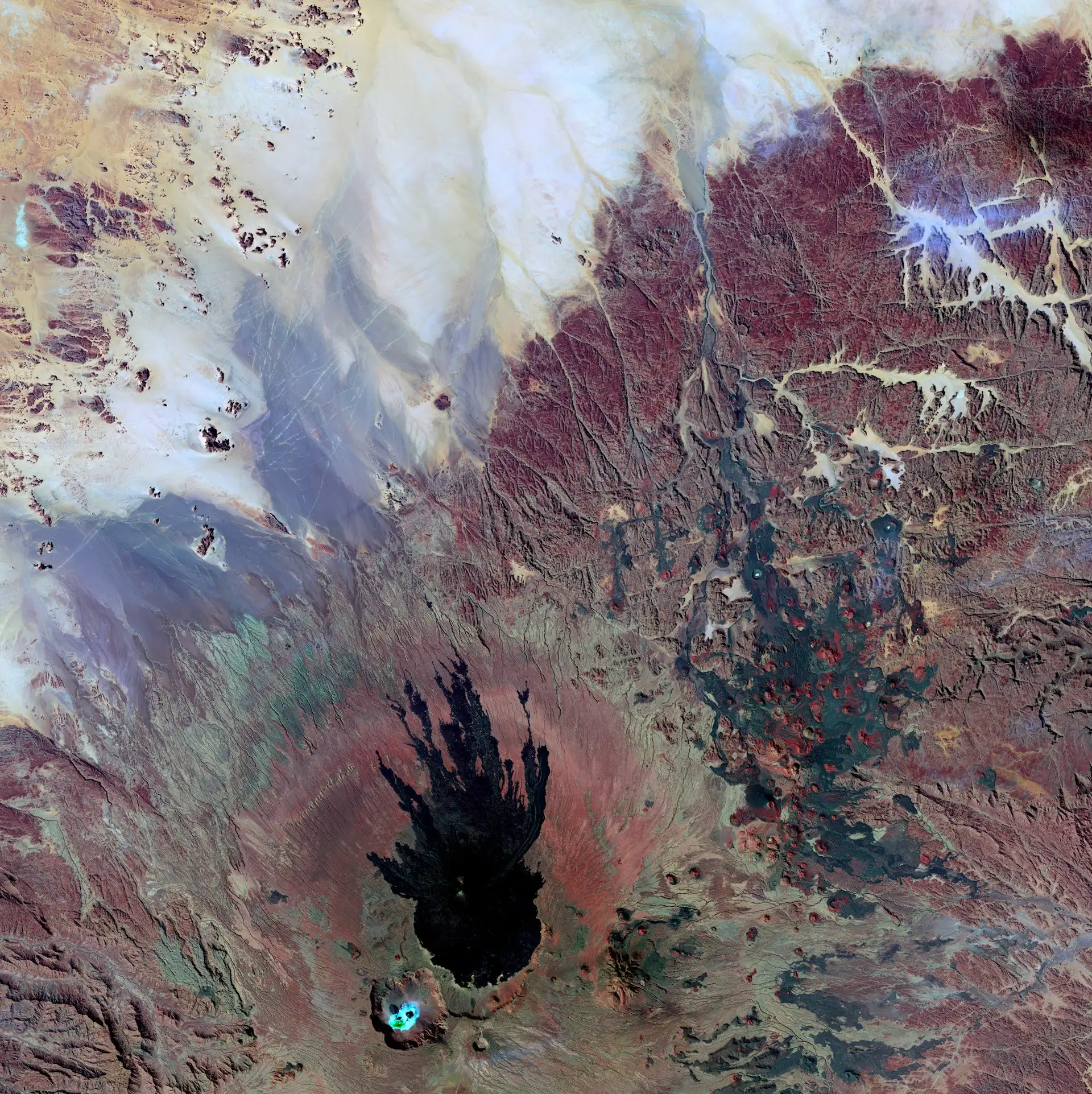
The Tibesti massif in the far north is Africa's largest volcanic range and one of the Sahara's great landscapes. Emi Koussi (3,445 meters) is the Sahara's highest peak. The calderas, hot springs, and salt lakes of the Tibesti have been described by every explorer who reached them as among the most alien and beautiful places on earth. The Toubou people who inhabit this region have been the Sahara's great travelers for millennia. The Tibesti is not accessible to tourists in 2026 due to the security situation near the Libyan border. Document it here as part of Chad's geography that may be accessible in different future conditions.
Sarh and the Chari Basin
The towns of Sarh and Moundou in southern Chad are in the country's most densely populated and agriculturally productive region — the Sara homeland, the cotton-growing belt that was French colonial Chad's primary economic zone. The landscape is savanna grassland cut by the rivers that eventually reach Lake Chad. Less dramatic than Zakouma or the Ennedi but gives a sense of the southern Chadian cultural and ecological baseline. Some visitors combine a day in Sarh with the Zakouma visit since it's in the same southeastern region. Check current conditions in Moyen-Chari region before planning.
Culture & Etiquette
Chad is linguistically one of the most complex countries in Africa: over 120 languages are spoken across a territory that contains Sahelian Arab nomads, Saharan Toubou, Nilotic Sara farmers, Lake Chad basin Kanuri, and dozens of other distinct peoples. French and Arabic are the official languages. In N'Djamena, French works for educated professionals and Arabic for the merchant and northern communities. In Zakouma's region (southeastern Chad, Sara homeland), local Sara languages dominate alongside French. In the Ennedi, the Toubou and Arab nomadic communities use Arabic and local languages.
The cultural divide between the Muslim north and the Christian/animist south is real and historically significant — it was one of the drivers of the civil conflict — but in practice, most Chadians navigate it with more pragmatism than the international media's periodic coverage of north-south tension suggests. The greeting culture across both zones is warm and patient. Rushing past greetings is consistently noticed and consistently costs you.
"Salaam aleykum" is the standard greeting throughout northern and central Chad and is used by Muslims and non-Muslims alike in many contexts. "Bonjour, ça va?" covers the French-speaking south. In either context, the greeting exchange — asking after health, family, work — is not a preamble to conversation, it is the conversation. Give it time.
Glass tea — sweet, strong, poured from height to create foam — is the gesture of hospitality across Chadian culture from the Saharan north to the southern villages. Accept the first glass immediately. The second and third follow. Refusing is a social statement you don't want to make.
In both Zakouma and the Ennedi, your guide's knowledge of the current security situation, the wildlife behavior, and the correct etiquette for any community or checkpoint encounter is the foundation of a successful trip. Their instructions are not suggestions.
Chad is majority Muslim and conservative dress — covered shoulders and knees, head covering for women in the north — is appropriate outside lodge and camp environments. In N'Djamena, smart casual is the baseline; more conservative in the market and northern neighborhoods.
Strictly enforced and potentially dangerous. This applies to the presidential compound area, military installations, checkpoints, uniformed personnel, and anything that could be construed as security infrastructure. Cameras near any of these invite detention that can be prolonged and difficult to resolve.
Political expression in Chad is restricted and monitored. Foreigners who engage publicly with political criticism can face expulsion or detention. Listen to what Chadians share; do not probe or offer your own political analysis.
Night road travel in Chad carries serious risk from both criminal and security incidents. This applies everywhere in the country, including routes around N'Djamena. Plan all movements to reach your destination before dark. This is not precautionary advice — it is the standard practice of every operator and every experienced traveler in the country.
Toubou and Arab nomadic encampments in the Ennedi and northern regions have their own hospitality protocols. Do not approach and enter a camp without being invited or without your guide having established the appropriate greeting. The hospitality once established is genuine and generous; the unannounced arrival is inappropriate.
Toubou and Saharan Culture
The Toubou people of the Tibesti and Ennedi regions have inhabited some of the harshest terrain on earth for millennia and developed a culture of mobility, endurance, and resource management appropriate to it. Their knowledge of the desert — water sources, safe routes, weather patterns, the behavior of the few animals that survive in extreme aridity — is specific and practical in a way that no external science has replicated. The phrase "dead heart of Africa," historically used by Europeans who crossed the Sahara with great difficulty and suffering, describes the Toubou homeland; the Toubou themselves have simply called it home and managed it sustainably for thousands of years.
Sara Culture and the South
The Sara peoples of southern Chad — the largest ethnic group in the country — maintained a culture centered on agriculture, iron-working, and ceremonial traditions that colonial conquest disrupted but did not destroy. The Yondo initiation ceremony, a male initiation rite of extraordinary intensity, was banned by the French and then by postcolonial governments nervous about its political dimensions, and has been periodically revived and suppressed. Sara culture is the cultural bedrock of N'Djamena's educated political class — the bureaucracy, teachers, and professionals who make the capital function.
Glass Tea Ritual
The three-glass mint tea ceremony, poured from a small metal pot from a considerable height to aerate and cool the tea, is the social institution of Chadian Muslim culture in the same way that café culture is the social institution of southern France. It happens everywhere: in market stalls, in nomadic camps, in government offices. The first glass is strong, the second sweeter, the third sweetest. There are regional variations but the principle is constant. Participating in this ritual, even imperfectly, is more culturally valuable than anything you can buy at a craft market.
Rock Art Heritage
Chad has some of the world's most significant prehistoric rock art, concentrated in the Ennedi and Tibesti but found across much of the country's rocky terrain. The images span from the Green Sahara period (cattle, hippos, elephants painted when the Sahara was wet) through the pastoral period (camel, horse) to more recent historical images. The art is protected in principle by UNESCO listing but in practice is at risk from looting, vandalism, and general neglect. Visitors should not touch, remove, or damage any rock art surface and should report any obvious damage or vandalism to their guide.
Food & Drink
Chadian cuisine is shaped by geography: the south uses millet, sorghum, cassava, and fish from the Chari and Logone rivers; the Saharan north uses dried meat, dates, dried fish from Lake Chad, and the grain brought by caravan. In N'Djamena, these traditions overlap with French colonial influences and the Lebanese and Arab restaurant culture that's common across Francophone Africa. In Zakouma's camp, the lodge kitchen provides adequate meals oriented to international visitors. In the Ennedi on a desert expedition, your cook prepares meals from supplies carried in the vehicle convoy.
La Bouillie (Millet Porridge)
The foundational food of the Sahelian zone: fermented millet or sorghum cooked into a thin porridge drunk from calabash gourds in the morning and thickened into a stiff paste for main meals. The thin version with tamarind and sugar is breakfast across much of Chad; the thick version with sauce is lunch and dinner. It is simple food made from what grows reliably in a climate that tests everything, and it is genuinely good when cooked by someone who knows how.
Dried Lake Chad Fish
The salanga (small Lake Chad sardine, dried whole) and capitaine (Nile perch) from the lake and the Chari River are the protein staples of Chad's central and western zones. Dried salanga is sold throughout the country and used as a flavoring agent in sauces and stews in the same way dried shrimp is used in West Africa. Fresh grilled capitaine from the Chari River in N'Djamena is the city's best available meal — served at riverside restaurants near the Corniche with sliced onion and a chili condiment.
Brochettes and Grilled Meat
Beef, goat, and camel brochettes grilled over charcoal are available at roadside and market grills across the country. In N'Djamena, the area around the Grande Marché in the evening transforms into a grill alley that serves the best available street food at remarkably low prices. In the Saharan north, dried camel meat is a practical travel food used by nomadic communities for the same reason beef jerky was invented: drying concentrates protein and prevents spoilage across distances where refrigeration doesn't exist.
Jarret de Boeuf Sauce
A slow-cooked beef shin stew with okra, dried fish, groundnut, and fermented locust bean that's the Sara homeland's most elaborate dish. Found at local restaurants in Sarh and the southeastern towns. The fermented locust bean (soumbala) gives the sauce an umami depth that distinguishes it from the simpler stews of the north. This is food from a culture with access to year-round water and agricultural diversity — the southern Chad cuisine that doesn't travel far beyond the region.
Karkanji (Hibiscus Tea)
Dried hibiscus flowers boiled into a deep crimson tea, cooled and sweetened with sugar. It is the standard cold drink across the Sahelian zone, refreshing in the heat and loaded with vitamin C from the hibiscus. Sold in plastic bags on every street corner and at market stalls. Called bissap in West Africa, jus de bissap in Francophone markets, and karkanji or zoborodo locally. More genuinely refreshing on a 38°C day than anything else available.
Gala Beer and Millet Beer
Gala is Chad's national lager, brewed in N'Djamena and available in the south and in the capital. Beer is not available in the predominantly Muslim north. Traditional millet beer (bilbil or dolo) is brewed by Sara and other southern communities and consumed communally in clay pots — the same basic production process and social function as similar fermented grain drinks across sub-Saharan Africa. At Zakouma lodge, the camp bar is stocked for international visitors. In the Ennedi, there is no alcohol; adjust expectations accordingly.
When to Go
The timing question in Chad depends almost entirely on which destination you're visiting and on the security situation at the time. Zakouma has a specific seasonal window driven by the park's calendar and the savanna's wildlife patterns. The Ennedi has different seasonal constraints driven by the desert climate. The overriding factor, as always in the CAR series, is security — confirm with your operator no more than four weeks before departure.
Peak Wildlife Season
Jan – MayZakouma's dry season. Wildlife concentrates at water sources, vegetation thins, and game viewing is at its most productive. The elephant herds in January through March are particularly spectacular — large aggregations at the main pools, calves visible, bulls separated from family groups on the periphery. The park opens in December and closes in late May/June when rains begin and roads flood.
Saharan Winter
Nov – MarThe Ennedi in the cool months is extraordinary: daytime temperatures manageable (25–30°C), nights cold (5–10°C), the light hitting the sandstone at low angles that make the colors shift from amber to orange to red as the day passes. April through October the heat (40–50°C daytime) makes desert travel genuinely dangerous without exceptional preparation. November to March is the only sensible window.
Zakouma Rainy Season
Jun – NovZakouma closes in late May/June. Rains transform the savanna from dusty brown to lush green. Roads flood. The park is inaccessible to visitors. The wildlife disperses across the now-watered landscape in ways that make game viewing difficult. This is when African Parks' rangers do their off-season maintenance and anti-poaching surveillance.
Ennedi Summer
Apr – OctSummer in the Sahara. Daytime temperatures in the Ennedi reach 45 to 50°C and higher. Vehicle metal becomes untouchable. Water requirements per person per day exceed what's practical to carry without elaborate logistics. Even experienced Saharan operators do not run Ennedi trips in summer. This is not a challenge to overcome — it is a meteorological fact.
Trip Planning
Chad requires more preparation than almost any country in this series except the Central African Republic. A specialist operator is non-negotiable: for Zakouma, this means booking directly through African Parks or one of the very few specialist operators with established relationships with the park; for the Ennedi, a desert specialist with experience in northeastern Chad and current security intelligence is the baseline requirement. Do not attempt either destination independently.
The practical structure of a Zakouma trip: international flight to N'Djamena, 24–48 hours in the capital for logistics and briefing, charter flight to Zakouma (90 minutes), 5–8 nights in the park, charter back to N'Djamena, international departure. The Ennedi trip: international flight to N'Djamena, 24–48 hours for logistics, domestic flight or overland (with operator convoy) to Fada, 7–12 days in the Ennedi, return to N'Djamena, international departure. Neither trip is simple. Both deliver experiences with no equivalent elsewhere.
N'Djamena
Arrive international. Operator briefing and visa/permit confirmation. Day two: Grande Marché for cultural orientation, Chari River Corniche, logistics finalization. Early bed before the 5am charter departure.
Zakouma National Park
Charter to Zakouma airstrip. Five full days: morning drives (4:30am departure), midday camp rest, afternoon drives (3pm–6:30pm). Night drive once. Final evening at Rigueik waterhole. The elephant herd's behavior changes daily — repeated morning drives on the same routes produce consistently different encounters as the herd moves through its territory.
Return N'Djamena + Depart
Morning charter back to N'Djamena. International departure same day or the following morning. Build one buffer night in N'Djamena for any logistics delays on the return journey.
N'Djamena Preparation
Arrive. Operator final equipment and food check. Customs and permit confirmation. Fuel and water logistics briefed. The Ennedi expedition departs fully self-sufficient: everything needed for 10 days in the desert is in the vehicles. Nothing is available out there.
N'Djamena to Fada
Either by domestic flight (when available) to Fada or a two-day overland drive with the operator convoy. The overland route reveals the transition from Sahel to Sahara — the vegetation thinning, the soil turning sandy, the human presence reducing to occasional nomadic camps. Arrive Fada and meet the local liaison.
Ennedi Plateau
Six days in the Ennedi. The operator determines routing based on current conditions. Essential stops: Guelta d'Archei (crocodiles, palm trees, canyon walls with rock art), the Aloba Arch (one of the world's largest natural arches), the rock art panels near the oasis camps, and the open desert sections where the scale of the landscape becomes physical rather than intellectual. Nights under the Saharan sky.
Return N'Djamena + Depart
Return journey to Fada and flight or overland back to N'Djamena. One night in the capital before international departure. The city feels entirely different after ten days in the Sahara.
N'Djamena
Arrival and preparation. Briefing for both legs. This trip requires advance coordination between the Zakouma operator (African Parks) and the Ennedi operator — they are different organizations with different logistics and security frameworks. Your specialist operator should manage this interface.
Zakouma
Six days in the park. Charter in and out. Full wildlife immersion: morning drives, night drives, extended waterhole sessions. The sixth day in Zakouma, when you have started to recognize individual elephants and understand the family group dynamics, is substantially richer than the first.
N'Djamena Transition
Return to the capital between the two expedition legs. Two nights: one for decompression from the safari, one for preparation for the desert. The contrast between Zakouma's green-gold savanna and what you're about to enter will be visible in the landscape from the plane window as you fly northeast to Fada.
Ennedi Plateau
Six days in the Sahara. The full Ennedi circuit: Guelta d'Archei, the major rock art sites, the Aloba Arch, the stone tower formations around Archei, the desert camp under the Milky Way. By day four of the Ennedi, you will understand why people who visit once spend years trying to return.
Specialist Operator — Mandatory
Zakouma: book through African Parks directly (africanparks.org) or through one of their authorized booking partners. Do not use any operator claiming Zakouma access that is not specifically listed by African Parks — the park's security and access arrangements are tightly managed. Ennedi: a handful of specialist Saharan operators have the experience, equipment, and local contacts required. Ask any operator for their specific Ennedi experience, their local liaison contacts, and their emergency evacuation protocol.
Vaccinations
Yellow Fever vaccination mandatory for entry. Typhoid, Hepatitis A and B, Rabies, and Meningitis strongly recommended. Malaria prophylaxis essential for the south (Zakouma, N'Djamena) — the Saharan north has lower malaria risk but it's not zero at the edges. Cholera vaccination advisable. Consult a specialist travel health clinic with your specific itinerary at least eight weeks before departure.
Full vaccine info →Cash and Currency
Chad is almost entirely cash-based. The XAF CFA franc is the currency. ATMs exist in N'Djamena but have limited reliability. Carry sufficient cash in euros or USD to exchange for your full trip before leaving N'Djamena. Zakouma payments to African Parks are typically arranged before arrival. Ennedi operators invoice before departure. Cash in N'Djamena covers local expenses; nothing else accepts cards.
Specialist Insurance
Standard travel insurance may exclude Chad under current government advisories. You need specialist coverage explicitly including: medical evacuation from Zakouma or the Ennedi to N'Djamena and then to Paris or Nairobi; security evacuation; and coverage for activities in areas under travel advisories. Confirm in writing that Chad is covered before departure.
Water — Desert Critical
For the Ennedi specifically: water is the fundamental logistics constraint. Your operator carries all water for the expedition. In summer, 6–8 liters per person per day is a minimum requirement. Even in winter, 4–5 liters per day for activity is necessary. Understand your operator's water logistics before booking: how much water capacity do the vehicles have, what is their resupply plan, what happens if they need more? This is not overthinking — it is the right question.
Satellite Communication
In both Zakouma and the Ennedi, mobile coverage is nonexistent. Your operator will have satellite communication for emergency use. A personal satellite communicator (Garmin inReach or similar) is advisable for the Ennedi expedition specifically — it allows position sharing with someone at home and provides a personal emergency beacon independent of your operator's equipment.
Transport in Chad
Transport in Chad is, with the exception of chartered light aircraft, among the most challenging in Africa. The road network is minimal and in most places consists of piste — compacted earth tracks that become impassable in rain and require 4x4 capability at any time. Chad has no functional rail network. International flights connect N'Djamena to Paris and a handful of African hubs. Everything beyond the capital requires either a charter flight or specialist overland convoy.
Charter Flight (N'Djamena–Zakouma)
Included in AP packagesThe standard and strongly recommended access to Zakouma. Cessna Caravan or similar aircraft from N'Djamena to the park airstrip in approximately 90 minutes. African Parks coordinates all charter logistics as part of their visitor packages. Luggage limits are strictly enforced — typically 15kg soft bag only.
Operator 4x4 Convoy (Ennedi)
Included in expedition packagesAll Ennedi expeditions move by 4x4 convoy — typically 3 to 6 vehicles carrying passengers, fuel, water, food, and camping equipment. The operator's vehicles and drivers are the entire transport system for 10 or more days. Vehicle quality matters: ask specifically about the fleet's condition and the driver team's desert experience when selecting an operator.
Domestic Flights
$100–300/routeTchad Airlines and occasionally other operators run domestic routes from N'Djamena to Abéché, Sarh, Moundou, and occasionally Fada. Schedules are unreliable and change without warning. Domestic flights are used when available to reduce the overland component of Ennedi access. Confirm the current schedule with your operator rather than assuming any published timetable is current.
Taxis (N'Djamena only)
Negotiate before boardingTaxis and motorcycle taxis operate in N'Djamena. Use only operator-vetted vehicles or pre-arranged transport from your hotel. Do not take street taxis from the airport. The security risks in N'Djamena make ad-hoc transport a category of risk worth eliminating. Your operator or hotel can arrange all city transport you need.
Overland Bush (Ennedi approach)
Included in operator packageThe overland route from N'Djamena to Fada (roughly 1,000km) crosses the Sahelian transition zone and takes two full days minimum. Some operators prefer this to the unreliable domestic flights. The journey is genuinely interesting — the transition from semi-arid Sahel to desert is visible kilometer by kilometer — but requires security assessment of the route at the time of travel.
No Night Driving
Security rule: non-negotiableThis is not a transport option but its absence is important to document: night driving on any road in Chad is not done by responsible operators. Security incidents, road conditions, and the complete absence of roadside assistance make night driving a category of risk that cannot be managed. All itineraries must accommodate this constraint. Plan to be at camp by sunset on every day of your trip.
Accommodation in Chad
Accommodation in Chad follows the same two-destination pattern as everything else. In N'Djamena, a handful of established hotels serve the international visitor and NGO market. In Zakouma, African Parks operates Tinga Camp, one of the finest safari camps in West and Central Africa. In the Ennedi, accommodation is tented camping carried by the operator convoy. There is nothing else that constitutes viable accommodation for international visitors.
N'Djamena Hotels
$80–180/nightRadisson Blu, Novotel, and La Tchadienne are the established international options in N'Djamena. La Tchadienne, on the Chari River with a riverside setting, is considered by regular visitors to be the most characterful. All provide the security, consistent power supply, and international standards that make N'Djamena manageable as a transit base. Pre-book well in advance — business travelers and NGO workers fill these hotels in the dry season.
Tinga Camp, Zakouma (African Parks)
$400–600/person/nightThe flagship African Parks camp in Zakouma, built on a forested hill above the Salamat floodplain. Eight comfortable tented chalets with en-suite facilities, a central dining and bar area, and a small plunge pool for the hottest midday hours. The camp is designed around the experience of being in the Chadian savanna: open to the surrounding forest and savanna sounds, the nightly proximity to elephant and hyena guaranteed by the location, the particular quality of waking before dawn to a landscape that belongs to its animals.
Desert Camp (Ennedi)
Included in expeditionEvery night of the Ennedi expedition is in a different location, chosen by the guide for shelter, shade, and access to the next day's destinations. Tents are erected and struck daily. The camp is the operator's equipment — tent quality, sleeping mat quality, and camp furniture quality all vary significantly between operators. Ask specifically about sleeping arrangements when comparing options. The sky, which is the dominant feature of the camp experience, is the same for everyone.
Guesthouses (Secondary Cities)
$20–50/nightSarh and Moundou in the south have basic guesthouses adequate for transit overnights between N'Djamena and Zakouma (overland route). In Fada (Ennedi access town), the options are very basic — typically a few rooms in a mud-brick compound that functions as the community's only accommodation. Your operator will brief you on the Fada situation specifically.
Budget Planning
Chad is expensive for international visitors — not because of tourist premiums but because of the genuine logistics costs of operating in a remote, infrastructure-poor country with significant security requirements. Zakouma's costs reflect African Parks' international conservation camp standards and the charter flight access. The Ennedi's costs reflect 10 days of fully self-sufficient desert operations with experienced specialist guides. Neither is comparable to safari pricing in East or Southern Africa where infrastructure reduces operational cost.
- All-inclusive at Tinga Camp
- All game drives and activities
- Charter flight from N'Djamena
- Park fees and conservation levy
- Minimum 3 nights recommended (5+ ideal)
- Fully guided 10–12 day expedition
- All vehicles, fuel, food, water
- Camping equipment and logistics
- Local guide and cook included
- N'Djamena–Fada transport included
- International flights return
- 6 nights Zakouma (African Parks)
- 10-day Ennedi expedition
- N'Djamena accommodation
- Specialist insurance
Key Cost Items
Visa & Entry
Most nationalities require a visa to enter Chad. Visas are obtained through Chadian embassies abroad — the main options for Western travelers are the embassies in Paris, Brussels, Washington D.C., and a small number of other capitals. Visa on arrival has been offered at N'Djamena International Airport at some periods but is unreliable — apply through an embassy for certainty. Allow six weeks minimum for processing. Your specialist operator will advise on the current process for your specific nationality and will typically assist with documentation requirements.
Apply through the nearest Chadian embassy at least 6 weeks before travel. Yellow Fever vaccination certificate mandatory. Operator's invitation letter advisable. Your specialist operator will assist with documentation. Visa on arrival sometimes available at N'Djamena airport but not reliable — apply through embassy.
Safety in Chad
The detailed security picture is in the Security section above. What follows focuses on day-to-day safety management in the N'Djamena transit and in the Zakouma and Ennedi destinations.
Most of Chad Outside Three Zones
The majority of Chad's territory — the north, most of the center, the west (Lake Chad), the east (Sudan border) — is either actively dangerous from armed groups, cross-border conflict, or genuinely inaccessible without specialist desert expedition capabilities. These areas do not constitute viable visitor destinations in 2026.
N'Djamena
Elevated urban risk. Use operator-vetted transport only. Avoid political gatherings. Do not photograph military, government, or presidential areas. Night movement outside your hotel is inadvisable. The Radisson Blu and similar international hotels have security protocols that reduce risk significantly compared to local guesthouses.
Zakouma (Southeastern Chad)
African Parks manages security effectively within the park. The charter flight route eliminates the risk of overland travel through contested areas. Inside the park, wildlife is the primary safety consideration: follow guide instructions precisely around elephants (highly unpredictable at close range) and other large mammals. The park's anti-poaching force operates around the camp perimeter at night.
Ennedi (Northeastern Chad)
The Ennedi itself has been relatively stable but the routes through the northeastern Sahara require current security intelligence. Your operator should have specific local contacts in Fada and along the routes who provide real-time information. The main risks are isolated criminal activity (banditry on remote tracks) and getting stranded by vehicle breakdown without recovery capacity.
Checkpoints
Police, military, and gendarmerie checkpoints are frequent on all roads around N'Djamena and on the approaches to sensitive areas. Have all documentation accessible. Be cooperative. Let your driver and guide handle communications. Do not photograph checkpoints. Having an operator's letter explaining your purpose helps checkpoint interactions considerably.
Health Risks
Malaria in the south and center, heat-related illness everywhere in summer, waterborne diseases across the country. The Ennedi's specific risk is dehydration and heat exhaustion even in winter if water management is inadequate. Meningococcal meningitis outbreaks occur in the Sahel — vaccination before travel is advisable.
Emergency Information
Your Embassy in N'Djamena
Several Western embassies maintain reduced staff in N'Djamena. Verify current operational status and emergency contacts before travel.
Book Your Chad Trip
Start with African Parks for Zakouma (africanparks.org) or a verified Ennedi specialist for the desert. Use the resources below for the support infrastructure around those core bookings.
The Country That Ate Its Lake
There is a photograph taken in 1963 by a NASA satellite and another taken in 2020 by the same satellite program. In the first, Lake Chad fills its basin like a thumb pressed into the map — a broad, irregular blue that makes you understand immediately why the Kanem-Bornu Empire built itself here, why trans-Saharan trade routes ran toward this water. In the second, there is almost nothing: patches of marsh and open water so small they read as stains rather than lakes.
The Kanuri word for this lake, the word that gave the country its name, is tsade — which means simply "large body of water." The lake named the country and the country is named for the lake and the lake is nearly gone. Thirty million people in four countries depend on what remains. The question of whether the lake can be stabilized through watershed management and reduced extraction is being debated in UN meeting rooms while the fishers and farmers who cannot wait for those meetings adapt as they always have.
In the Ennedi, the rock paintings of people who watched the Green Sahara dry out 5,000 years ago are still there, in the sheltered overhangs where wind and rain haven't reached them. They show cattle, elephants, and humans in a landscape that no longer exists. They are not memorial or warning — they are just the record of people who were there and tried to document what they saw. That seems like the right instinct. Go, see, document. That is what travel is for.